Shapes Worksheets
Free shapes worksheets with answer key. No login or account needed. Naming shapes, identifying shape transformations, word problems and much more. A grading column and quick grade scale make grading a breeze, and modified pages help with lower level learners or when just introducing a topic. Great for teachers or for homeschool.
More about these worksheets ▾ Show less ▴
×
About these worksheets
These worksheets cover shape identification across multiple levels. Students name basic 2D shapes by their sides and corners, identify quadrilaterals, recognize regular and irregular polygons from triangles through decagons, classify right triangles, identify solid 3D figures, determine which shapes combine to form a figure, and classify triangles by angles and side lengths. Resources span first through fourth grade and beyond.
1g1
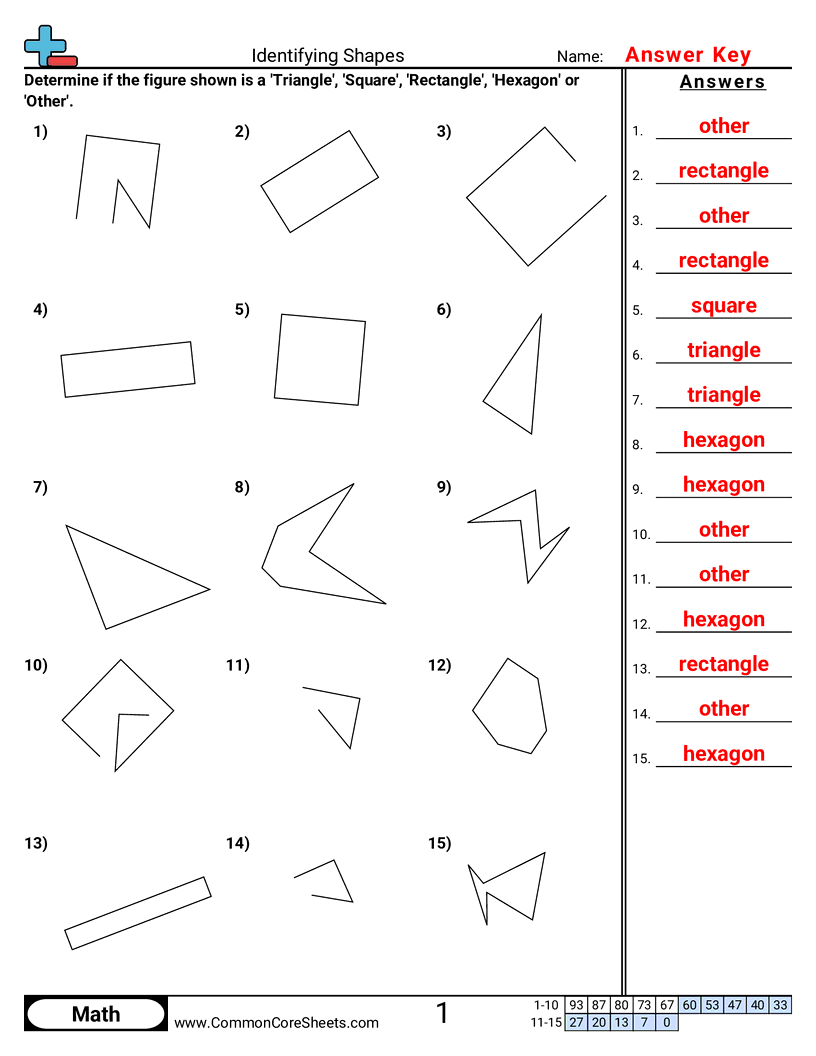
Name common 2D shapes by looking at a picture. Tell shapes apart by counting sides and corners (vertices). Recognize and name basic polygons like triangles, quadrilaterals, pentagons, hexagons, and octagons. Use simple shape properties (like straight sides vs a curved edge) to identify the shape.
2g1
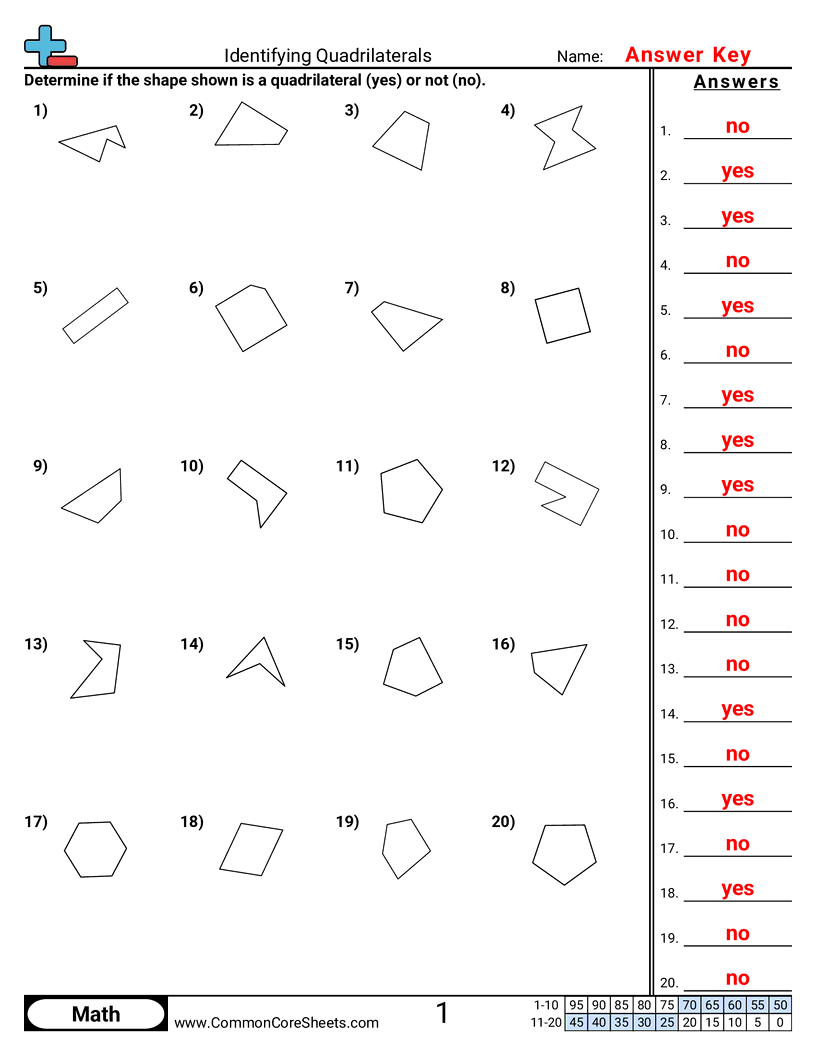
Decide whether a shape is a quadrilateral by checking that it has 4 straight sides. Count sides and vertices on a shape to support your answer.
4g2 5g3
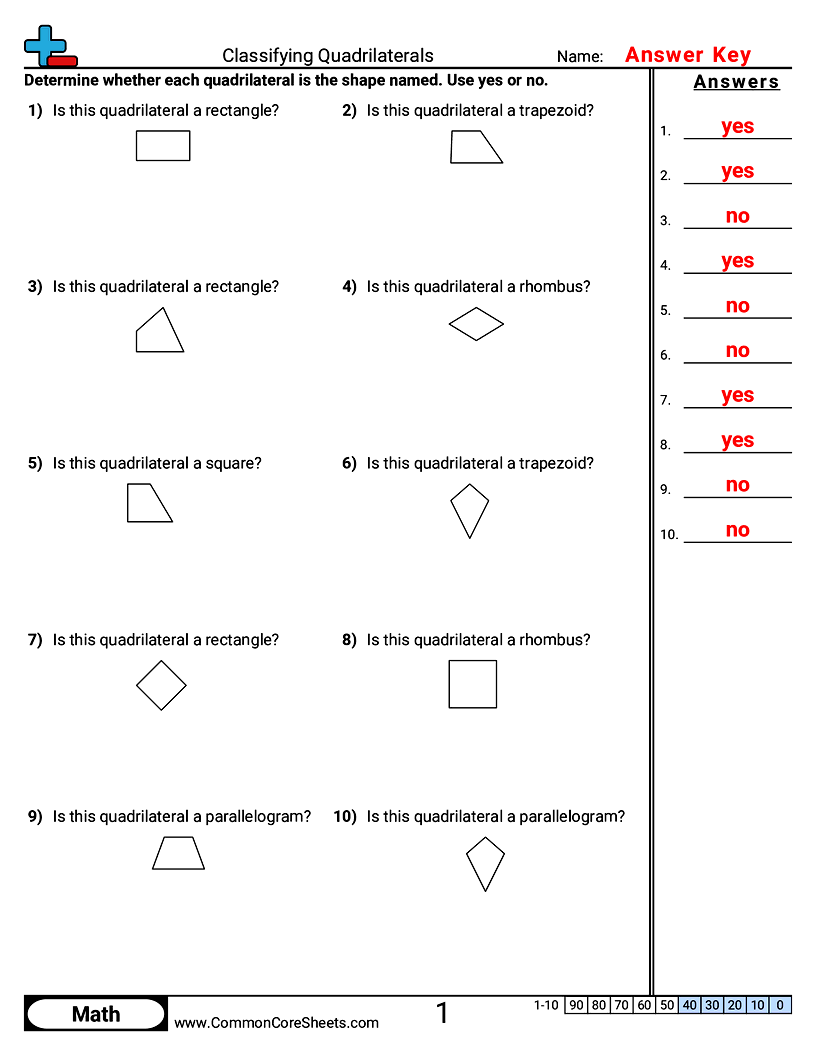
Decide whether a quadrilateral is a square, rectangle, rhombus, parallelogram, trapezoid or kite. Use side lengths, parallel sides and right angles to classify a shape. Recognize that a square is also a rectangle, a rhombus and a parallelogram.
4g2 5g3
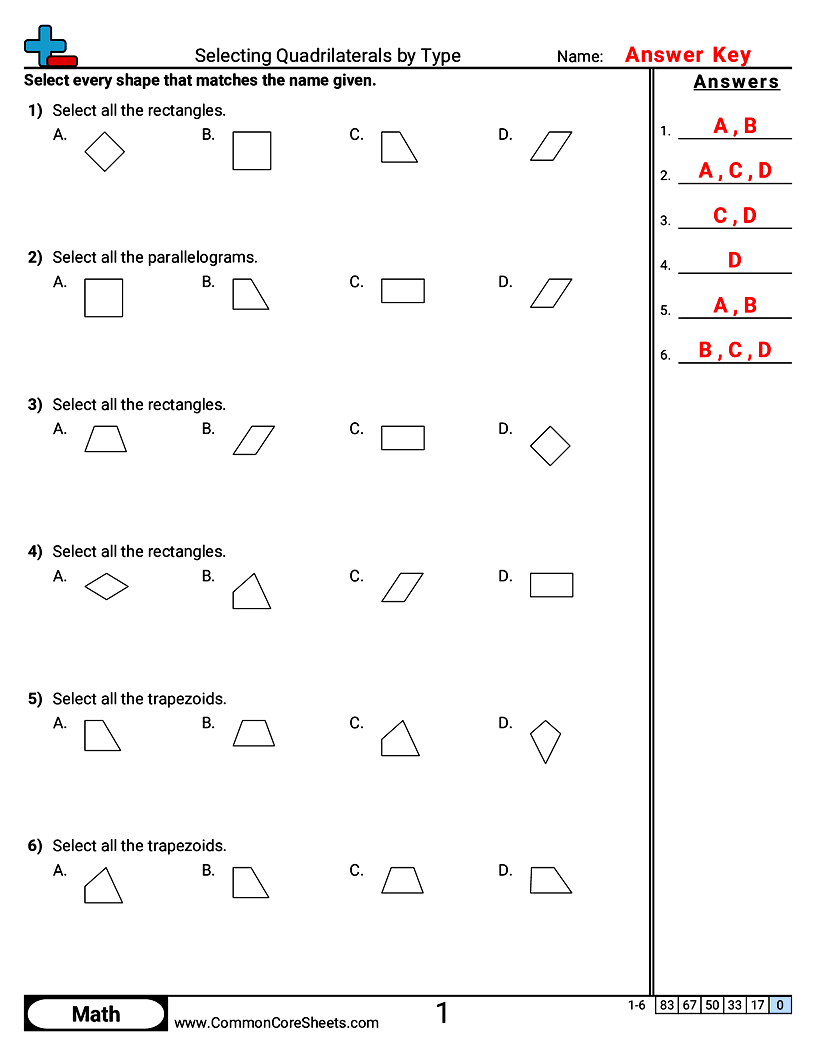
Select every shape of a named type from a group of quadrilaterals. Hold a definition against several figures at once. Recognize that more than one shape in a group can share a name.
3g1
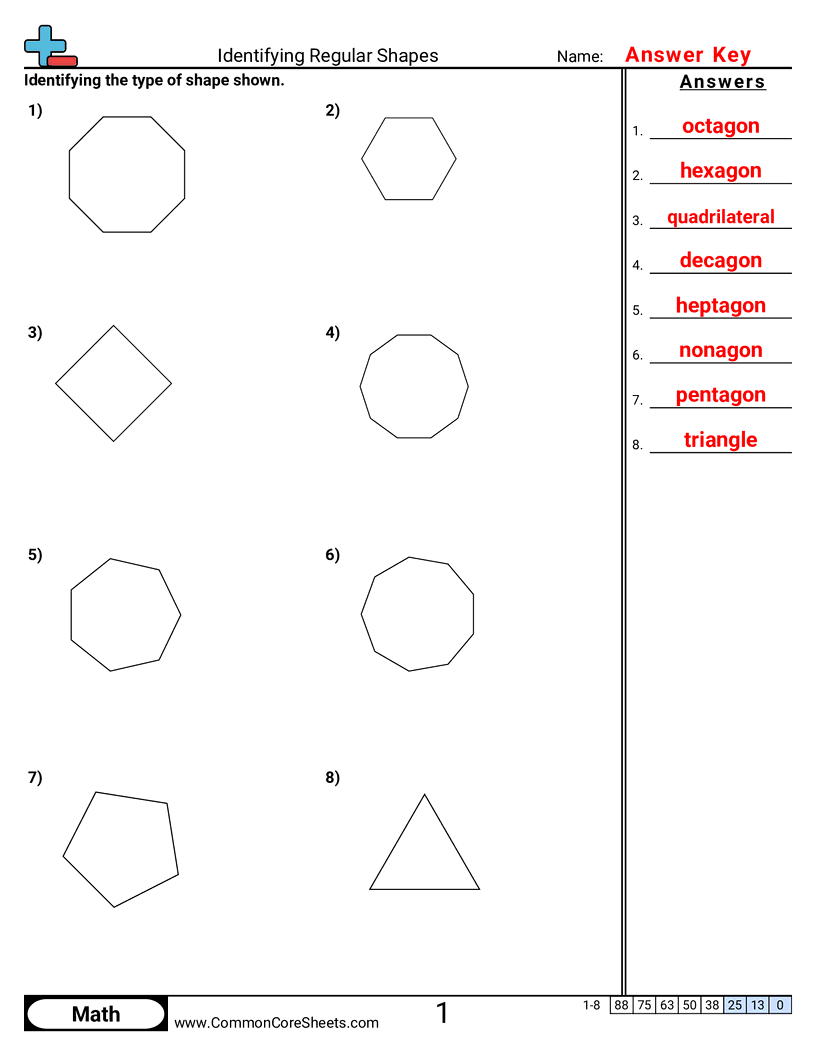
Name a regular polygon by counting its sides (triangle through decagon). Use the words triangle, quadrilateral, pentagon, hexagon, heptagon, octagon, nonagon, and decagon correctly. Tell that a shape is regular by noticing its equal sides and equal angles. Count sides and vertices carefully to avoid mixing up similar-looking polygons.
3g1
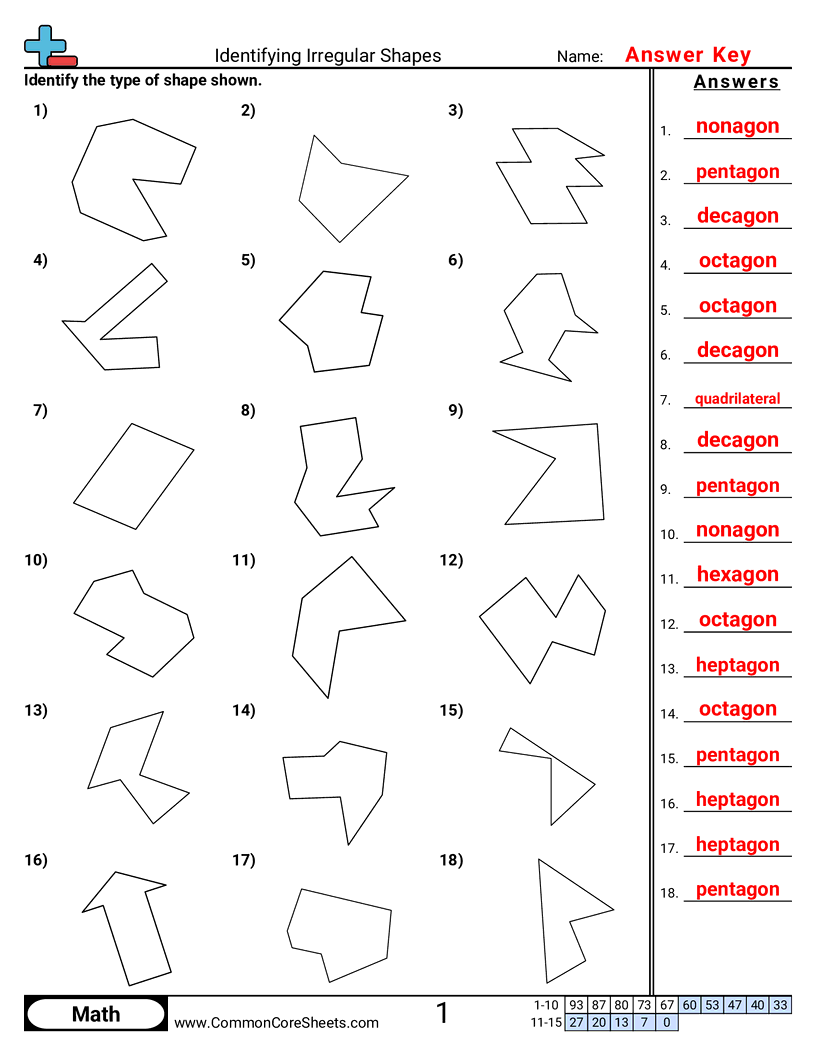
Count the sides and corners (vertices) of a polygon to figure out what it is. Name irregular polygons as quadrilaterals, pentagons, hexagons, heptagons, octagons, nonagons, or decagons. Use shape clues like sides, angles, and vertices to choose the correct polygon name.
3g1
Identify common polygons by name when you read a short word problem. Count and match the number of sides to the correct shape. Use shape clues in a sentence (like “has 8 sides”) to choose the right polygon.
3g1
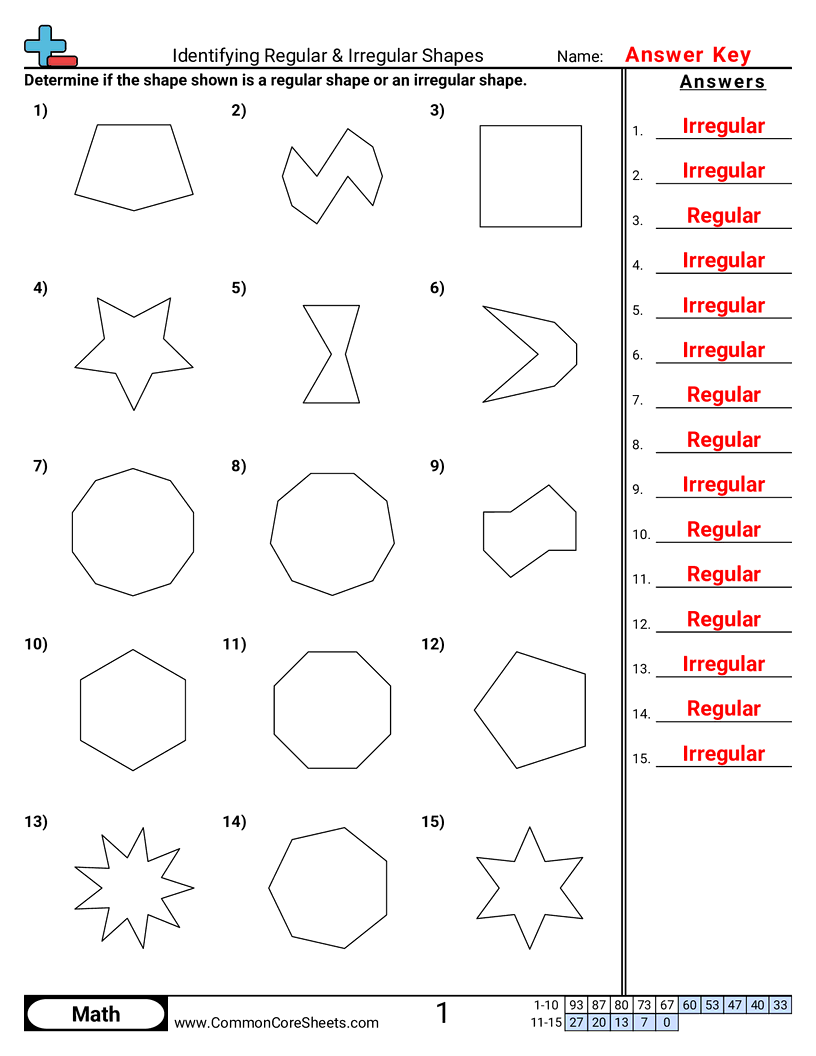
Decide whether a polygon is regular or irregular by checking if all sides and angles match. Spot shapes that look similar but are irregular because one side or angle is different. Use words like side, angle, and vertex to describe why a shape is regular or irregular. Compare different polygons and sort them into regular and irregular groups.
4g2
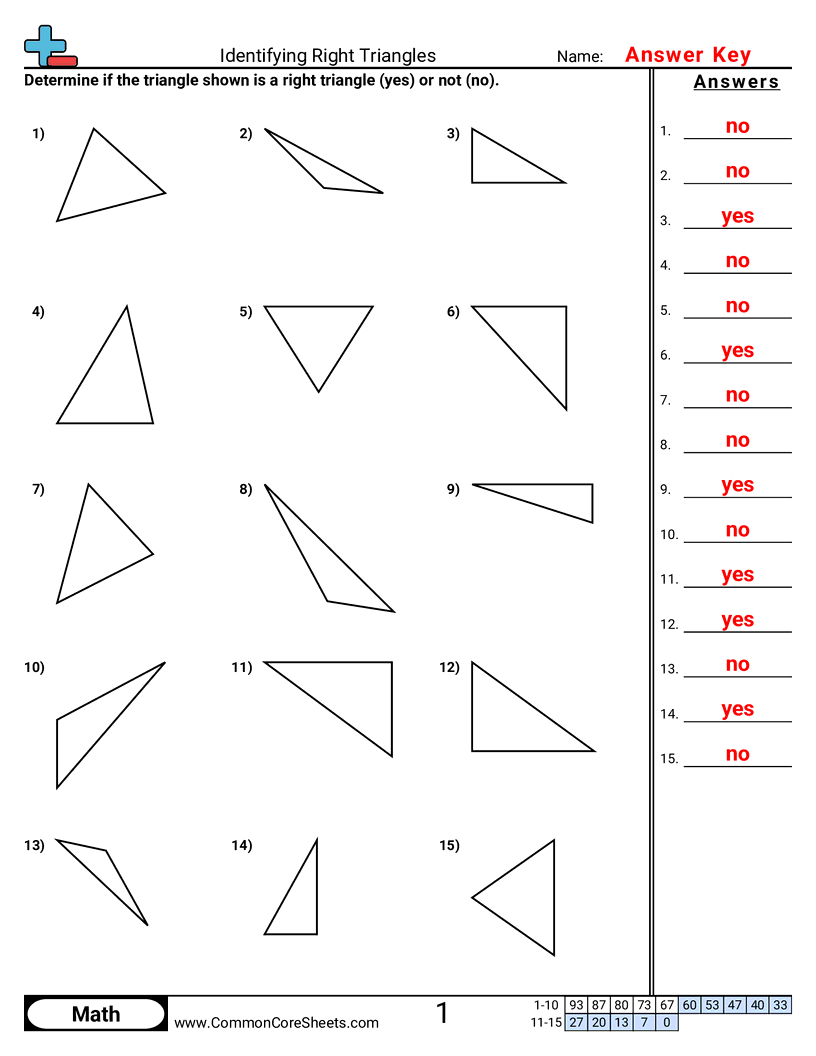
Spot whether a triangle has a square corner (a 90° angle). Tell the difference between right triangles and triangles that have no 90° angle.
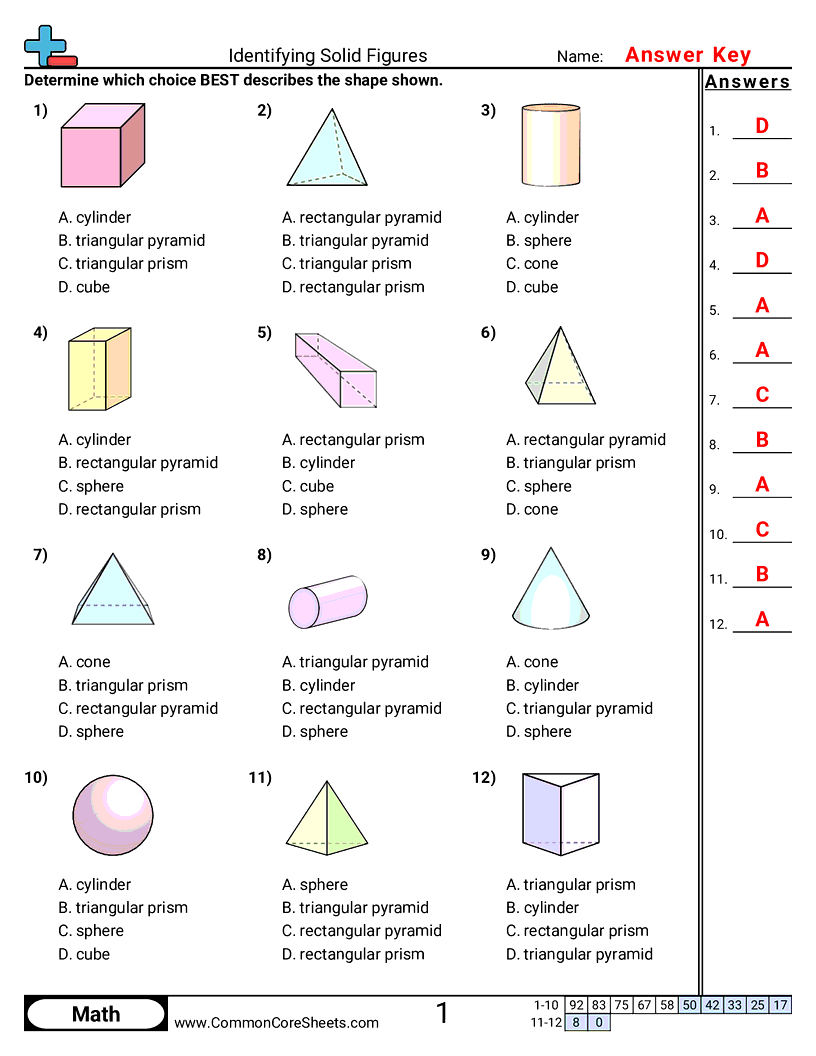
Recognize common 3D shapes like cubes, spheres, cones, cylinders, prisms, and pyramids by looking at pictures. Tell the difference between similar solid shapes, like a cube versus a rectangular prism.
Recognize common shapes like triangles, squares, rectangles, and other polygons by their sides and corners. Look at a combined figure and decide which two shapes could fit together to make it. Use clues like straight edges, angles, and matching sides to rule out shapes that don’t work. Compare similar shapes (like squares vs. rectangles) and pick the one that matches the figure.
4g2
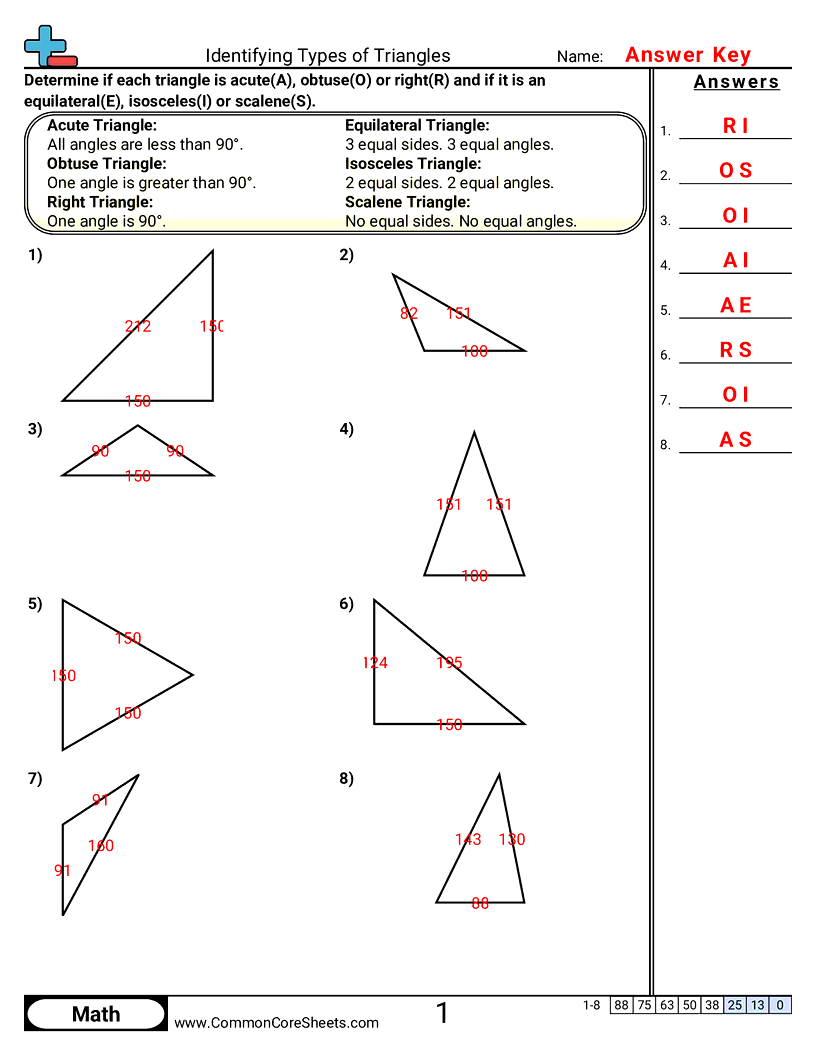
Decide whether a triangle is acute, right, or obtuse by looking at its angles. Decide whether a triangle is equilateral, isosceles, or scalene by comparing its side lengths. Use angle and side clues together to classify the same triangle in two different ways.
5g3 5g4
Rule out a term that cannot describe a triangle Know that two congruent angles mean two congruent sides Recognize that a right or obtuse triangle can still be isosceles Classify triangles by both their sides and their angles
About these worksheets
Students explore the attributes and properties of both 2D and 3D shapes. Activities include counting faces, edges, and vertices of 3D shapes, determining whether given measurements can form a triangle, identifying cross-sections of sliced 3D shapes, drawing different perspectives of solids, classifying shapes by properties, evaluating true-or-false statements about shapes, and filling in attribute tables. Resources span fifth through seventh grade.
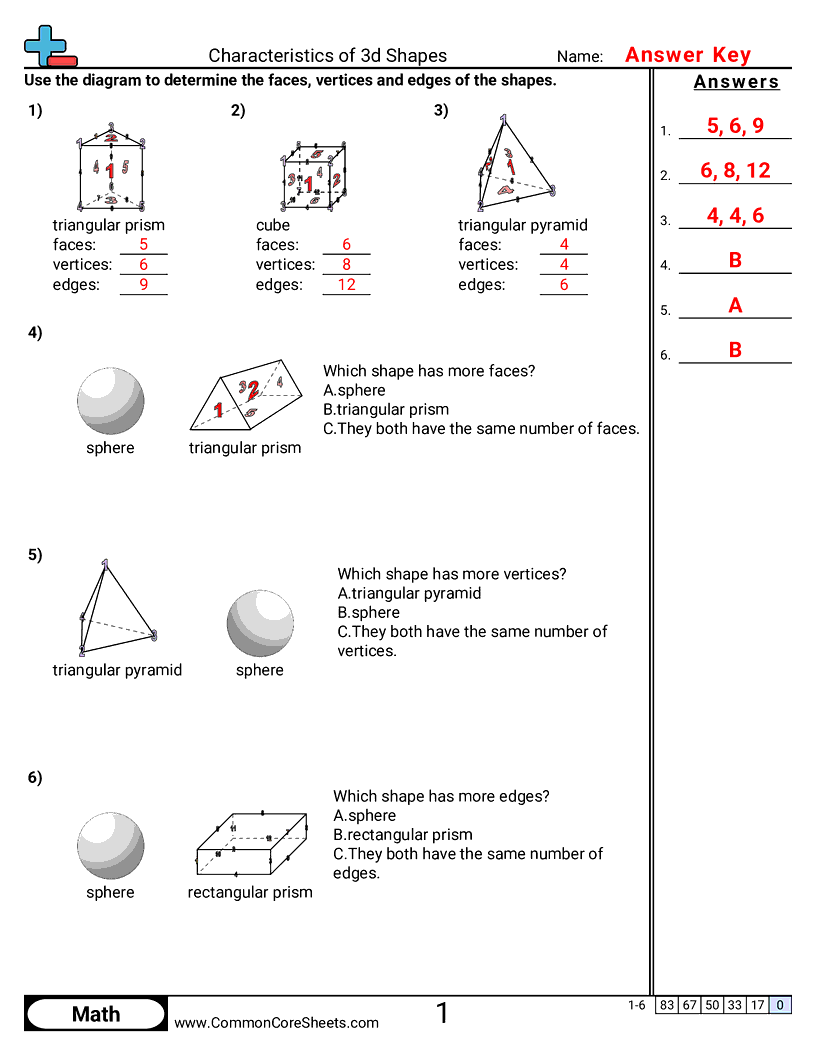
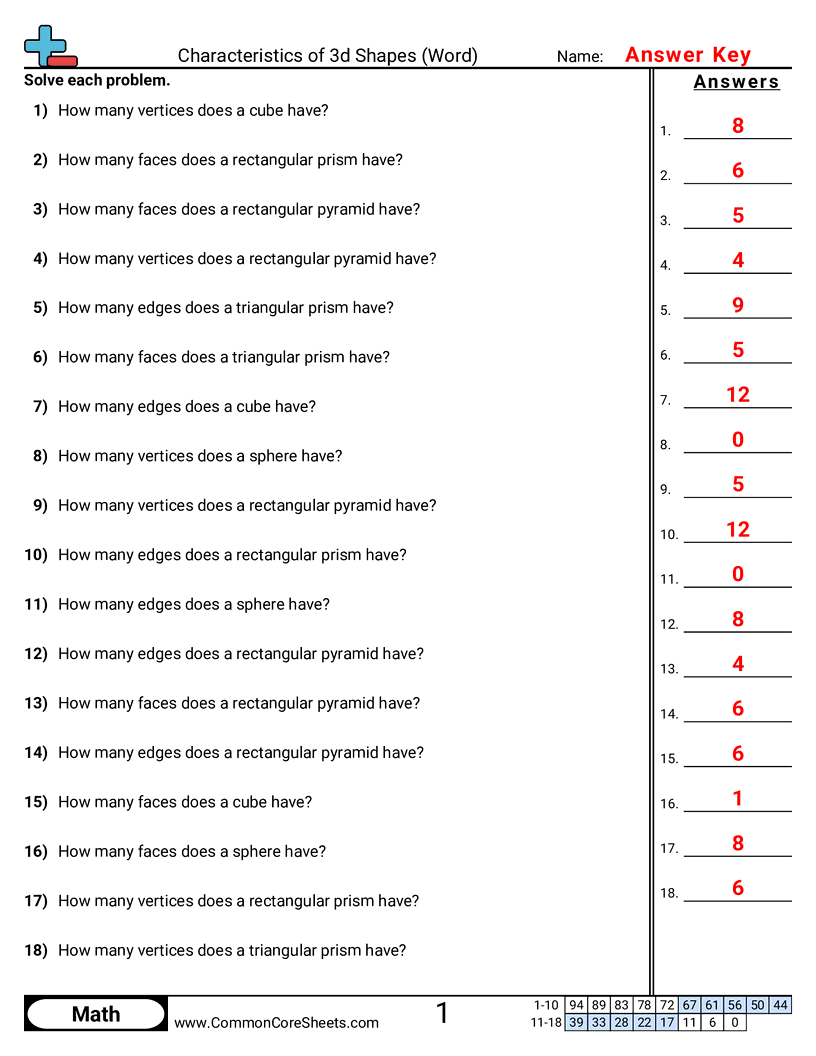
Count how many faces, edges, and vertices a 3D shape has. Tell the difference between flat faces and curved surfaces on a shape.
7g2
Decide whether three given side lengths can actually make a triangle. Decide whether three given angle measures can form a triangle. Use the triangle inequality rule to compare side lengths and check if a triangle is possible. Use the fact that a triangle’s angles add up to 180° to check if a triangle is possible.
7g3
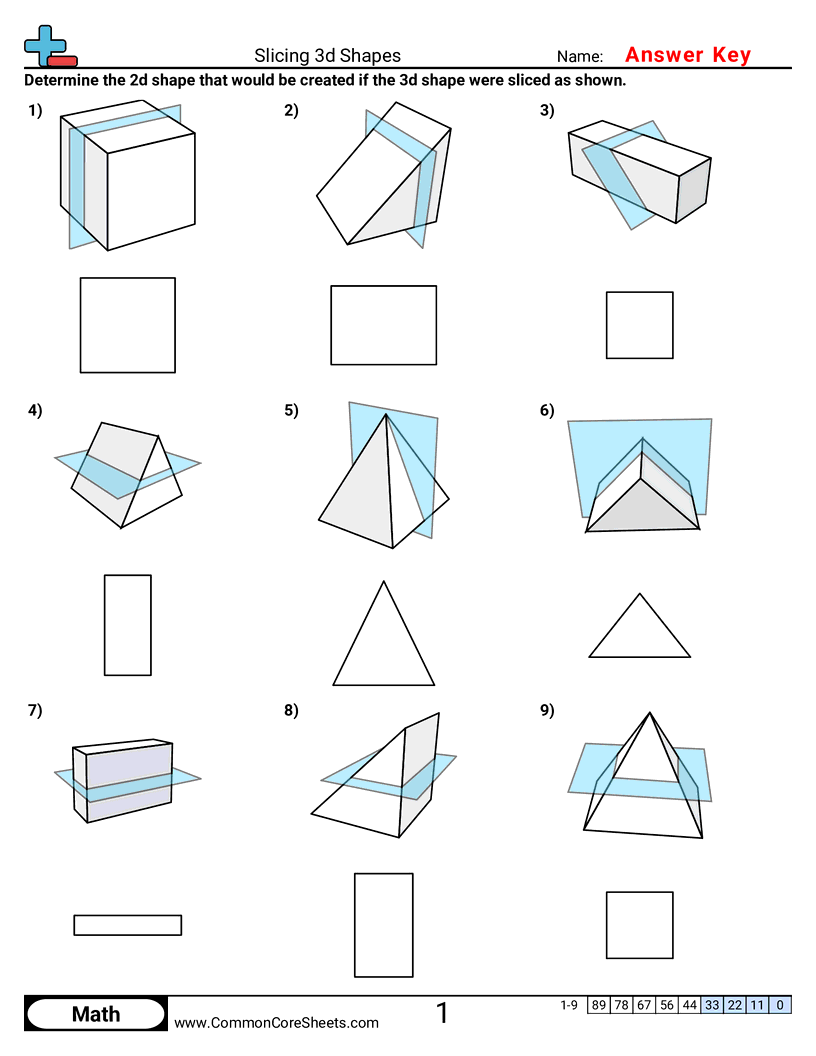
Figure out what 2d shape you get when a 3d solid is sliced. Tell the difference between slices that make circles, triangles, rectangles, and other polygons. Use clues from the direction of the cut (straight across, angled, or through the middle) to predict the cross-section.
7g3
Picture what a 3D solid would look like when you look at it from the front, side, or top. Match a 3D shape to the correct 2D view of its faces and edges. Use clues like which parts are visible or hidden to choose the right perspective. Mentally rotate a solid to see how its view changes without moving the paper.
5g4
Identify and name common shapes by looking at their sides, corners, and angles. Sort shapes into groups based on shared properties, like how many sides they have or whether sides are parallel. Tell the difference between types of quadrilaterals (square, rectangle, rhombus, trapezoid, kite) by checking their features.
5g3
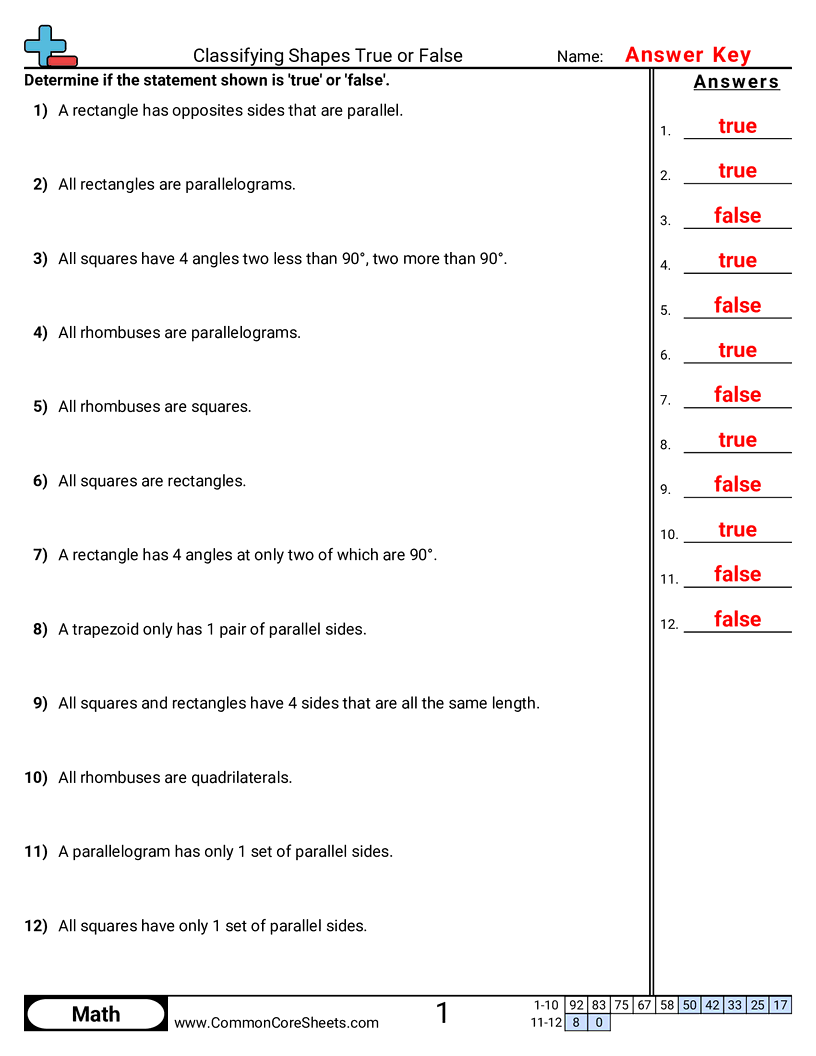
Decide whether a statement about a shape is true or false by looking at its sides, angles, and vertices.
5g3
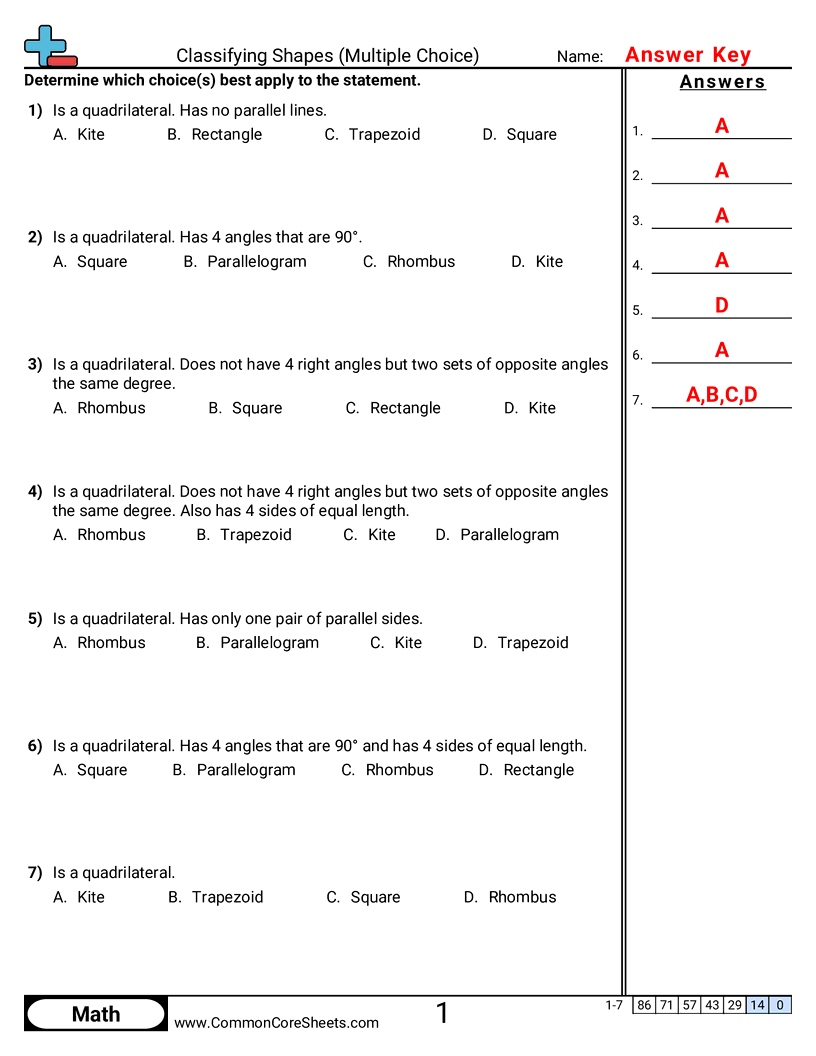
Use clues about sides, angles, and corners to name the shape being described. Tell the difference between common quadrilaterals like rectangles, squares, rhombuses, trapezoids, and kites. Sort shapes into the right groups using rules like parallel sides, equal sides, and right angles.
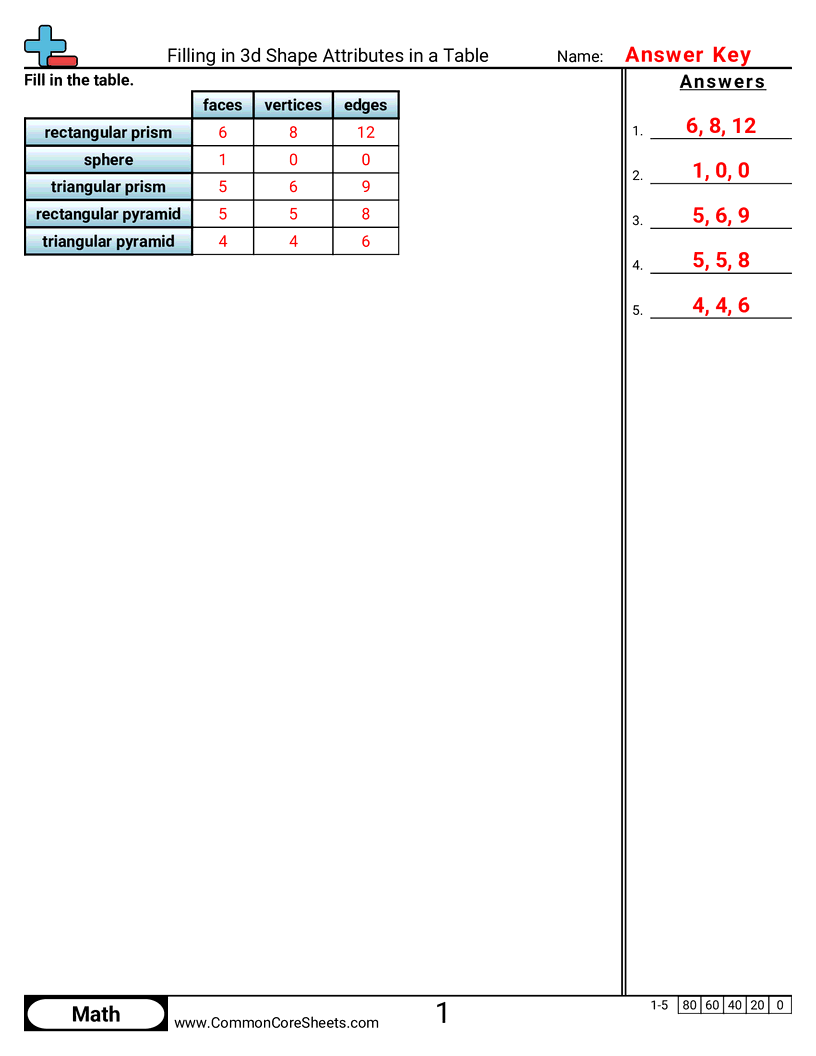
Identify common 3d shapes like prisms, pyramids, cylinders, cones, and spheres. Count how many faces, edges, and vertices a 3d shape has. Use a table to organize and record a shape’s attributes clearly.
Identify the faces, edges, and vertices on common 3d shapes.
2g1
Count the flat sides (faces) on a 3D shape Count the edges where two faces meet Count the corners (vertices) of a solid figure Recognize common solids like cubes, pyramids, and prisms
2g1
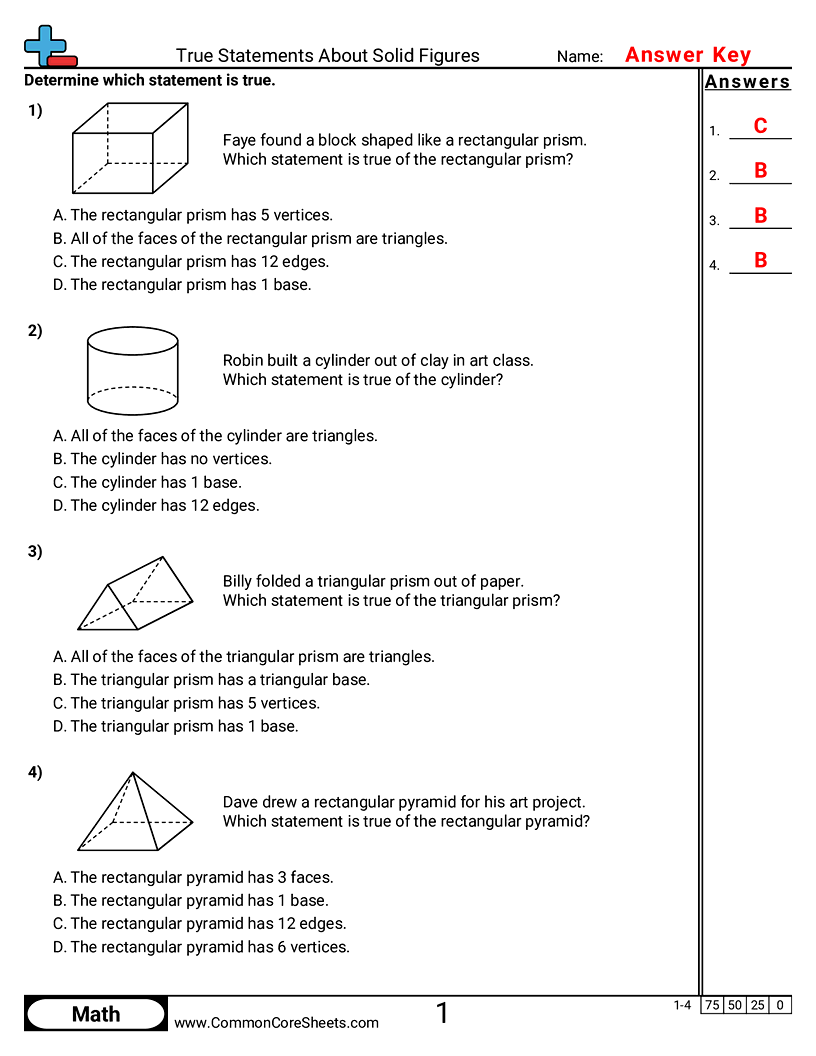
Compare two solid figures by their attributes Count the faces, edges and vertices of a solid figure Know how many bases a prism and a pyramid have Judge whether a statement about two figures is true or false
2g1
Count the faces, edges and vertices of a solid figure Know how many bases a prism and a pyramid have Name the shape of a solid figures base Judge whether a statement about a figure is true or false
6g4
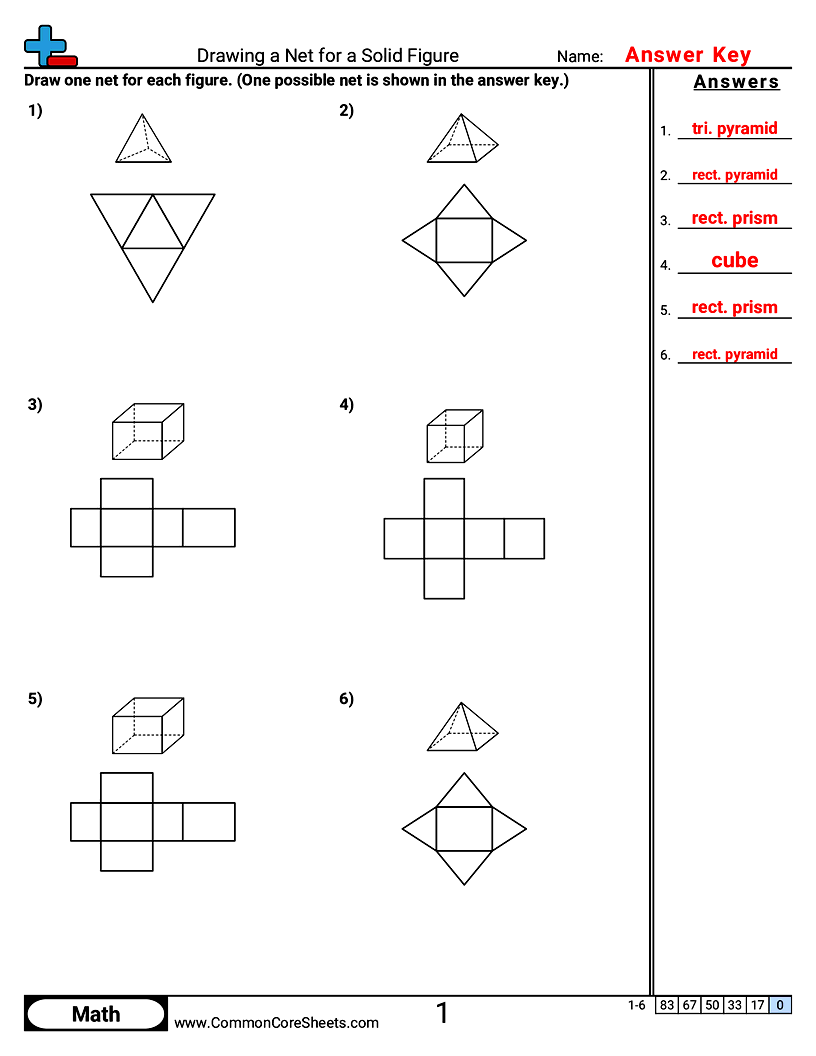
Recognize the net of a cube and of a rectangular prism Tell a square pyramid net from a triangular pyramid net Count the faces in a net and note their shapes Picture how a flat pattern folds into a solid
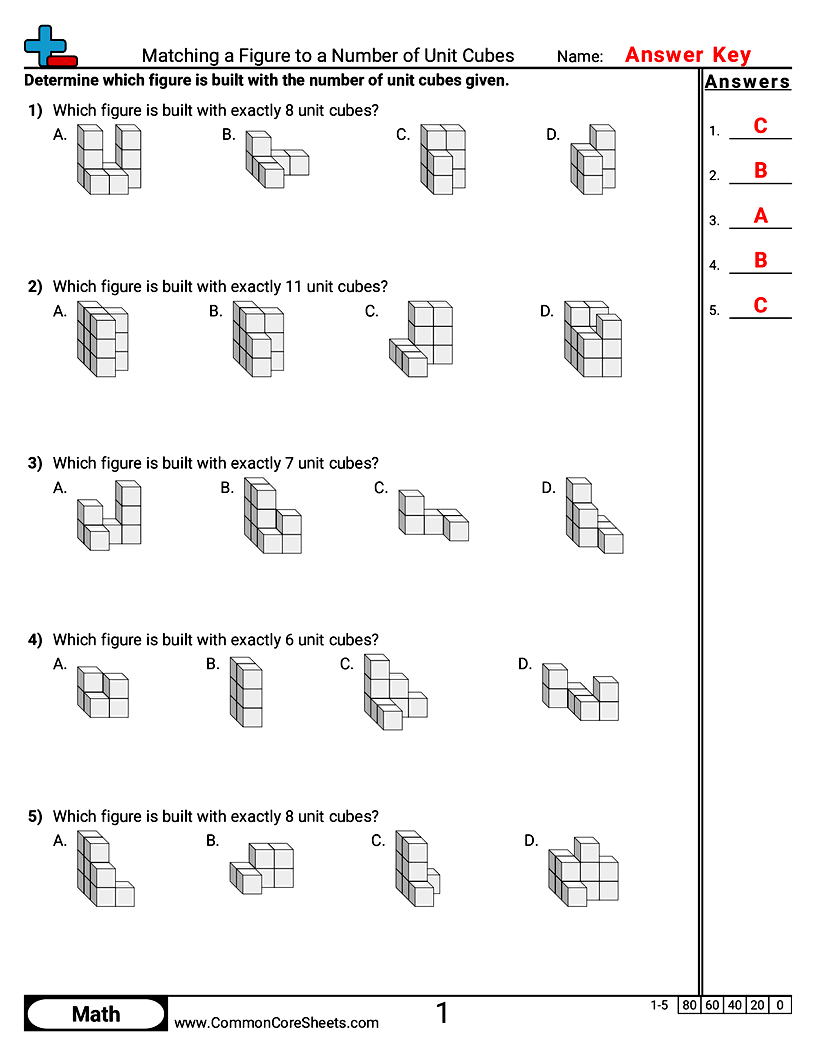
Count every unit cube in a three-dimensional figure Account for the cubes behind and beneath the ones in front See a drawn figure as something that could be built out of blocks Read a picture of a solid as a structure rather than a flat shape
Count the unit cubes in each of several figures Match a number of cubes to the figure it would build Compare figures that differ by only one or two cubes Recognize that two figures can look alike and still take different numbers of cubes
2g1
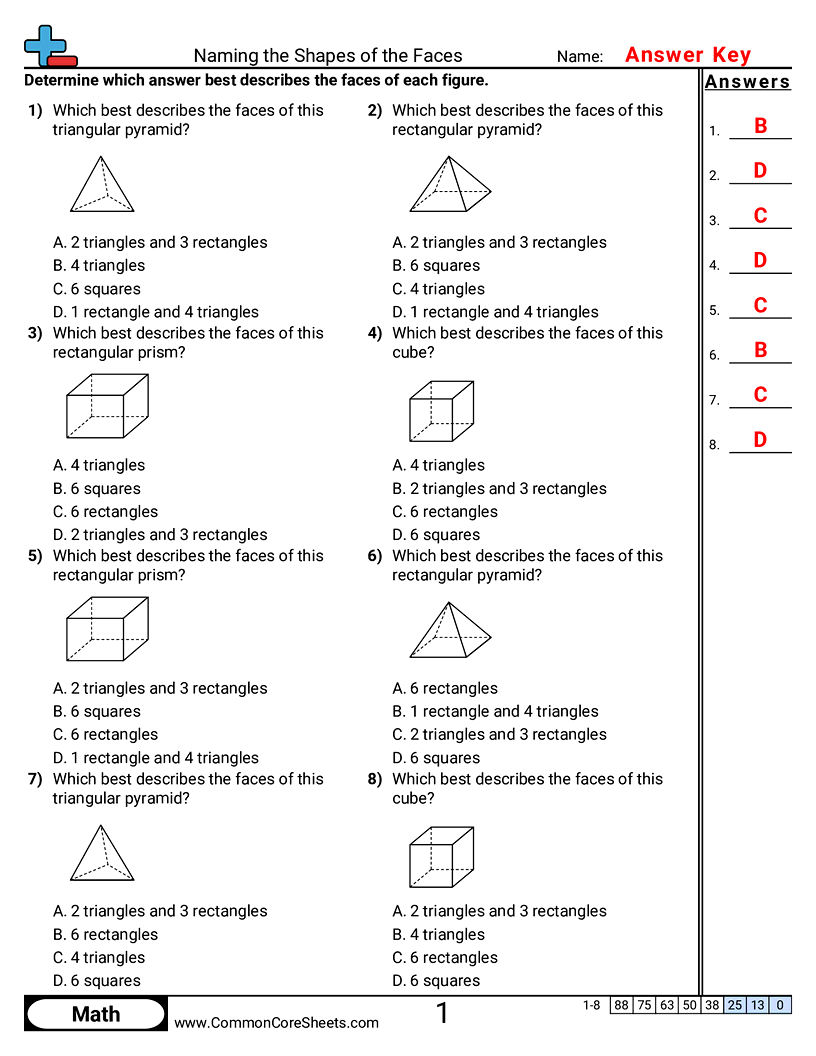
Name the shapes of a solid's faces. Tell a pyramid from a prism by its faces. Describe a three-dimensional figure.
2g1
Identify a figure from its attributes. Use face shapes to tell figures apart. Classify three-dimensional figures.
6g4
Draw a net for a solid figure. Recognize that a solid can have more than one net. Connect the faces of a solid to the parts of its net.
6g4
Choose the net that folds into a solid. Tell a valid net from an arrangement that will not fold. Match faces to a three-dimensional figure.
6g4
Select every net that folds into a solid. Recognize that a solid has more than one net. Tell a valid net from an arrangement that will not fold.
About these worksheets
These worksheets introduce geometric transformations. Students practice drawing scaled rectangles using scale factors, identifying whether a shape has been translated (slid), rotated (turned), or reflected (flipped), and determining whether pairs of shapes are similar, congruent, or neither. Aligned with seventh grade geometry.
7g1
Practice using a scale factor to make a rectangle larger or smaller. Multiply a rectangle’s width and height by the same number to keep the shape similar. Check that the new rectangle’s side lengths stay in the same ratio as the original.
8g3
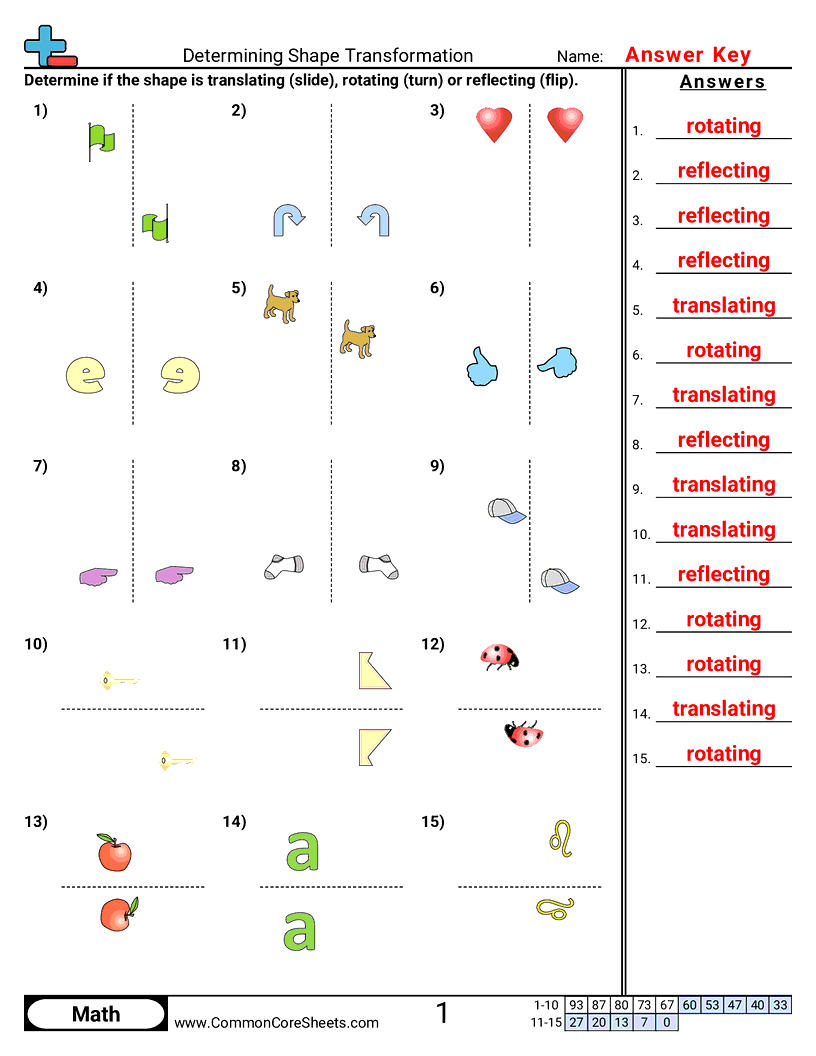
Tell whether a shape has been slid, turned, or flipped to a new position. Use clues like direction, angle, and mirror images to name the correct transformation. Notice what stays the same after a move, like the shape’s size and side lengths. Describe how a shape moved using simple words like left/right, up/down, turn, and flip.
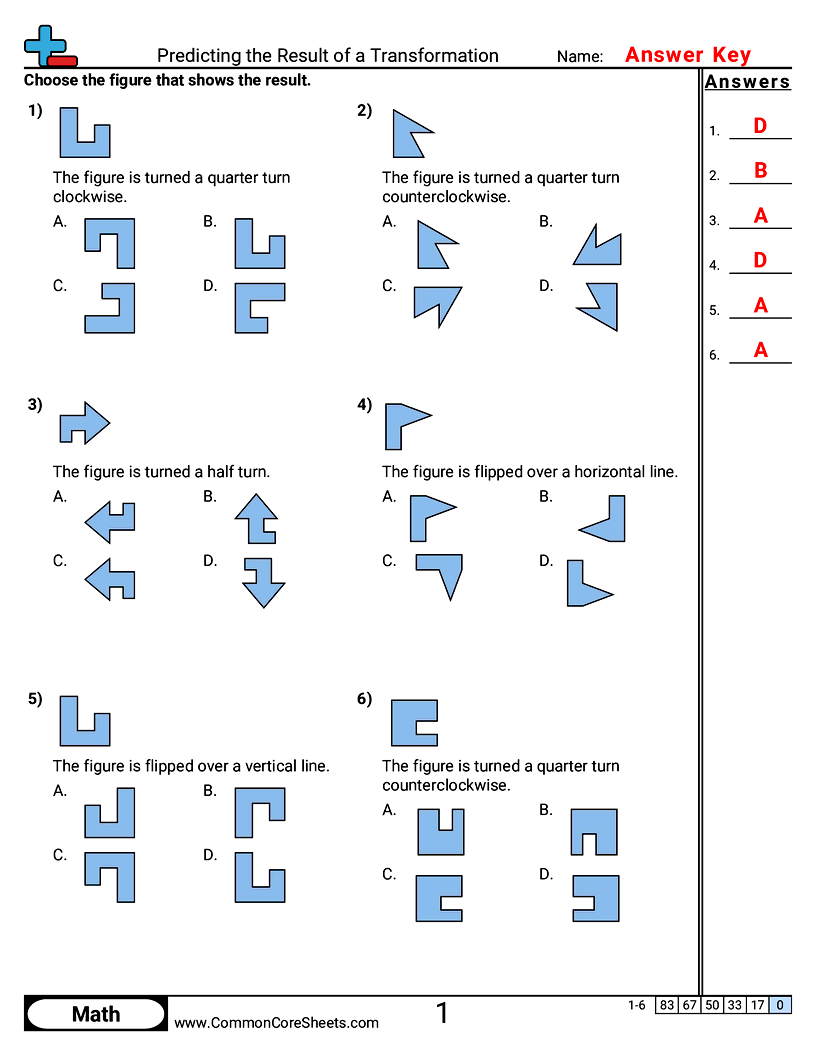
Picture a figure after a quarter or half turn. Picture a figure after a flip over a vertical or horizontal line. Tell a flip from a turn by looking at the result.
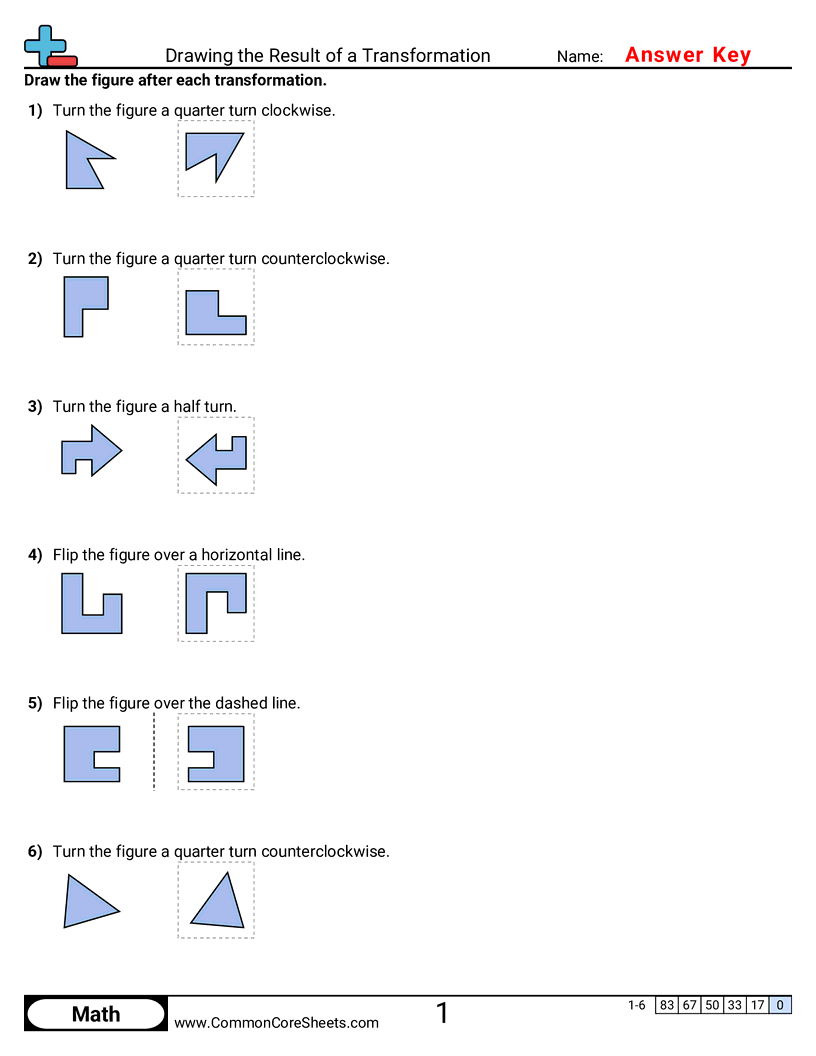
Draw a figure after a flip over a given line. Draw a figure after a quarter or half turn. Keep the size and shape unchanged while the position changes.
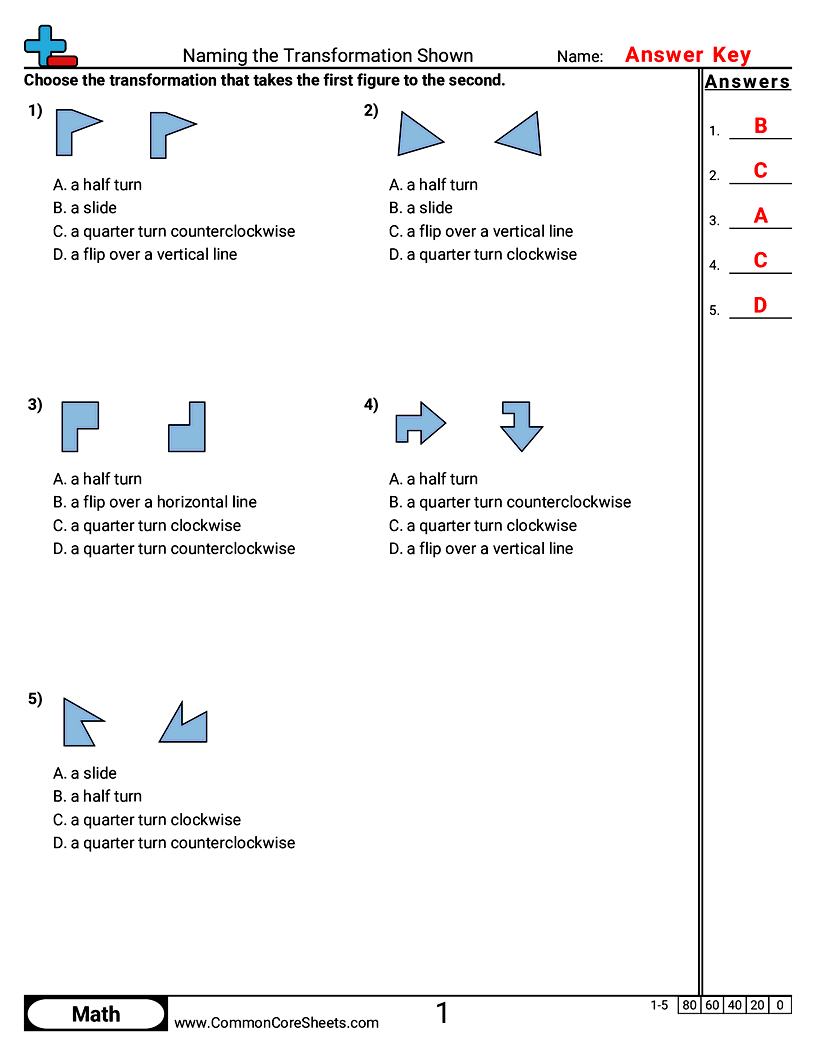
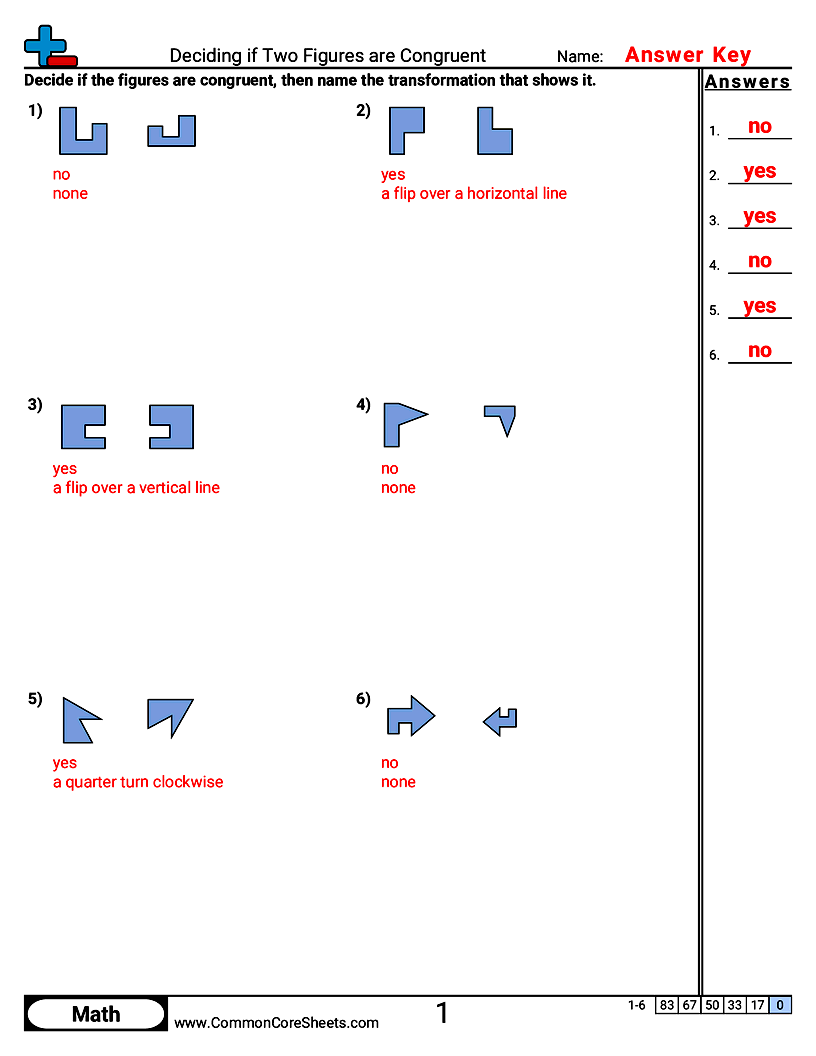
Name the transformation that takes one figure to another. Tell a quarter turn clockwise from a quarter turn counterclockwise. Tell a flip over a vertical line from a flip over a horizontal line.
8g4
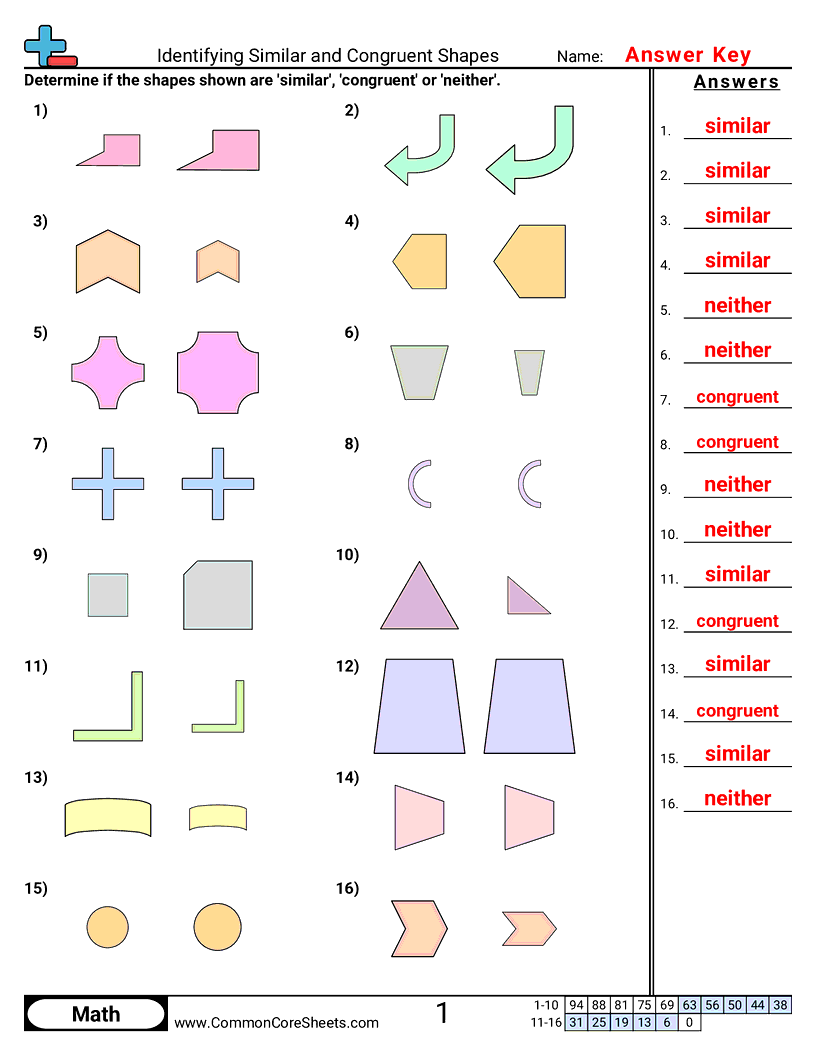
Decide whether two shapes are congruent (same size and shape) or not. Decide whether two shapes are similar (same shape but scaled bigger or smaller) or not.
8g2
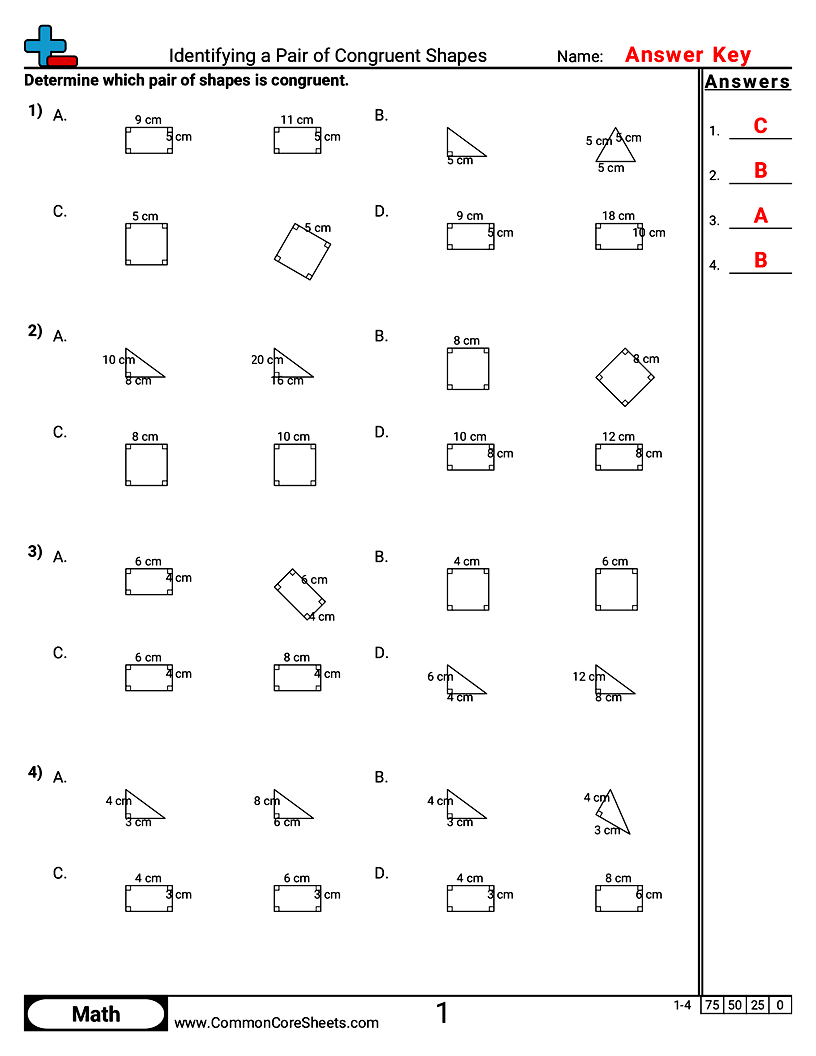
Recognize that turning a shape does not change its size Tell congruent shapes from similar ones Compare shapes by every measurement, not just one Use side labels to decide whether two shapes match
8g2
Decide whether two figures are congruent. Name the transformation that maps one onto the other. Recognize that a resized figure is not congruent even when the shape matches.
8g2
Find the side of a congruent figure that matches a given side. Follow the lettering round a figure after it has been turned. Recognize that a flip reverses the order the letters run.
8g2
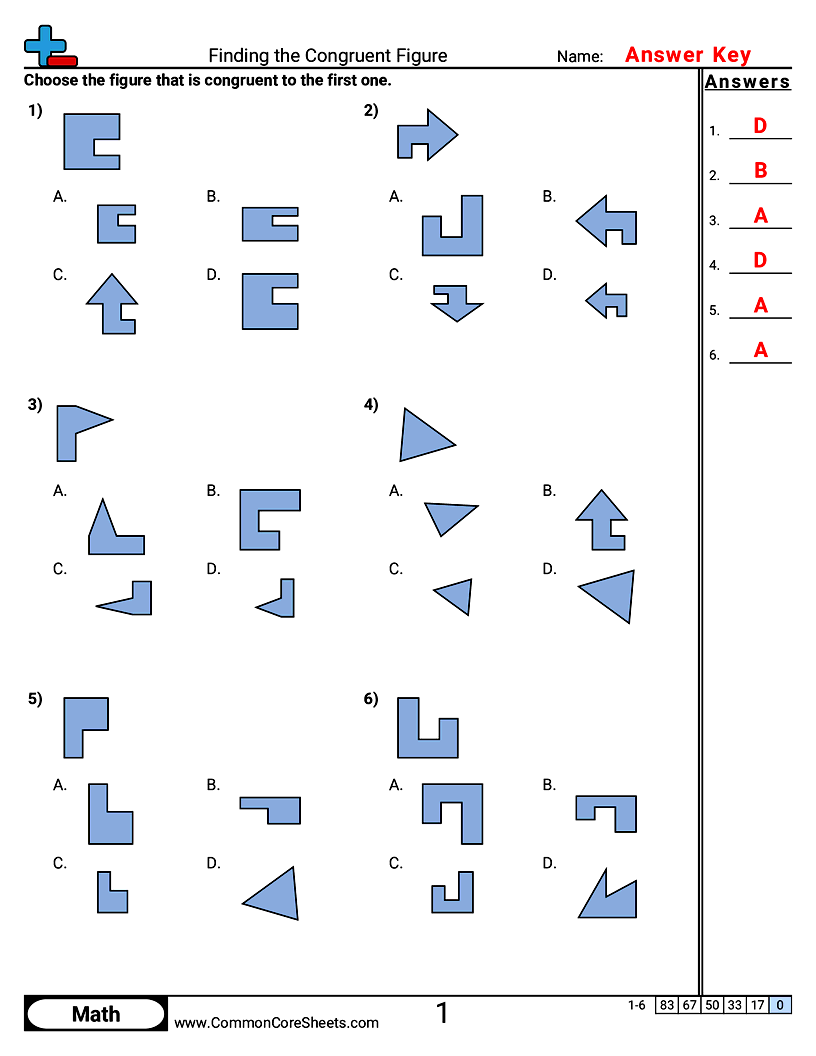
Choose the figure congruent to a given one. Tell a congruent figure from a similar one. Recognize a figure that has been stretched in one direction only.
About these worksheets
Students determine whether a given line is a line of symmetry by checking if it divides a shape into two matching halves. These worksheets build spatial reasoning and the concept of reflective symmetry. Aligned with fourth grade geometry standards.
4g3
Decide whether a drawn line splits a shape into two matching halves. Use the idea of folding or a mirror reflection to check if both sides line up. Spot when a line is not a line of symmetry because parts don’t match or don’t line up. Describe the line of symmetry as the line that makes two equal, mirrored sides.
4g3
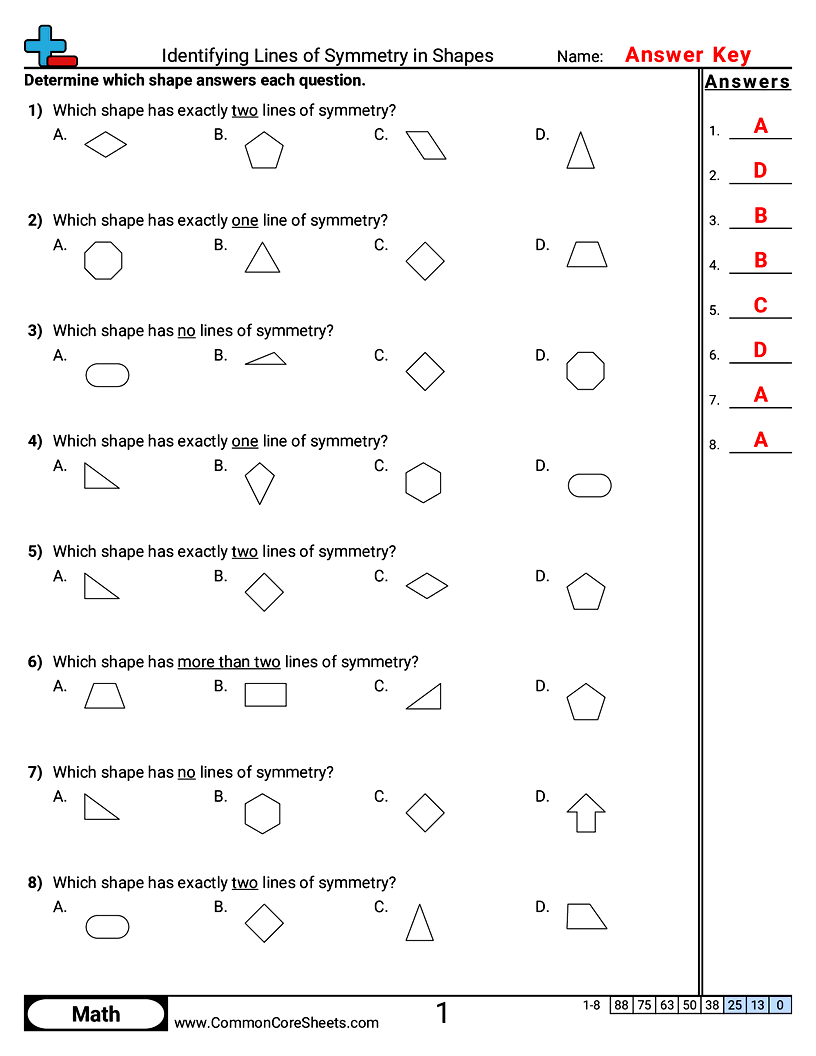
Count the lines of symmetry in a two-dimensional shape Recognize a shape that has no line of symmetry Recognize a shape with exactly one line of symmetry Compare shapes by their symmetry rather than their name
4g3
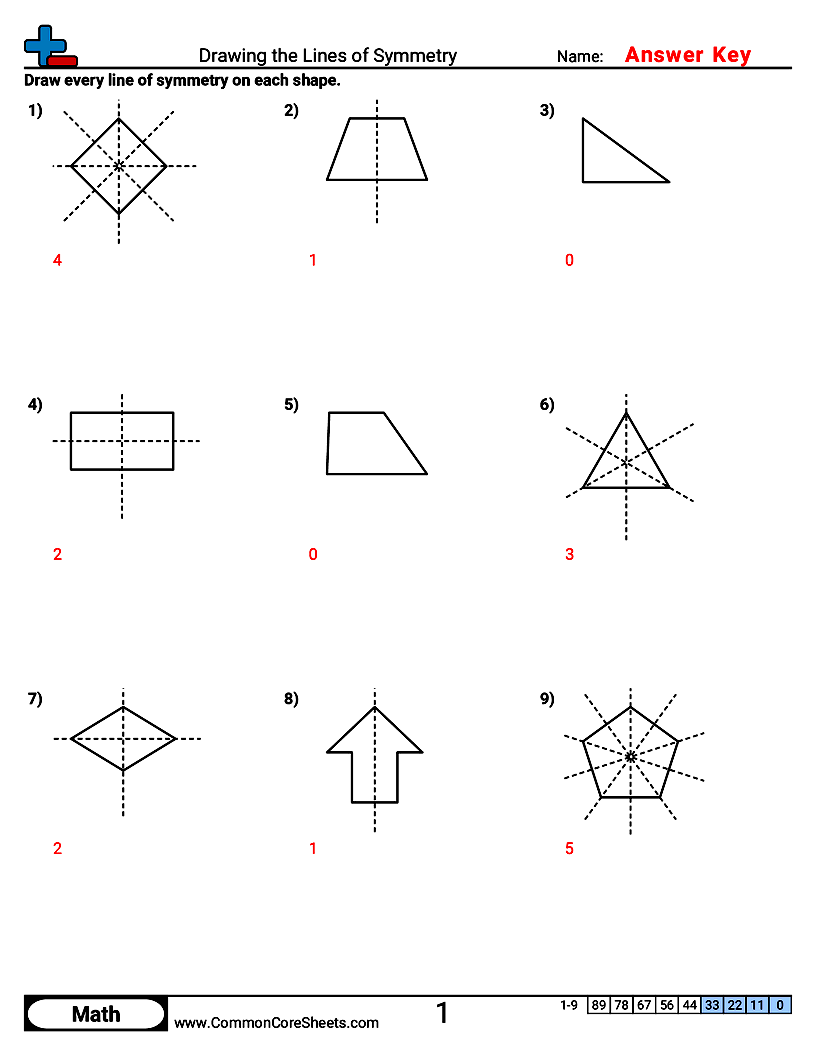
Find every line of symmetry in a shape. Recognize shapes that have none. Know that a regular shape has as many lines as it has sides.
4g3
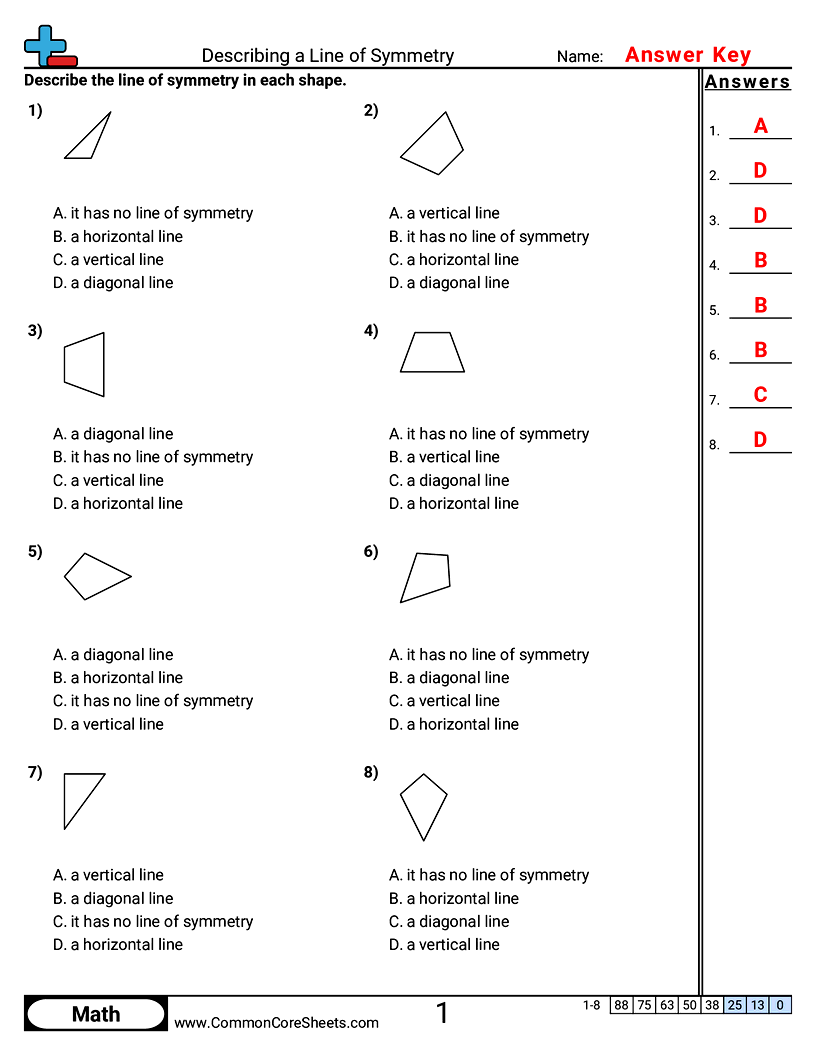
Say whether a line of symmetry runs vertically, horizontally or diagonally. Recognize a shape with no line of symmetry. See that turning a shape turns its line of symmetry with it.
4g3
Draw every line of symmetry on a shape. Remember the diagonal lines on a square. Show that some shapes have none.
Shapes worksheets by grade
1st Grade Shapes Worksheets (1 worksheet) 2nd Grade Shapes Worksheets (6 worksheets) 3rd Grade Shapes Worksheets (4 worksheets) 4th Grade Shapes Worksheets (9 worksheets) 5th Grade Shapes Worksheets (6 worksheets) 7th Grade Shapes Worksheets (4 worksheets)
Playwire Advertisement