Area & Perimeter Worksheets
Cover area and perimeter from concrete to abstract with nearly 30 free worksheets. Students begin determining area and perimeter with unit blocks, then calculate both for quadrilaterals, triangles, and circles, work backwards to find the length of a missing side, and solve area and perimeter word problems. Each worksheet is a printable PDF with a full answer key in multiple versions - no login or account needed - and most can be assigned online. Modified pages offer a lighter problem load, and the grading column with quick grade scale speeds up checking. These area and perimeter worksheets span 3rd through 7th grade geometry.
×
Determining Area with Blocks
Link
About these worksheets
Students learn to find the area of shapes using grid-based counting methods. Worksheets progress from counting full blocks to working with partial blocks, then move to using rows and columns for rectangular areas. Activities also include finding area by tiling, continuing area patterns, and calculating the area of right triangles on a grid. These resources align with third through sixth grade standards and help students transition from counting to using area formulas.
3md6
Count square units to find the area of a shape made from full blocks. Read a tiled grid and keep track of units so the answer is in square units.
3md6
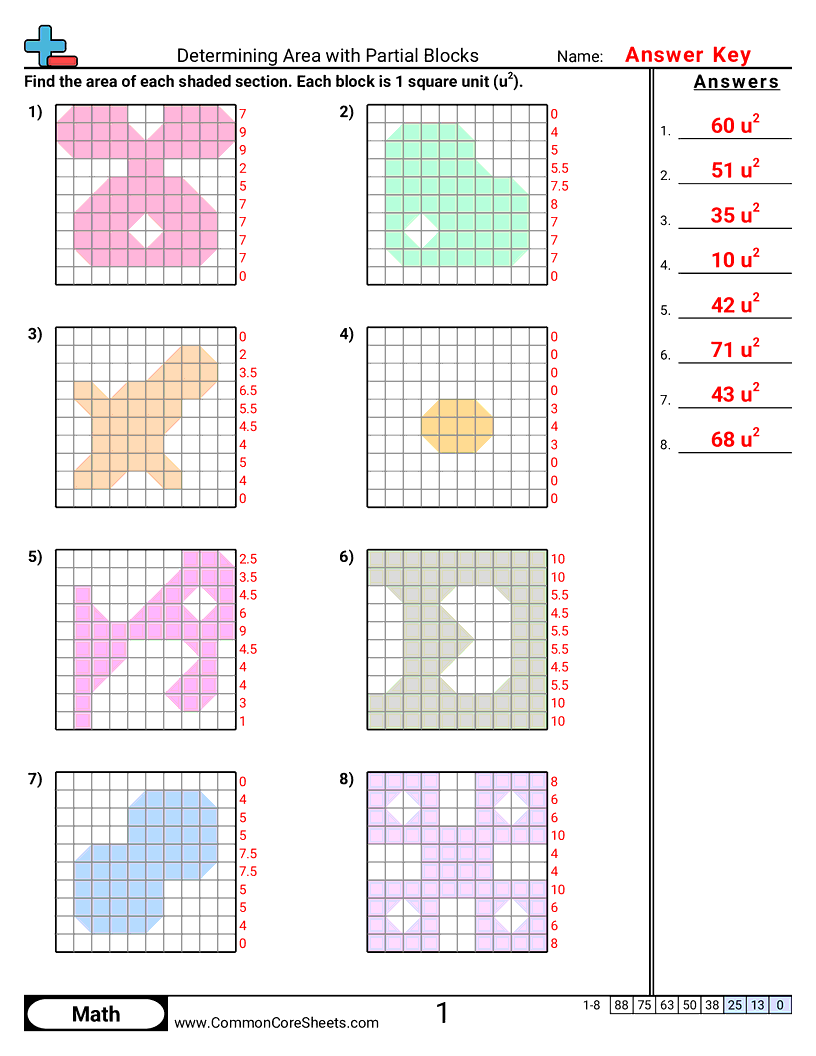
Find the area of a shape by counting square units on a grid. Add up full and partial blocks to get the total area of a figure.
3md6
Find the area of a rectangle by counting square units in a grid. Use rows and columns to figure out area without counting every square one by one. Write the area using the correct square units (square units). Connect area to multiplication by using length × width for rectangles.
3md7b
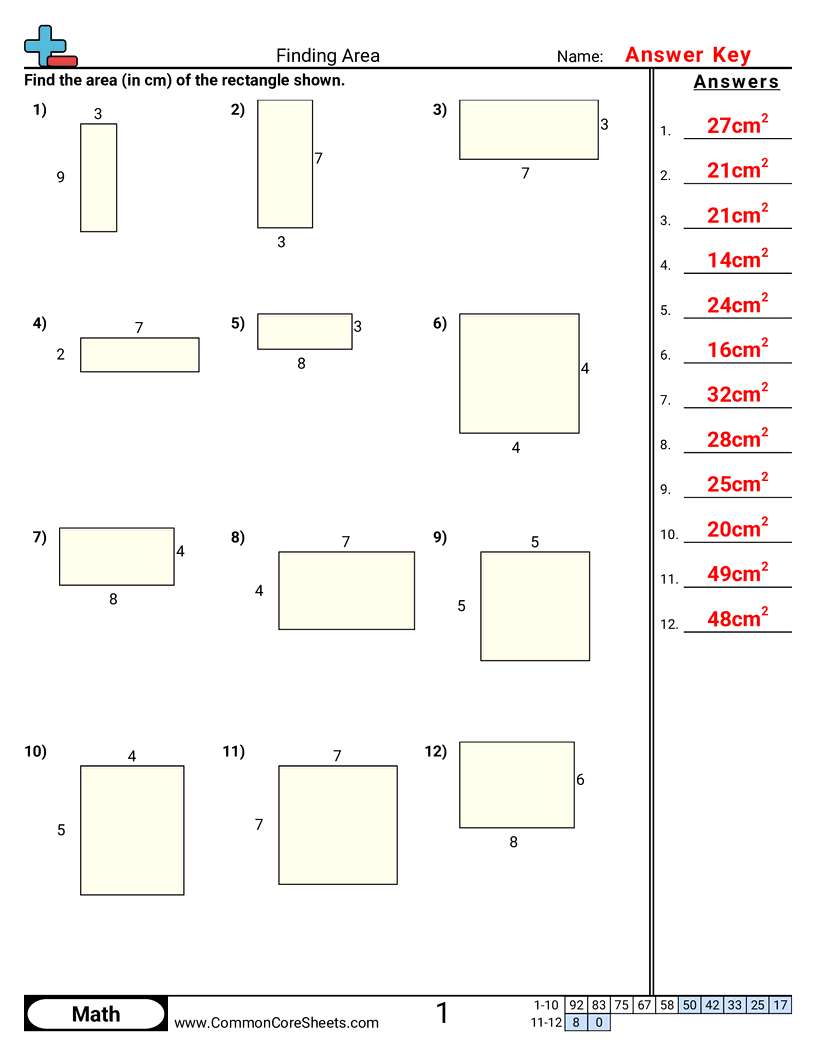
Find the area of a rectangle by multiplying its length and width. Use the correct square units (like cm² or m²) when writing an area answer.
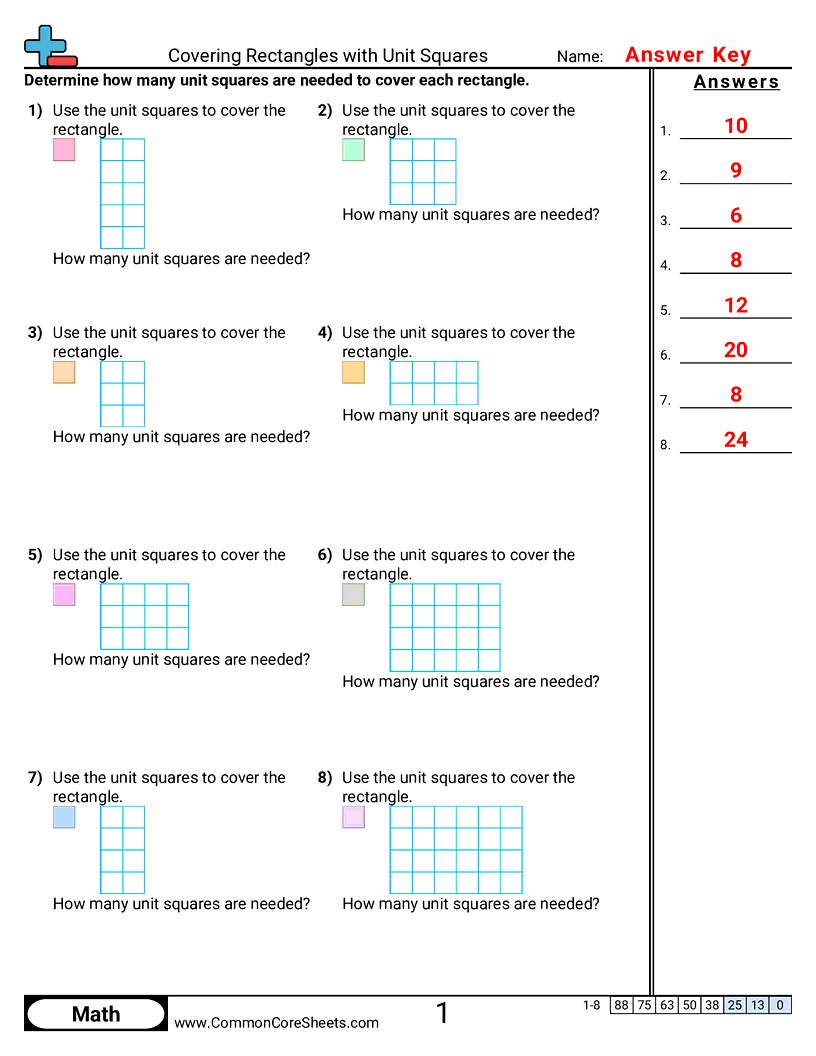
3md7a
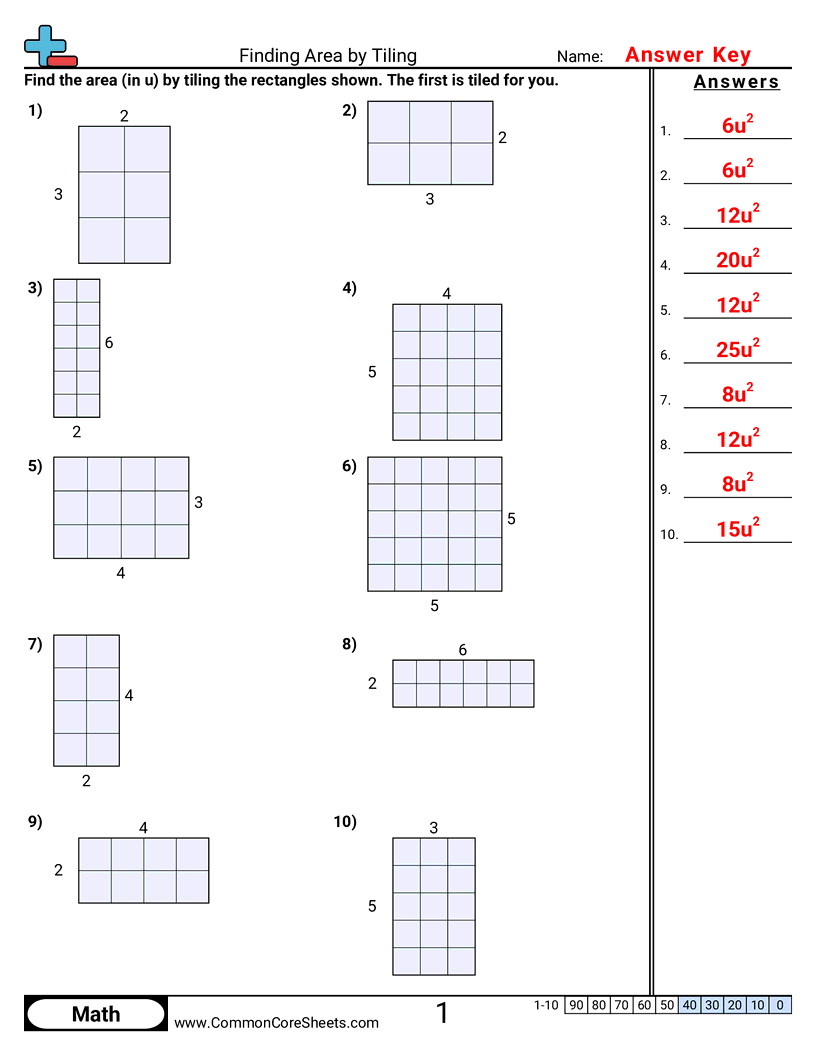
Cover a rectangle with equal-size square tiles without gaps or overlaps. Count the tiles to find the area in square units. Use rows and columns to keep track of tiles and avoid miscounting. Explain that area means how much flat space a shape covers.
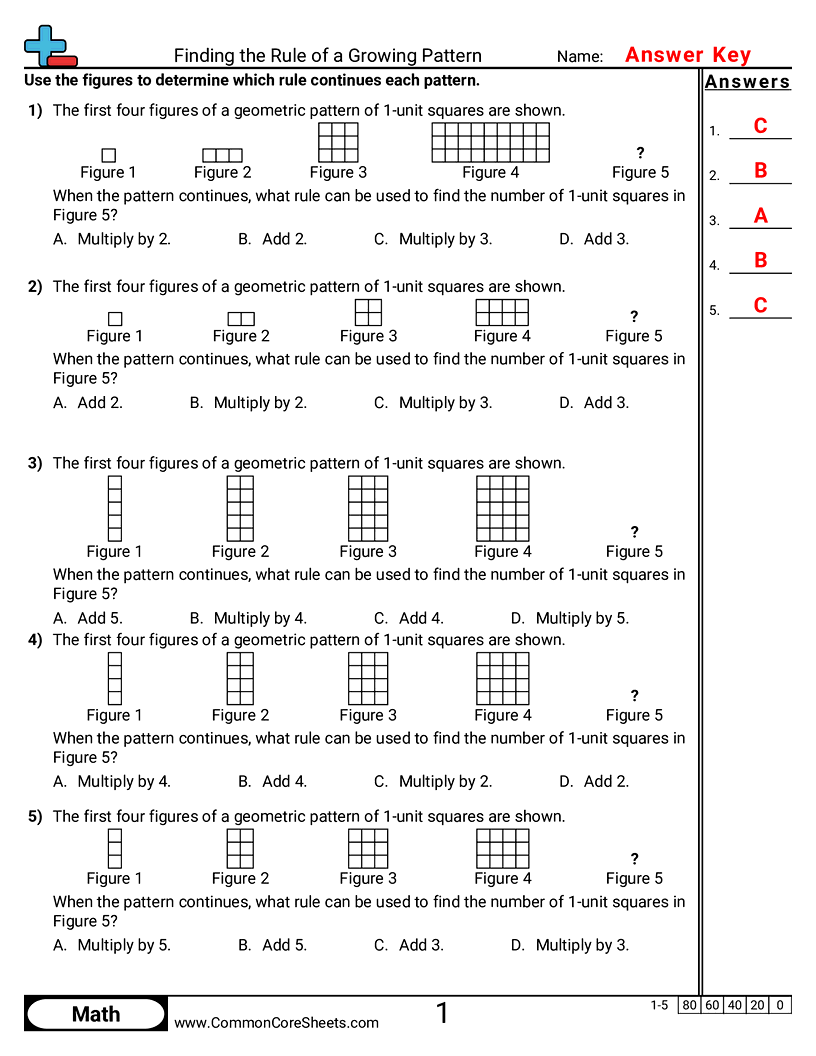
4oa5
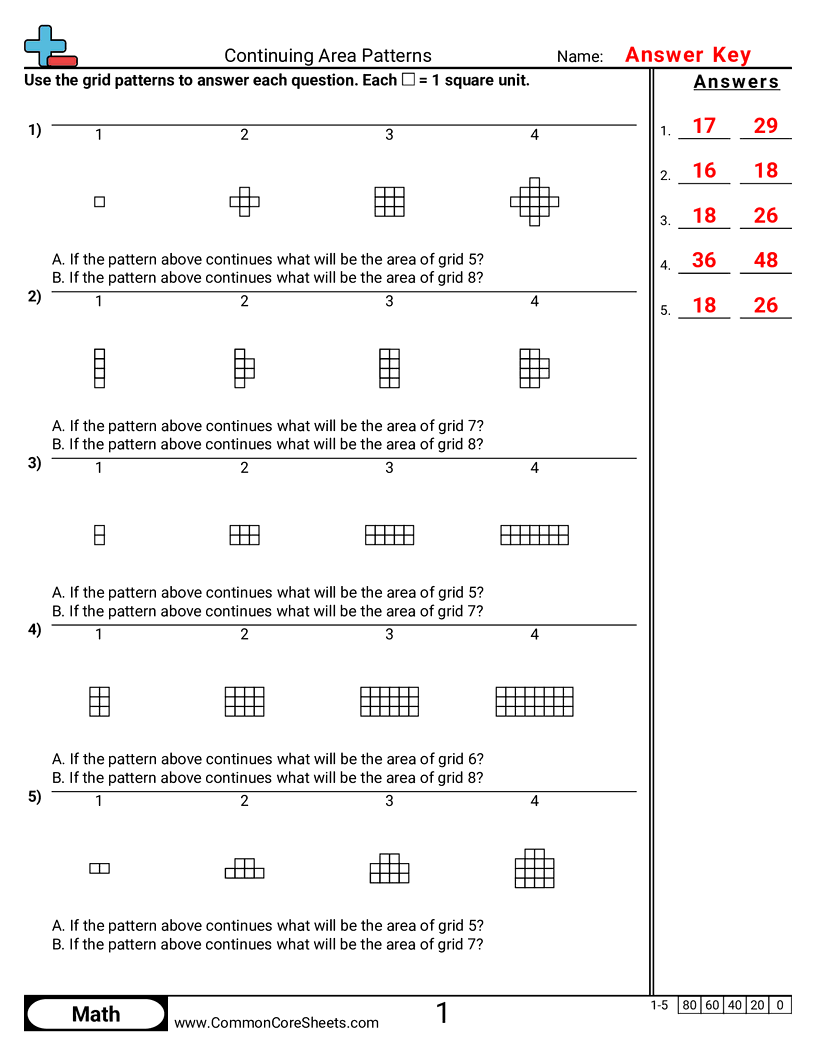
Find the area of a grid by counting square units. Notice how a shape or grid is growing from one step to the next. Use the pattern to predict the area of the next shape in the sequence.
4oa5
Describe a growing pattern of squares with a single operation rule. Count the squares in each figure before choosing a rule. Test a rule against every figure, not just the first two.
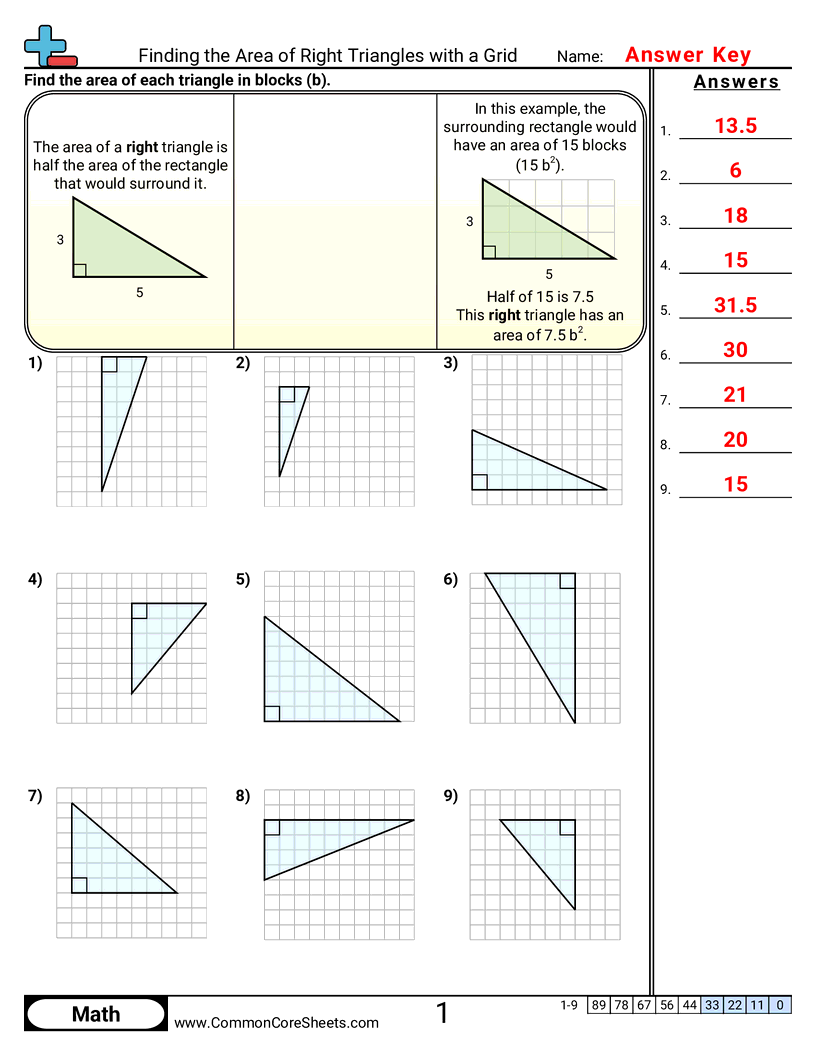
6g1
Use the grid to count square units and find the base and height of a right triangle. Use the area formula for a right triangle (area = 1/2 × base × height). Make sure the base and height you choose are perpendicular sides of the right triangle.
3md5b
Count the number of squares that fill a rectangle to find its area Understand that area is measured in equal-sized square units Connect the number of squares to the size of a rectangle Practice comparing which rectangle is bigger by counting squares
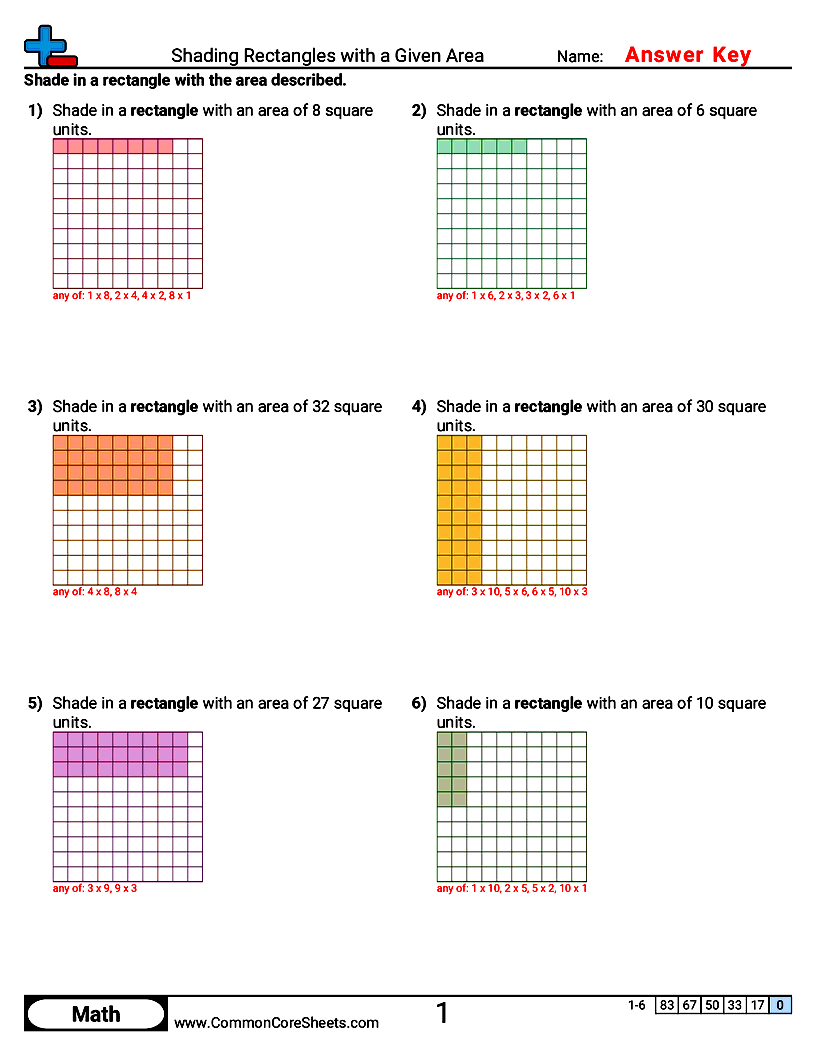
3md5b
Understand that area is measured by counting square units Shade a rectangle to show a specific number of square units Connect the number of squares to the total area Recognize area as the space a shape covers
Determining Perimeter with Blocks
Link
About these worksheets
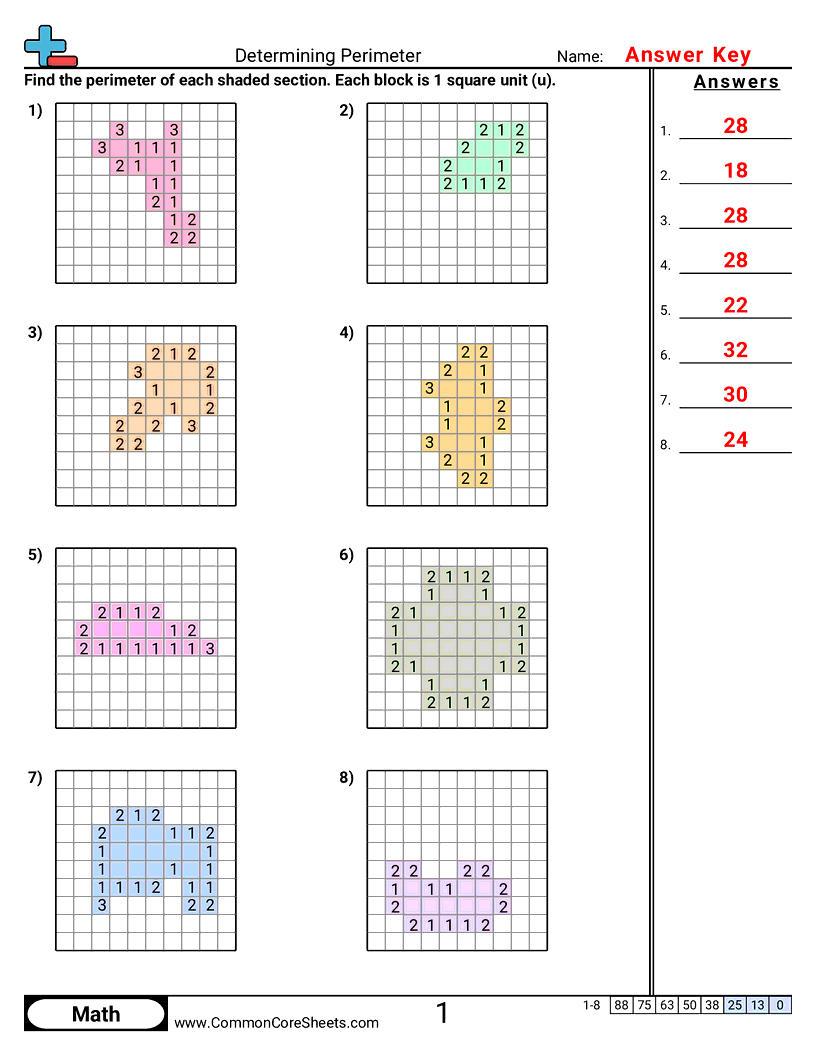
These worksheets help students find the perimeter of shapes by counting the unit segments along the outside edge of a figure. Using grid-based visuals, students practice identifying and adding the outer edges to calculate perimeter. This hands-on approach builds understanding before students move on to using perimeter formulas with given measurements.
3md6
Find the perimeter by counting the unit blocks around the outside of a shape. Use units correctly by counting each block edge as 1 unit of distance. Handle shapes made from rectangles or block shapes that have corners and indentations.
About these worksheets
These worksheets cover a comprehensive range of quadrilateral measurement skills. Students find the area and perimeter of rectangles, explore rectilinear shapes by decomposing them into smaller rectangles, create rectangles with given area or perimeter constraints, and work with scale factors. Problem sets include whole numbers, decimals, and fractions, and span third through seventh grade standards.
3md7d
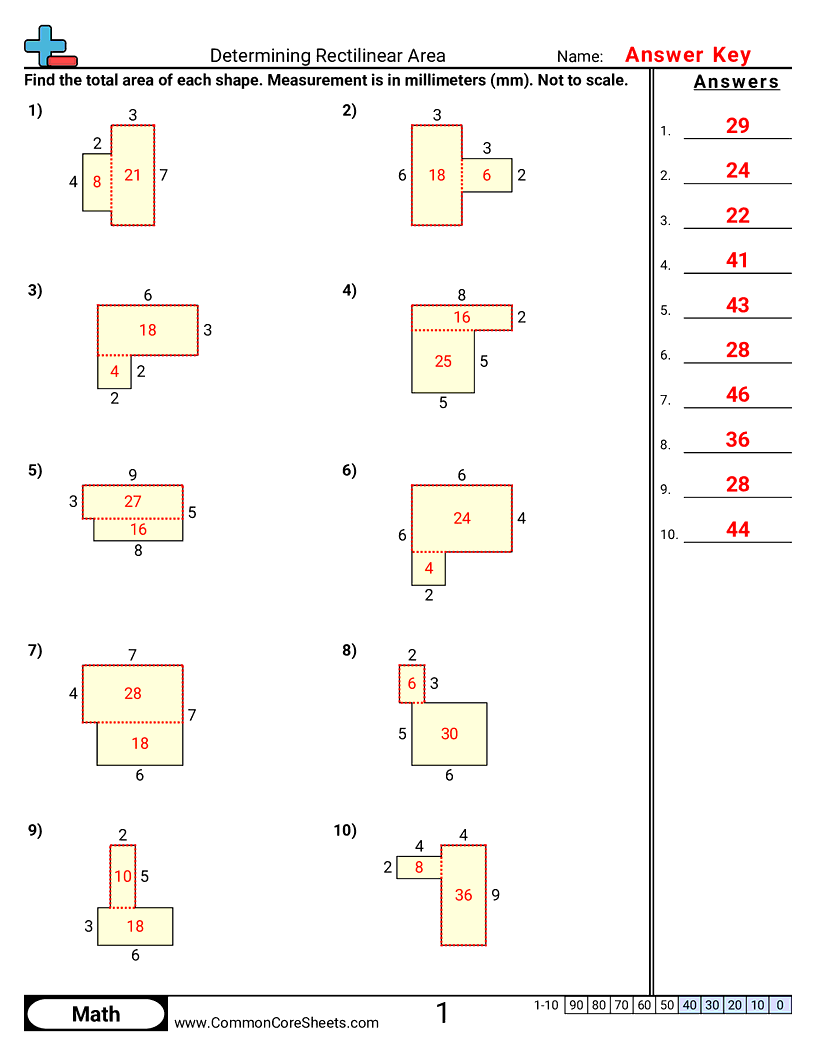
Find the area of an L-shaped or step-shaped figure by breaking it into rectangles. Add the areas of the smaller rectangles to get the total area of the whole shape. Label area using square metric units (like square centimeters or square meters).
3md8
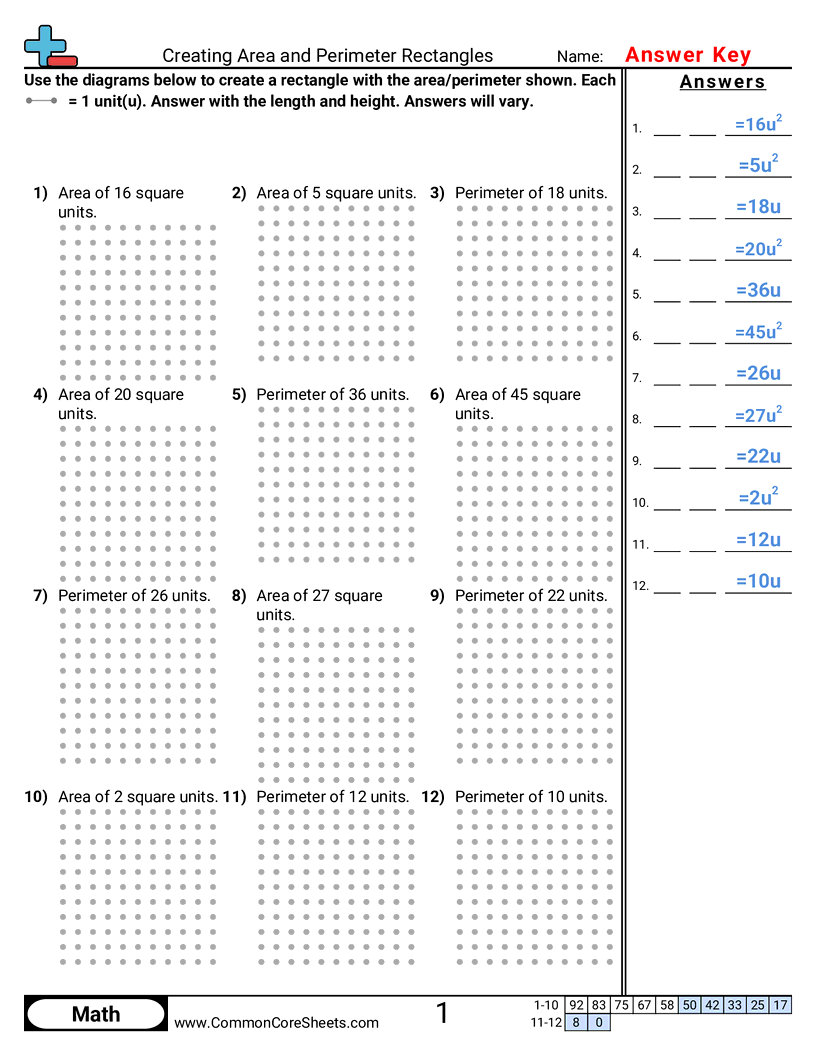
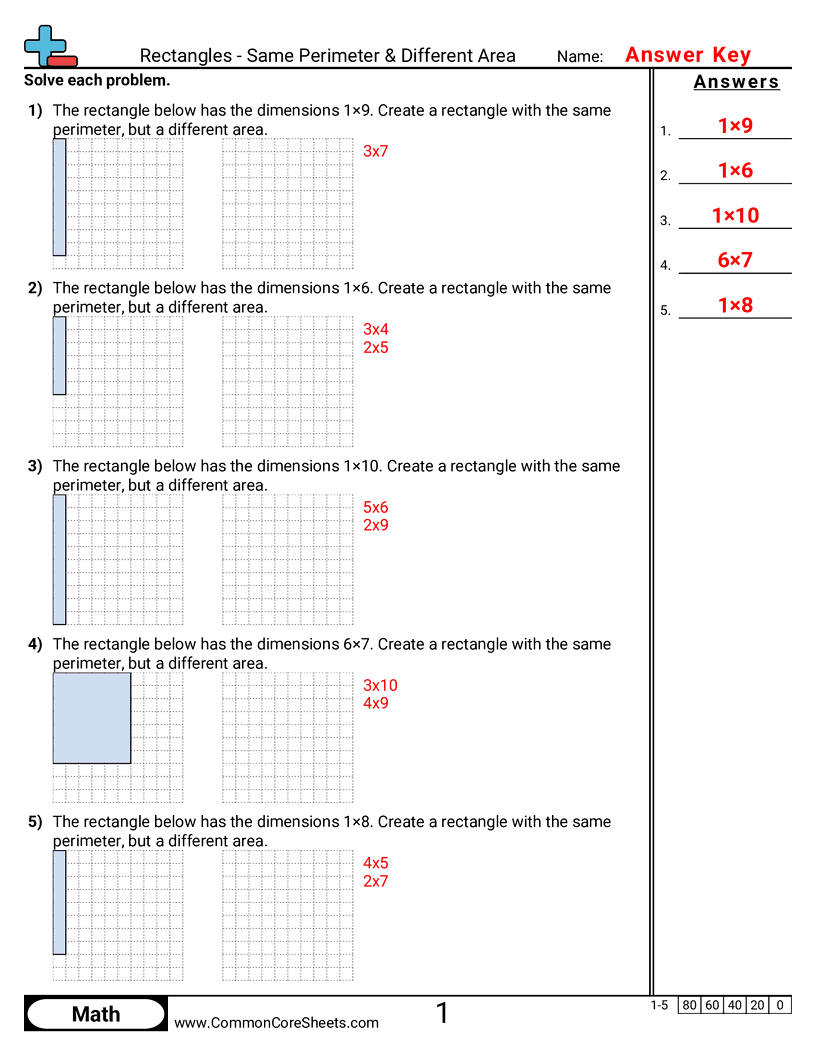
Find different length-and-width pairs that make a rectangle with a given area. Find different rectangles that have a given perimeter by choosing side lengths that add up correctly. Tell the difference between area (square units inside) and perimeter (units around the edge). Use multiplication and addition to check that a rectangle’s dimensions match the area or perimeter given.
3md8
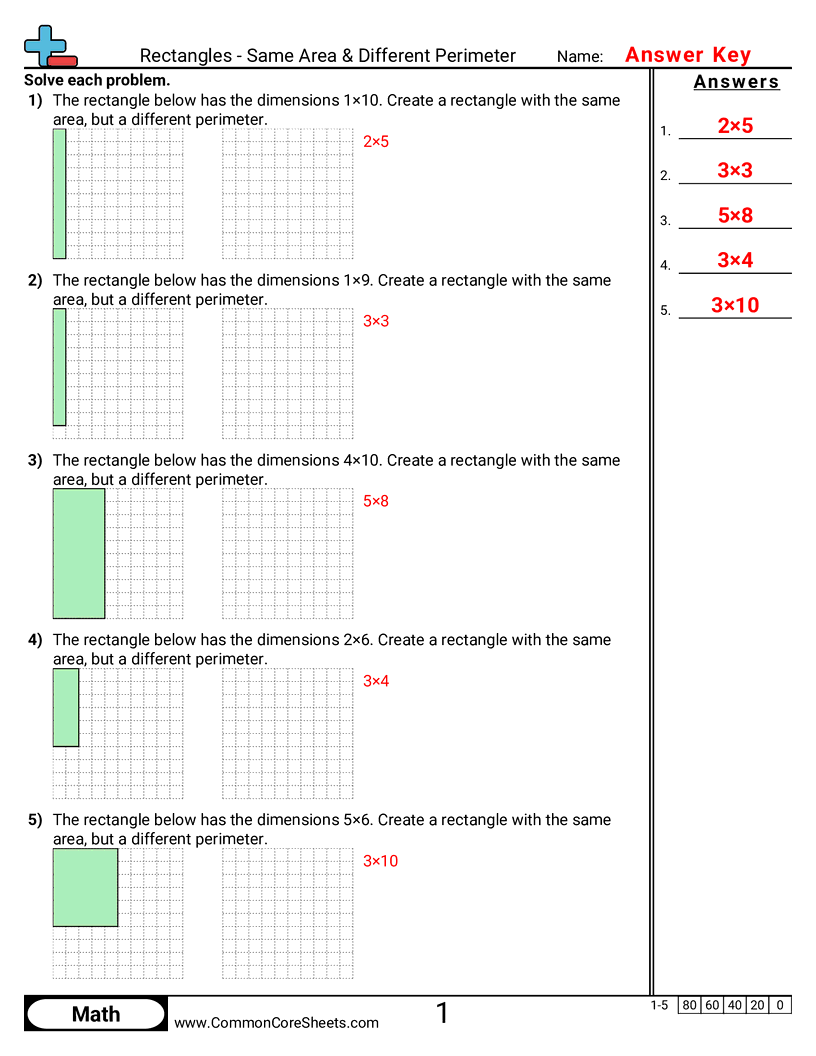
Find the area of a rectangle by multiplying length × width. Find the perimeter of a rectangle by adding all the side lengths. Use factor pairs to make different rectangles that still have the same area. Compare rectangles to see how changing the side lengths can change the perimeter even when the area stays the same.
3md8
Find the area of a rectangle by multiplying length × width. Find the perimeter of a rectangle by adding all the side lengths. Create different rectangles that have the same area by using different factor pairs. Compare rectangles to see how changing the side lengths can change the perimeter even when the area stays the same.
4md3
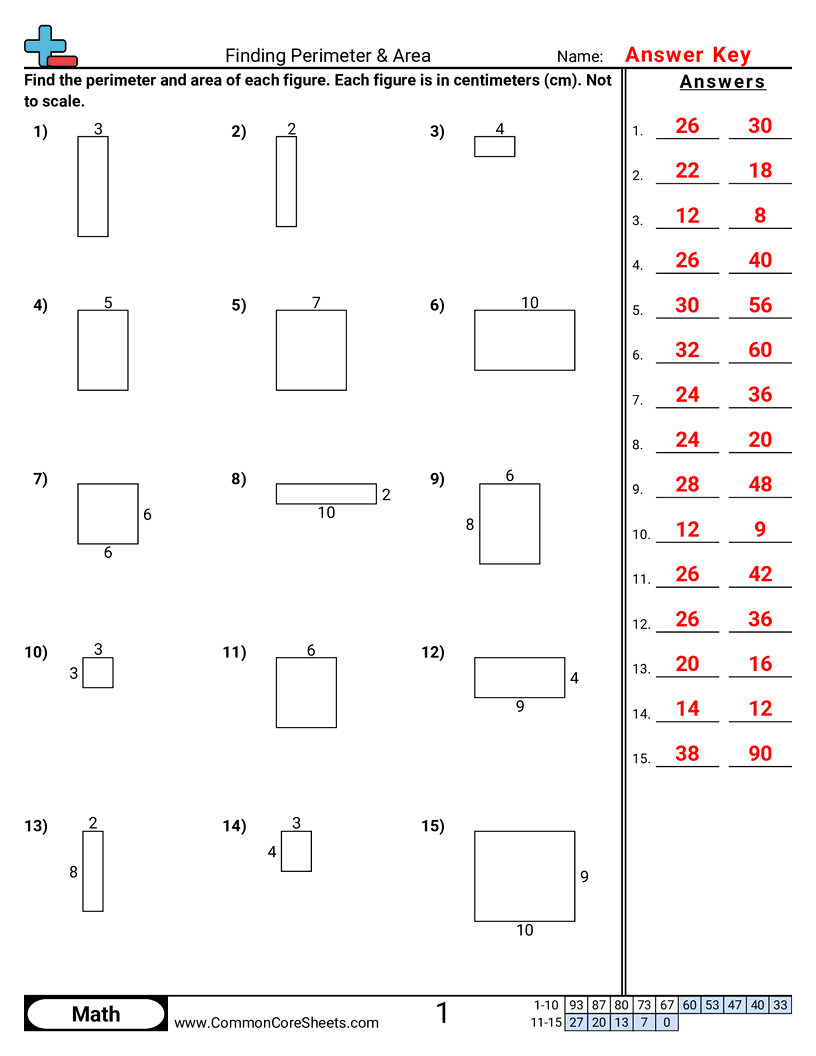
Find the area of a rectangle by using its length and width. Find the perimeter of a rectangle by adding the lengths of all four sides. Tell the difference between area (square units) and perimeter (units around the edge).
3md8
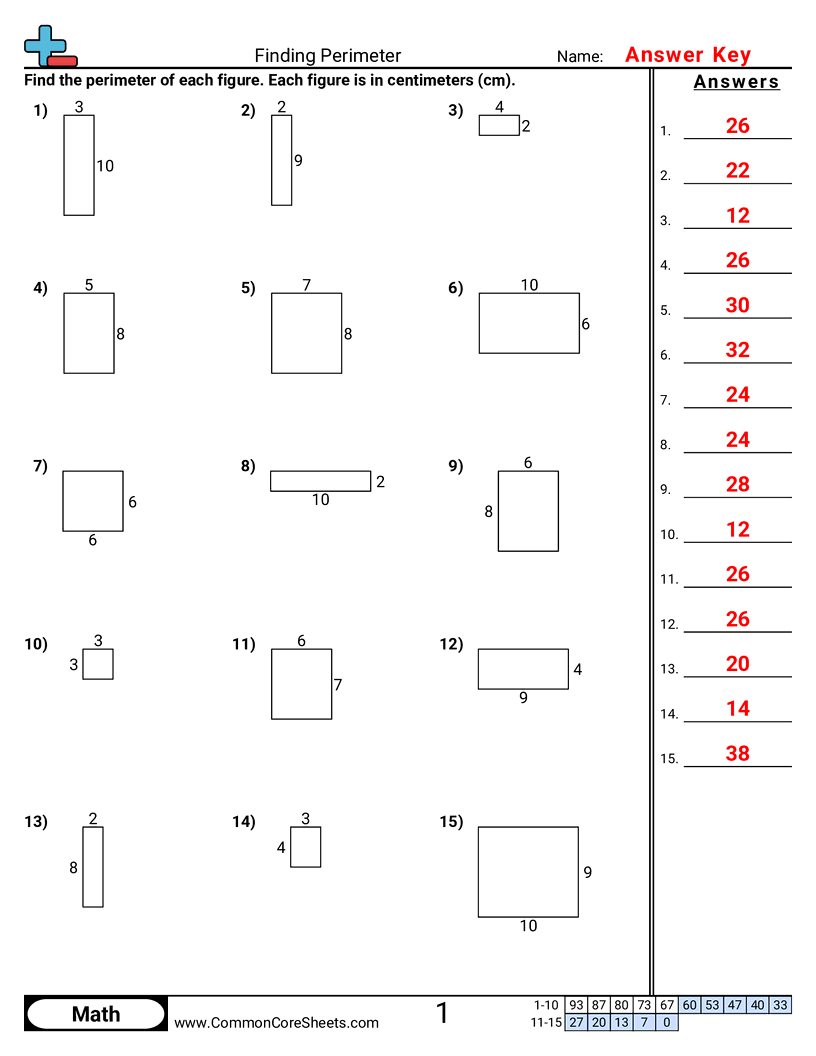
Find the perimeter of a rectangle by adding the lengths of all four sides. Use the fact that opposite sides of a rectangle are equal to find the two lengths that are not labeled. Recognize that perimeter is a distance around a figure and is measured in ordinary units, not square units.
3md8
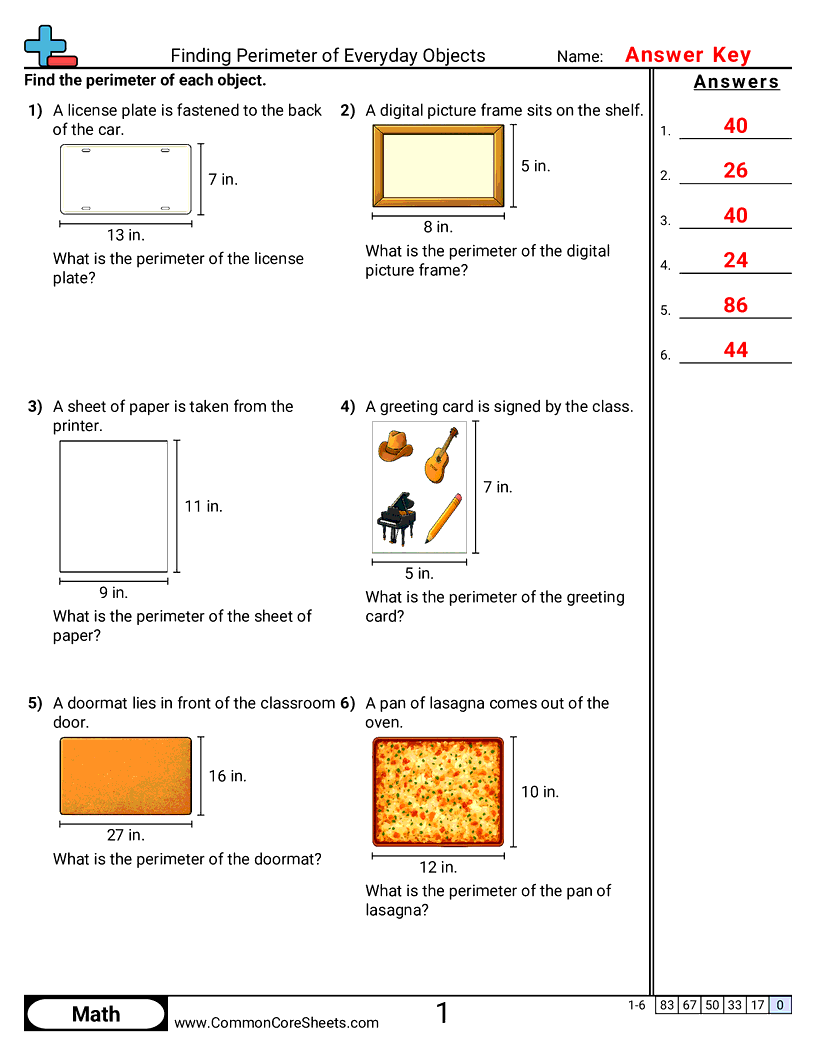
Find the perimeter of a real rectangular object from its labeled width and height. Read a measurement from a dimension line on a diagram. Use the fact that opposite sides of a rectangle are equal to account for the two sides that are not labeled. Attach the correct unit to a perimeter and recognize that it is a length, not an area.
7g1
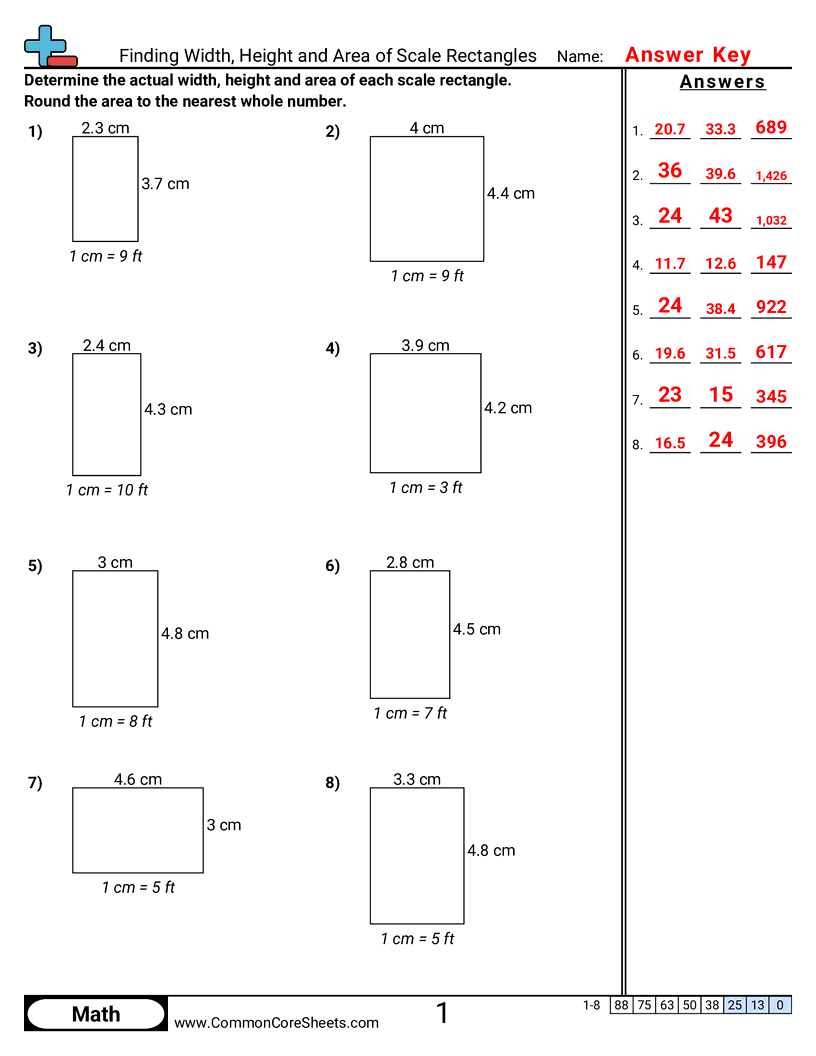
Use a scale factor to find a missing width or height of a rectangle. Keep side lengths in the same ratio when a rectangle is enlarged or reduced. Calculate the area of a rectangle after its dimensions have been scaled.
6ns3
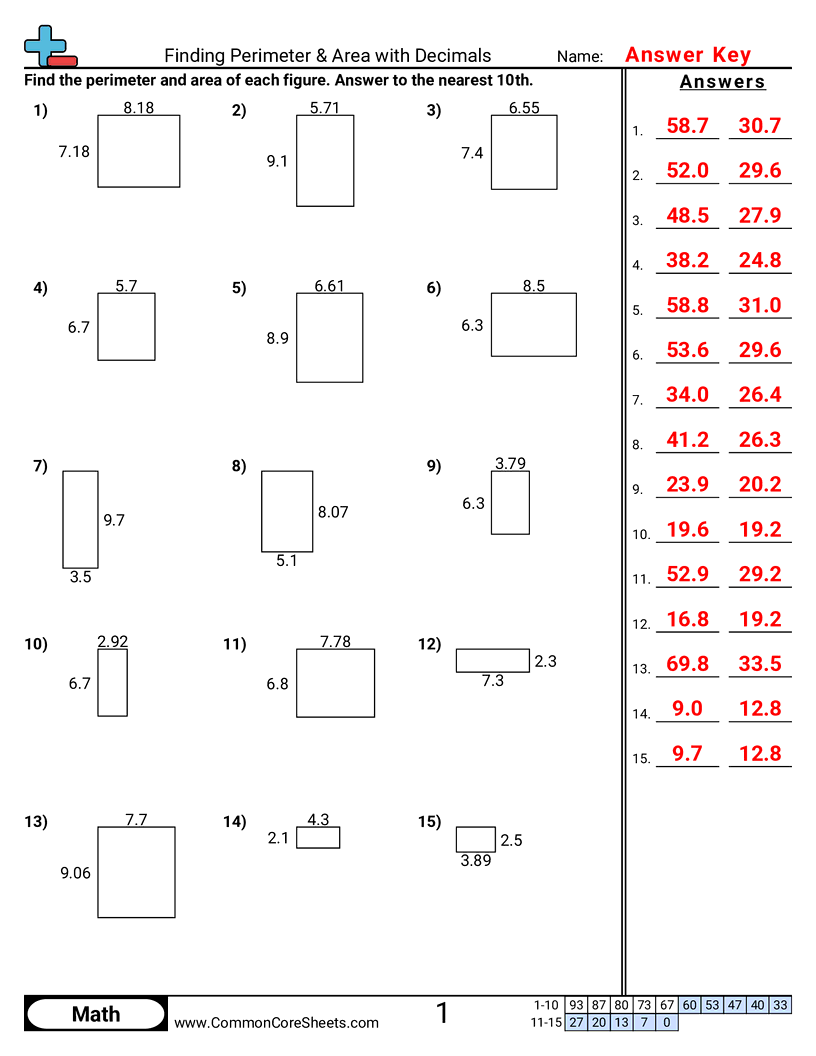
Find the perimeter of a quadrilateral by adding all the side lengths when the measurements include decimals. Find the area of rectangles and other quadrilaterals using given decimal dimensions.
4md3
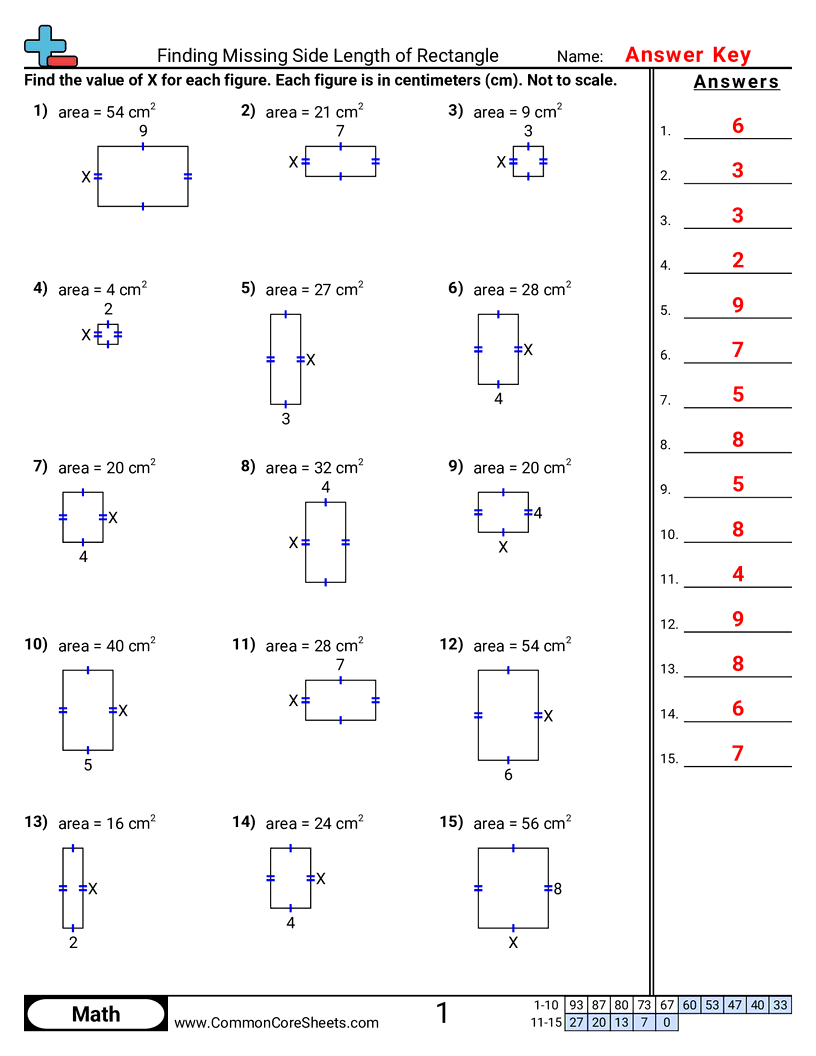
Find a missing side length of a rectangle when you know the area and one side. Use multiplication and division to connect side lengths and area of rectangles.
4nbt5
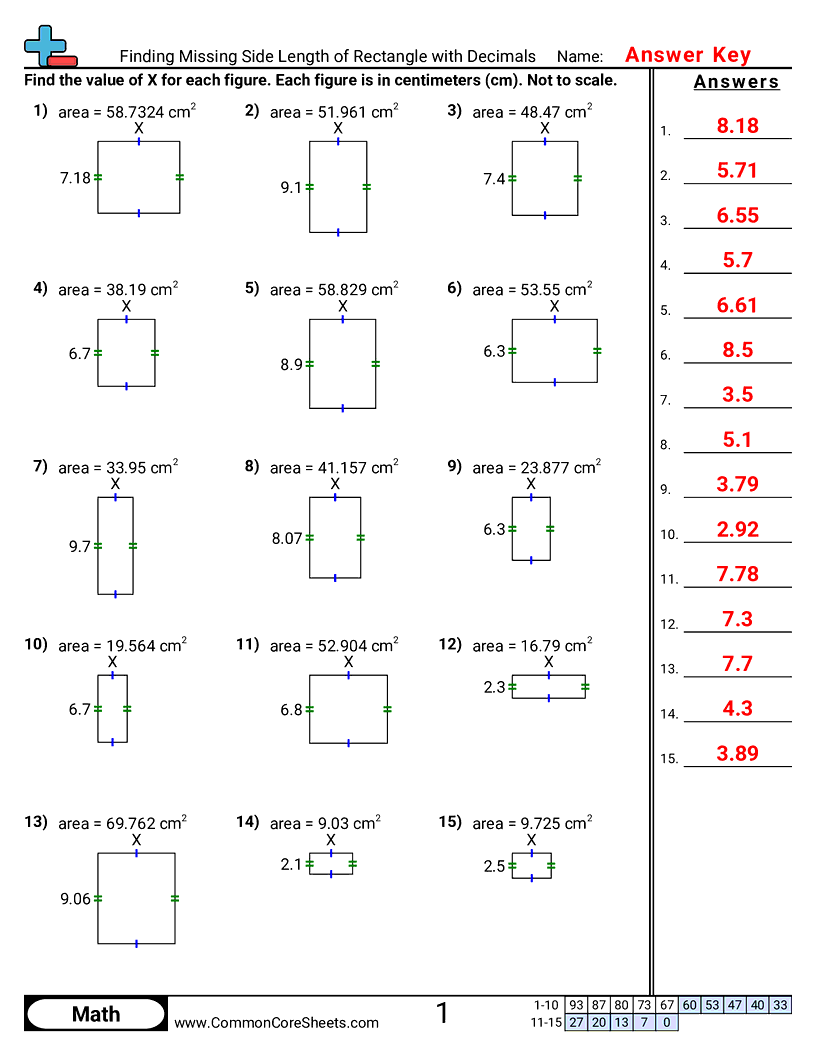
Use the area of a rectangle to figure out a missing side length when the other side is given. Divide with decimals to find the unknown width or height of a rectangle.
5nf6
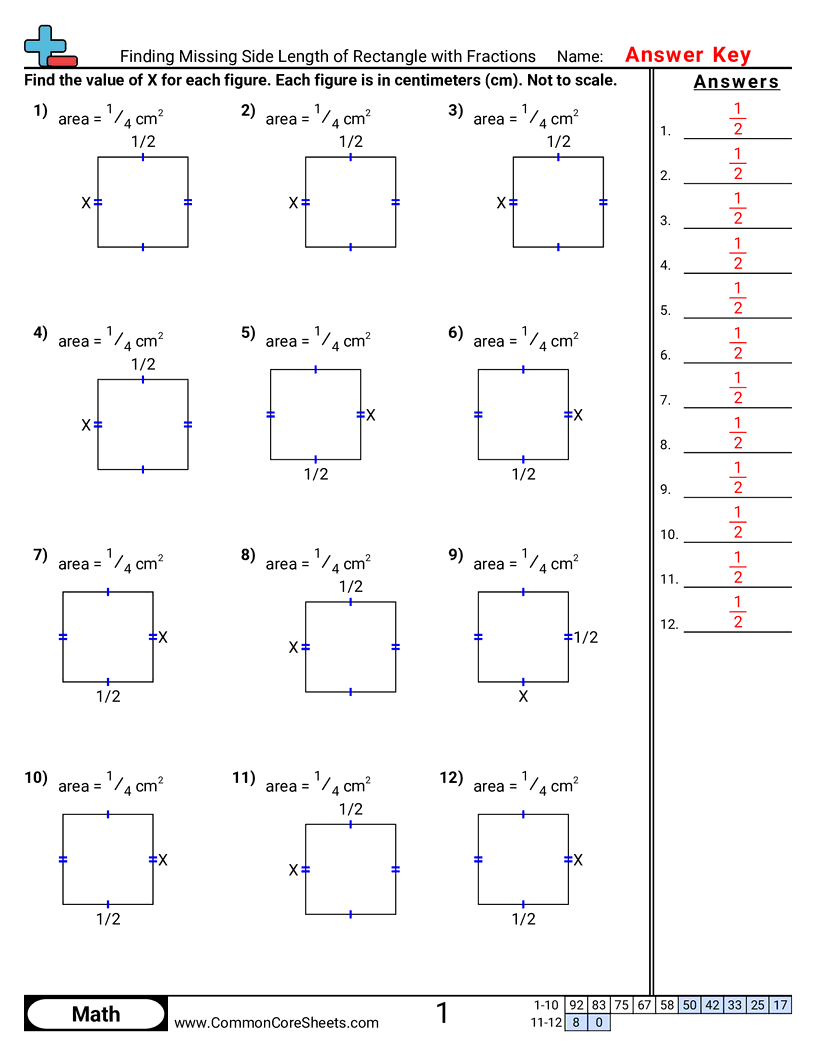
Use the area of a rectangle and one side length to find the missing side length. Divide with fractions to solve for an unknown width or height.
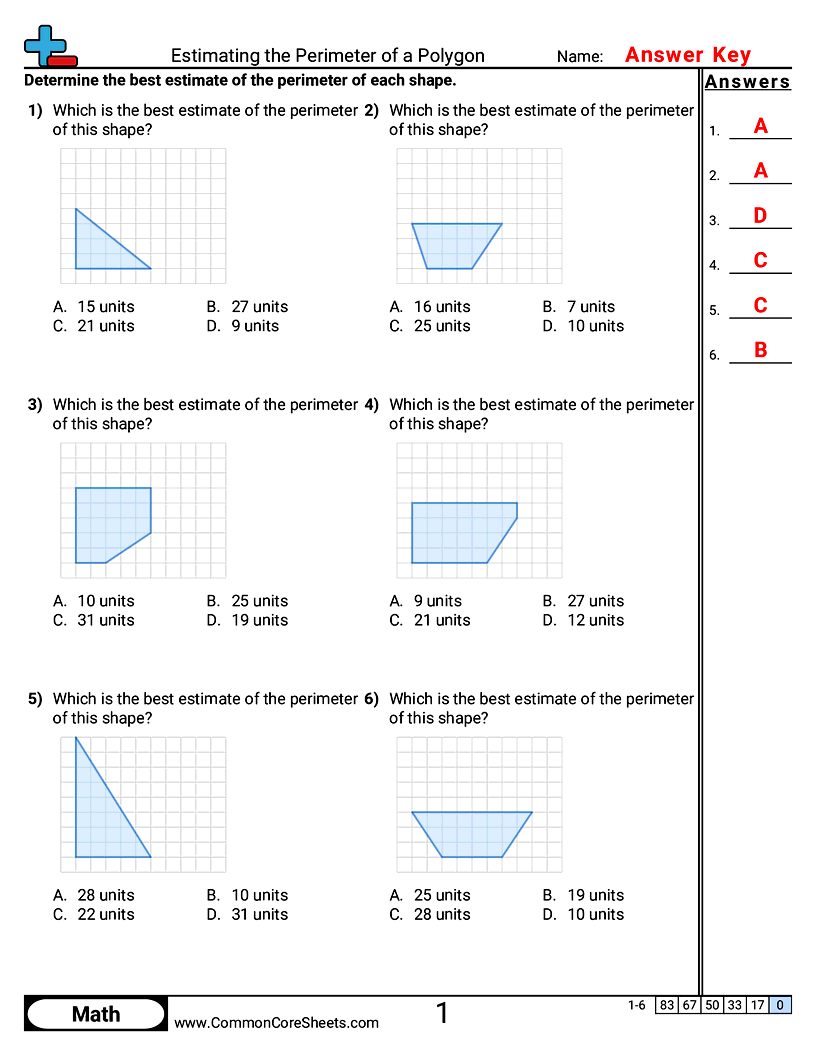
Estimate the perimeter of a polygon. Judge the length of a slanted side. Reason about a length without measuring it.
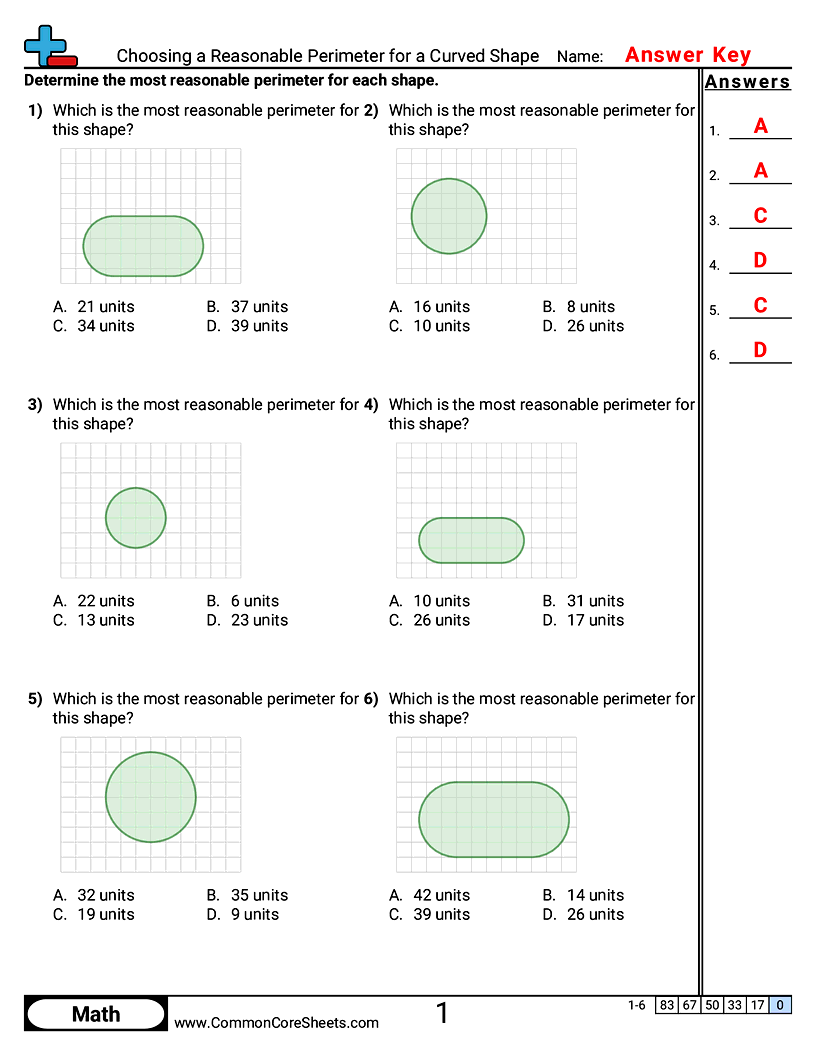
Judge a reasonable perimeter for a curved shape. Argue that a value is or is not reasonable. Compare a curve to the straight line it replaces.
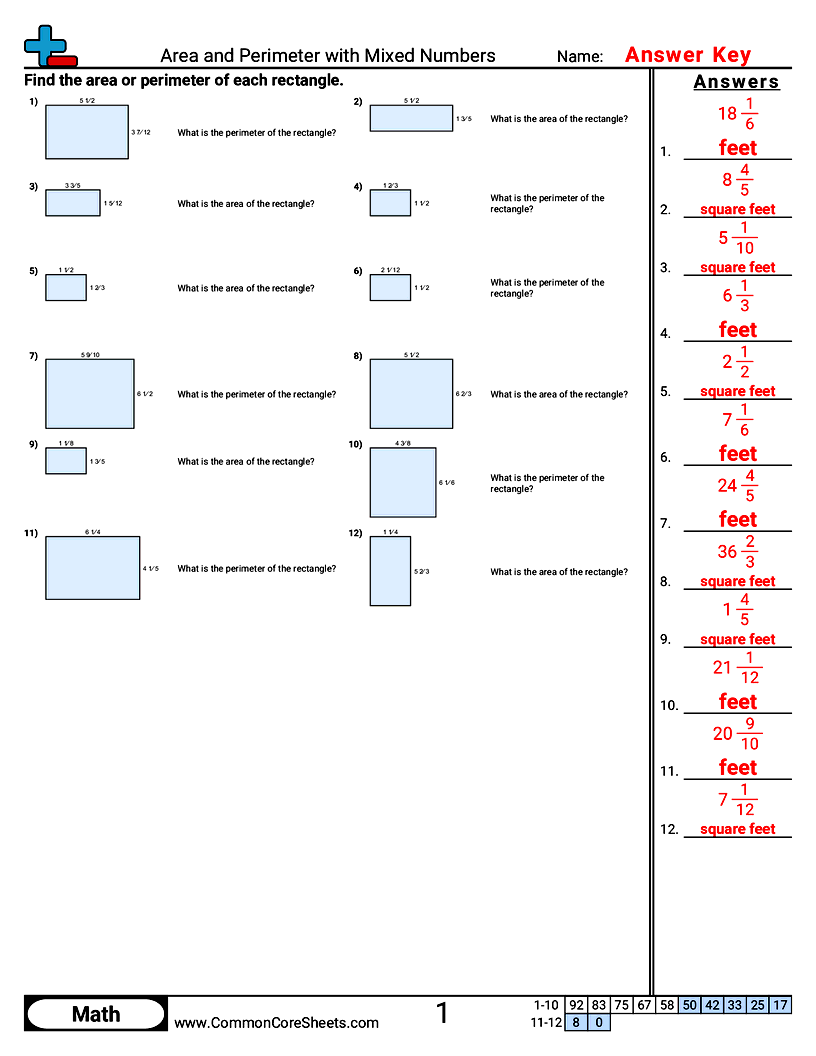
Find the area of a rectangle with mixed number sides. Find the perimeter of a rectangle with mixed number sides. Write the answer in simplest form with its unit.
6g1
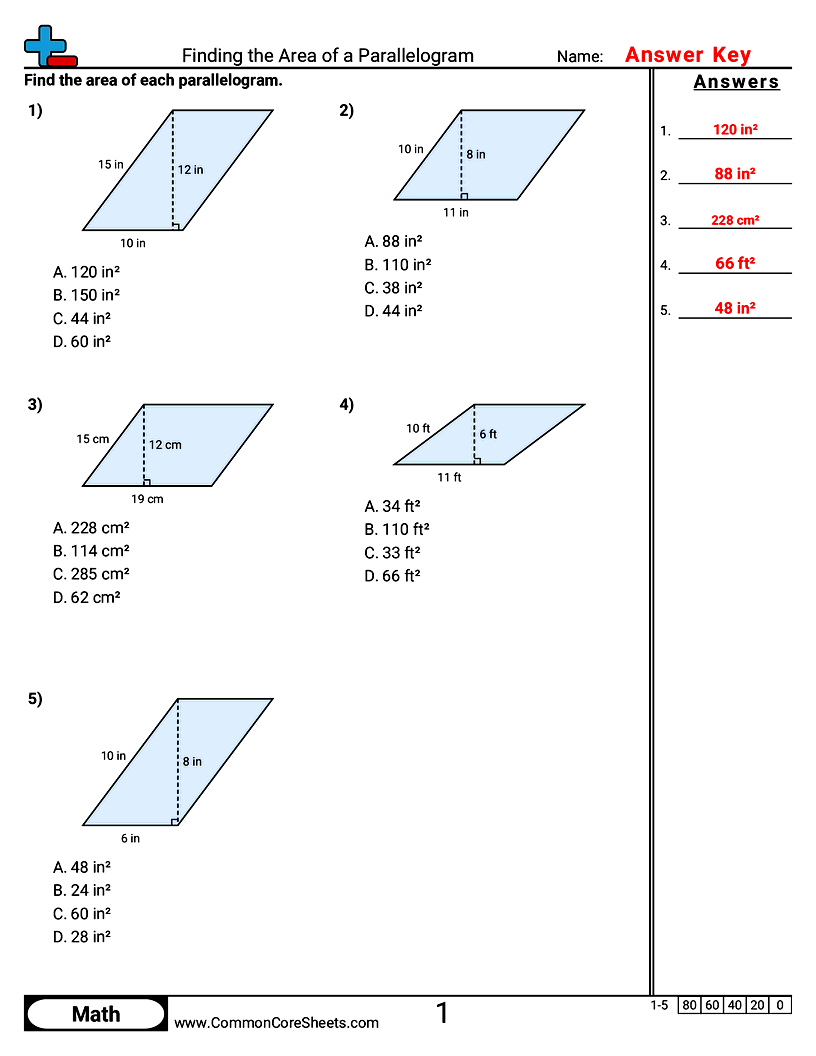
Multiply a base by a height to find an area. Use the height rather than the slant side. Write an area in square units.
6g1
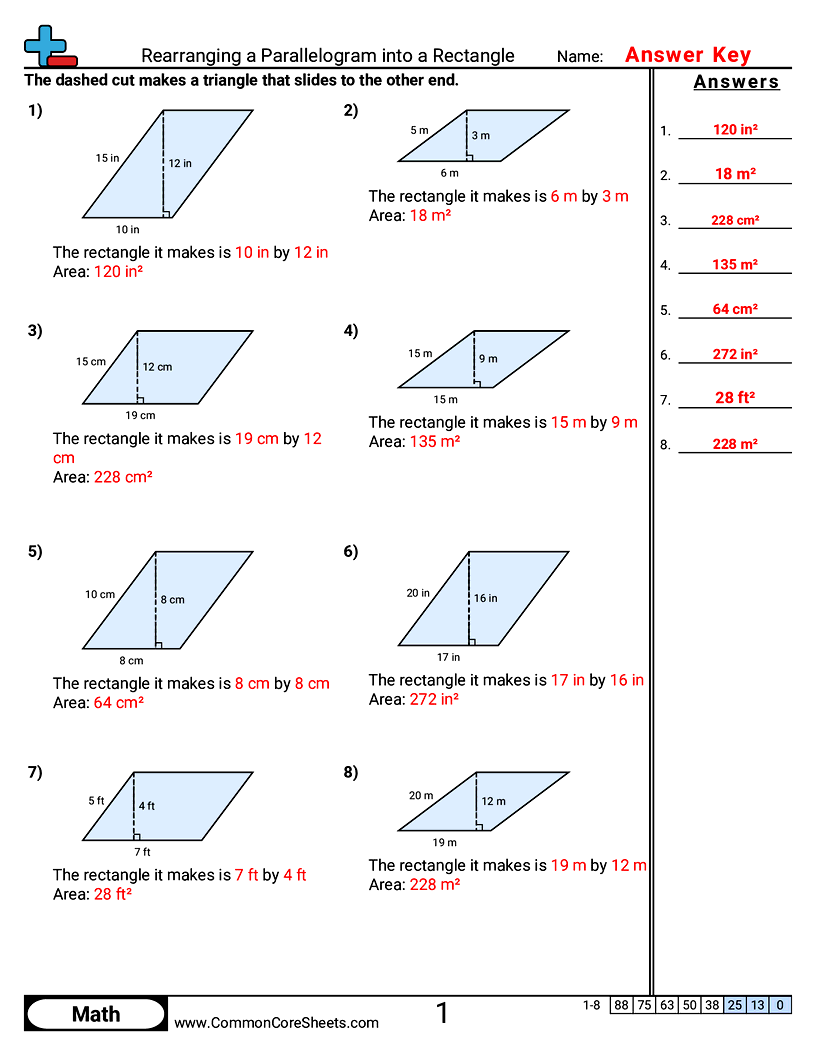
See that cutting along the height and sliding makes a rectangle. Give the rectangle its base and height. Explain why the slant side is not in the formula.
6g1
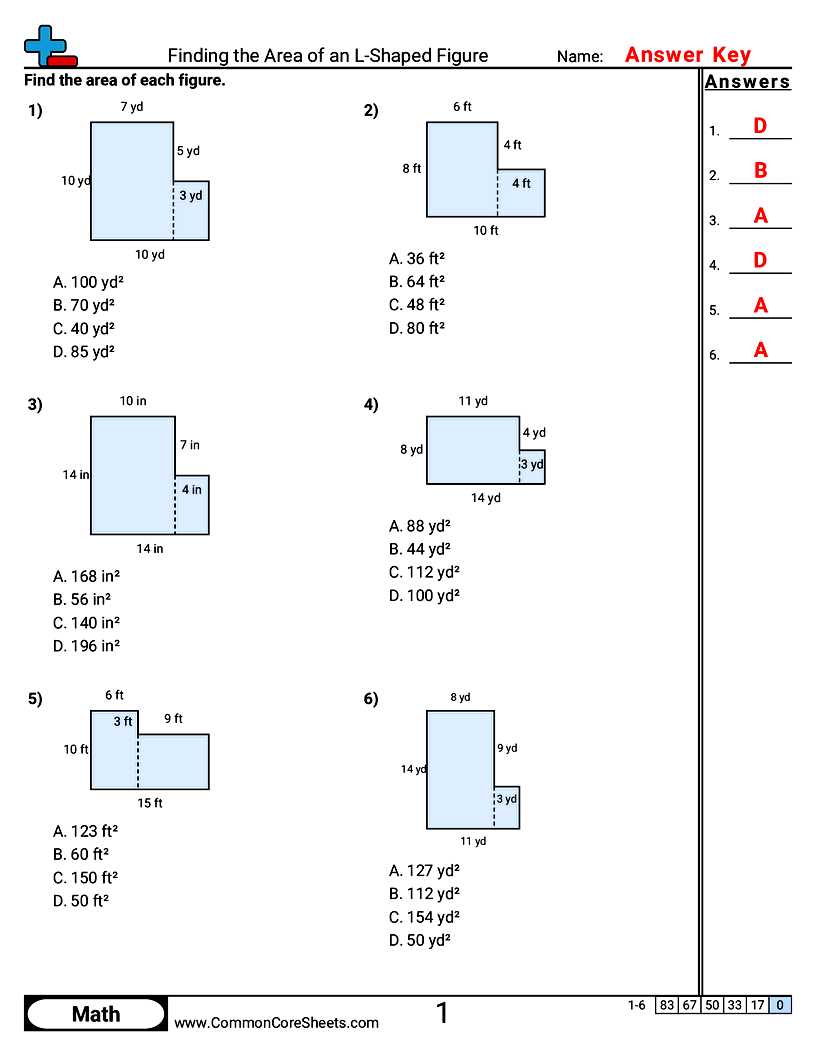
Cut an L-shaped figure into two rectangles. Work out a length that is not labelled. Add the areas of the pieces.
6g1
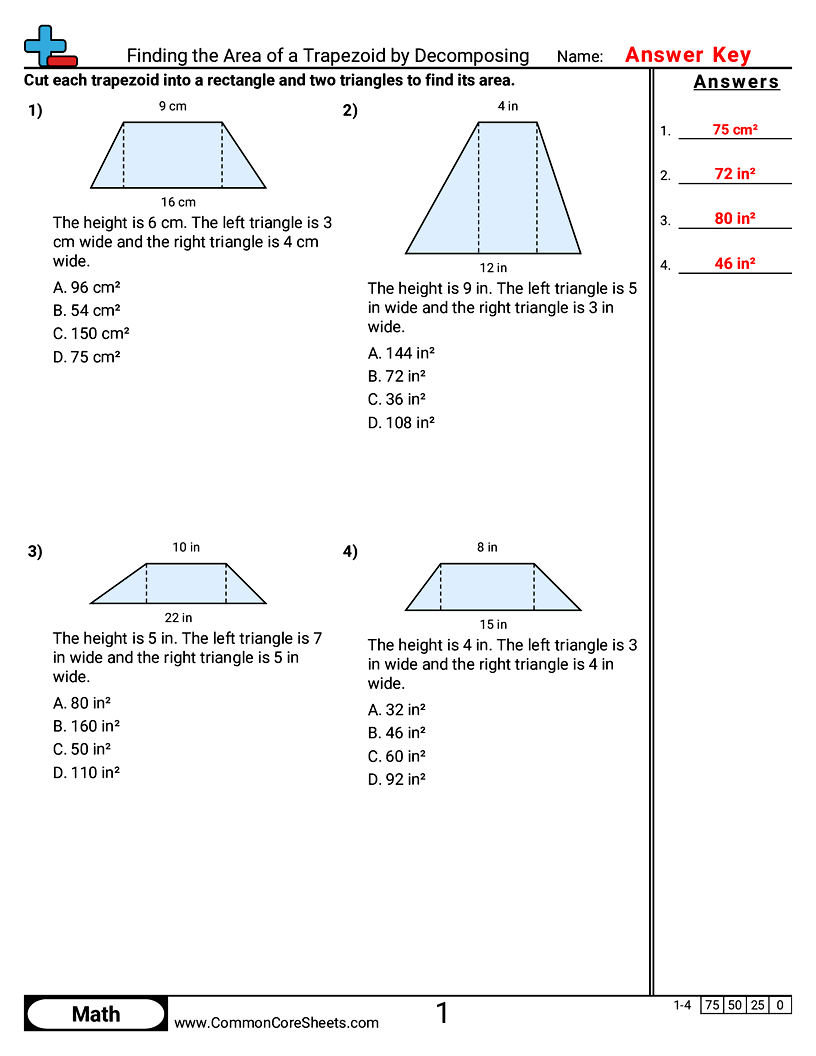
Cut a trapezoid into a rectangle and two triangles. Find the area of each piece and add them. See where the trapezoid formula comes from.
About these worksheets
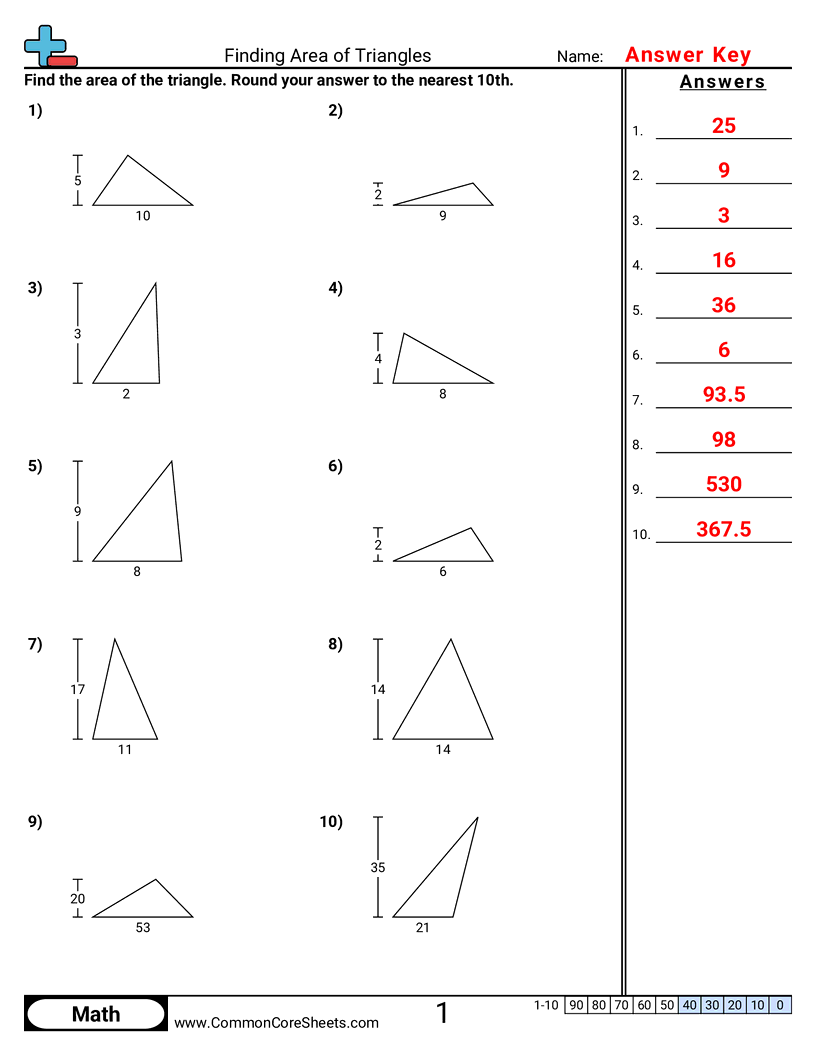
Students practice finding the area of triangles using the formula base times height divided by two. Each worksheet provides the base and height measurements, helping students identify the correct dimensions and apply the formula accurately. These worksheets are designed for sixth grade geometry.
6g1
Use the triangle area formula (base × height ÷ 2) to find area. Identify which measurements are the base and the matching height in a triangle diagram. Multiply the base and height and then divide by 2 accurately. Write the final area using square units.
6g1
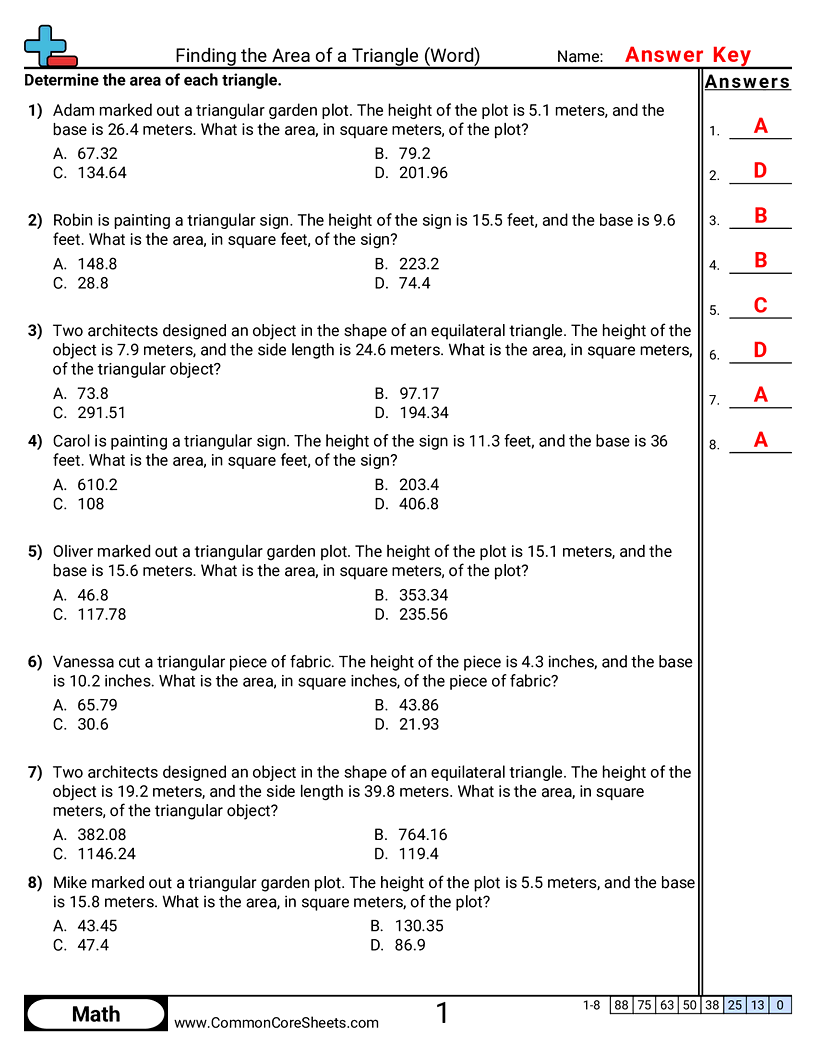
Use the formula for the area of a triangle Remember to halve the product of base and height Tell area from perimeter Work with measurements given to one decimal place
6g1
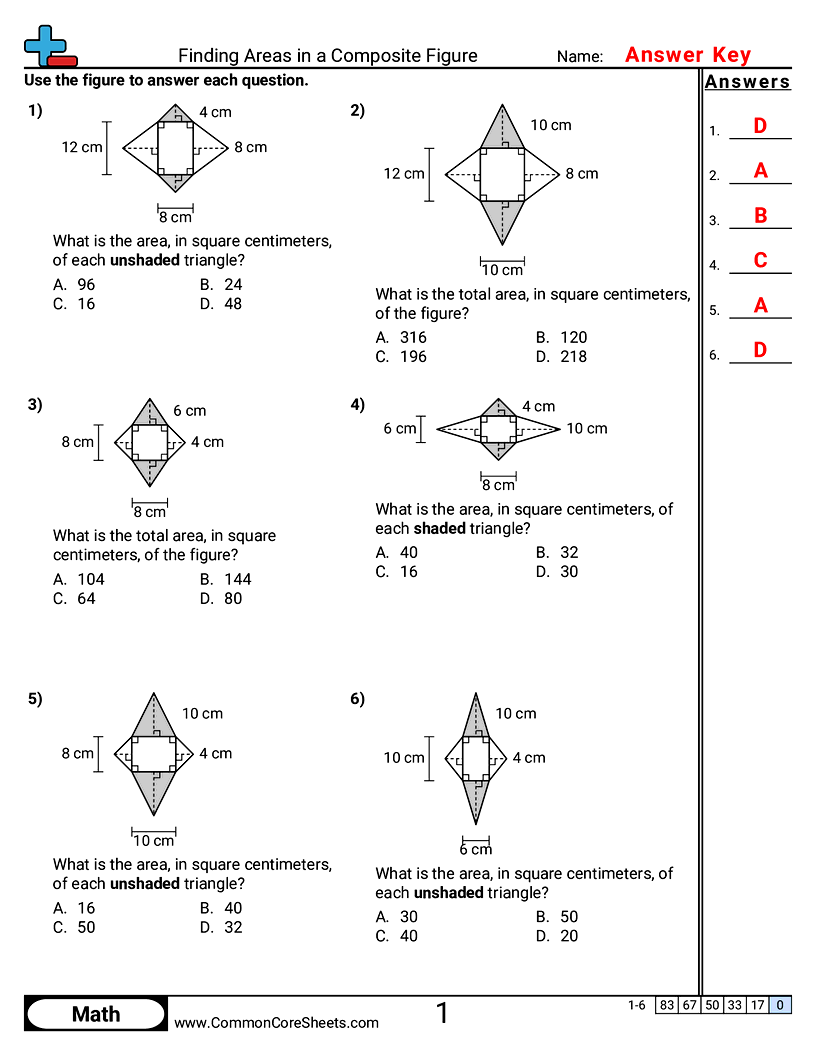
Break a figure into rectangles and triangles Pick the measurements that belong to one piece of a figure Find the area of a triangle inside a larger figure Add the parts to find a total area
About these worksheets
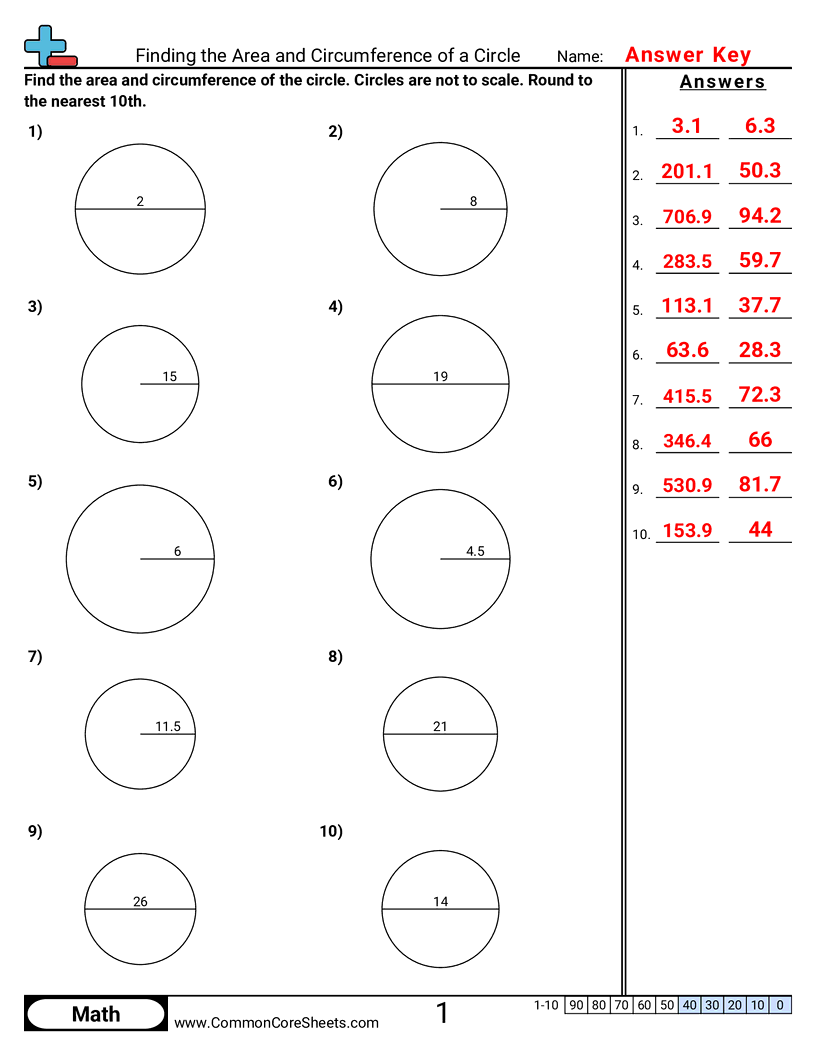
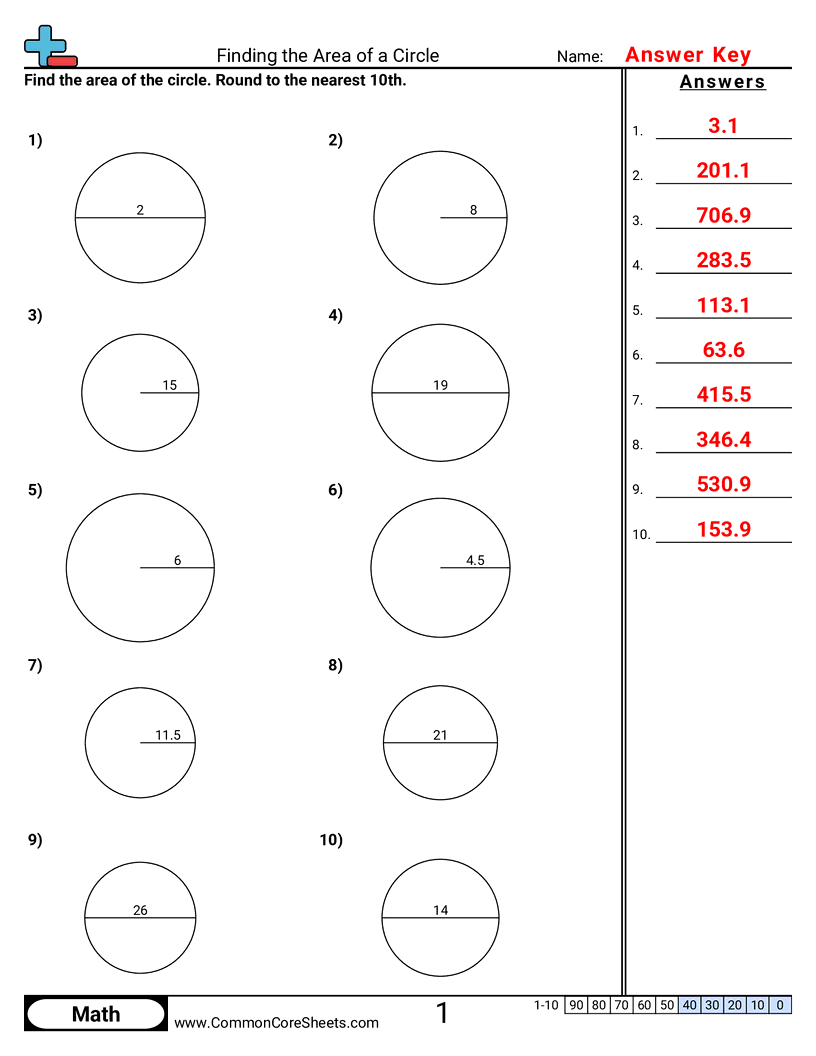
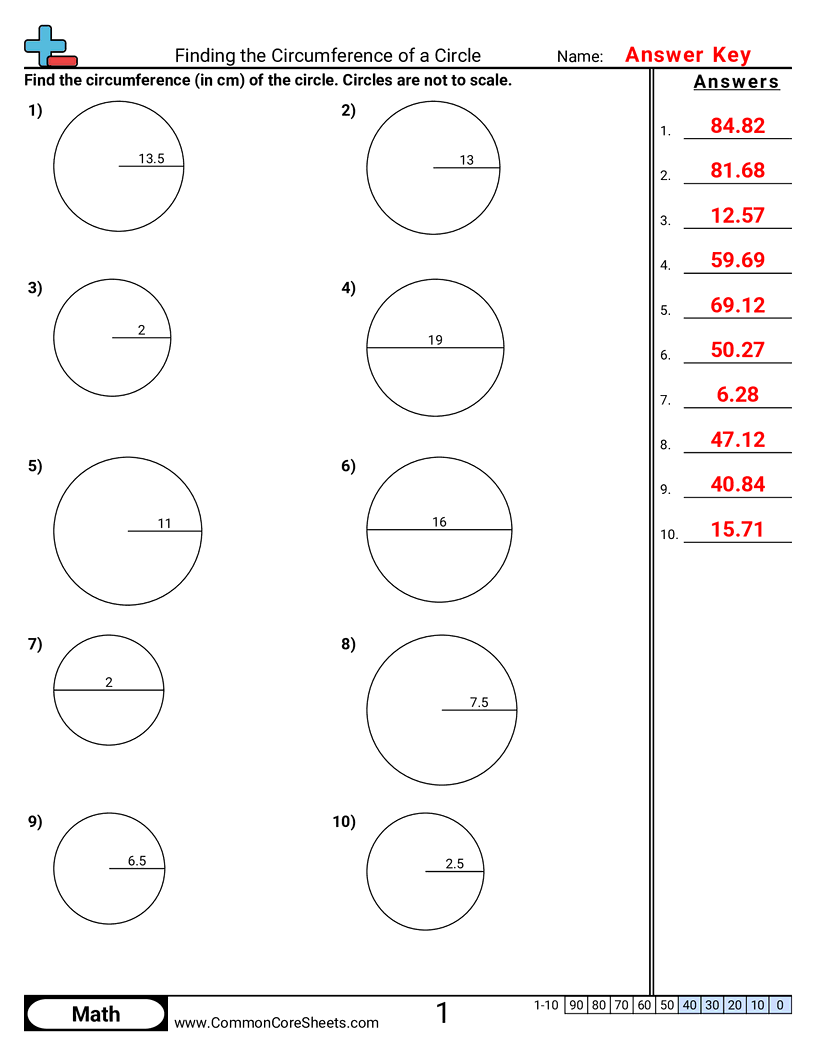
These worksheets cover the essential circle measurement formulas. Students practice finding the area using A = πr², the circumference using C = πd or C = 2πr, and solving for both in combined problem sets. Activities include working with radius and diameter values and applying pi in calculations. Aligned with seventh grade geometry standards.
7g4
Use the radius or diameter to find a circle’s circumference. Use the radius to find a circle’s area. Work with pi (π) in formulas, including using an approximate value like 3.14. Round decimal answers to the requested place value and include the correct units.
7g4
Practice finding the area of a circle using the formula A = πr² Figure out the radius by dividing the given diameter in half before calculating Round the area to the nearest tenth
7g4
Practice finding circumference using the diameter of a circle Practice finding circumference using the radius of a circle Use the value of pi in circle calculations Understand the relationship between radius, diameter, and circumference
Finding Length of a Side
Link
About these worksheets
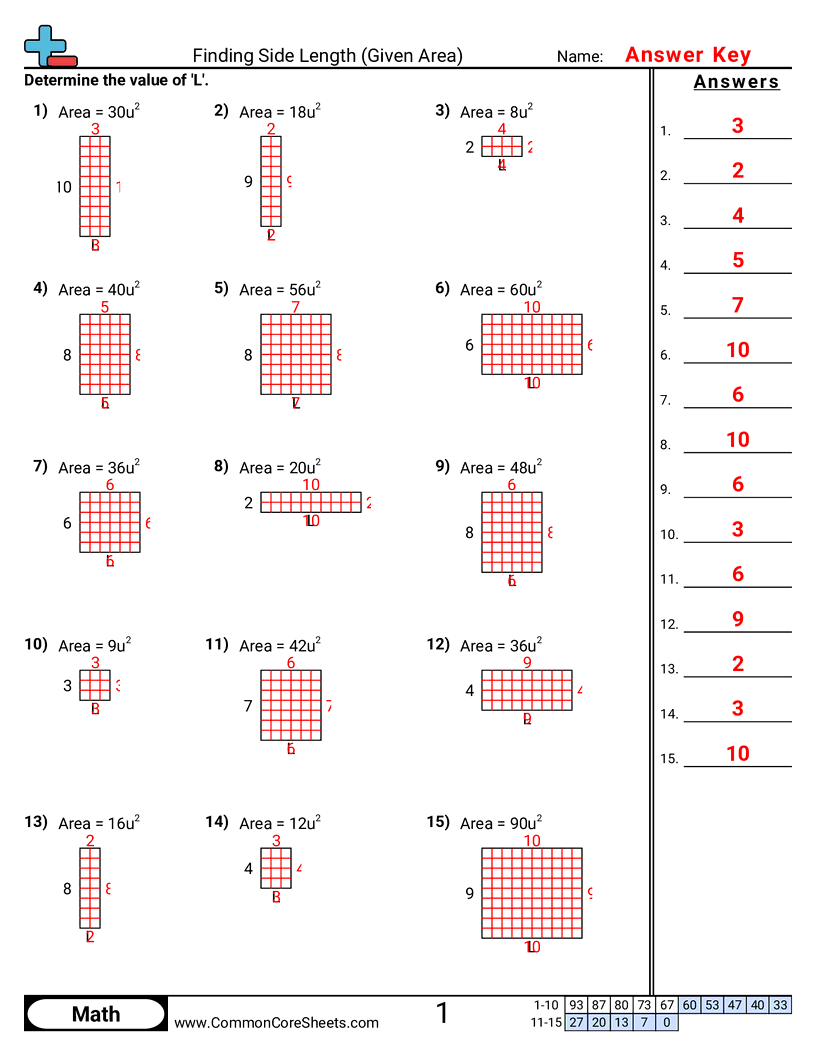
Students practice finding a missing side length of a rectangle or right triangle when given the area or perimeter. These worksheets reinforce the relationship between side lengths, area, and perimeter through reverse calculation — dividing area by a known side or subtracting known sides from a total perimeter. Problem sets span third grade through middle school, with some including decimal values.
3md8
Use the area of a rectangle to figure out a missing side length. Divide the area by the known side to find the unknown side. Check that the side lengths you found make the correct area when multiplied.
3md8
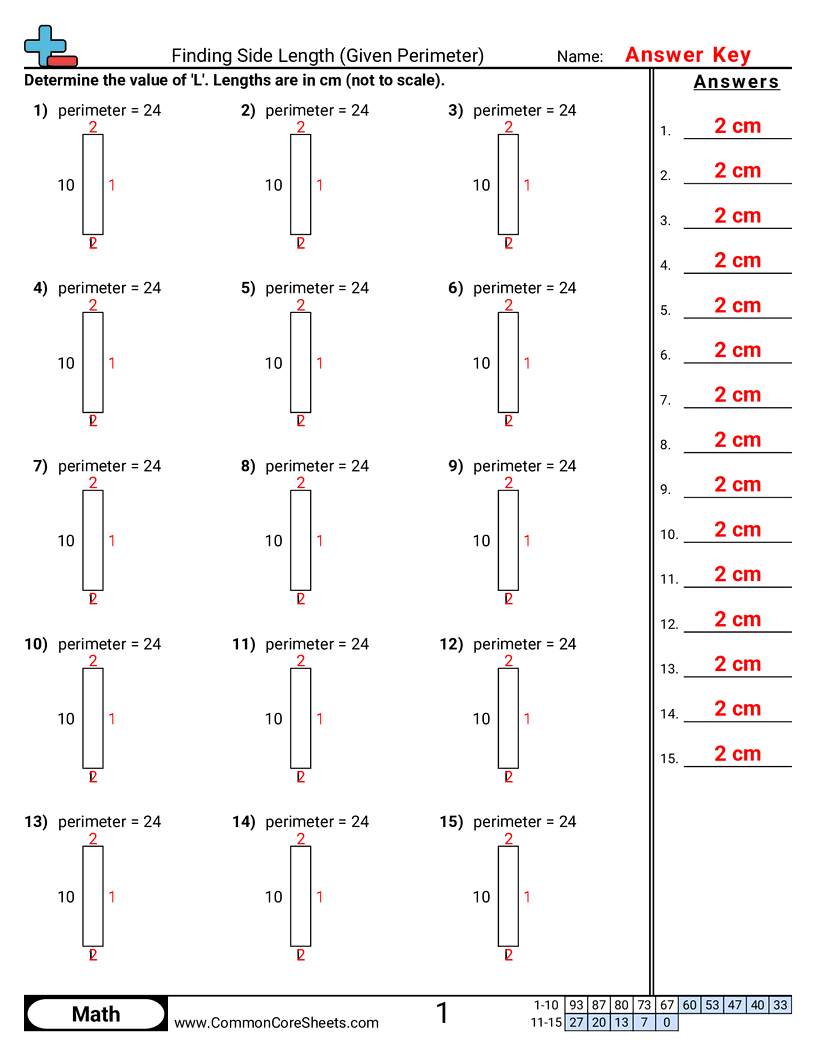
Use the perimeter of a rectangle to figure out one missing side length. Add the known side lengths and subtract from the total perimeter to find what is left. Use the fact that opposite sides of a rectangle are equal to solve for the unknown side. Write the answer with the correct measurement units.
4md3
Find a missing side length of a rectangle when you know the area and one side. Use multiplication and division to connect side lengths and area of rectangles.
6g1
Use the area of a rectangle to figure out a missing side length. Multiply and divide with decimals to solve for an unknown side. Keep track of units (like square units vs. units) so the answer makes sense. Read a rectangle diagram and match each number to the correct side.
6g1
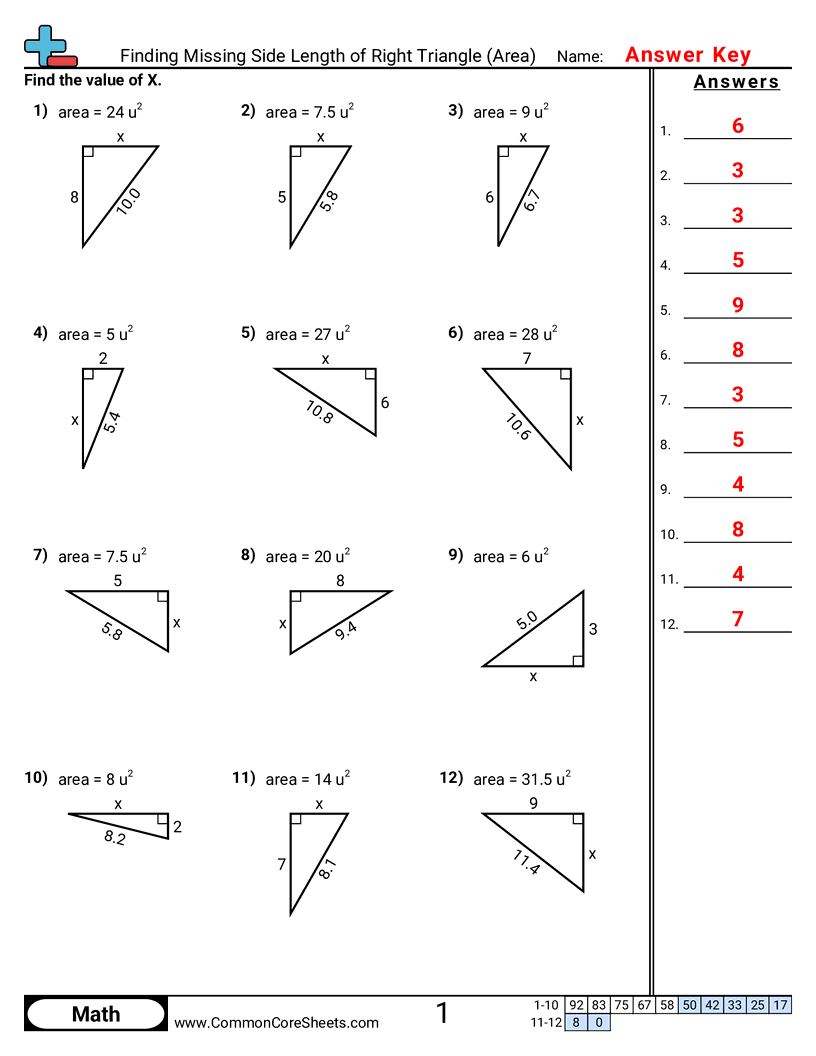
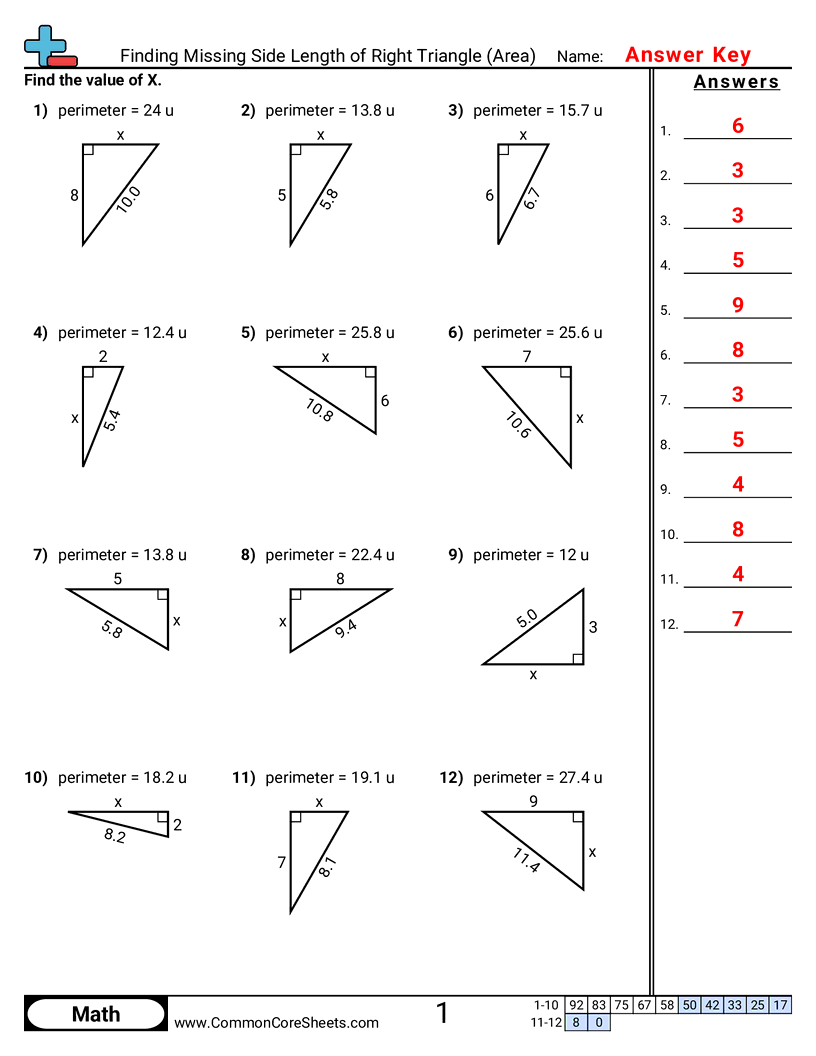
Use the area formula for a right triangle to find a missing side length. Solve for the unknown base or height when the area and the other leg are given.
6g1
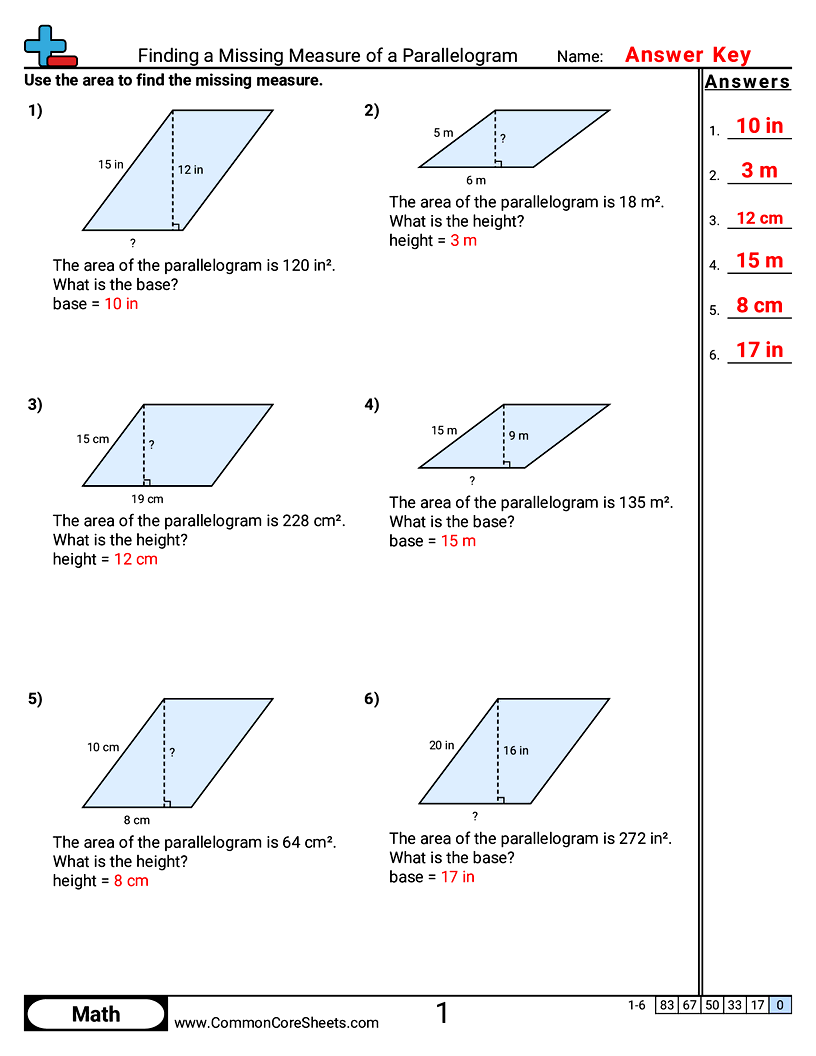
Divide an area by a base to find a height. Divide an area by a height to find a base. Ignore a measurement that is not needed.
Finding Area & Perimeter (words)
Link
About these worksheets
These worksheets present area and perimeter concepts through word problems and three-dimensional shapes. Students read real-world scenarios to determine whether they need to calculate area or perimeter of rectangles, and they find the surface area of prisms and other 3D figures by adding up the areas of each face. Aligned with fourth and sixth grade standards.
4md3
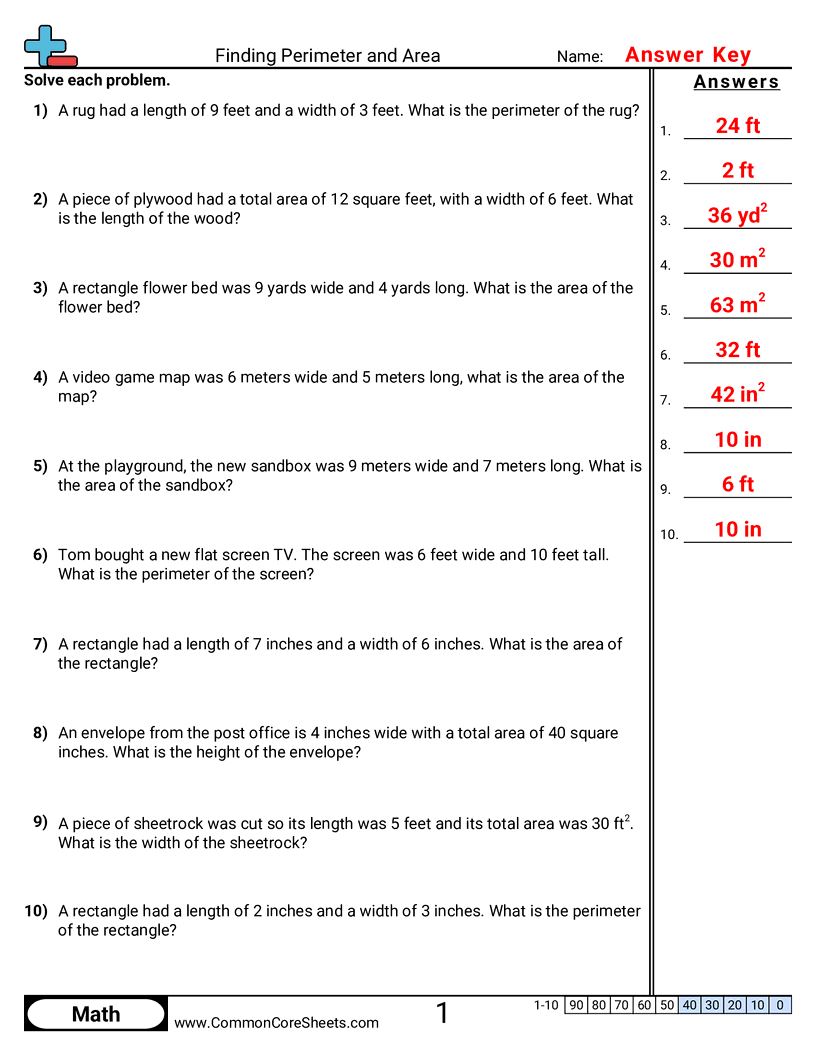
Read a word problem and decide whether it is asking for perimeter or area. Find the perimeter of rectangles by adding side lengths. Find the area of rectangles using length × width and square units. Use the correct units when writing answers (units for perimeter and square units for area). Solve real-world measurement situations like fencing, borders, tiling, or covering a surface.
6g4
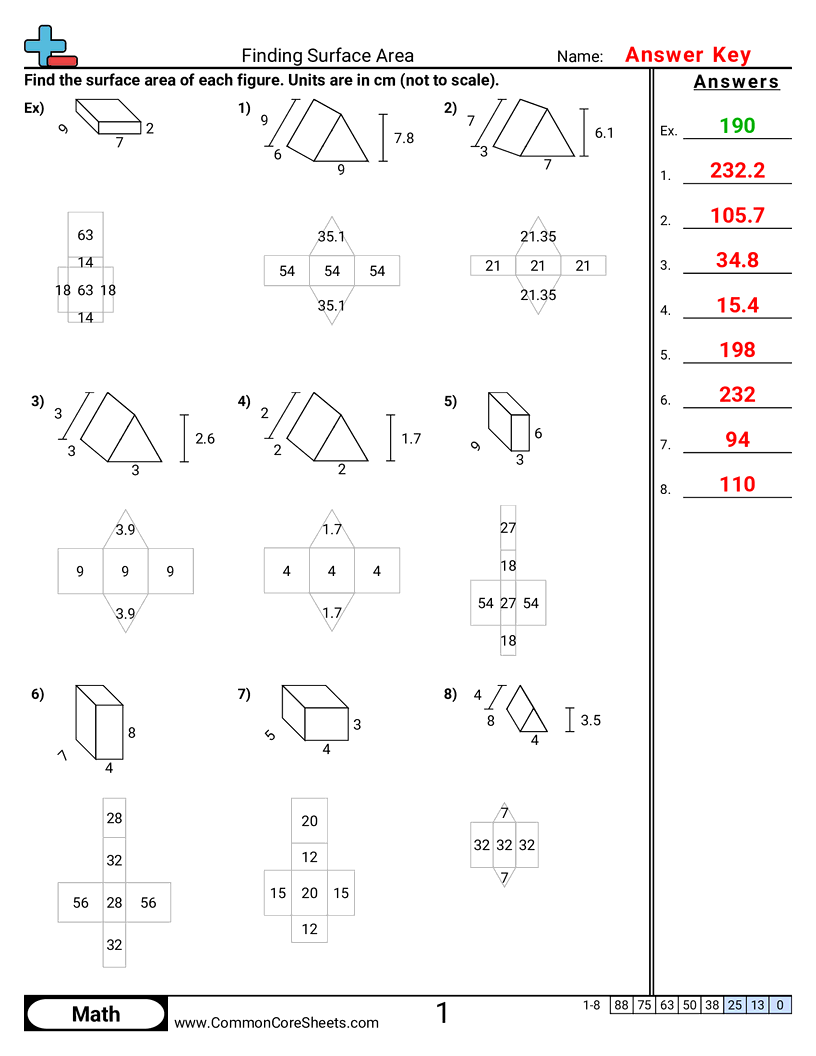
Find the surface area of a 3D shape by adding up the areas of all its faces. Use a net or picture of a prism to count faces and match the right measurements to each face. Calculate the area of rectangles and triangles to get the area of each face.
3md7b
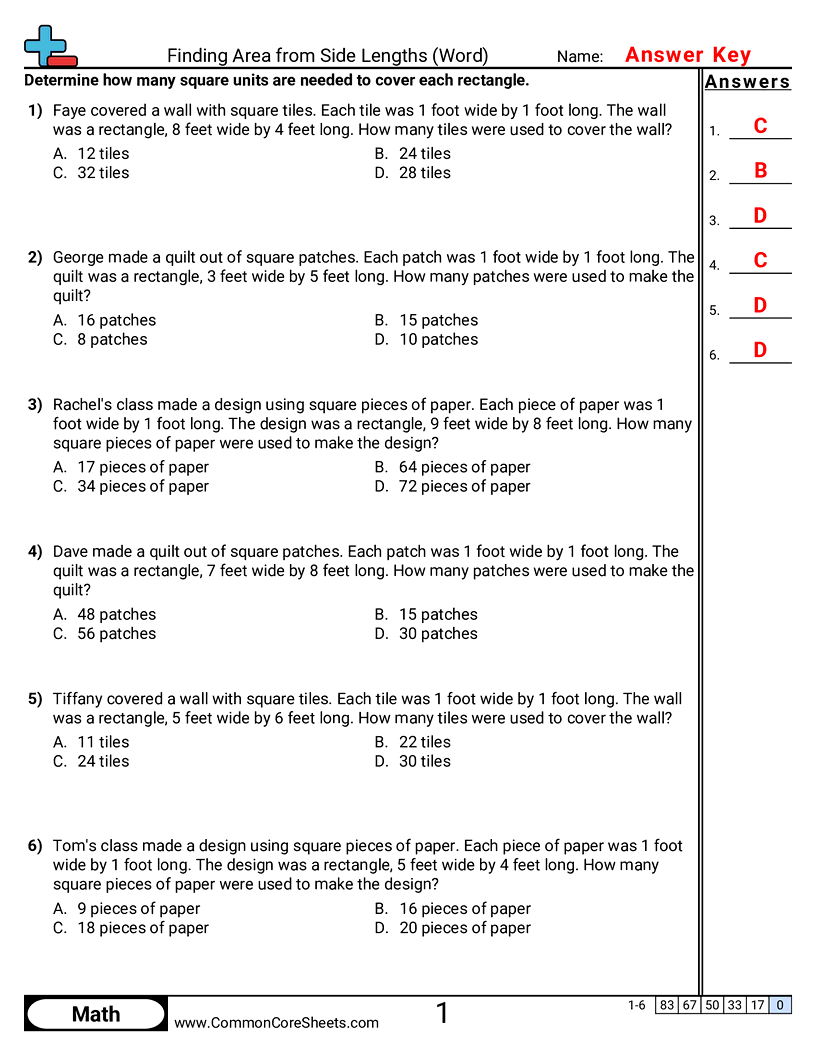
Find the area of a rectangle by multiplying its length by its width Pull the length and width numbers out of a word problem Practice multiplication facts while solving area problems Understand that area is measured in square units
4md3
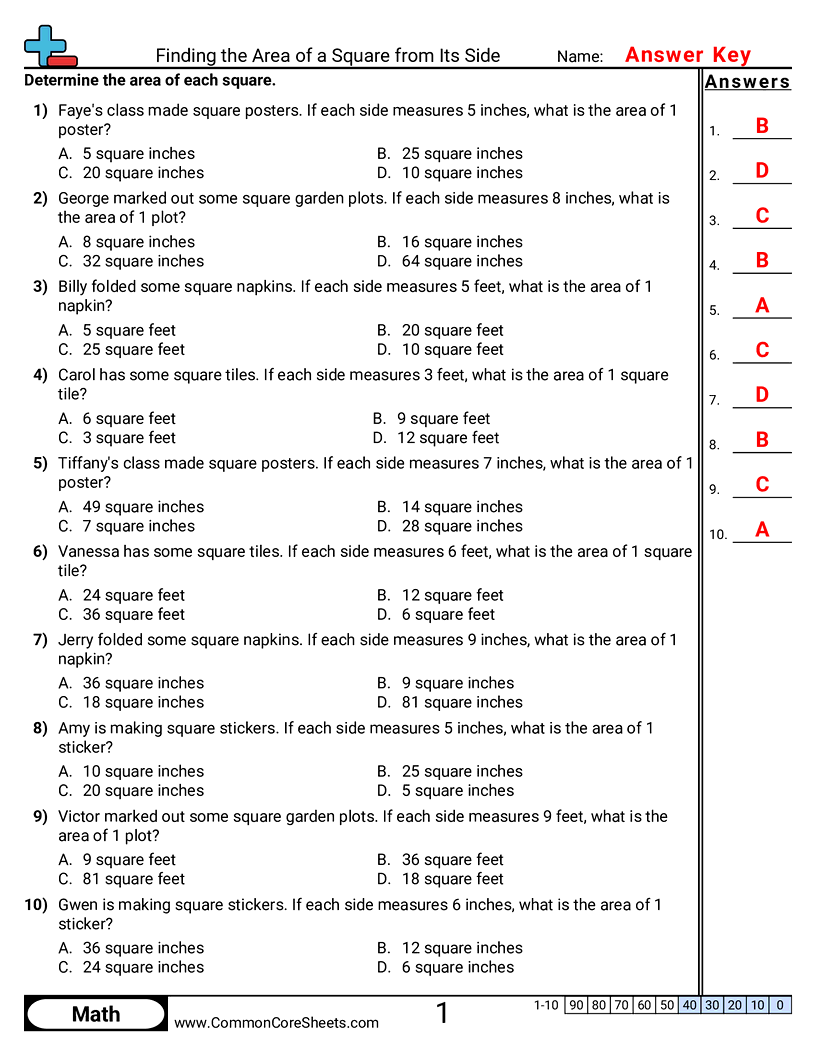
Find the area of a square from one side Tell the area formula from the perimeter formula Use square units for an area Read a side length out of a word problem
Playwire Advertisement