Identifying Lines of Symmetry in Shapes Worksheet Download
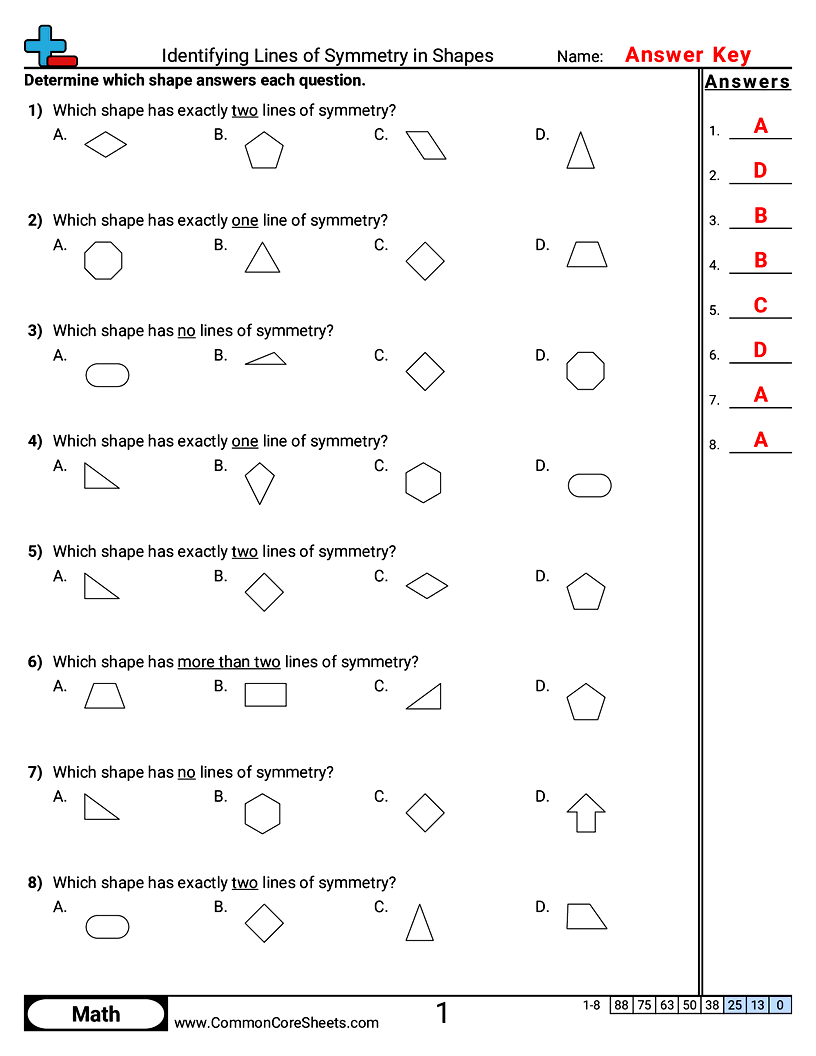
The shapes come from a new helper written for this sheet, because the site's shape library holds only REGULAR shapes and a symmetry question is built from the irregular ones - the parallelogram, the kite, the scalene triangle and trapezoid are the shapes that have none or one. The four choices always come from four different shape families and have four different symmetry counts, so a question never offers an isosceles trapezoid against a scalene one: they differ by a few pixels of slant at this size, and the question would be unfair however correct the mathematics is. The figures are drawn squarely rather than turned, because a square tipped 45 degrees reads as a diamond and invites an argument about the reader's orientation rather than the figure.


Sheet Information >
About this worksheet
Four shapes are drawn and students pick the one with no lines of symmetry, or the one with exactly one.
Student objectives
- Count the lines of symmetry in a two-dimensional shape
- Recognize a shape that has no line of symmetry
- Recognize a shape with exactly one line of symmetry
- Compare shapes by their symmetry rather than their name
Everyday practice
- Fold a piece of paper to check if a drawing looks the same on both sides
- Notice symmetry in letters like A, H, and M when writing
- Spot matching halves in a butterfly, snowflake, or leaf
- Decide where to fold a paper heart so both sides are even