Classifying Quadrilaterals Worksheet Download
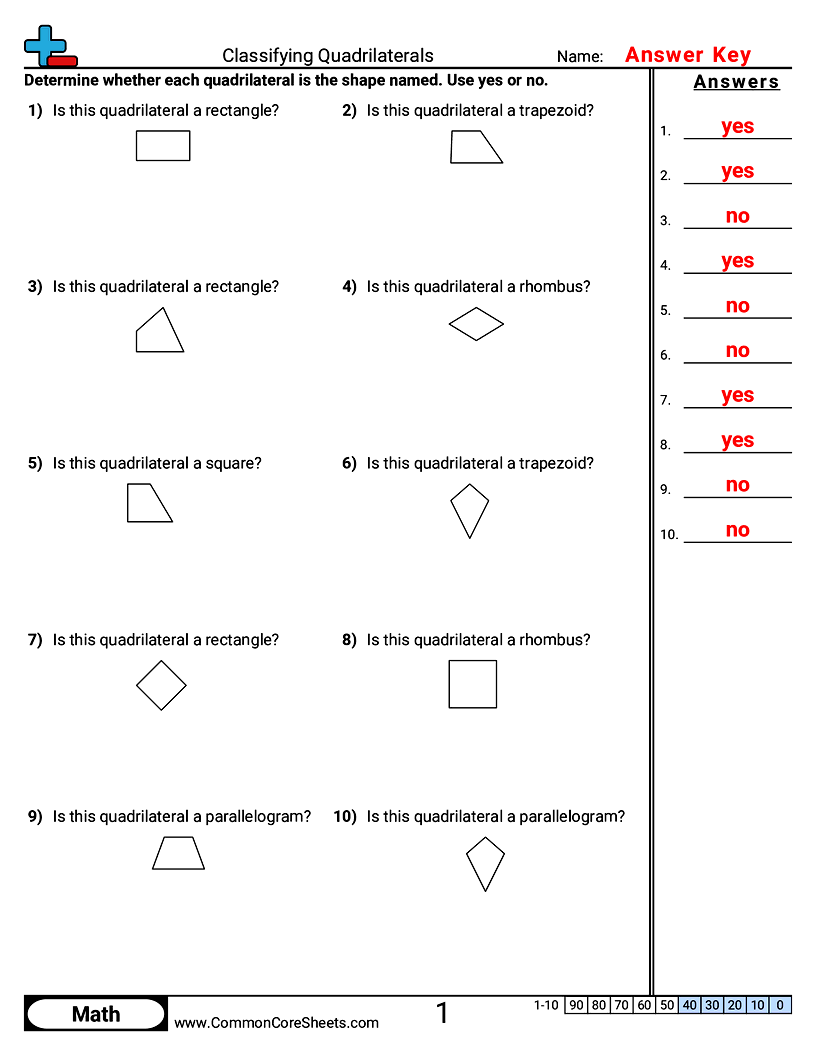
Free 4th Grade (5g3) math worksheets on Classifying Quadrilaterals. Each worksheet has 10 problems with an answer key and are ideal for teachers and homeschooling. You can download the PDF, create a set of flash cards or set it up for online learning.


Sheet Information >
About this worksheet
Each worksheet has 10 problems deciding whether a quadrilateral is a square, rectangle, rhombus, parallelogram, trapezoid or kite.
This worksheet names a quadrilateral type and asks whether the shape shown is one. Classification is inclusive, so a square answers yes to rectangle, rhombus and parallelogram - the hierarchy is the interesting part of the skill, and a child who thinks square and rectangle are separate boxes is exactly who this is for. Every shape is judged by measuring its sides, parallel pairs and right angles rather than by what it is called, and the two words that textbooks define differently, trapezoid and kite, are never paired with a shape where the two definitions disagree. Sheets can be customized, turned into flash cards, or assigned for online learning.
Student objectives
- Decide whether a quadrilateral is a square, rectangle, rhombus, parallelogram, trapezoid or kite.
- Use side lengths, parallel sides and right angles to classify a shape.
- Recognize that a square is also a rectangle, a rhombus and a parallelogram.
Everyday practice
- Find a rectangle in the room that is also a square, and one that is not.
- Sort cut-out quadrilaterals into piles by how many pairs of parallel sides they have.
- Explain why every square is a rectangle but not every rectangle is a square.