6th Grade Algebra Worksheets
Our 6th Grade Algebra Worksheets provide comprehensive practice with essential algebraic concepts through 26 different worksheet types. Students will master substitution, inequalities, number line representations, and expression manipulation skills that build the foundation for advanced mathematics.
More about these worksheets ▾ Show less ▴
Grade & filters: 6th Grade ▾
×
About these worksheets
These worksheets introduce students to the concept of variables and algebraic thinking. Activities include using substitution to evaluate expressions, writing and graphing inequalities on a number line, identifying numerical coefficients, solving for unknown values using all four operations, and exploring powers, bases, and slope. Aligned with sixth through eighth grade standards, these resources build the foundation for pre-algebra and algebra.
6ee5
Replace a variable with a given number and simplify the expression. Use substitution to find the value of an unknown in an equation. Check whether a number makes an equation true by substituting it in.
6ee6
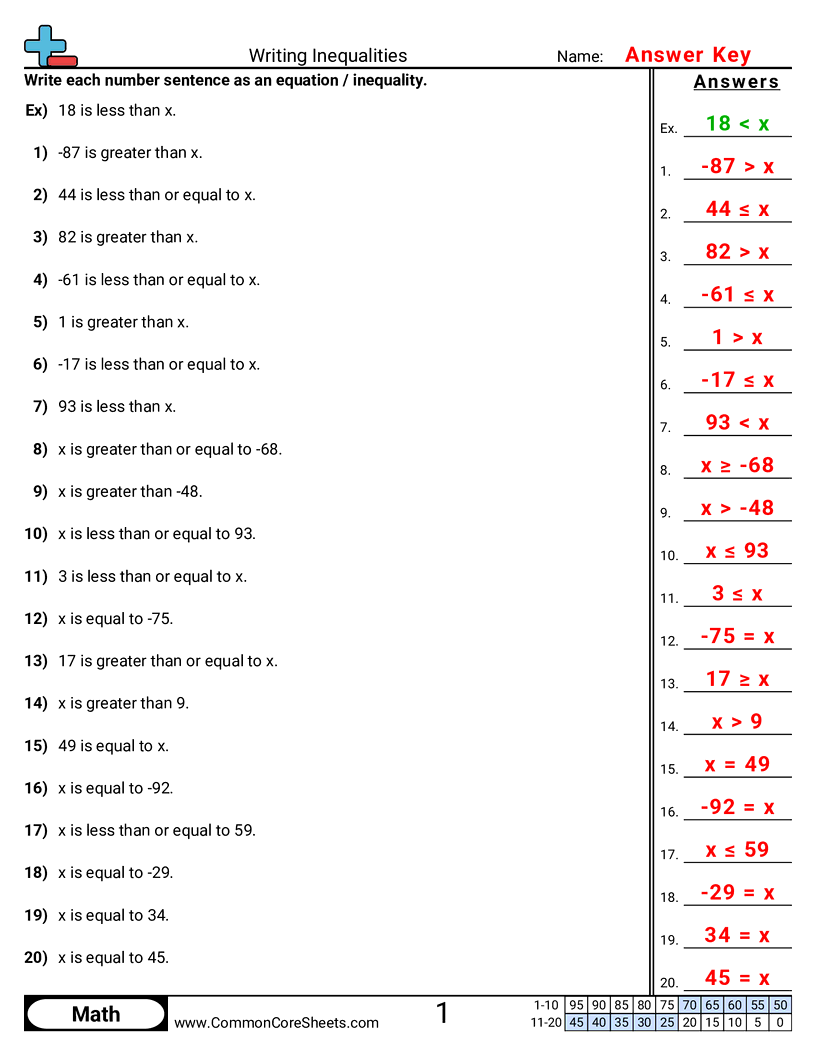
Choose the correct inequality symbol (>, <, ≥, ≤) based on what the sentence says. Write an inequality from a short word problem using a variable to represent the unknown number.
6ee8
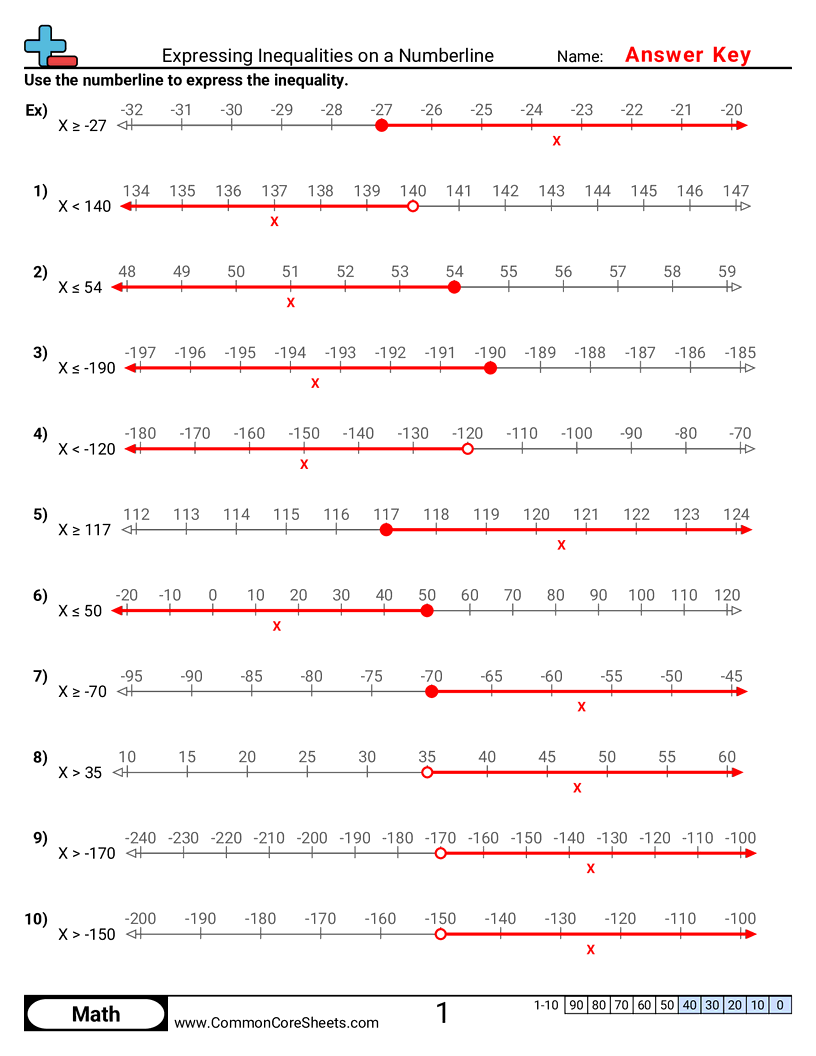
Read an inequality sign (>, <, ≥, ≤) and say what values it allows. Graph an inequality on a number line by choosing an open or closed circle and shading the correct direction.
6ee8
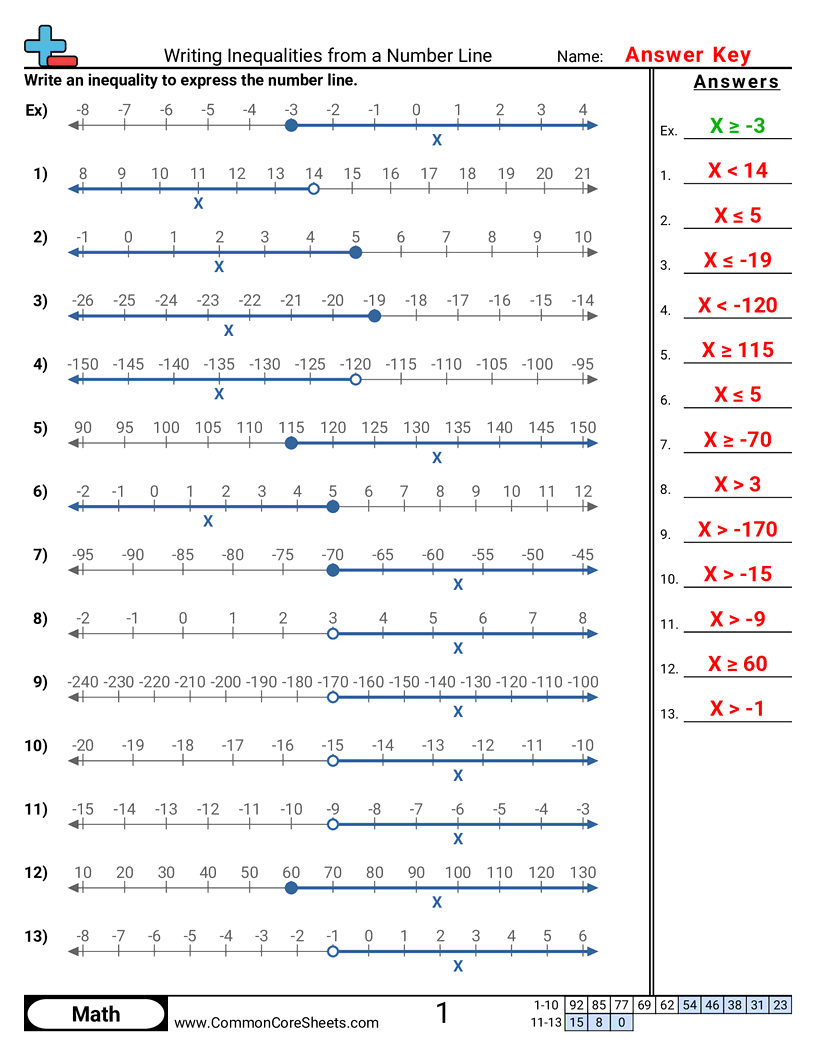
Decide whether an endpoint should be written with < or > versus ≤ or ≥ by noticing open and closed circles. Write the correct inequality (like x > 3 or x ≤ -2) to match the direction of the shading.
6ee8
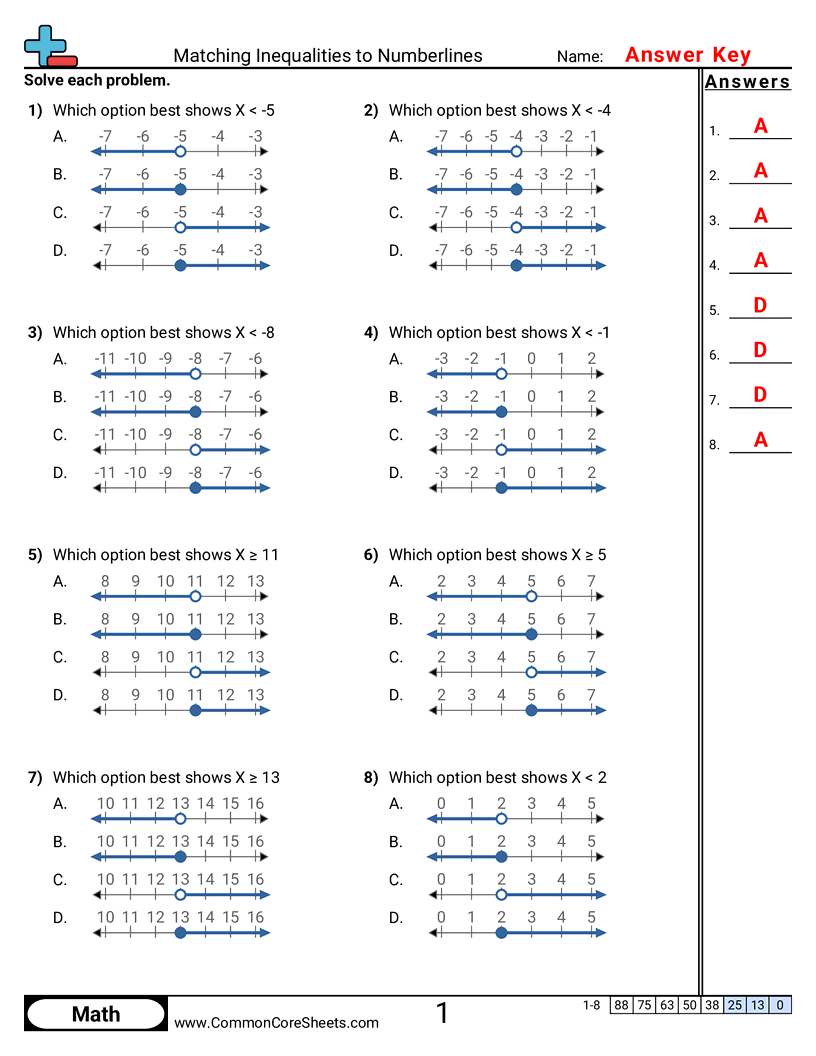
Match an inequality to the correct number line graph. Use open and closed circles to decide whether the endpoint number is included. Use the shaded direction on a number line to tell if the solutions are greater than or less than a value.
6ee7
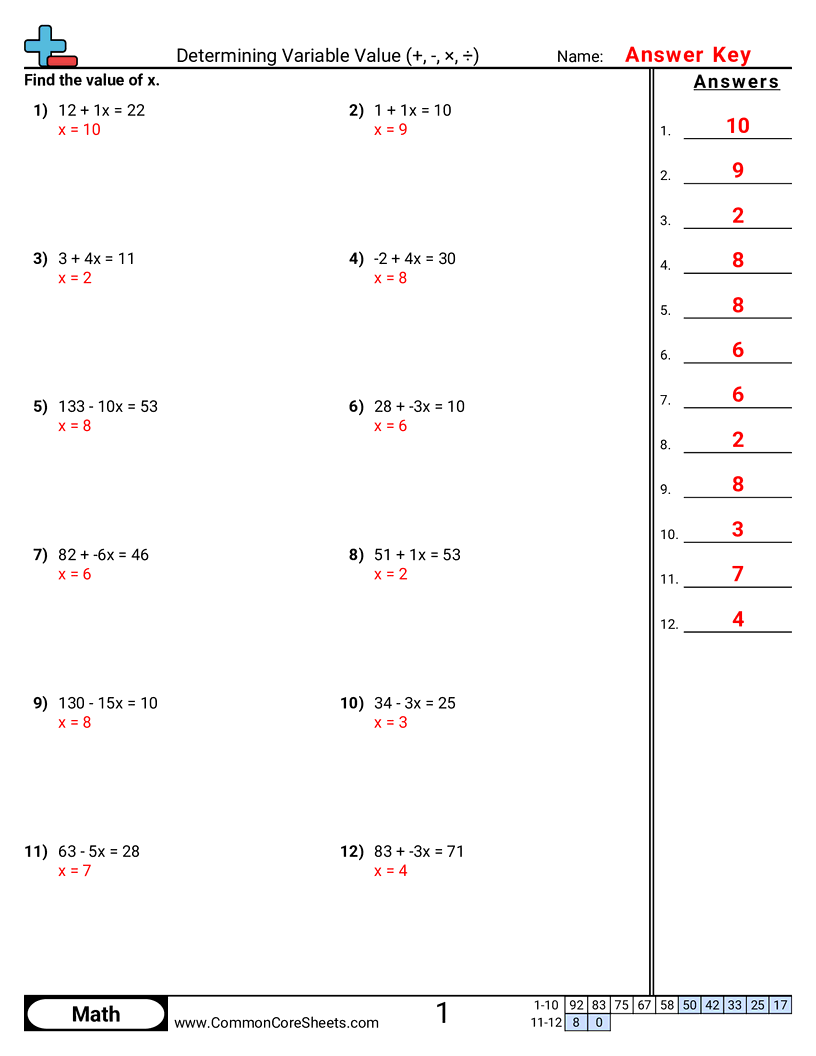
Solve simple equations to find the missing number or letter. Work with equations written in a horizontal format (like x + 7 = 15). Check that the value you found makes the equation true when you plug it back in.
6ee3
Rewrite an equation in a different order or grouping without changing its value. Use the distributive property to expand or factor expressions to make an equivalent equation.
6ee8
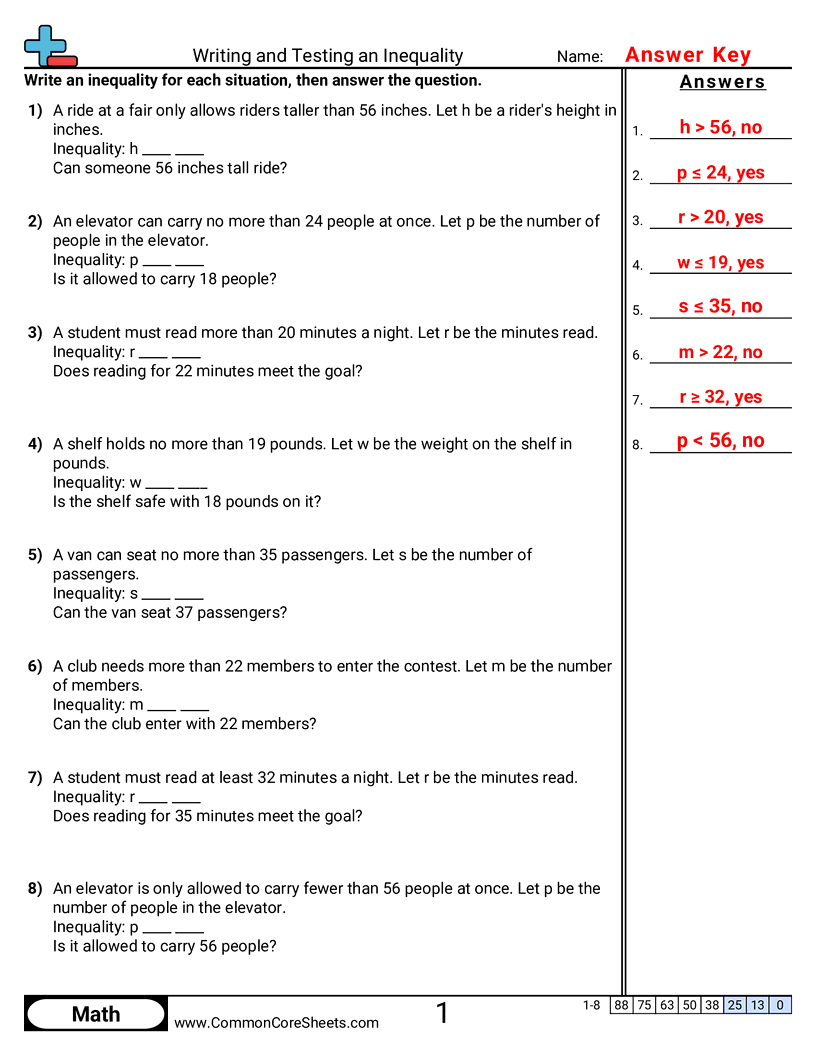
Translate a comparison in words into an inequality Tell more than from at least, and fewer than from no more than Choose the right inequality symbol for a situation Use a variable to stand for an unknown quantity
6ee5
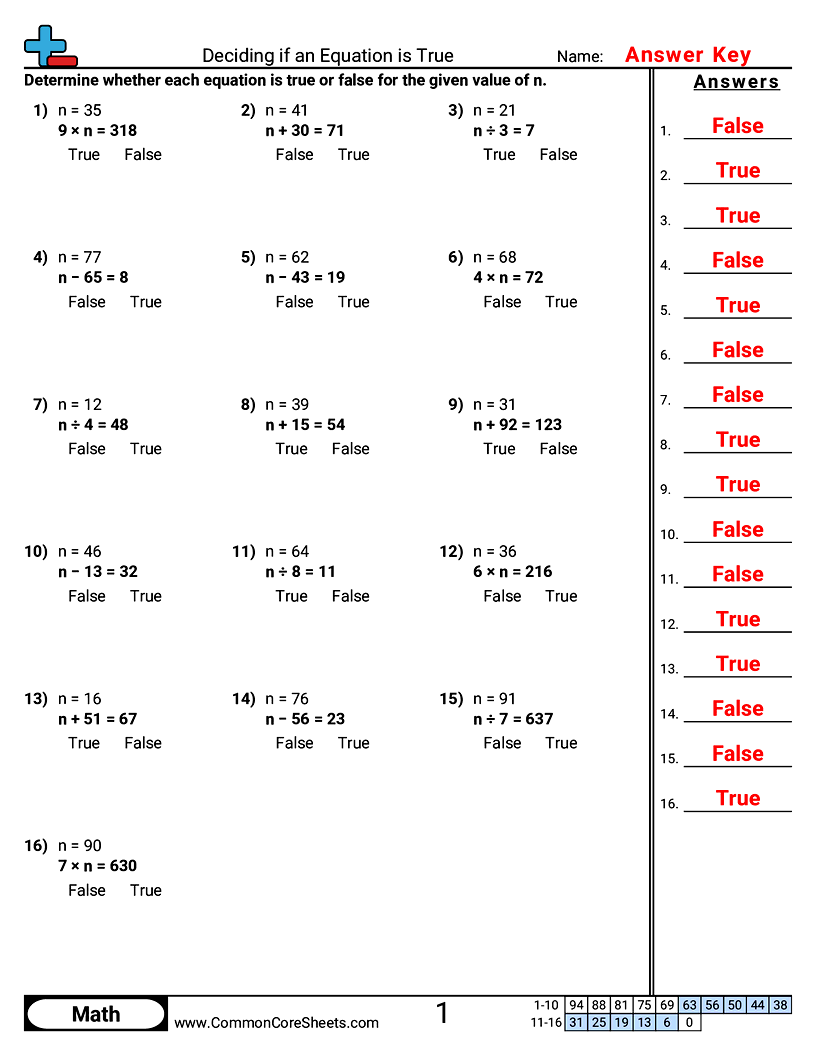
Substitute a value for a variable. Decide whether an equation is true. Evaluate an expression with one operation.
6ee5
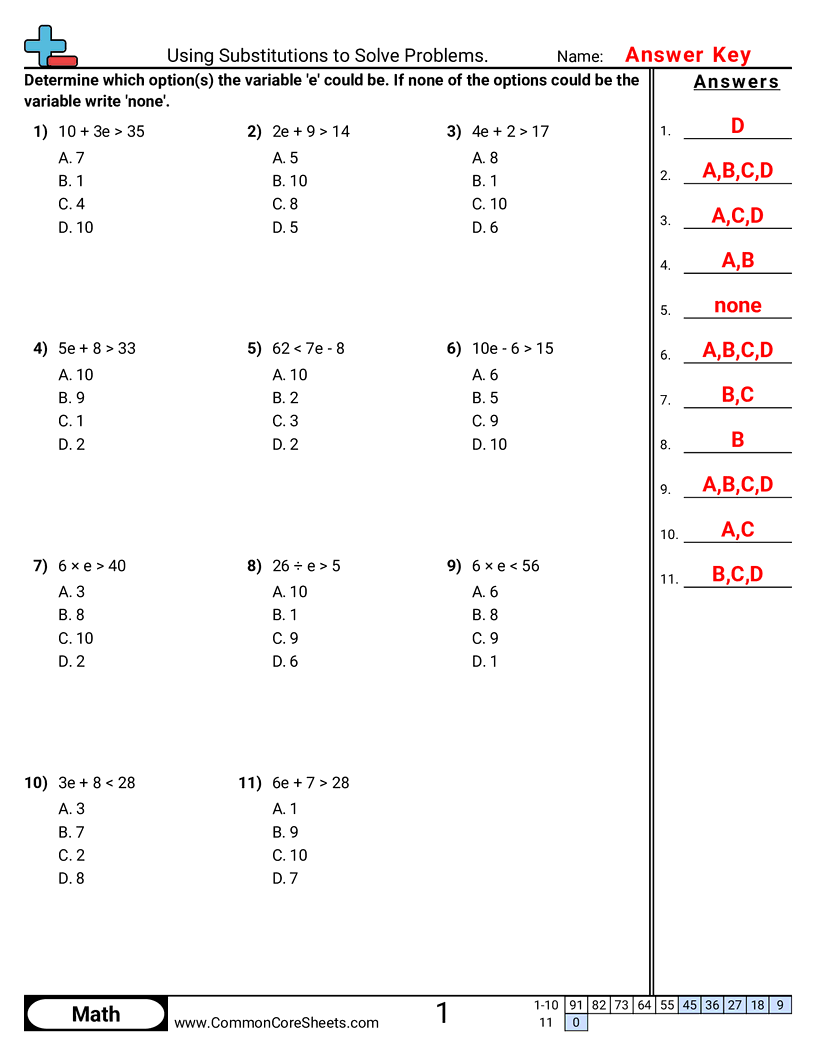
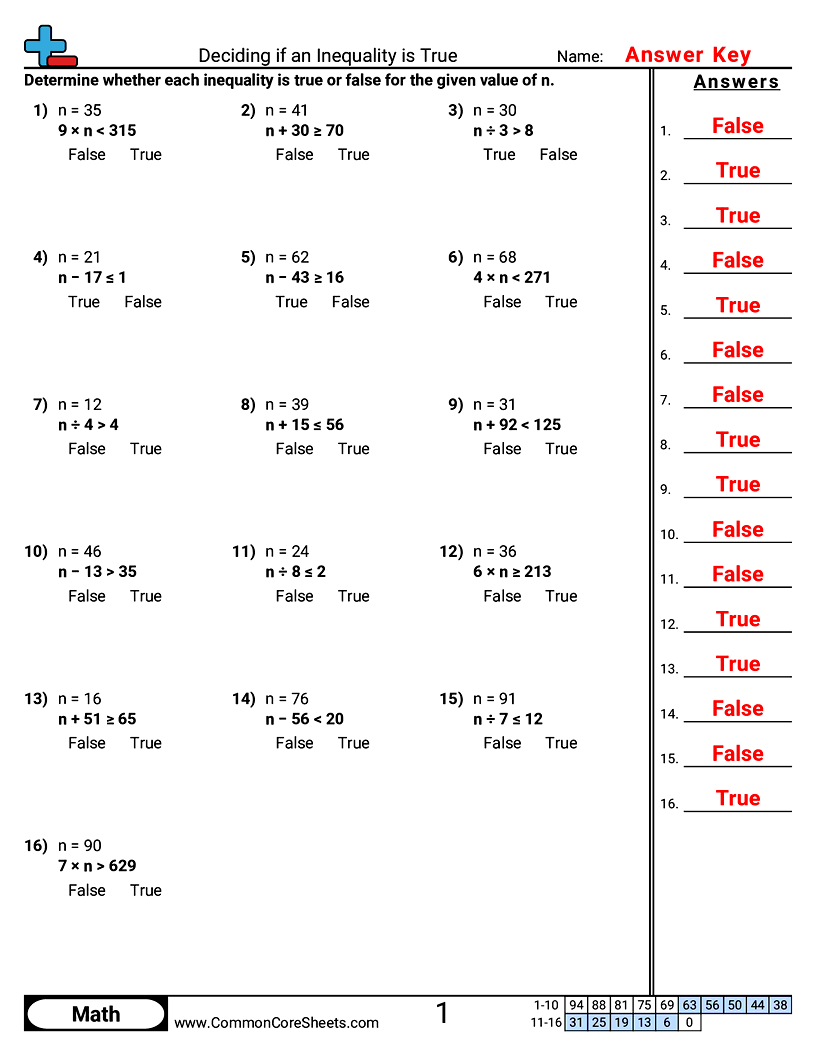
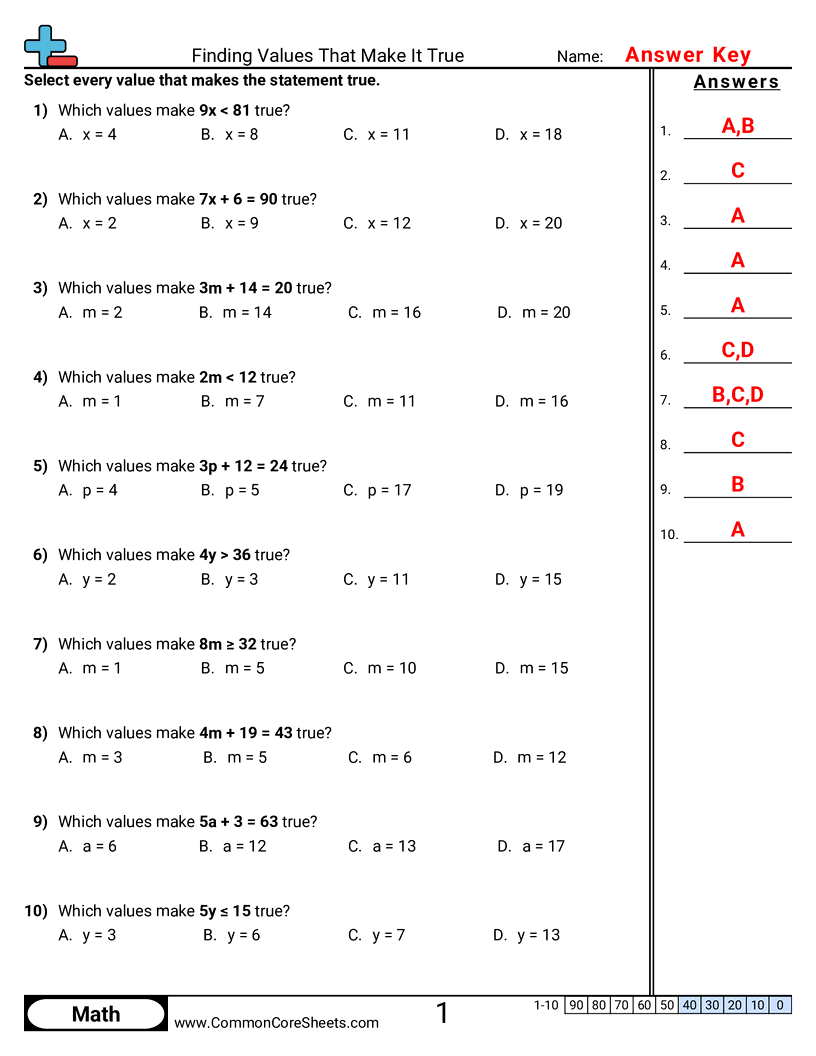
Substitute a value into an inequality. Decide whether an inequality is true. Tell greater than from greater than or equal to.
6ee2c
Substitute a value for a variable. Evaluate an expression with one or two operations. Respect parentheses when evaluating.
6ee2c
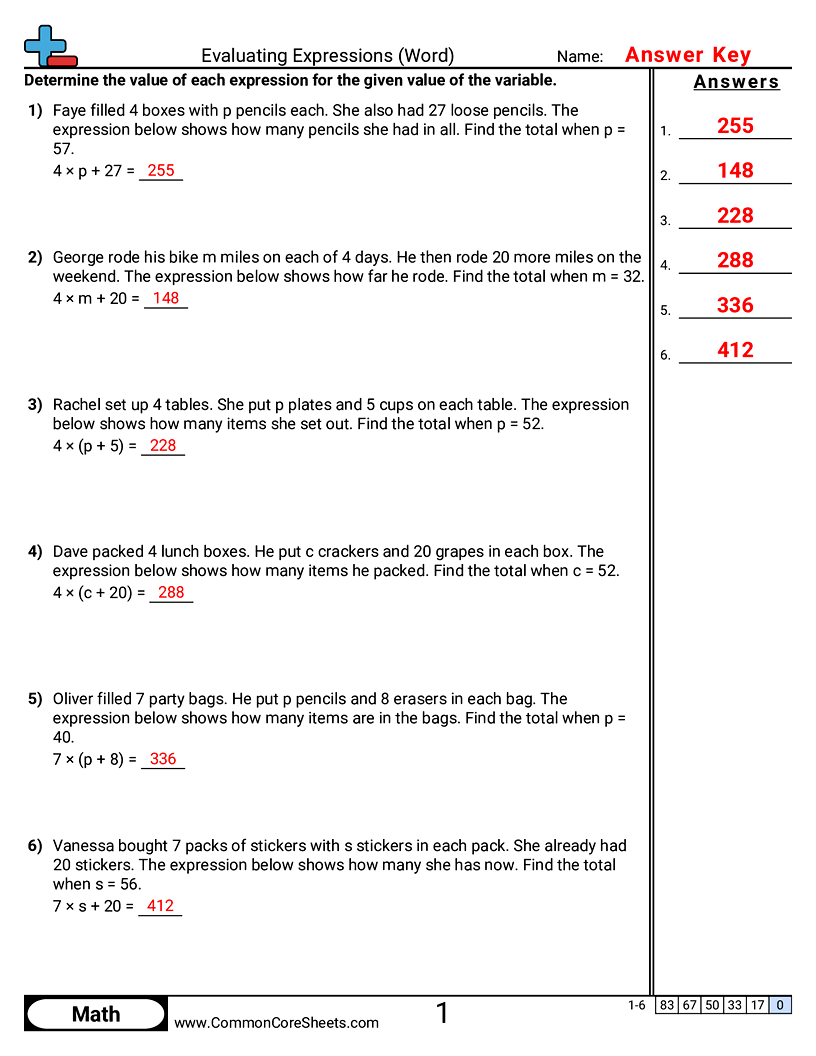
Evaluate an expression that describes a situation. Substitute a value into a two-step expression. Connect a story to an expression.
6ee5
Substitute several values into an equation. Substitute several values into an inequality. Recognize that an equation has one solution and an inequality has many.
6ee5 6ee8
Write an inequality from a situation. Decide whether a value satisfies it. Tell at least from more than at the boundary.
6ee7
Read a balanced scale as an equation. Take the same amount from both sides to find what a box is worth. See several equal boxes as a multiplication.
You are only seeing6th Grade
See all grades
5 more worksheets in this section
About these worksheets
Students practice expressing proportional relationships as equations and solving circle equations in standard form. These worksheets develop the ability to identify constants of proportionality, use variables to model real-world relationships, and apply algebraic techniques to geometric formulas. Suitable for seventh and eighth grade math.
6ee7
Solve for a variable when it is being divided by a number. Keep equations balanced by using multiplication or division to isolate the variable.
6ee7
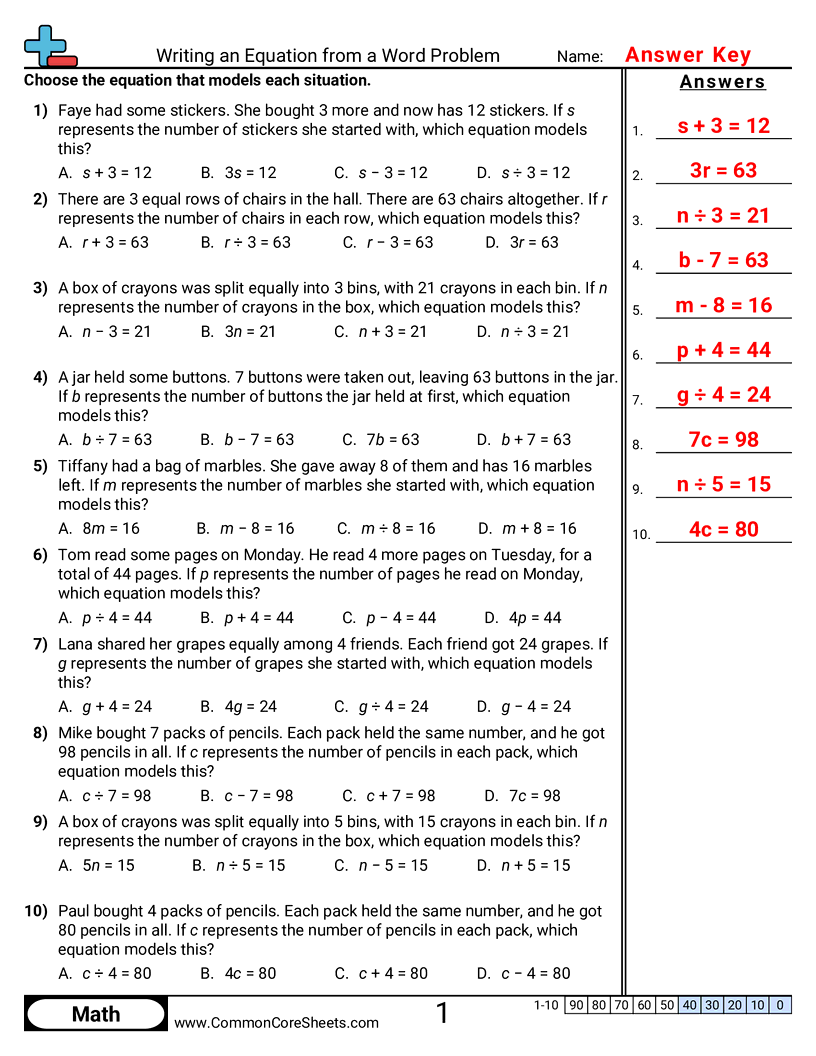
Decide which operation a situation describes. Write a one step equation with one variable. Tell what the variable stands for.
6ee7
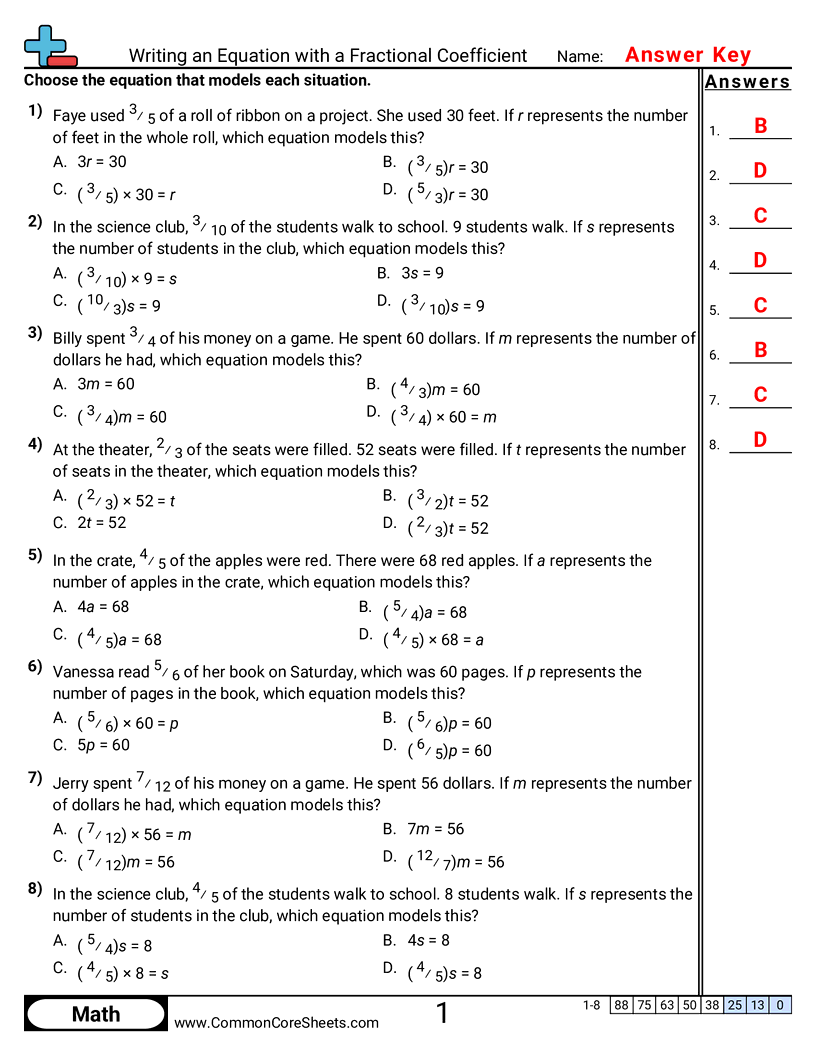
Write a fraction of an unknown amount as a coefficient. Tell the coefficient from its reciprocal. Apply the fraction to the unknown rather than to the amount already known.
6ee7
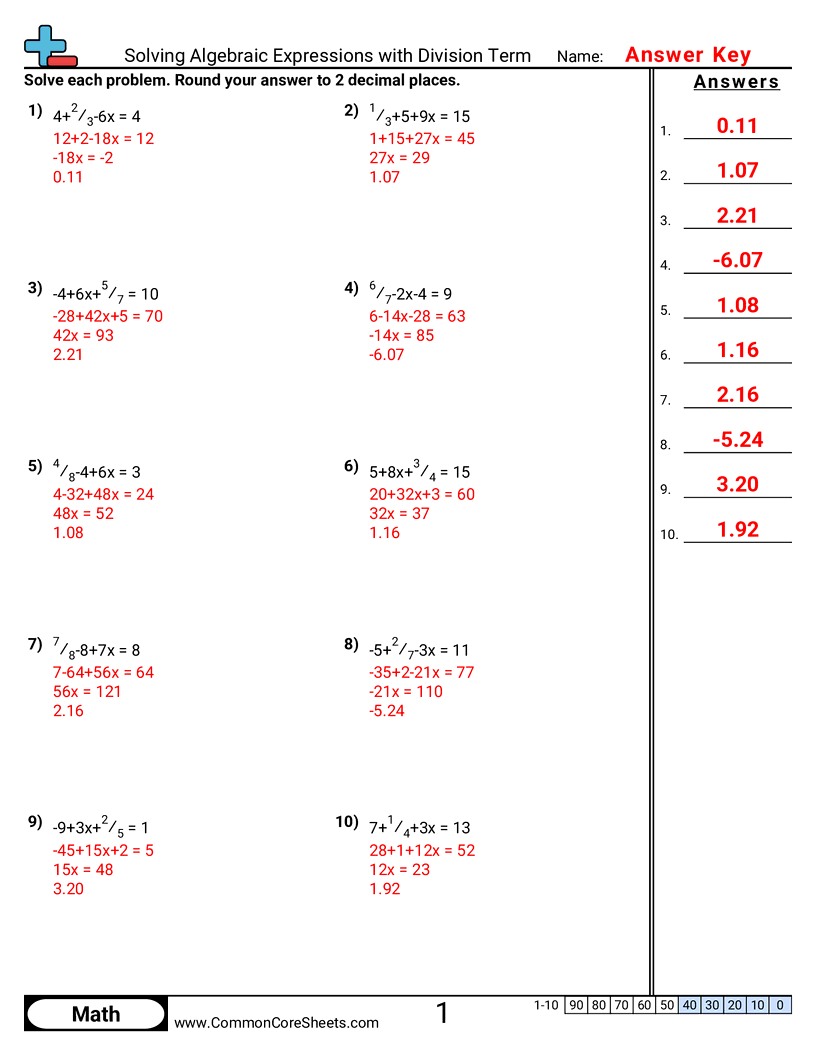
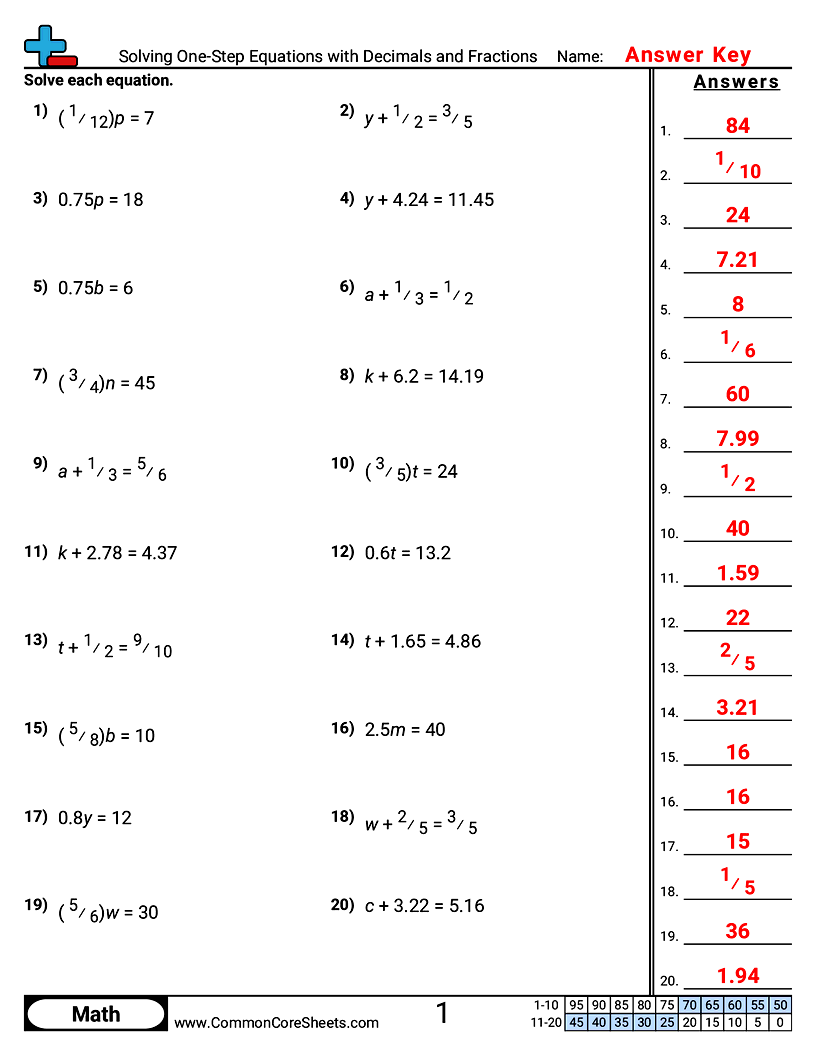
Undo an addition to solve for a variable. Undo a multiplication to solve for a variable. Work accurately when the numbers are decimals or fractions.
6ee7
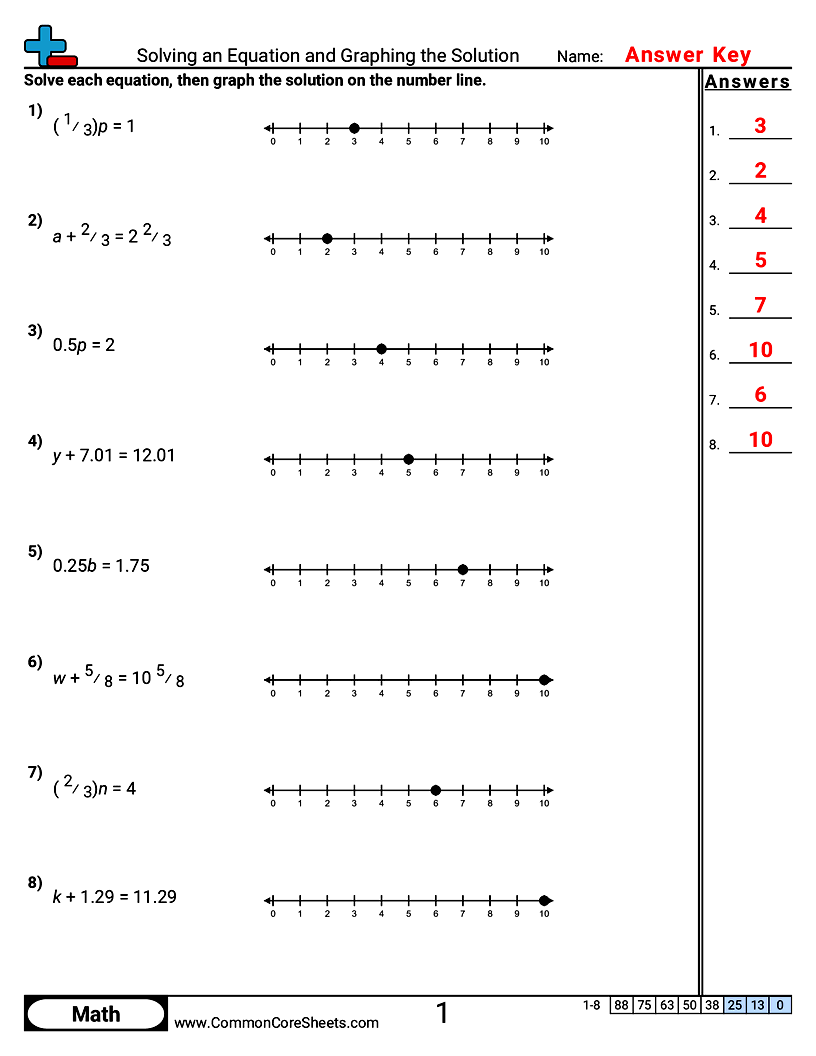
Solve a one step equation with decimals or fractions. Locate the solution on a number line. Use the position to check the size of the answer.
6ee7
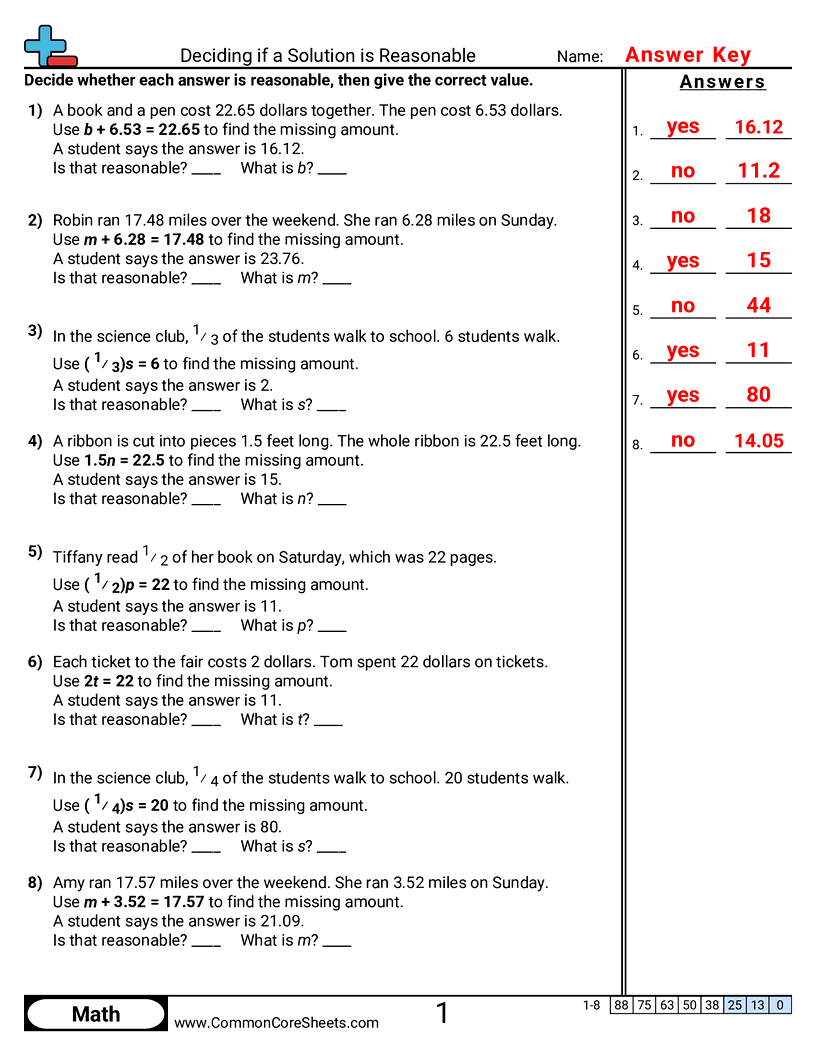
Say whether an answer should be larger or smaller than the number given. Spot an answer that is on the wrong side of that number. Find the correct value and confirm the judgement.
You are only seeing6th Grade
See all grades
4 more worksheets in this section
About these worksheets
These worksheets cover a wide range of algebraic expression skills, from simplifying and expanding to factoring. Students practice combining like terms, using the distributive property, rewriting expressions as multiples of a sum, solving linear equations with variables on both sides, and expanding polynomials using the box method. Topics also include perfect square trinomials and matching equivalent expressions, making these resources ideal for sixth through eighth grade algebra.
6ee2 6ee5
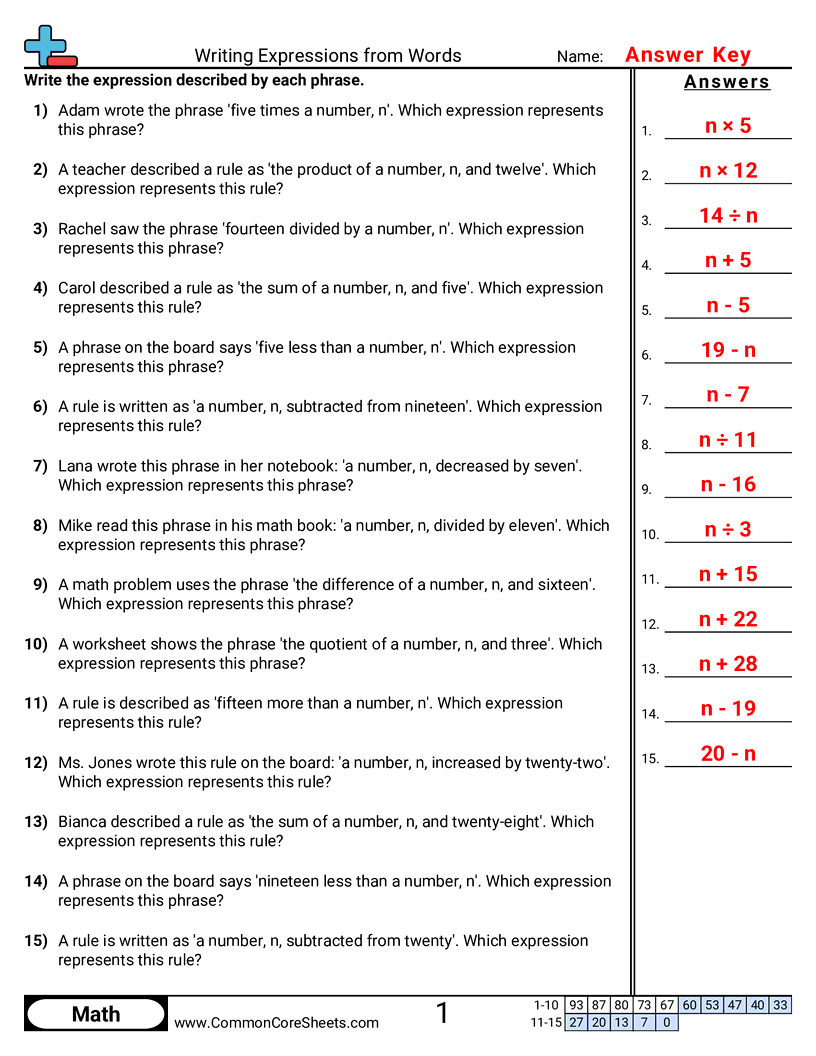
Translate a verbal phrase into an algebraic expression with one variable. Recognize which operation matches words like sum, difference, product, quotient, more than, and less than. Understand how word order changes expressions like subtracted from and divided by.
6ns4
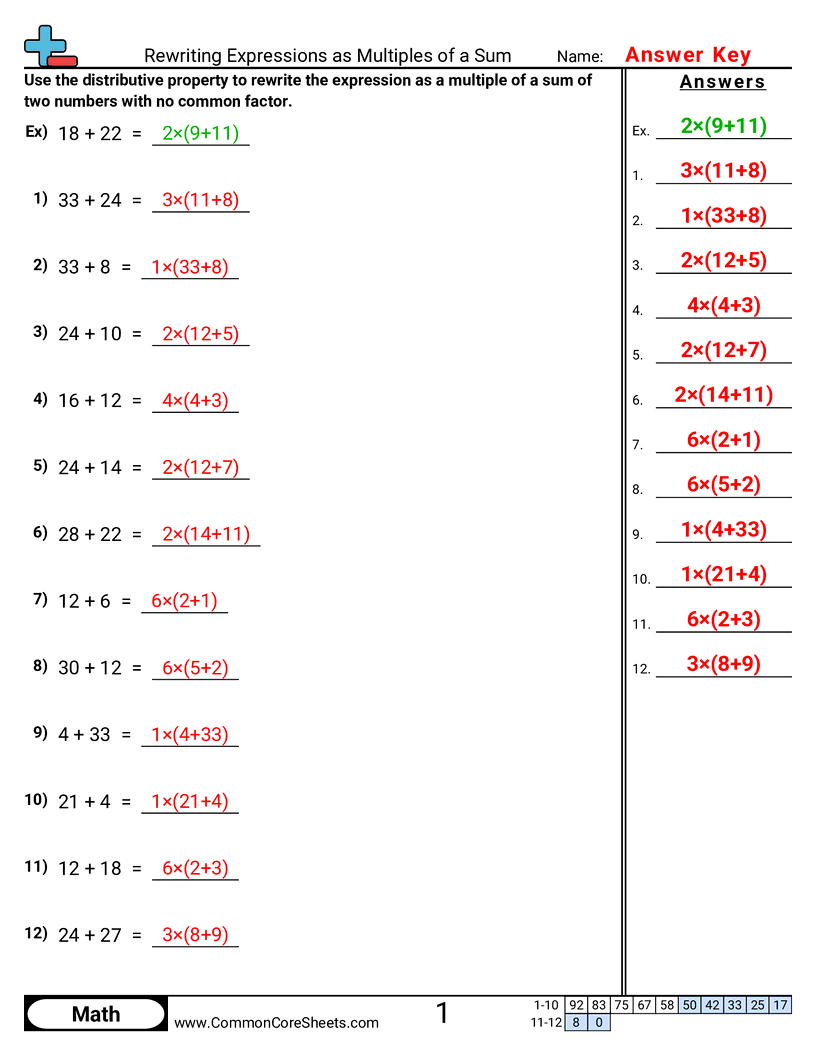
Rewrite an expression like 3x + 6 as a multiplication problem with parentheses, like 3(x + 2). Find the greatest common factor of the terms so you know what number or variable can be factored out. Keep expressions equivalent while working with coefficients and variables.
6ee3
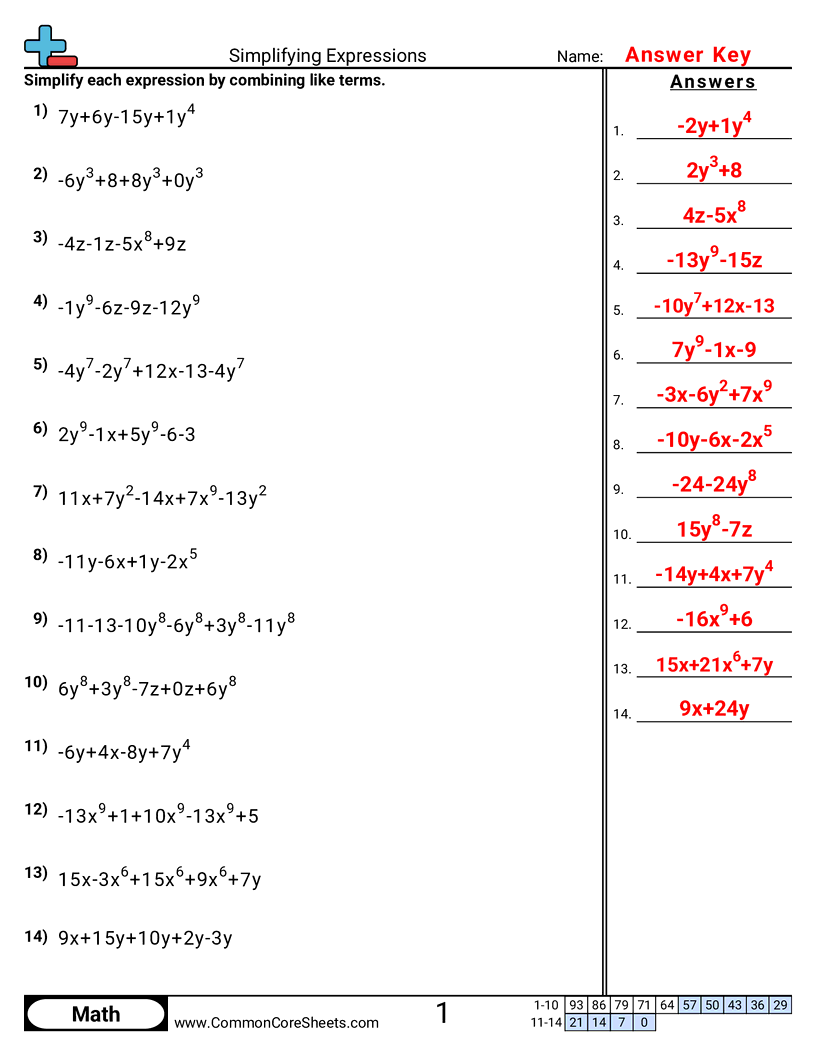
Combine like terms to make an expression shorter and easier to read. Keep track of positive and negative signs while adding and subtracting terms. Simplify expressions that include up to three different variables.
6ee4
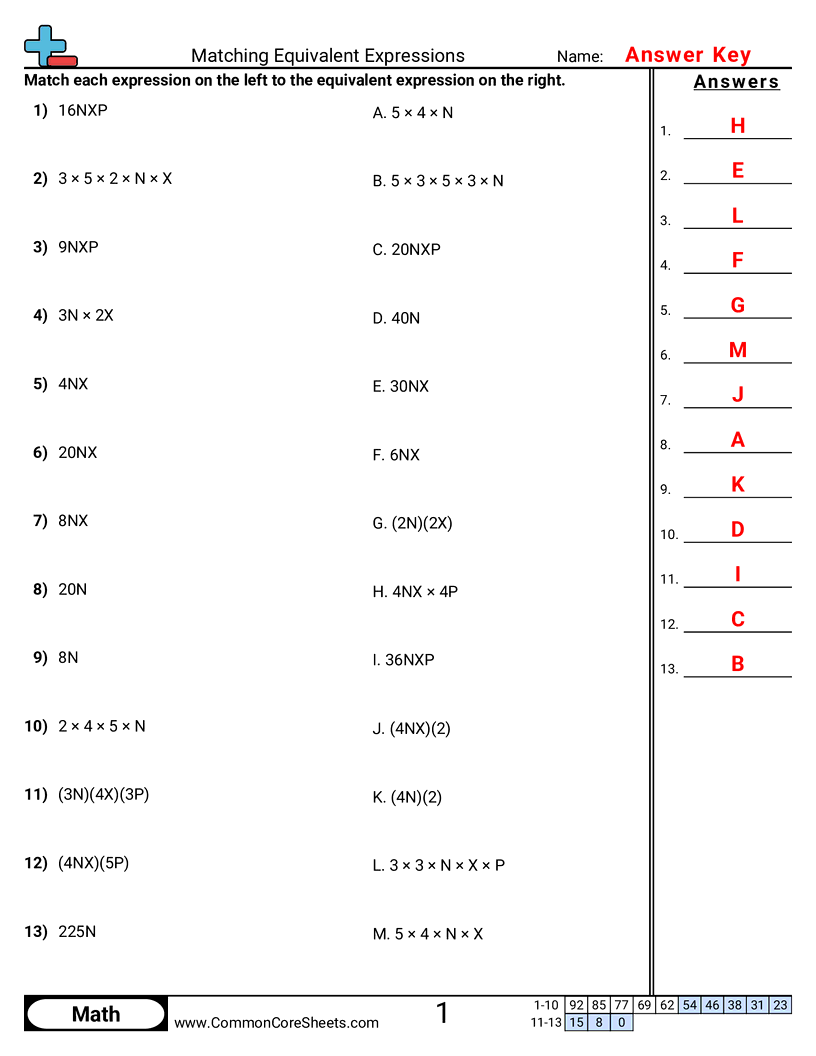
Recognize when two algebra expressions have the same value even if they look different. Simplify expressions by combining like terms. Rewrite expressions by factoring out a common number or variable.
6ee4
Apply the distributive property to a numerical expression Use the order of operations to evaluate an expression Recognize two expressions that name the same number Match equivalent expressions without evaluating everything
You are only seeing6th Grade
See all grades
10 more worksheets in this section
Advertisement