Shape Attributes Worksheets
This section provides comprehensive worksheets for students in grades 5-7 to master shape attributes and properties. Students work with 2D and 3D shapes through activities like identifying faces, edges, and vertices, determining triangle validity, analyzing cross-sections, and classifying shapes by their characteristics.
More about these worksheets ▾ Show less ▴
×
About these worksheets
Students explore the attributes and properties of both 2D and 3D shapes. Activities include counting faces, edges, and vertices of 3D shapes, determining whether given measurements can form a triangle, identifying cross-sections of sliced 3D shapes, drawing different perspectives of solids, classifying shapes by properties, evaluating true-or-false statements about shapes, and filling in attribute tables. Resources span fifth through seventh grade.
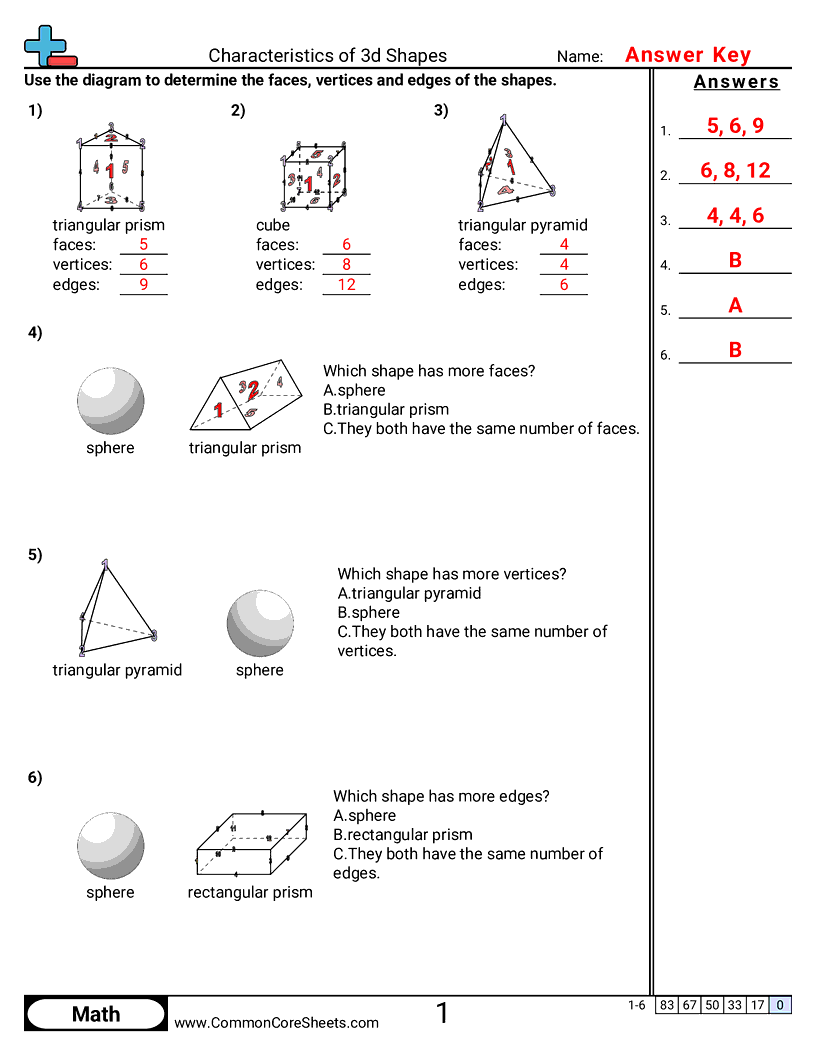
Count how many faces, edges, and vertices a 3D shape has. Tell the difference between flat faces and curved surfaces on a shape.
7g2
Decide whether three given side lengths can actually make a triangle. Decide whether three given angle measures can form a triangle. Use the triangle inequality rule to compare side lengths and check if a triangle is possible. Use the fact that a triangle’s angles add up to 180° to check if a triangle is possible.
7g3
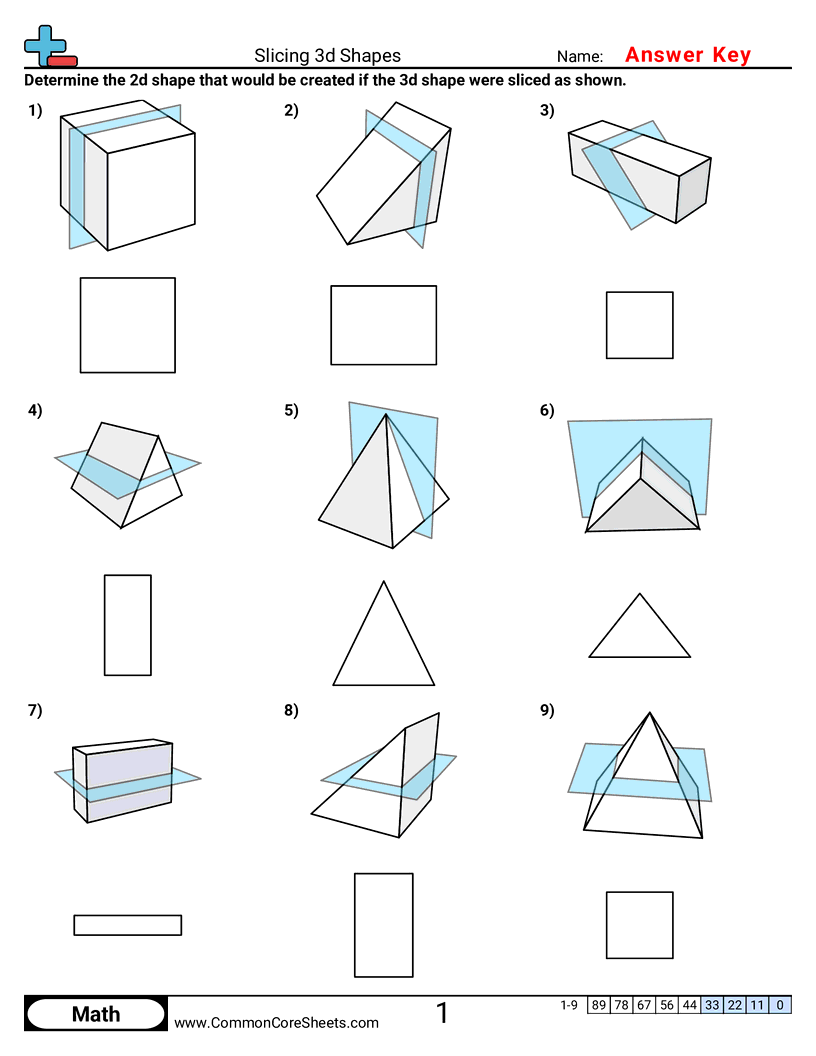
Figure out what 2d shape you get when a 3d solid is sliced. Tell the difference between slices that make circles, triangles, rectangles, and other polygons. Use clues from the direction of the cut (straight across, angled, or through the middle) to predict the cross-section.
7g3
Picture what a 3D solid would look like when you look at it from the front, side, or top. Match a 3D shape to the correct 2D view of its faces and edges. Use clues like which parts are visible or hidden to choose the right perspective. Mentally rotate a solid to see how its view changes without moving the paper.
5g4
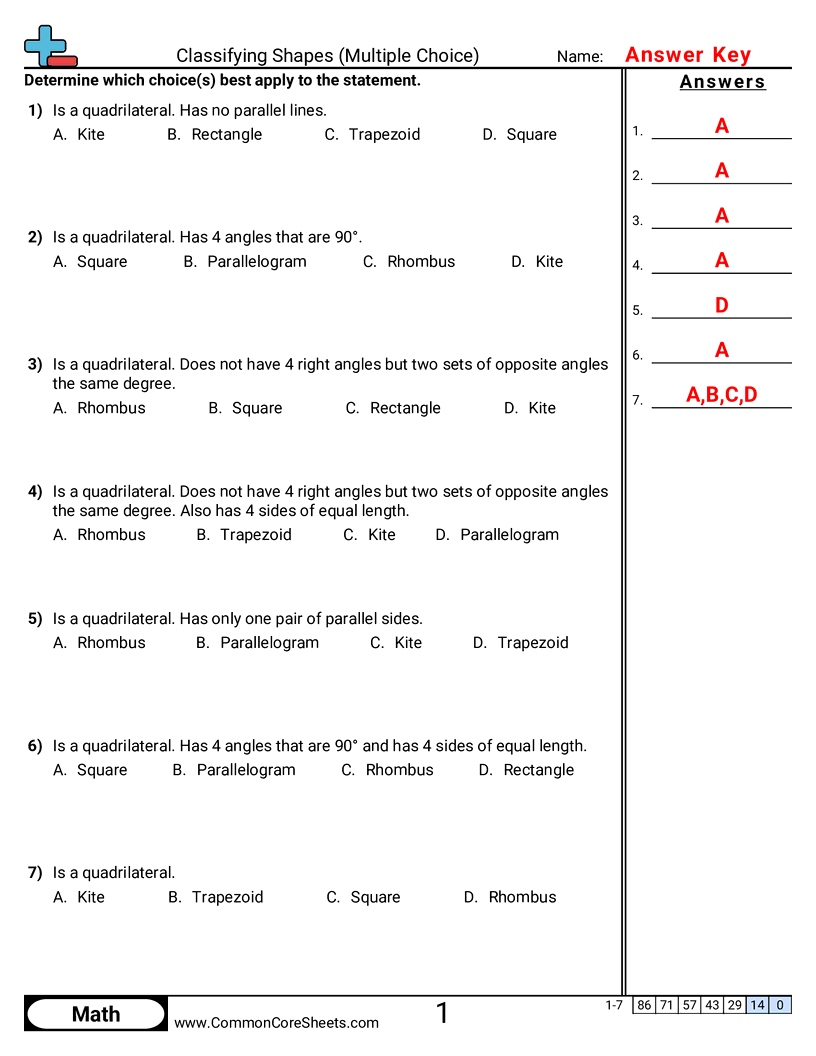
Identify and name common shapes by looking at their sides, corners, and angles. Sort shapes into groups based on shared properties, like how many sides they have or whether sides are parallel. Tell the difference between types of quadrilaterals (square, rectangle, rhombus, trapezoid, kite) by checking their features.
5g3
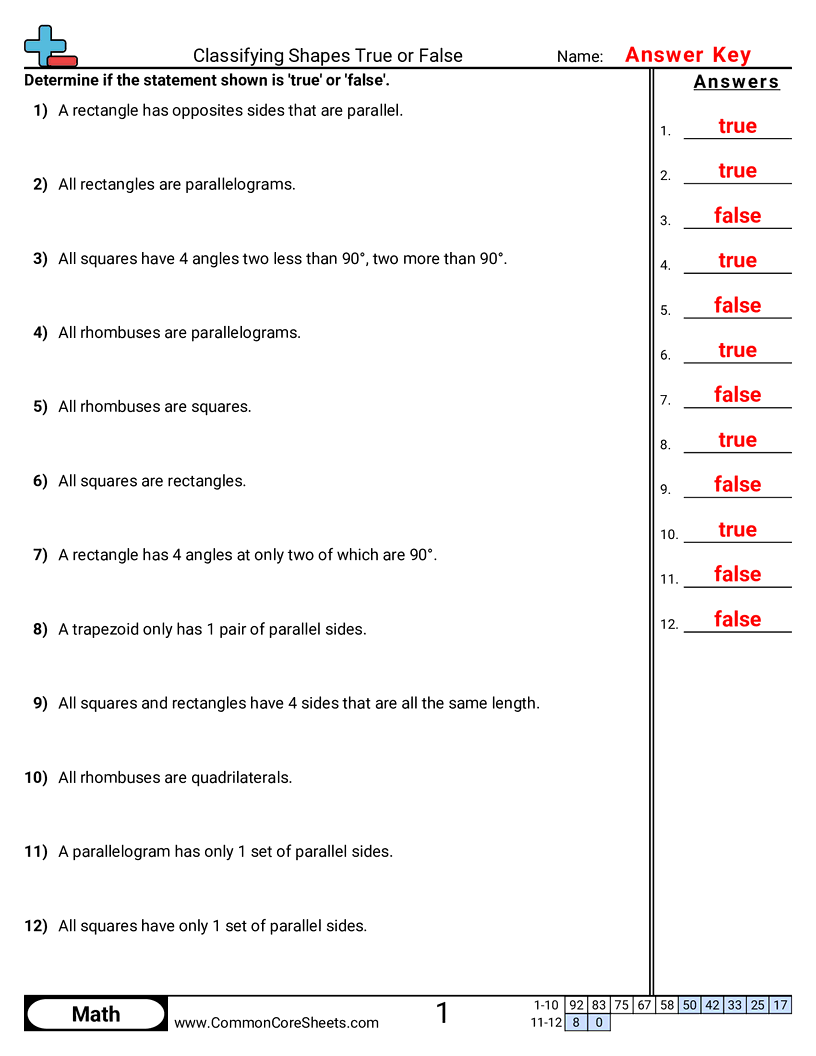
Decide whether a statement about a shape is true or false by looking at its sides, angles, and vertices.
5g3
Use clues about sides, angles, and corners to name the shape being described. Tell the difference between common quadrilaterals like rectangles, squares, rhombuses, trapezoids, and kites. Sort shapes into the right groups using rules like parallel sides, equal sides, and right angles.
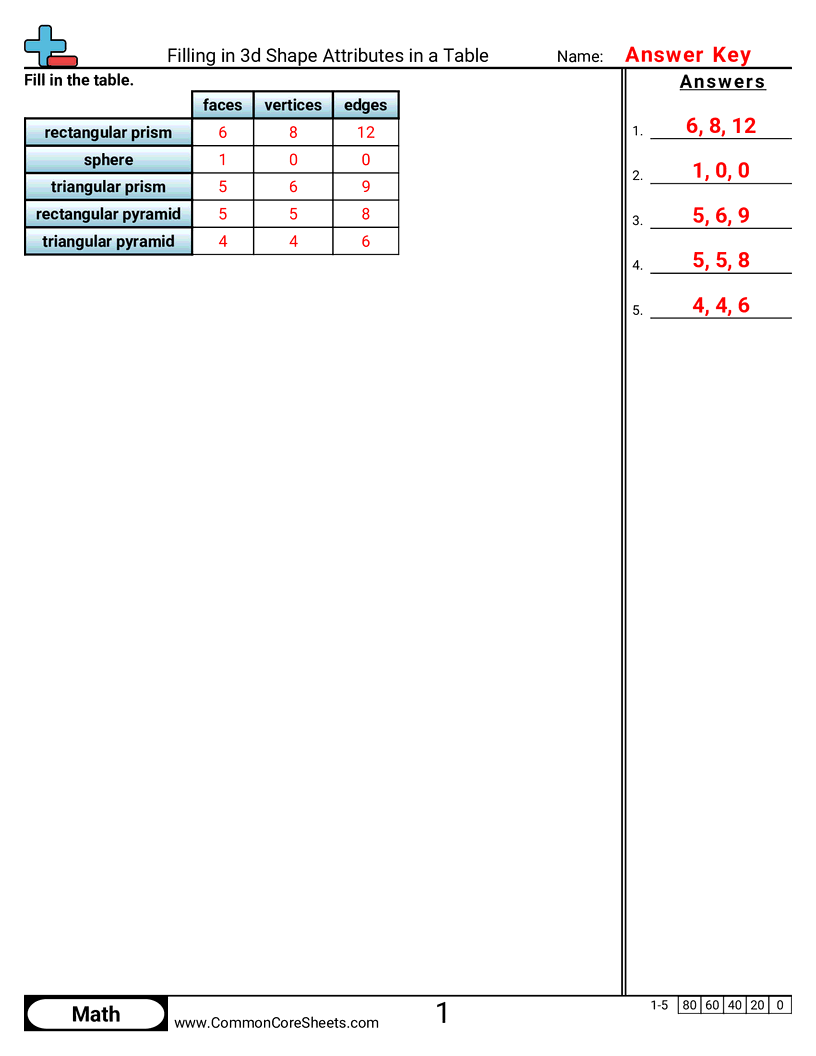
Identify common 3d shapes like prisms, pyramids, cylinders, cones, and spheres. Count how many faces, edges, and vertices a 3d shape has. Use a table to organize and record a shape’s attributes clearly.
Identify the faces, edges, and vertices on common 3d shapes.
2g1
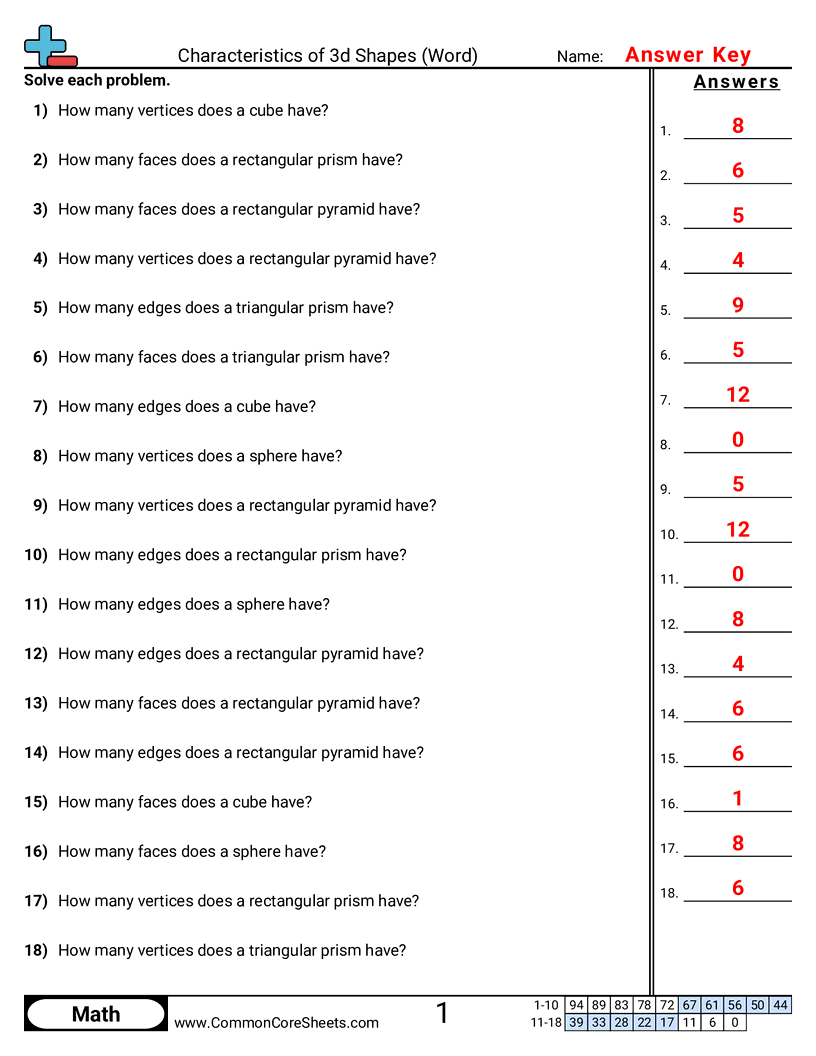
Count the flat sides (faces) on a 3D shape Count the edges where two faces meet Count the corners (vertices) of a solid figure Recognize common solids like cubes, pyramids, and prisms
2g1
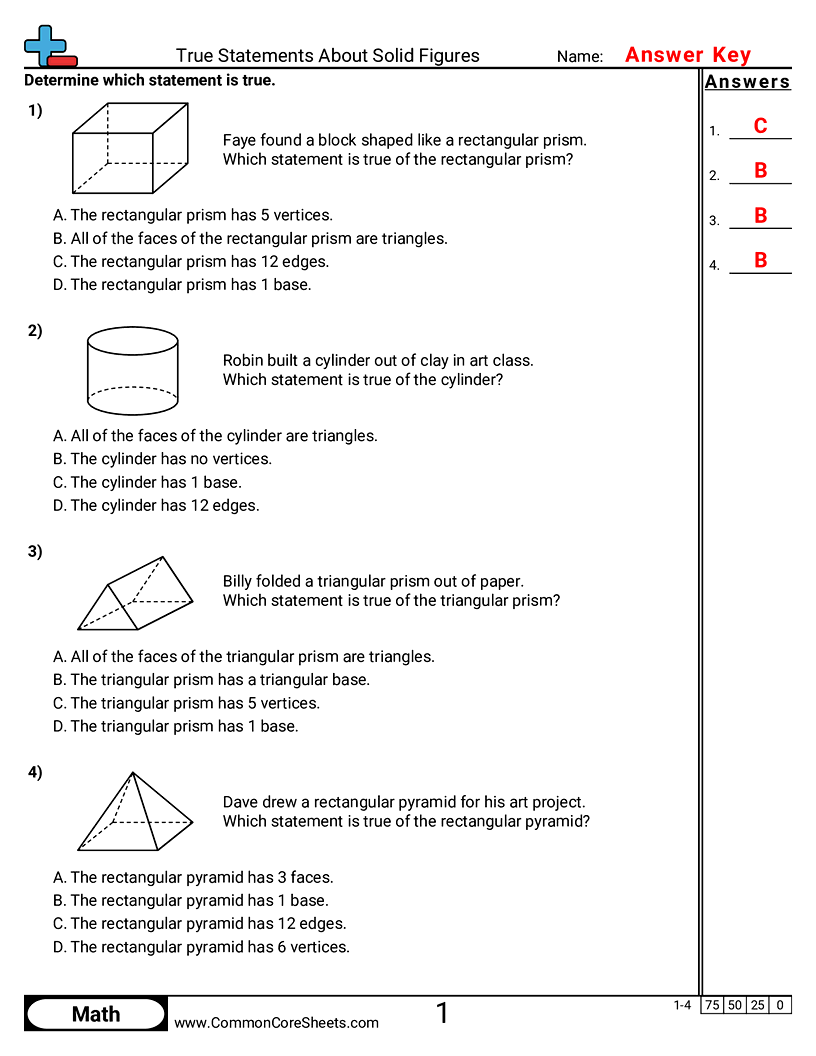
Compare two solid figures by their attributes Count the faces, edges and vertices of a solid figure Know how many bases a prism and a pyramid have Judge whether a statement about two figures is true or false
2g1
Count the faces, edges and vertices of a solid figure Know how many bases a prism and a pyramid have Name the shape of a solid figures base Judge whether a statement about a figure is true or false
6g4
Recognize the net of a cube and of a rectangular prism Tell a square pyramid net from a triangular pyramid net Count the faces in a net and note their shapes Picture how a flat pattern folds into a solid
Count every unit cube in a three-dimensional figure Account for the cubes behind and beneath the ones in front See a drawn figure as something that could be built out of blocks Read a picture of a solid as a structure rather than a flat shape
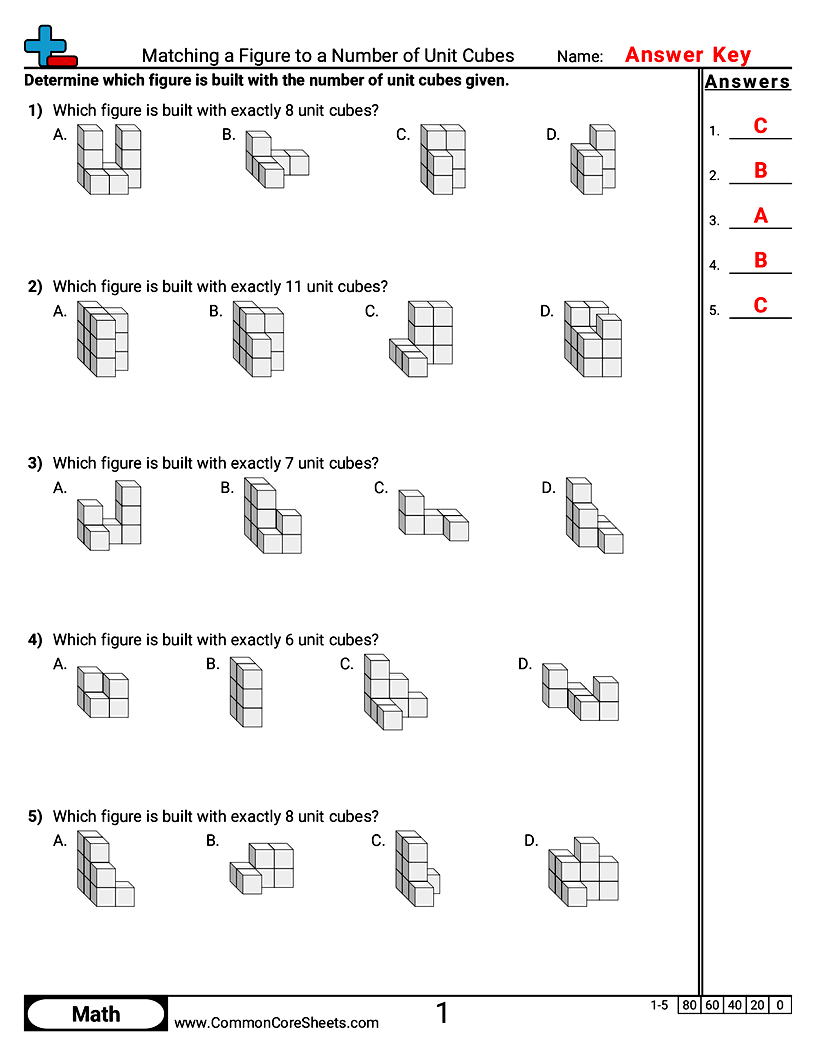
Count the unit cubes in each of several figures Match a number of cubes to the figure it would build Compare figures that differ by only one or two cubes Recognize that two figures can look alike and still take different numbers of cubes
2g1
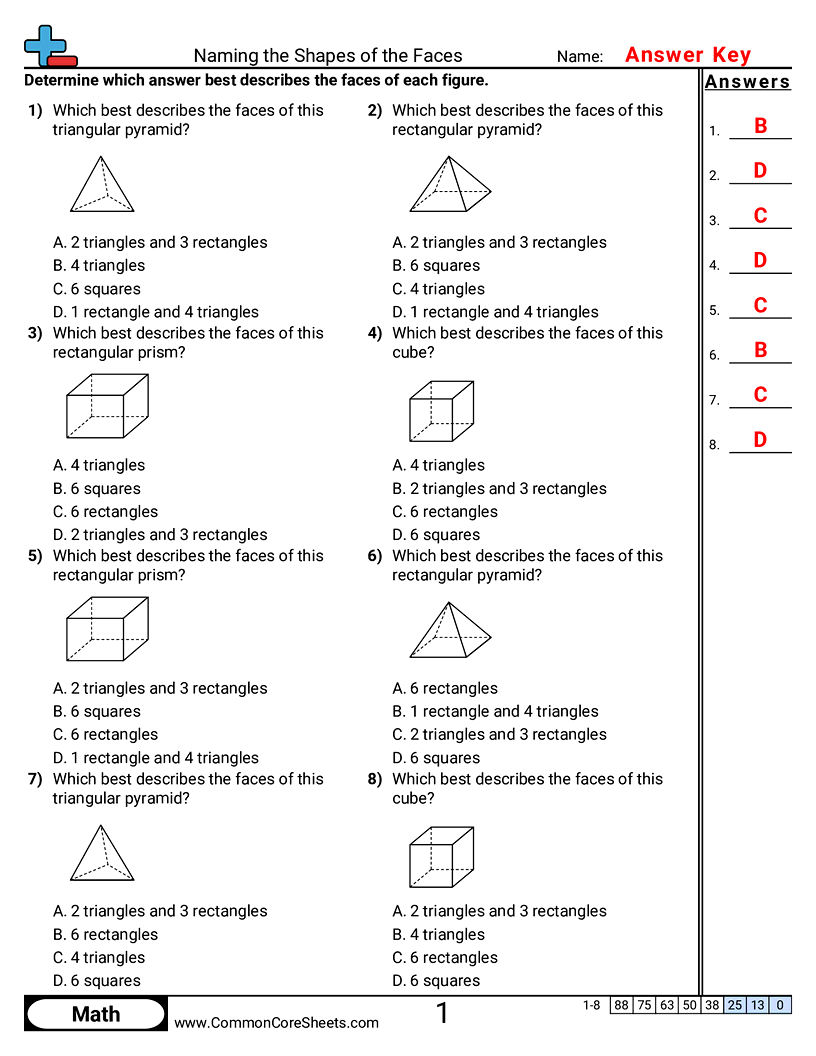
Name the shapes of a solid's faces. Tell a pyramid from a prism by its faces. Describe a three-dimensional figure.
2g1
Identify a figure from its attributes. Use face shapes to tell figures apart. Classify three-dimensional figures.
6g4
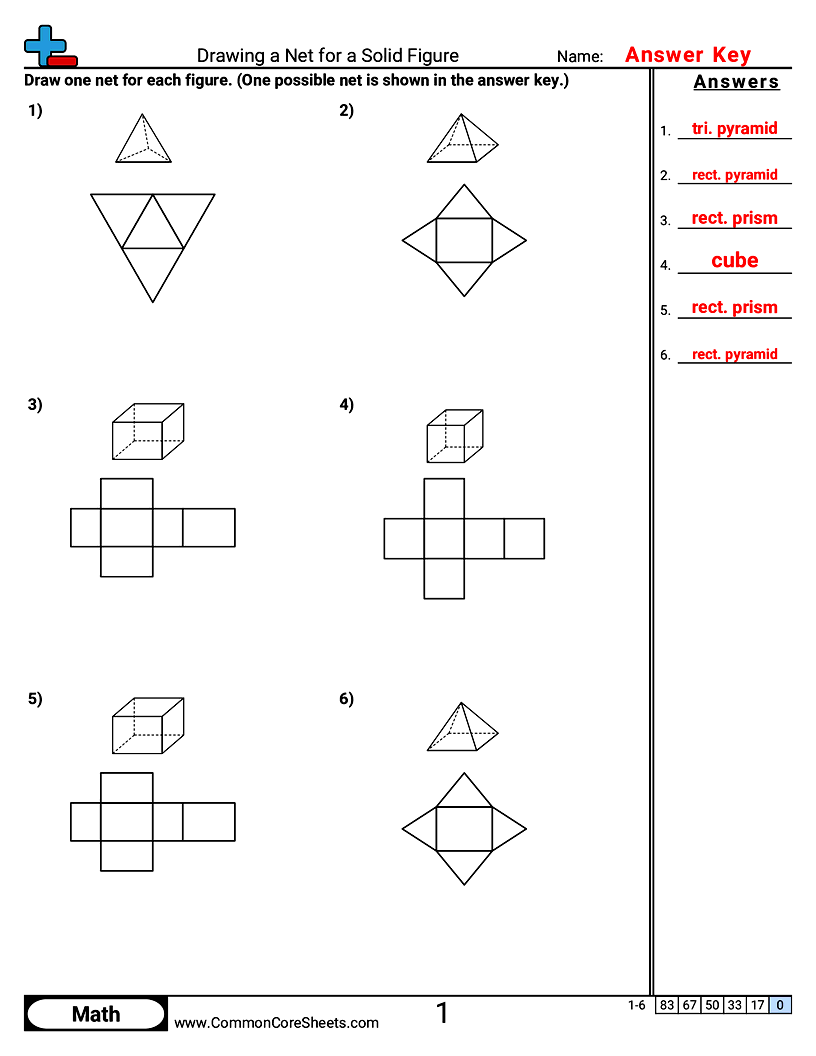
Draw a net for a solid figure. Recognize that a solid can have more than one net. Connect the faces of a solid to the parts of its net.
6g4
Choose the net that folds into a solid. Tell a valid net from an arrangement that will not fold. Match faces to a three-dimensional figure.
6g4
Select every net that folds into a solid. Recognize that a solid has more than one net. Tell a valid net from an arrangement that will not fold.
Advertisement