3rd Grade Fraction Worksheets
Our 3rd grade fraction worksheets provide 33 comprehensive printable activities covering essential fraction concepts. Students will practice identifying fractions, partitioning shapes, working with number lines, comparing fractions, and finding equivalent fractions through visual models and multiple choice problems.
More about these worksheets ▾ Show less ▴
Grade & filters: 3rd Grade ▾
×
About these worksheets
These worksheets introduce the concept of fractions from the ground up. Activities include naming fractions from words and pictures, writing fractions from visual models, identifying correct fraction representations, partitioning shapes into equal parts, determining whether fractions equal zero, one-half, or one whole, examining fraction values between whole numbers, comparing relative fraction sizes, finding reciprocals, and expressing fractions in words and numbers. Resources span first through fifth grade.
3nf1
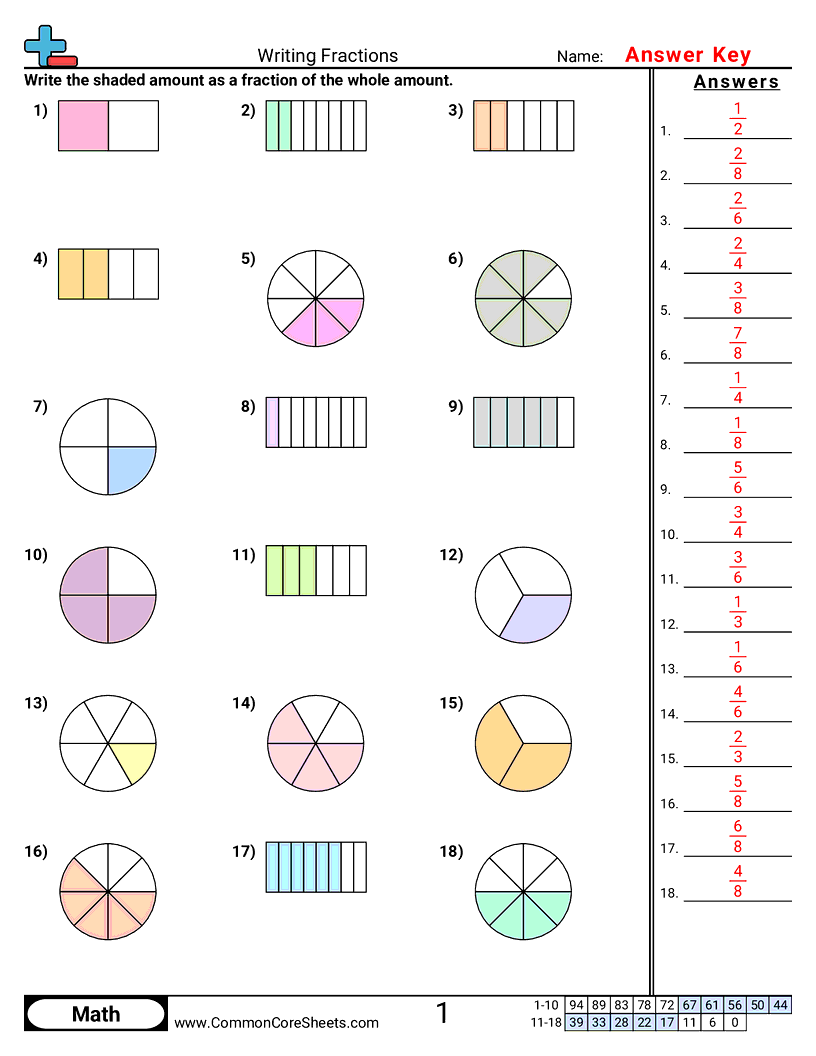
Look at a picture model and write the fraction it shows. Identify the numerator and denominator in a fraction. Match a shaded part of a whole to the correct fraction notation.
3nf1
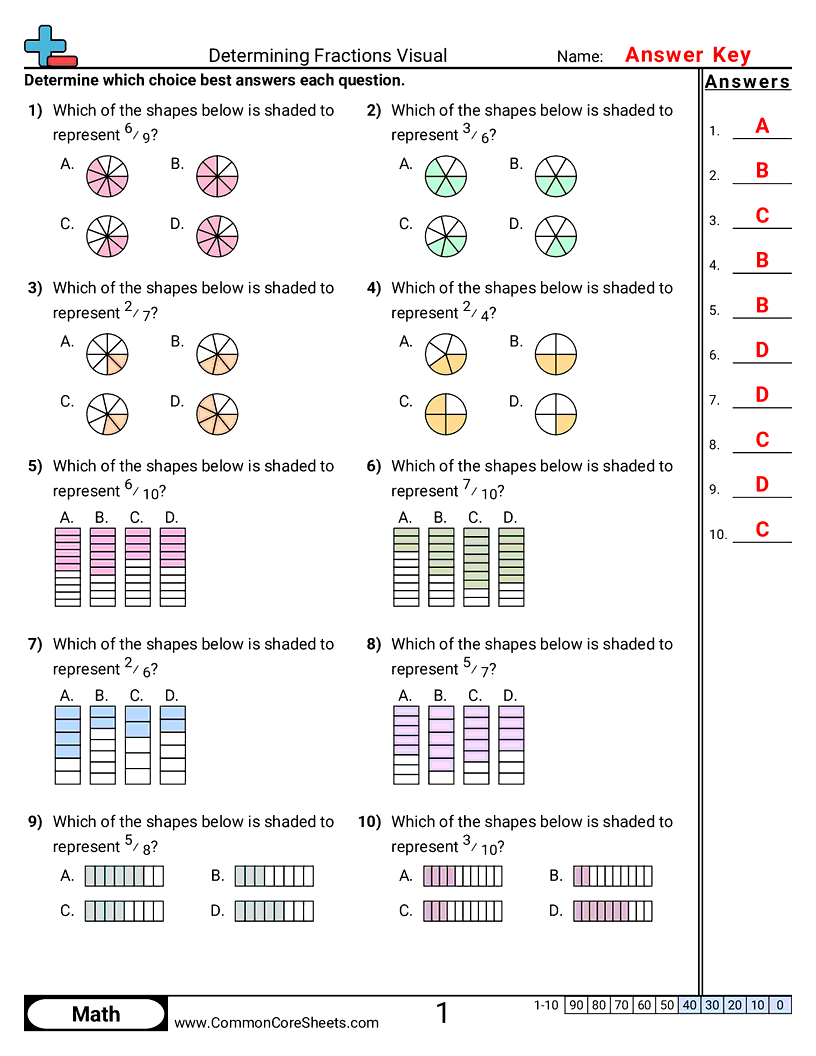
Match a written fraction to a picture that shows the same amount shaded. Tell how many equal parts the whole is split into and how many parts are shaded. Notice when pictures show different-sized parts and choose only models with equal parts.
3g2
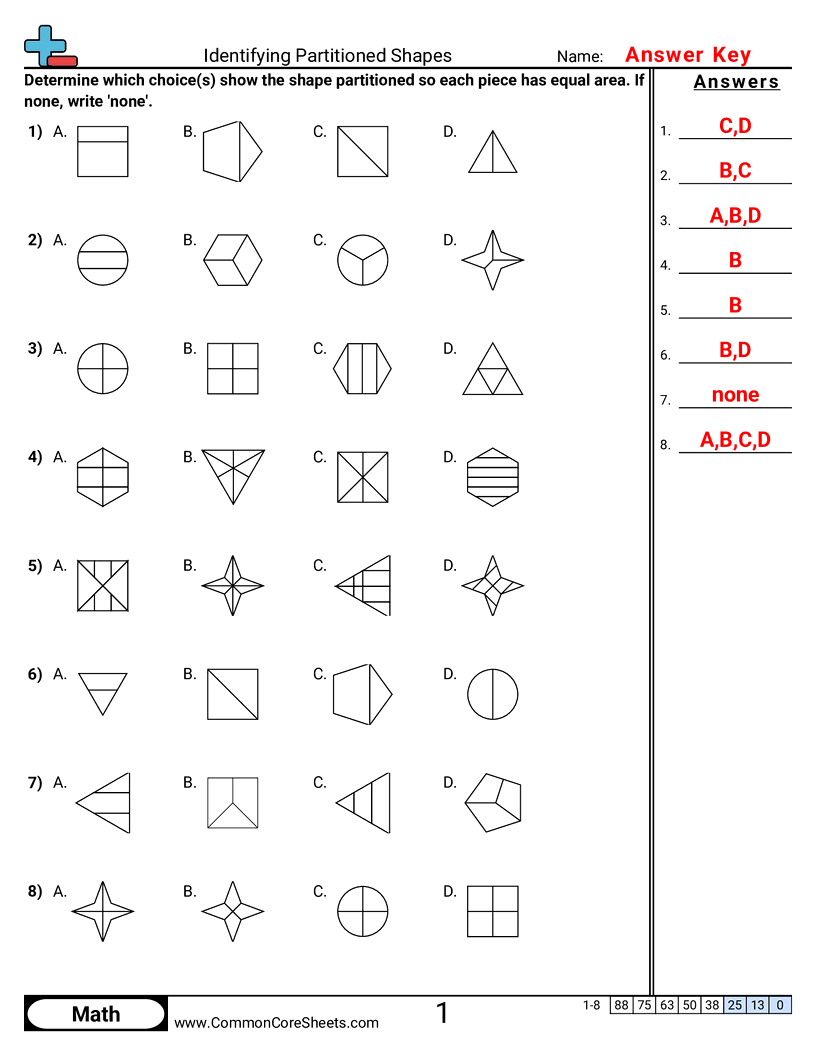
Split a shape into equal-size parts and explain that each part is the same area. Spot when parts are not equal and know that they do not make fair fractions.
3g2
Decide whether a shape has been split into equal-size parts. Tell the difference between equal partitions and uneven partitions in pictures. Connect a partitioned shape to the idea of a fraction as equal parts of one whole. Explain why a partition is not correct when the pieces are different sizes.
3nf3d
Decide whether a fraction is equal to 0, 1/2, or 1. Use the numerator and denominator to tell when a fraction means none, half, or a whole.
3nf1
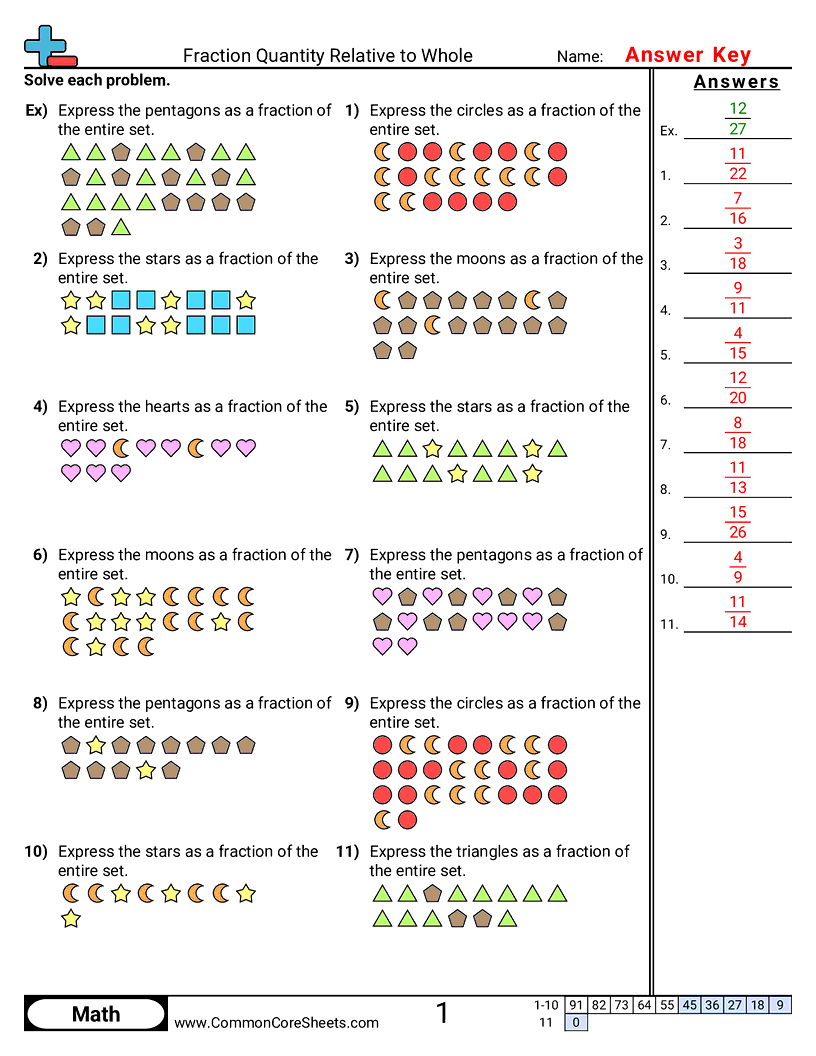
Explain a fraction as “part of a whole set,” using the numerator as the count shown and the denominator as the total.
3nf1
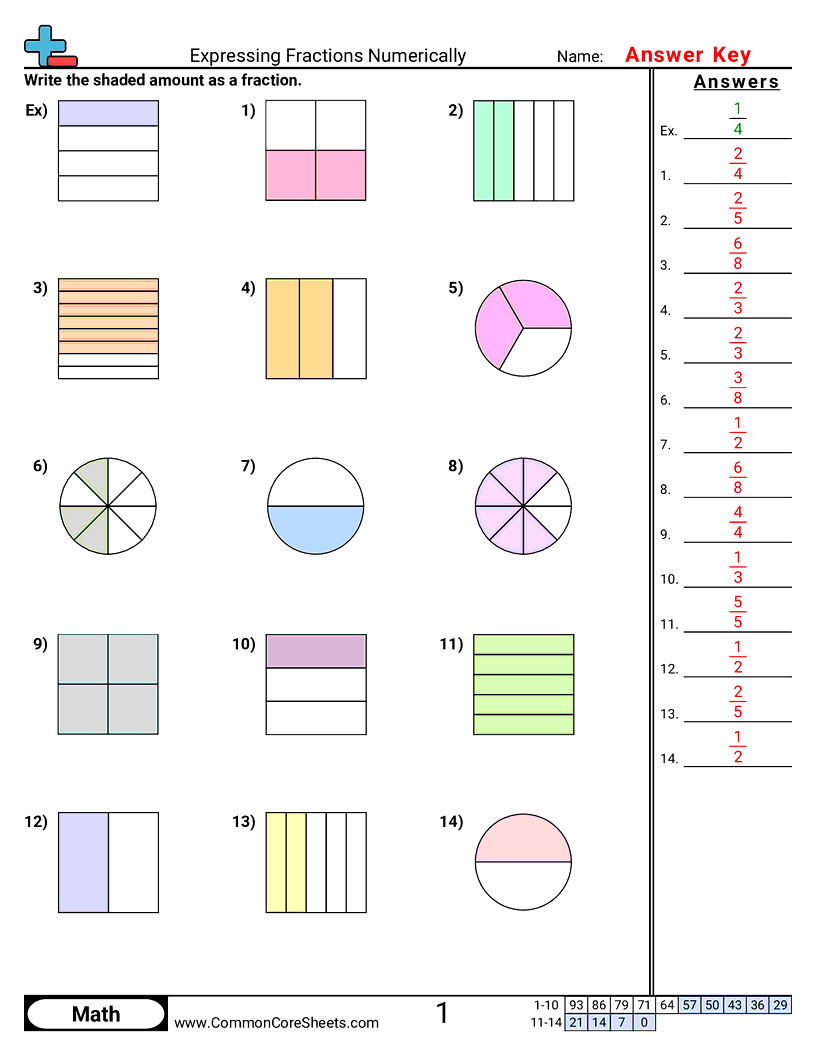
Write the shaded part of a picture as a fraction using a numerator and denominator. Count equal parts in a shape to figure out the denominator. Count shaded parts to figure out the numerator. Match a visual fraction model to the correct numeric fraction notation.
3nf1
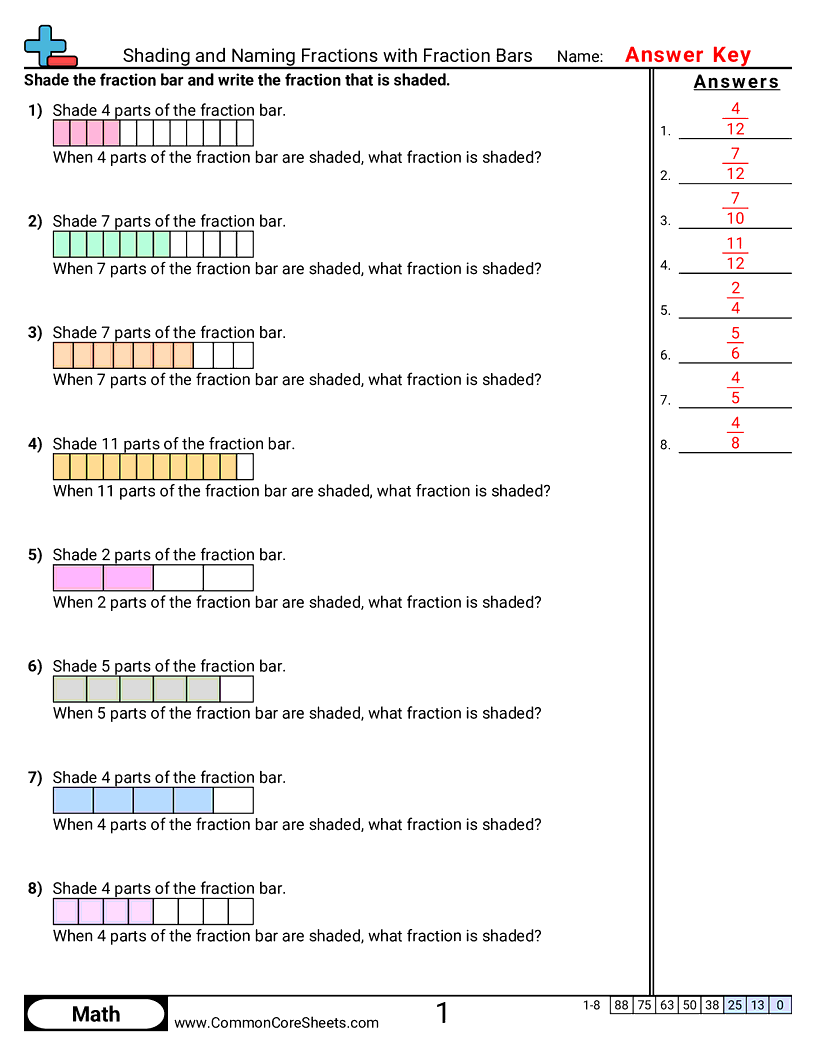
Shade a given number of equal parts on a fraction bar Count the equal parts in the whole to find the denominator Write the fraction that is shaded, such as 3/8 or 5/10 Understand that the numerator counts the shaded parts while the denominator counts every part
3nf1
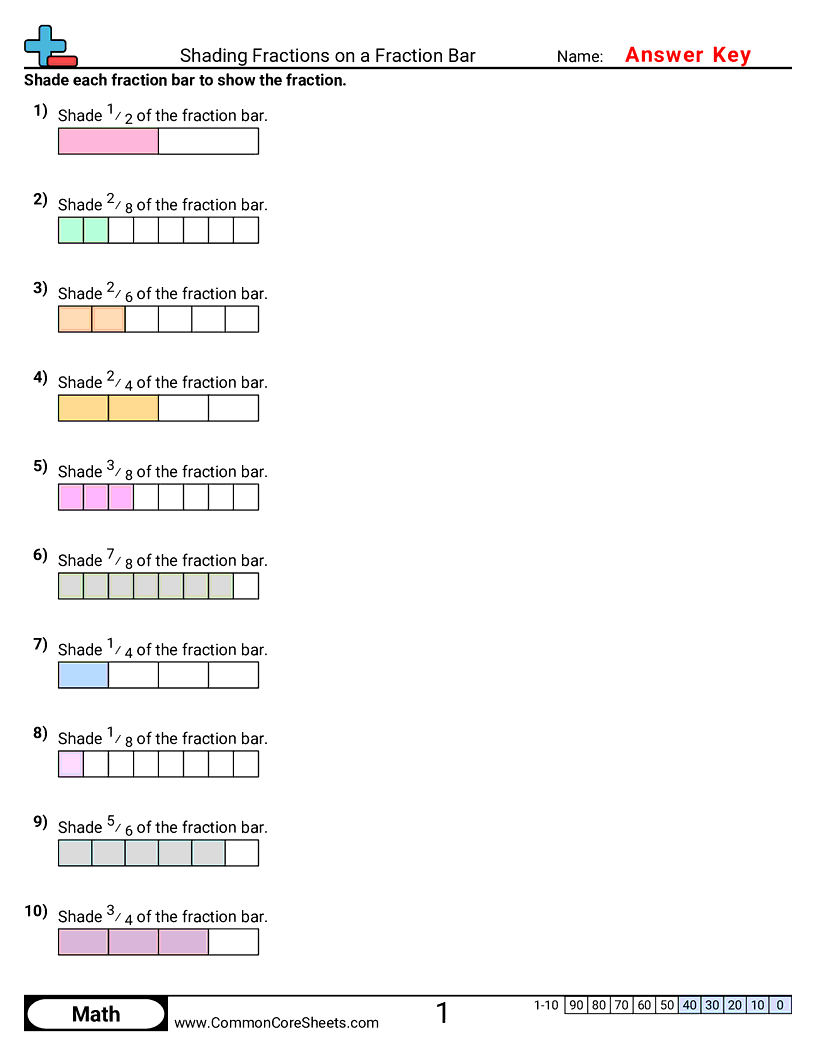
Shade the correct number of parts on a bar to match a fraction Understand that the bottom number tells how many equal parts the whole is split into Understand that the top number tells how many parts to color Connect a written fraction to its picture
3nf1
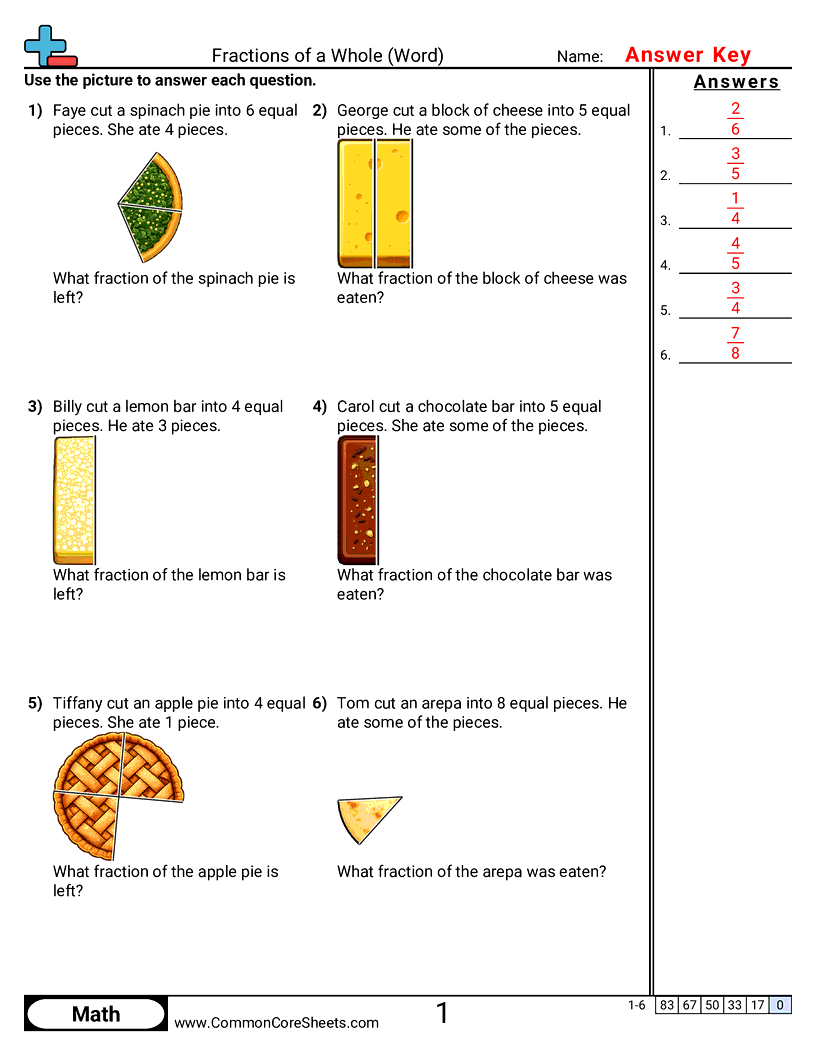
Name the fraction of a whole that is left after some equal pieces are removed Count the missing pieces in a picture to name the fraction that was eaten Use the total number of equal pieces as the denominator Recognize the same fraction idea in round wholes and in rectangular wholes
3nf1
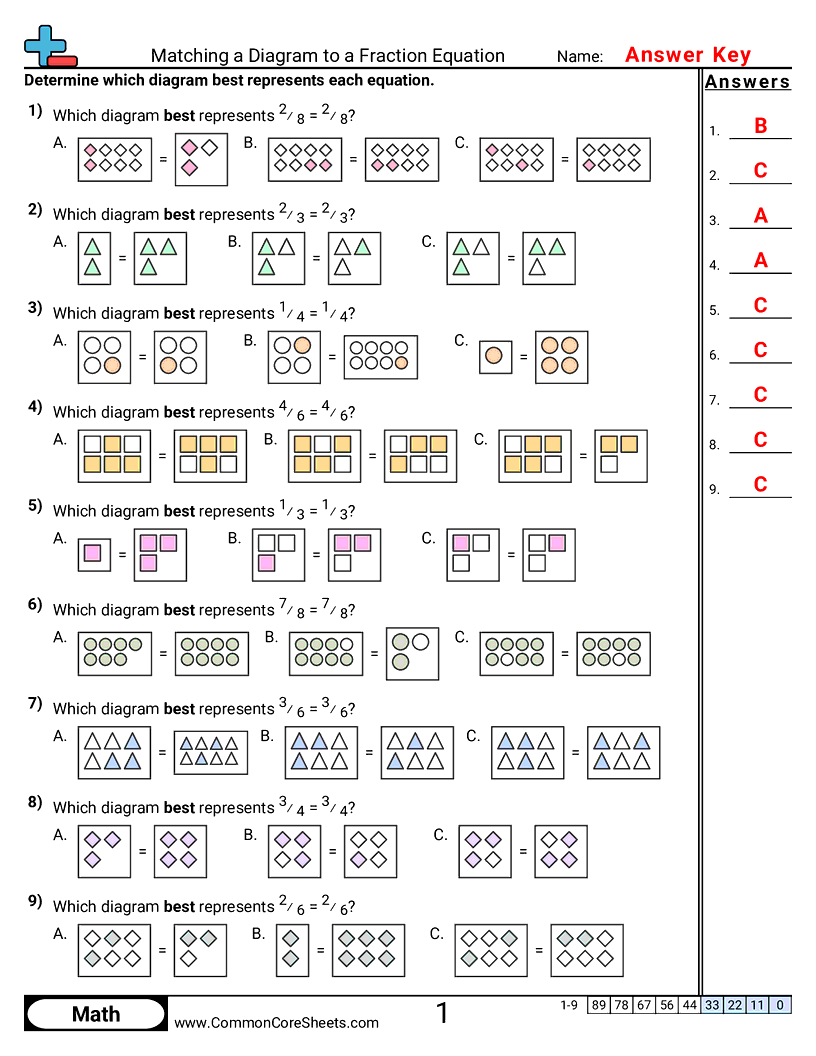
Read a shaded diagram and figure out what fraction it shows Match a picture of a fraction to the correct fraction equation Understand that the top number counts shaded parts and the bottom number counts total parts Compare several fractions to find the one that fits the picture
3nf1
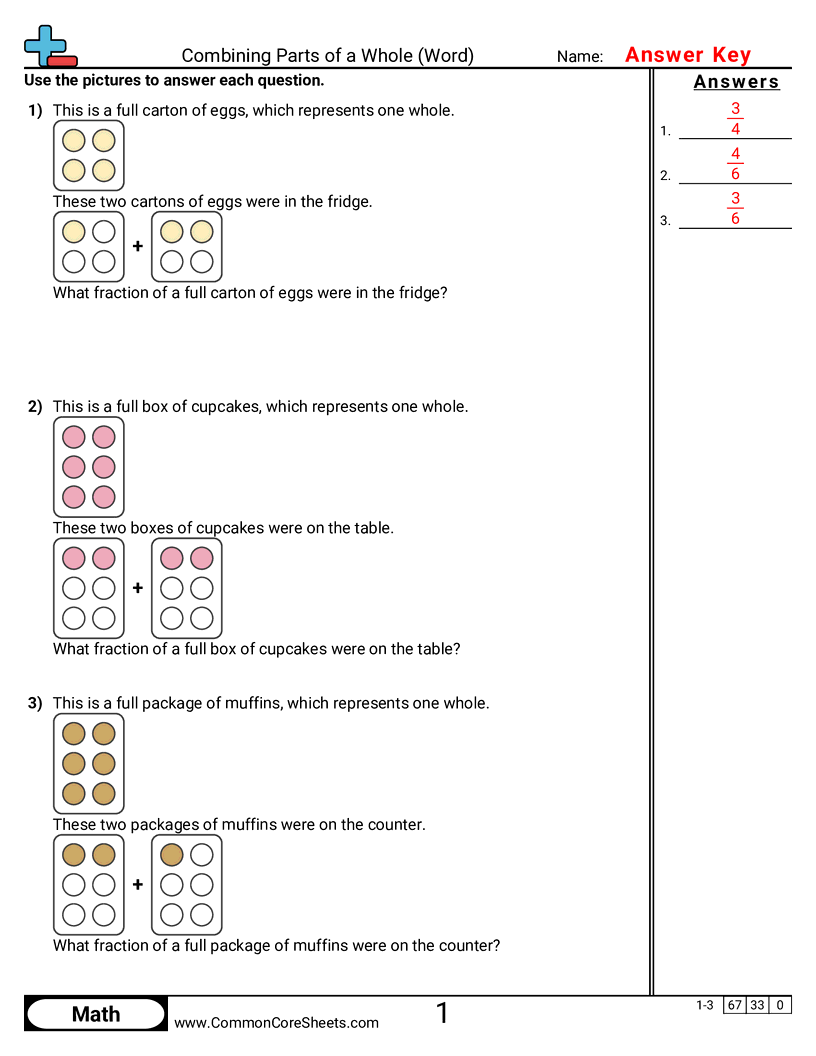
Practice adding fractions that share the same denominator Understand how parts combine to make a whole Read word problems and figure out which fractions to add Recognize when combined parts equal one whole
You are only seeing3rd Grade
See all grades
15 more worksheets in this section
About these worksheets
Students practice placing fractions on a number line, a key skill for understanding fraction size and order. Worksheets cover locating fractions between 0 and 1, partitioning and labeling number lines, placing fractions between whole numbers, and working with positive and negative fractions on a number line. Aligned with third through sixth grade standards.
3nf2a
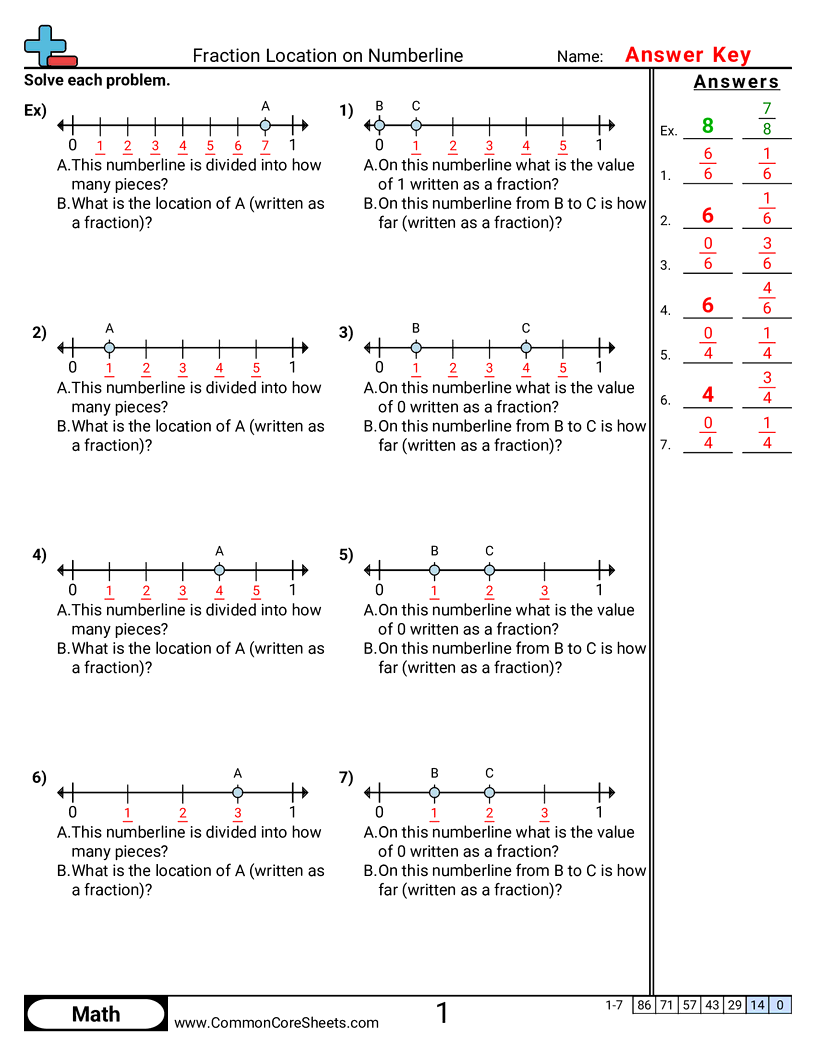
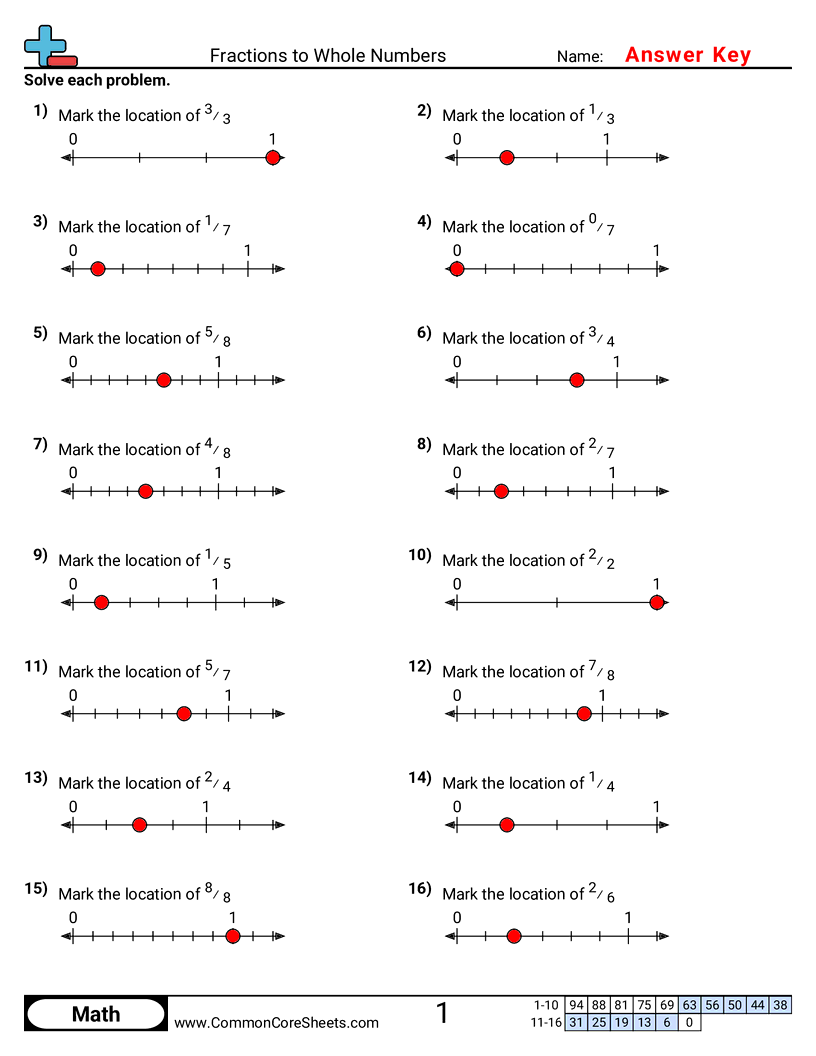
Find where a fraction belongs between 0 and 1 on a number line. Use the denominator to see how many equal parts the whole is split into on the number line. Use the numerator to count how many parts to move from 0 to reach the fraction. Use benchmarks like 0, 1/2, and 1 to decide if a fraction is closer to the start, middle, or end.
3nf2b
Find where a fraction belongs on a number line between 0 and 1. Use the denominator to see how many equal parts the whole is split into on the number line. Use the numerator to count how many parts from 0 to reach the fraction’s point. Recognize benchmark points like 0, 1/2, and 1 to help place and compare fractions.
3nf2b
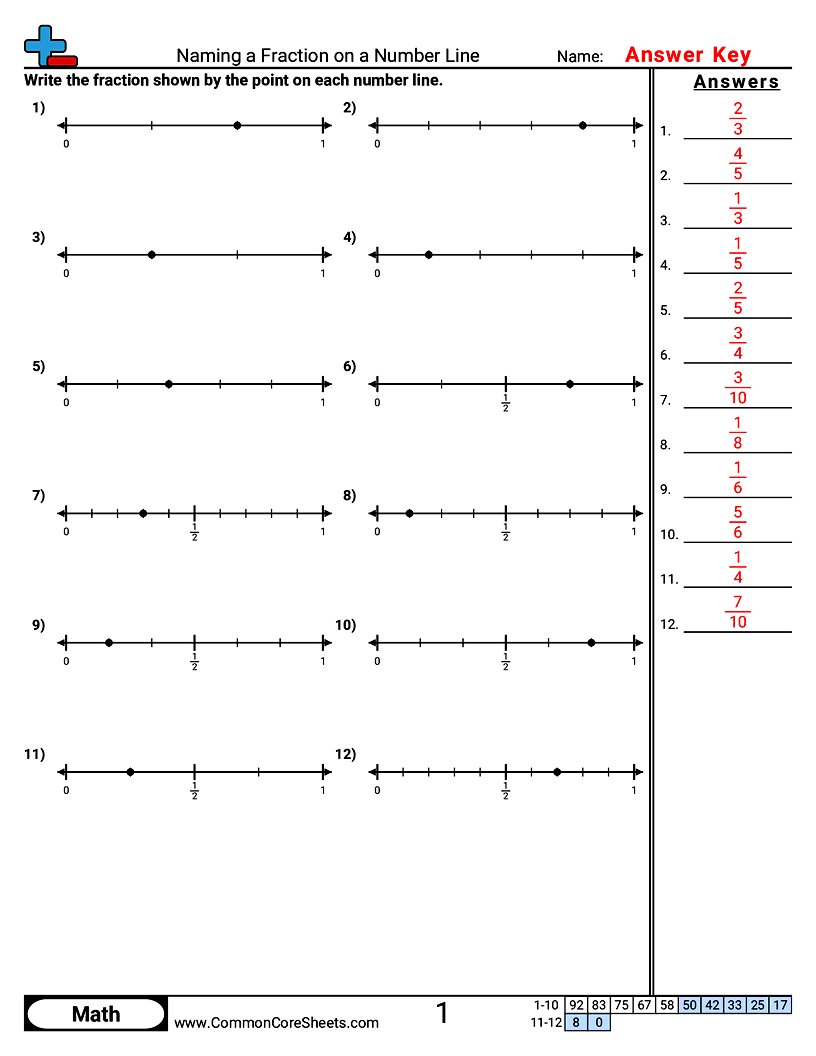
Name the fraction shown by a point on a number line. Use 0, one half and 1 as benchmarks to read a position. Count equal parts between 0 and 1 to find a denominator.
3nf2b
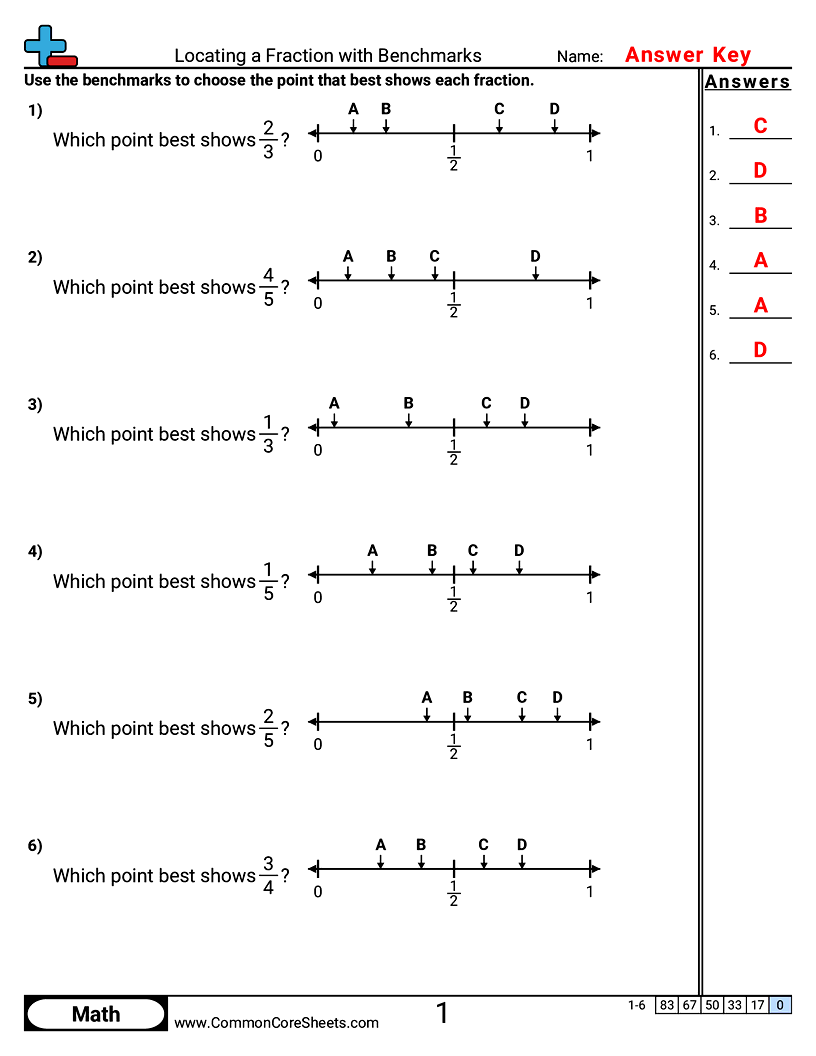
Decide roughly where a fraction falls using 0, one half and 1 as benchmarks. Choose the point on a number line that best shows a given fraction. Judge whether a fraction is less than, near, or more than one half.
3nf2a
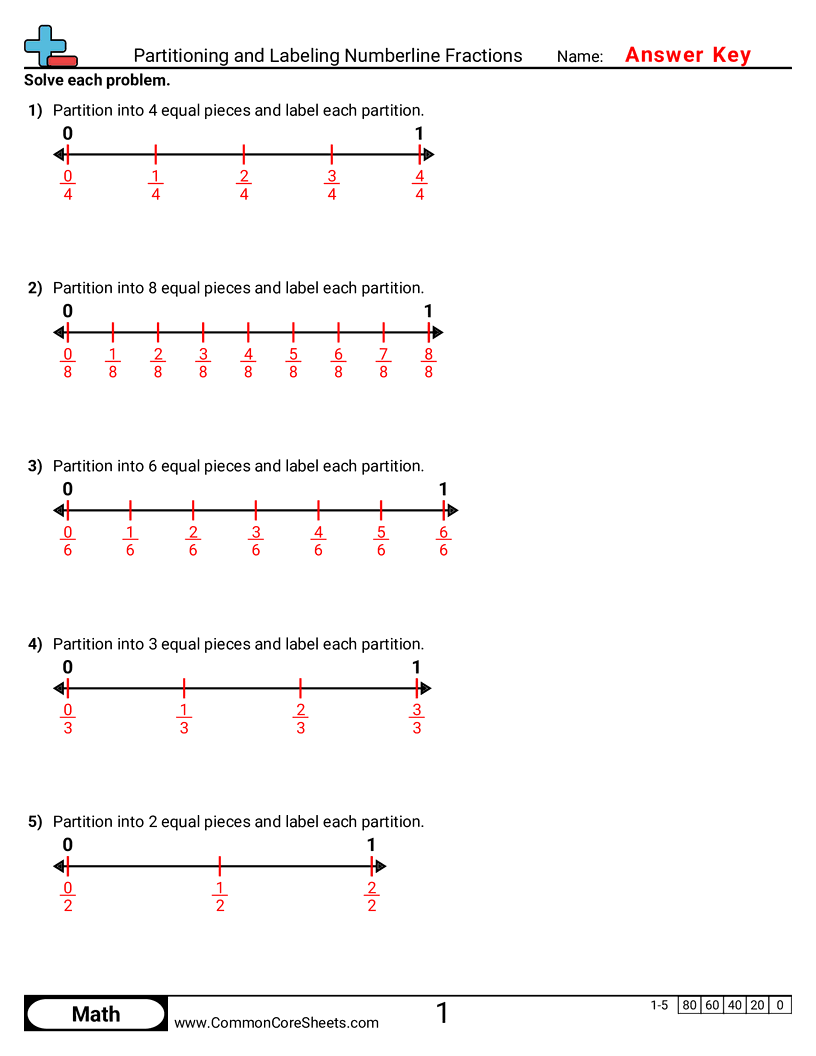
Break a whole number line segment into equal parts based on the denominator. Use the tick marks to label unit fractions like 1/4 or 1/6. Match the numerator and denominator to the correct point on a number line.
3nf3c
Find where a fraction belongs between two whole numbers on a number line. Use the denominator to split a number line segment into equal parts. Match a fraction to the correct tick mark by counting equal jumps from 0 or from a whole number. Explain why a fraction is closer to 0, 1, or another whole number based on its size.
3nf3d
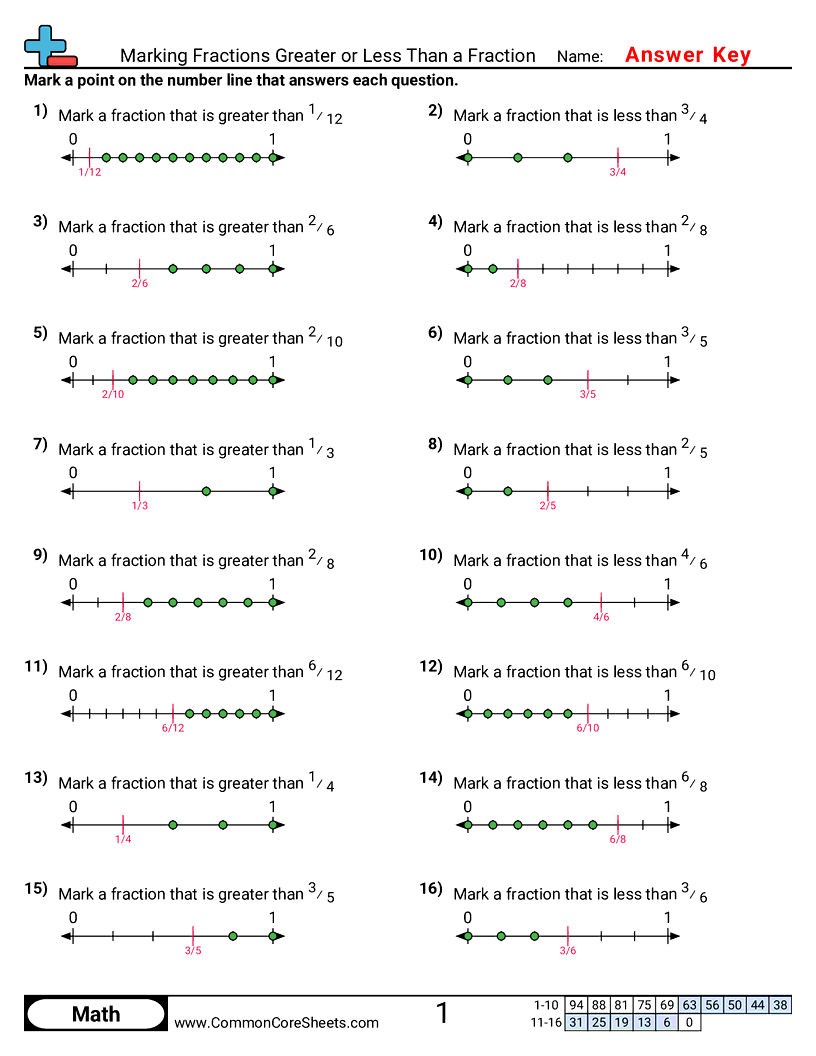
Locate a given fraction on a number line divided into equal parts Mark a fraction that is greater than a given fraction Mark a fraction that is less than a given fraction Recognize that a comparison question can have more than one correct answer
You are only seeing3rd Grade
See all grades
5 more worksheets in this section
About these worksheets
These worksheets develop fraction comparison skills using multiple strategies. Students compare fractions with same numerators or denominators, compare fractions with different denominators using common denominators, determine whether fractions are greater than, less than, or equal to one-half, order sets of fractions, and use visual models for comparison. Resources span third through fourth grade.
3nf3d
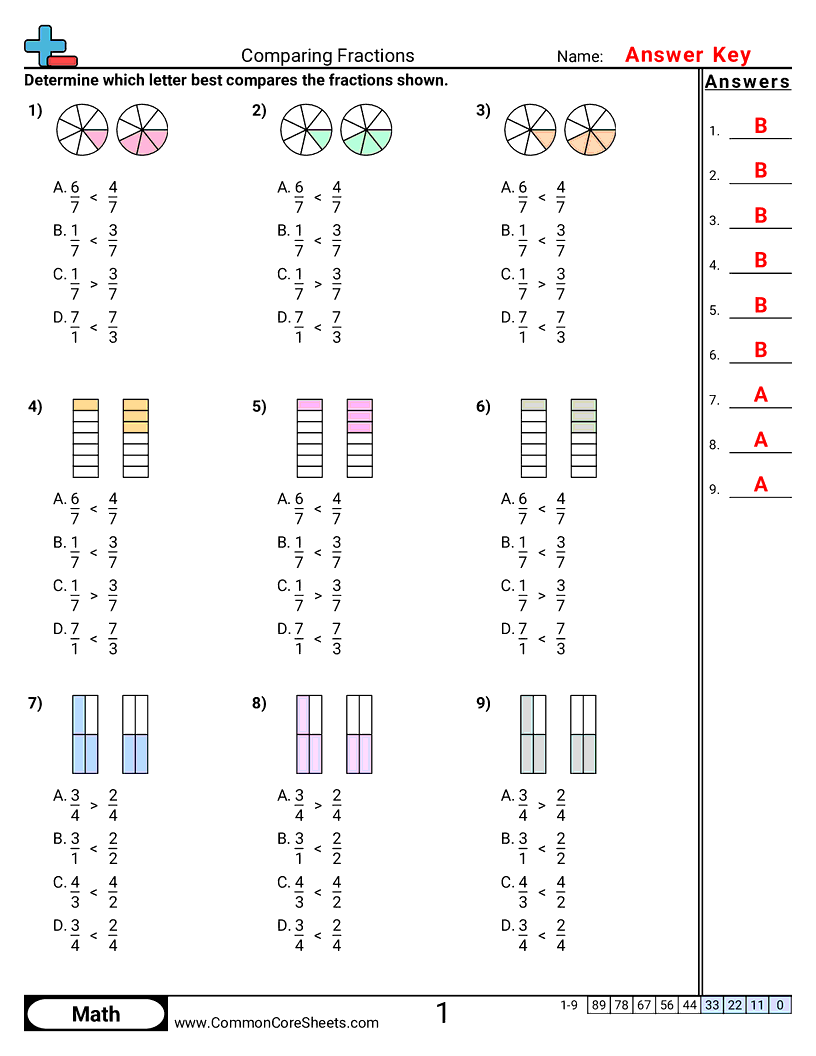
Compare two fractions and decide which one is greater, less, or if they are equal. Fill in the missing fraction to make a comparison statement true. Use fraction models or number lines to compare fractions by their size. Compare fractions with different denominators by thinking about equivalent fractions or common denominators.
3nf1
Match a shaded picture or model to the fraction it shows. Count equal parts to figure out the denominator and count shaded parts to figure out the numerator. Recognize the same fraction shown with different shapes or layouts (like bars, circles, or grids).
3nf3d
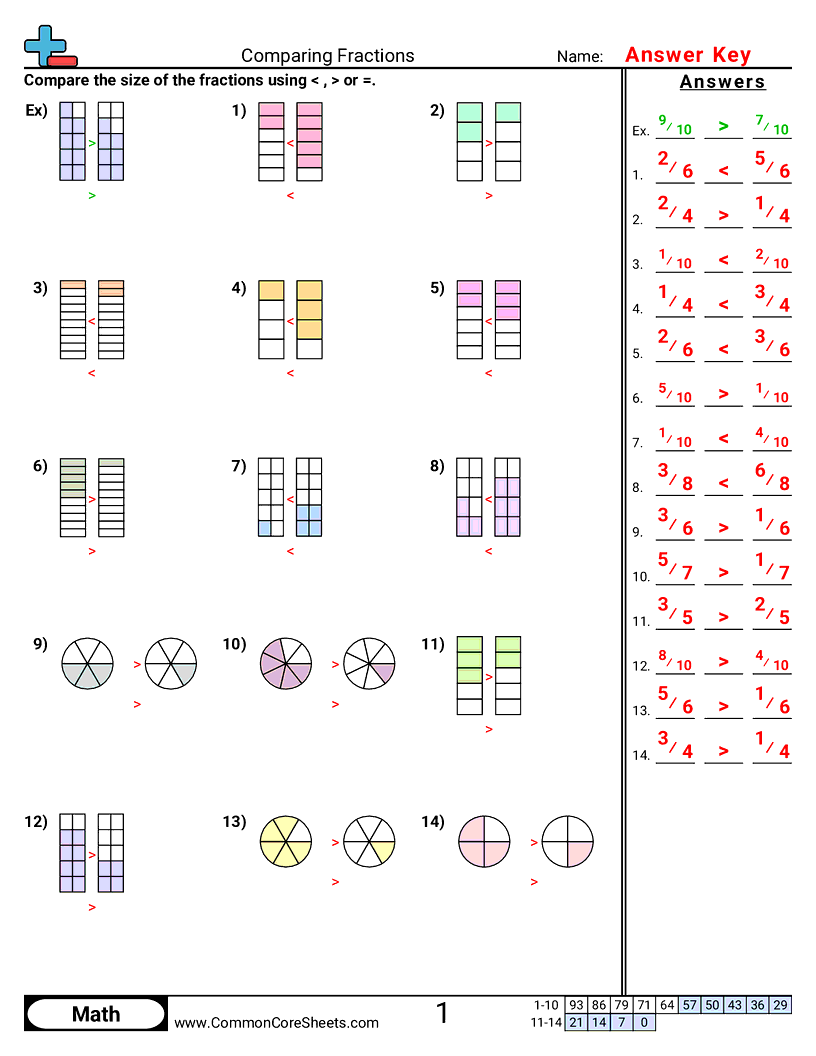
Decide which of two fractions is greater, less, or if they are equal. Use fraction pictures or models to compare the size of two fractions. Identify the numeric value of a visual fraction model. Count equal parts to figure out the denominator and count shaded parts to figure out the numerator.
3nf3d
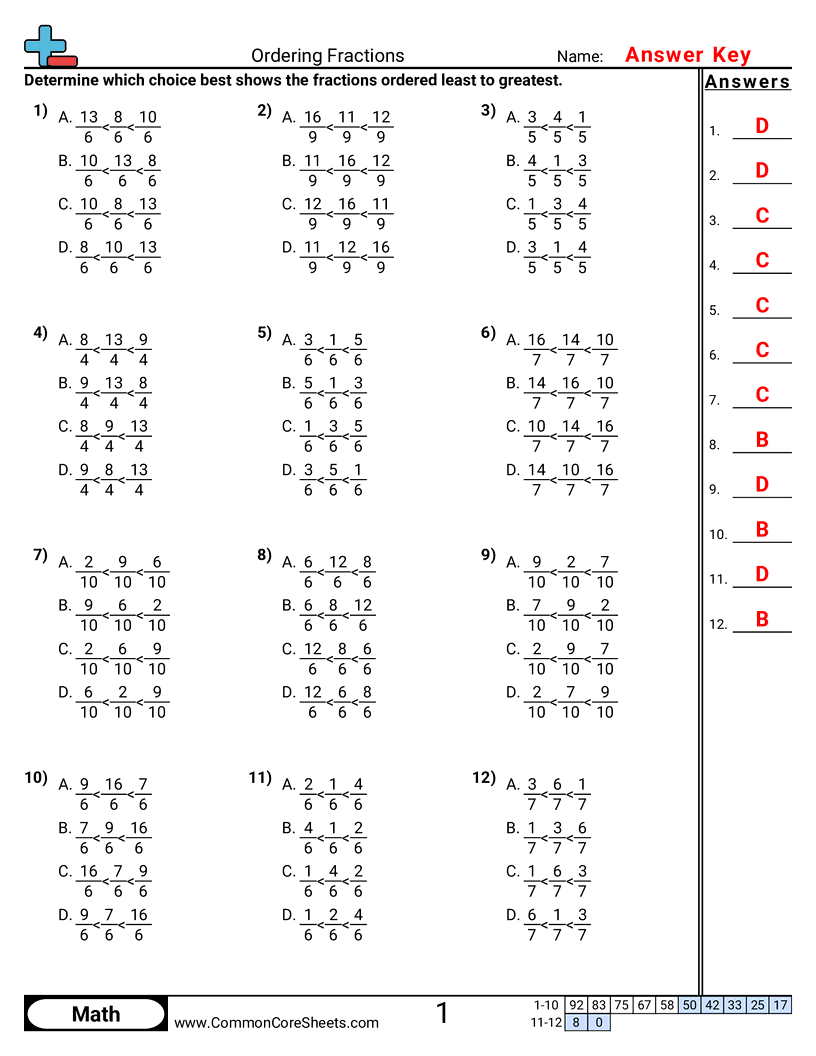
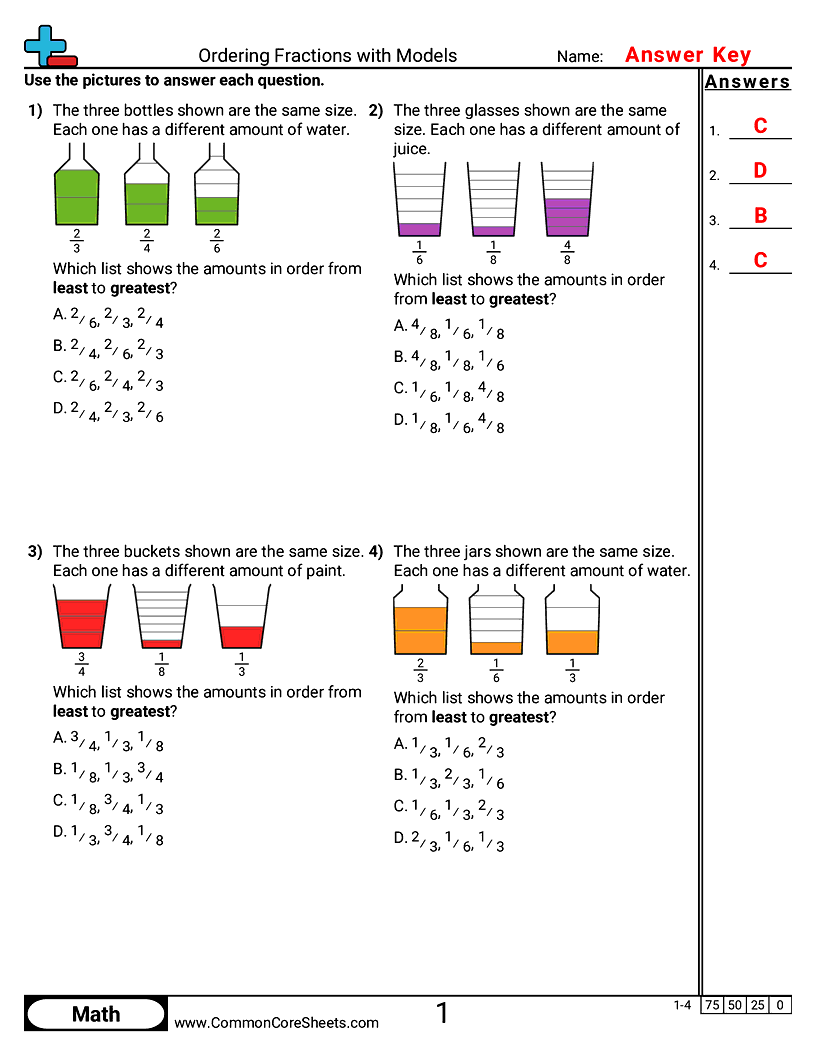
Put a set of fractions in order from least to greatest. Compare two fractions to decide which one is larger or smaller. Use benchmark fractions like 0, 1/2, and 1 to judge fraction size.
3nf3d
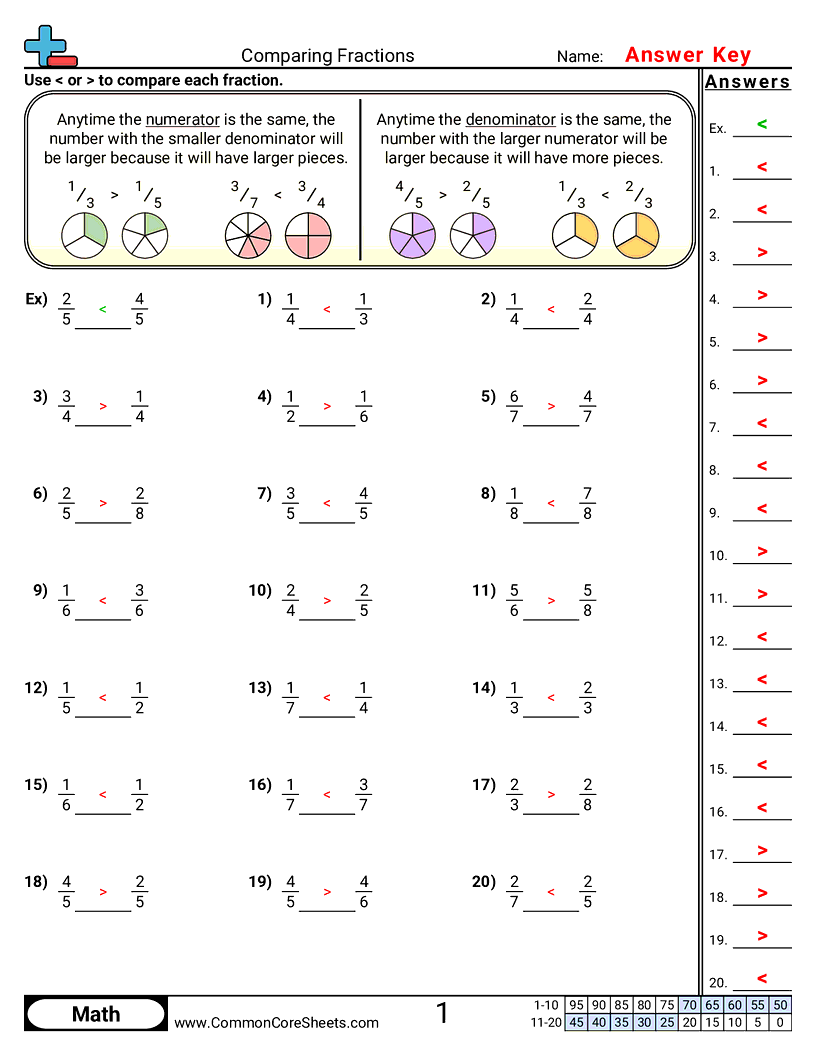
Compare two fractions when the denominators are the same by looking at which numerator is bigger. Compare two fractions when the numerators are the same by deciding which denominator makes bigger pieces. Use the symbols >, <, and = to show which fraction is larger, smaller, or if they are equal.
3nf3b
Decide which of two fractions is greater, less, or if they are equal by looking at pictures or models.
3nf3d 4nf2
Use a fraction model to decide which of two fractions is greater or less. Read the question carefully, since some ask for greater and some for less. Compare fractions with different denominators using a picture rather than a rule.
3nf3d
Compare fractions of the same whole using a picture Order three fractions from least to greatest Order three fractions from greatest to least See why a larger denominator means smaller pieces
You are only seeing3rd Grade
See all grades
5 more worksheets in this section
About these worksheets
Students learn to create, identify, and work with equivalent fractions. Activities include using visual models and number lines to find equivalent fractions, reducing fractions to simplest form, finding missing numerators or denominators, recognizing equivalent fraction patterns, writing whole numbers as fractions, and simplifying mixed numbers with improper fraction parts. Aligned with third through fourth grade standards.
3nf3b
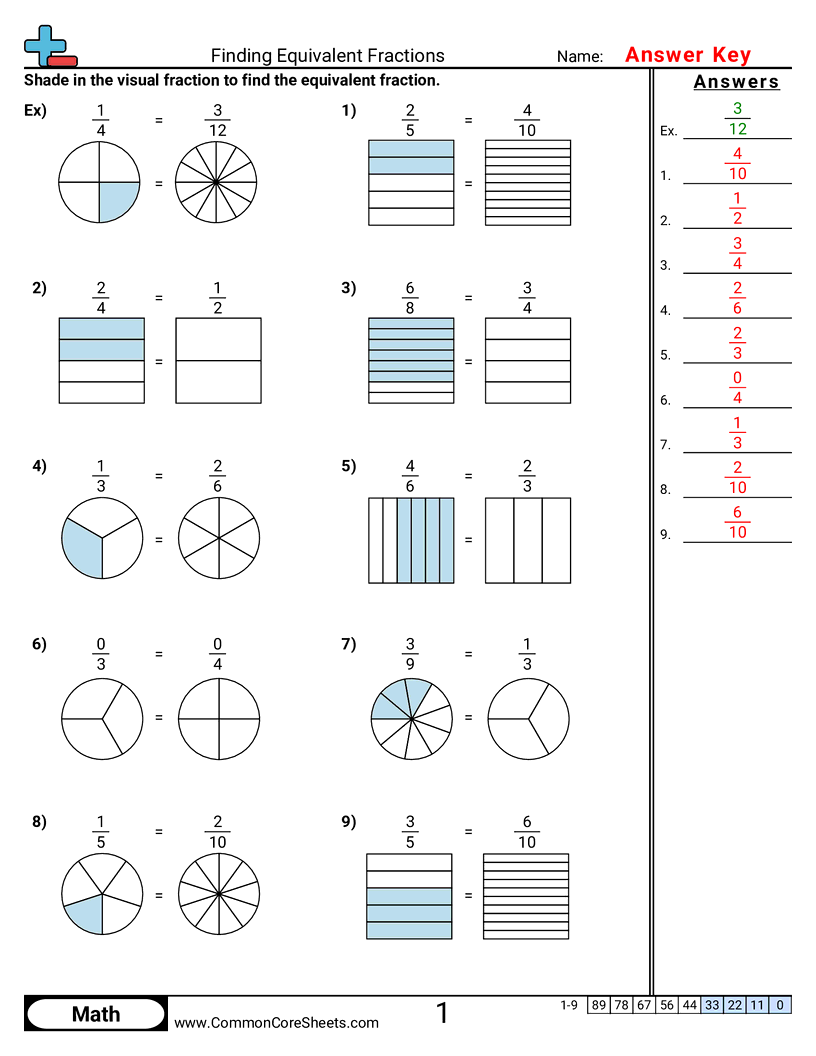
Use shaded pictures to see what fraction of a whole is shown. Express an equivalent fraction in a picture model. Match equivalent fractions by noticing when the whole is split into more equal parts. Connect the numerator and denominator to how many parts are shaded and how many parts there are in all.
3nf3a
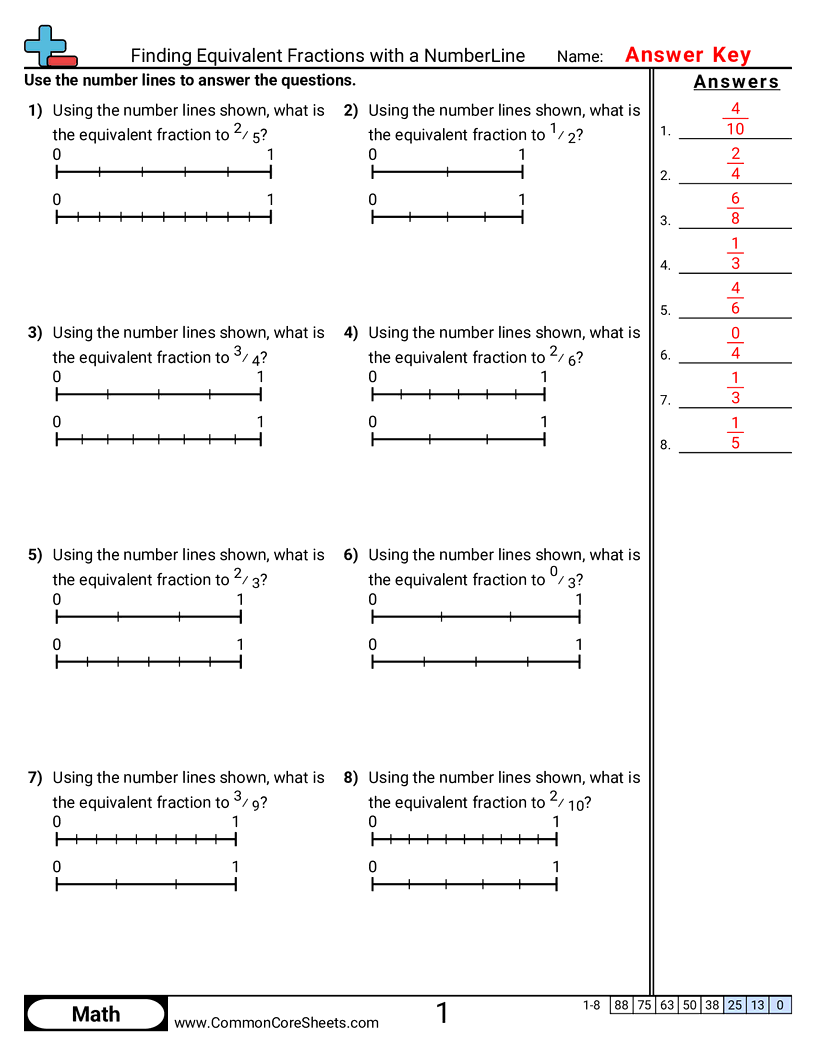
Use a number line to see where a fraction lands between 0 and 1. Find an equivalent fraction by splitting the same number line into more equal parts. Match two fractions that point to the same spot on a number line.
3nf3c
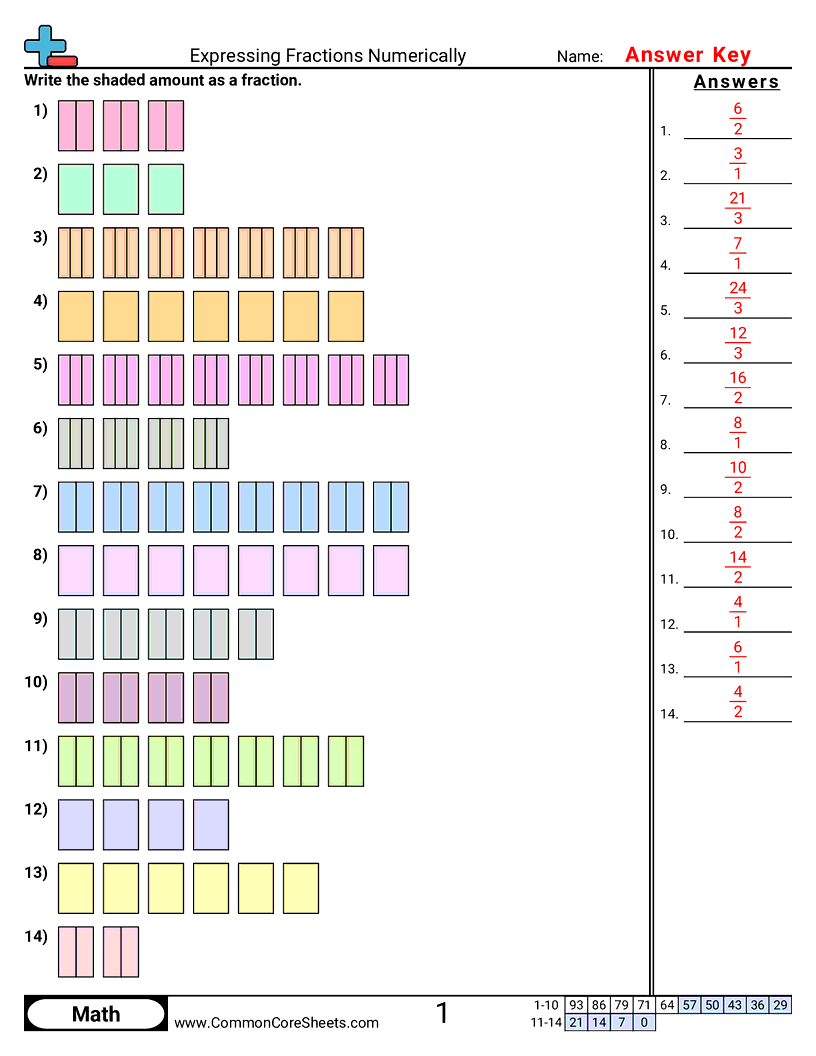
Practice counting shaded parts across multiple shapes to write an improper fraction Figure out the denominator by looking at how many equal pieces each shape is divided into Write fractions greater than one whole by counting all the shaded pieces as the numerator
3nf3c
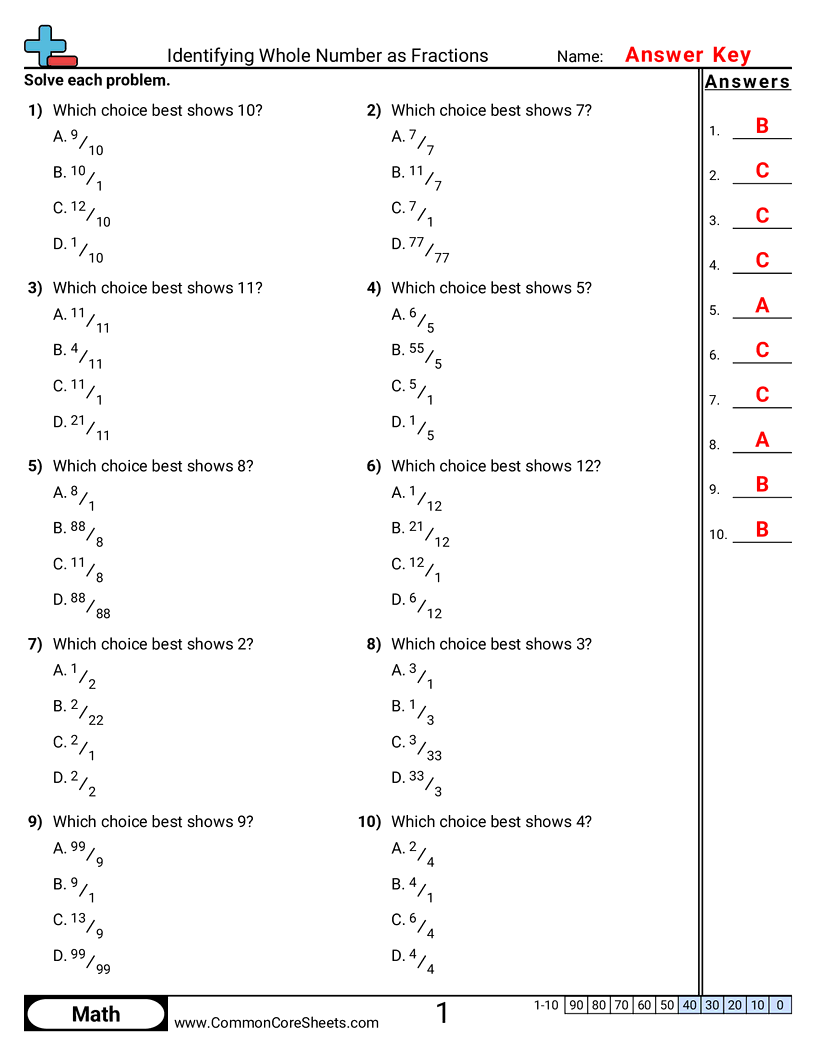
Recognize that any whole number can be written as a fraction with a denominator of 1. Write whole numbers in fraction form (like 5 as 5/1).
3nf3c
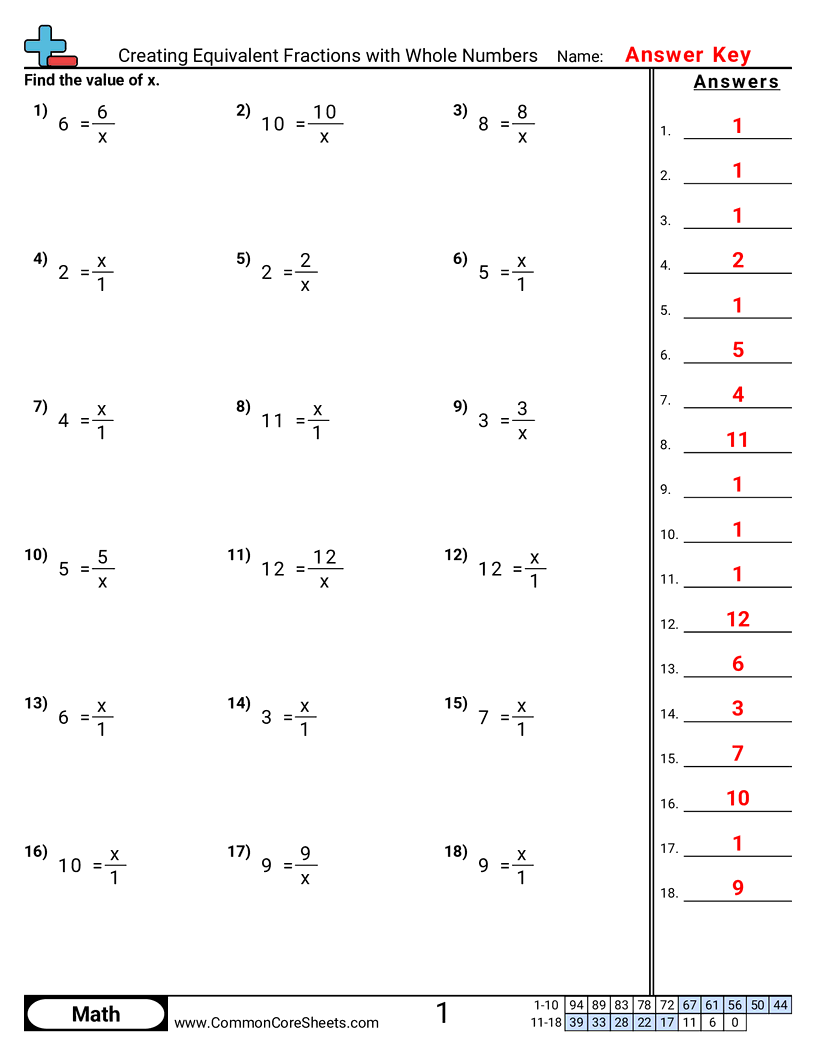
Practice understanding that any whole number can be written as a fraction (like 6 = 6/1) Find the missing value in a fraction that makes it equal to a whole number Learn that dividing a number by itself equals 1 and dividing a number by 1 equals itself
You are only seeing3rd Grade
See all grades
9 more worksheets in this section
About these worksheets
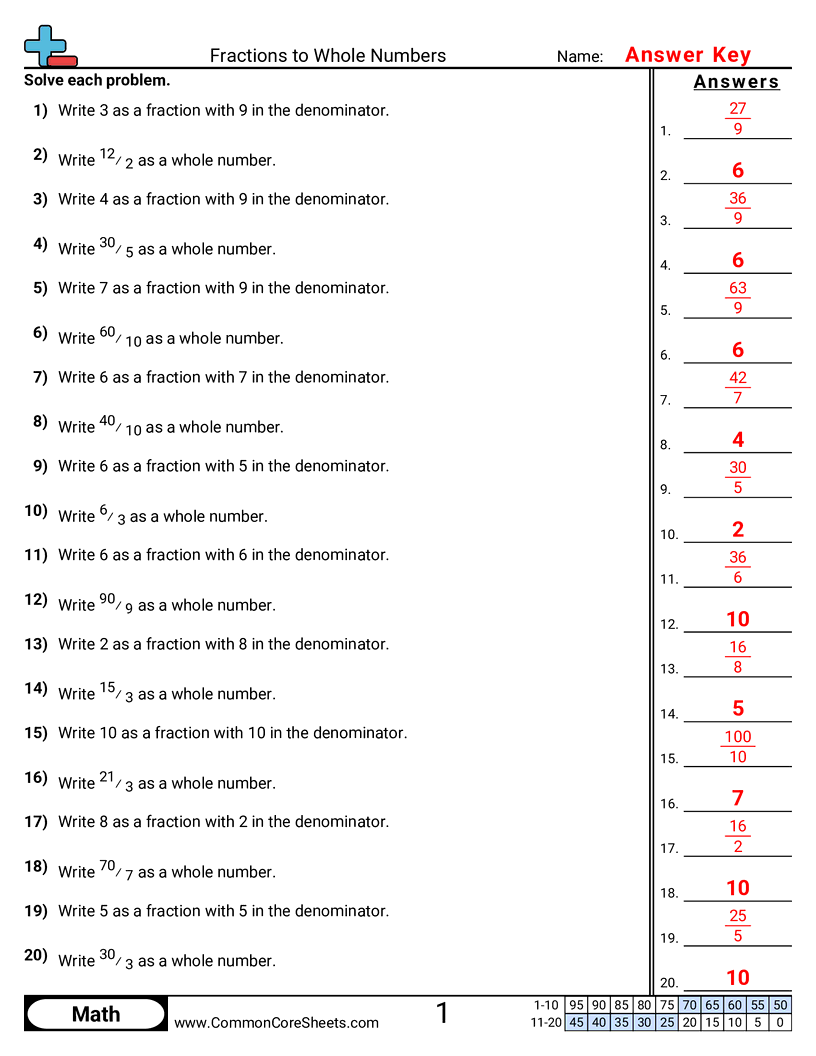
These worksheets focus on converting between different fraction forms. Students practice converting fractions to whole numbers, changing improper fractions to mixed numbers, converting mixed numbers to improper fractions, and matching visual models to both forms. Aligned with third and fourth grade standards.
Advertisement