Why Leaves Change Color Worksheet Download
Free reading comprehension worksheet about why leaves change color in autumn. Pick the reading level (kindergarten to 8th grade), print the passage with its questions, or assign it online.


Sheet Information >
Available at kindergarten, 1st grade, 2nd grade, 3rd grade, 4th grade, 5th grade, 6th grade, 7th grade and 8th grade reading levels.
Read the passage
Look at all the leaves turning red and gold! In fall many leaves change from green to yellow orange and red. They look like they are wearing bright new colors.
Those bright colors were hiding in the leaf all along! In summer green covers them up. When the days get short and cold the green goes away and the colors show.
Soon the pretty leaves let go and fall to the ground. You can rake them into a big pile and jump right in! Did you know one tree can drop thousands of leaves in one fall?
Have you ever seen a red leaf in fall? In autumn, leaves turn red, orange, and yellow. They make the trees look like they are on fire!
Those bright leaves start out green all summer. Green comes from a helper called chlorophyll that catches sunlight. When the days get short, the green fades away.
Once the green is gone, other colors get to show! The yellow and orange were hiding in the leaf the whole time. Soon the dry leaves fall down, and you can jump in them!
Have you ever seen a tree turn from green to bright orange, like a giant lit-up pumpkin? In autumn, leaves change from green to yellow, orange, red, and even purple. It looks like magic, but it is really science!
That green color comes from something inside leaves called chlorophyll, which soaks up sunlight to make food for the tree. In fall the days get shorter and there is less sunlight, so the green slowly fades away. When the green disappears, other colors that were hiding all along finally get to show off.
Those hiding colors are the sunny yellows and warm oranges, and they were in the leaves the whole summer! You just could not see them because the green was covering them up, like paint over a picture. The bright reds and purples are different, because the tree makes those brand-new in the cool fall weather.
After the leaves finish their big color show, the tree lets them go, and they float down to the ground. The tree does this to rest and stay safe through the cold, snowy winter. So next fall, when a red leaf lands by your feet, remember it made that color just for you!
Imagine you are walking through a park on a crisp fall day, kicking through leaves that crunch like potato chips under your feet. Above you, the trees glow with red, orange, and gold, like someone painted the whole forest overnight. But those colors did not appear out of nowhere. Some of them were hiding inside the leaves the whole time!
To understand where those colors were hiding, you first have to know why leaves are green in summer. Leaves are full of a green stuff called chlorophyll, which soaks up sunlight and turns it into food for the tree. So much green chlorophyll fills a summer leaf that it covers up every other color, like a green blanket. Underneath that blanket, yellow and orange colors called carotenoids have been waiting all along.
Those hidden yellows and oranges finally get their turn when autumn arrives and the days grow shorter. Because there is less sunlight, the tree stops making chlorophyll, and the green blanket slowly fades away. Then the yellows and oranges peek through, and some trees even make brand-new red and purple colors called anthocyanins. Sunny days and cool nights help trees make the brightest reds, so some autumns are far more colorful than others.
After the leaves put on their colorful show, they let go and float to the ground. The tree does this on purpose, sealing off each leaf so it can rest through the cold winter and save water. In spring, fresh green leaves will grow and the whole cycle starts again. Here is the wildest part: the fiery colors you love in fall were tucked inside the leaves since summer, just waiting for the green to step aside!
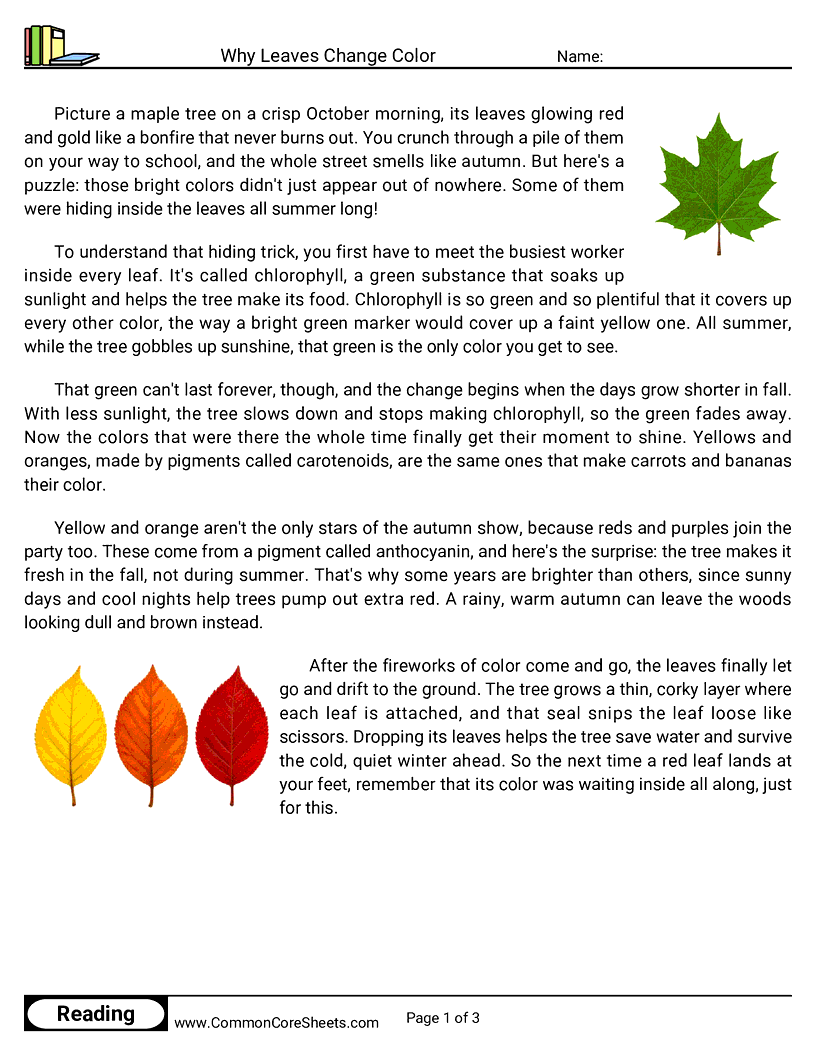
Picture a maple tree on a crisp October morning, its leaves glowing red and gold like a bonfire that never burns out. You crunch through a pile of them on your way to school, and the whole street smells like autumn. But here's a puzzle: those bright colors didn't just appear out of nowhere. Some of them were hiding inside the leaves all summer long!
To understand that hiding trick, you first have to meet the busiest worker inside every leaf. It's called chlorophyll, a green substance that soaks up sunlight and helps the tree make its food. Chlorophyll is so green and so plentiful that it covers up every other color, the way a bright green marker would cover up a faint yellow one. All summer, while the tree gobbles up sunshine, that green is the only color you get to see.
That green can't last forever, though, and the change begins when the days grow shorter in fall. With less sunlight, the tree slows down and stops making chlorophyll, so the green fades away. Now the colors that were there the whole time finally get their moment to shine. Yellows and oranges, made by pigments called carotenoids, are the same ones that make carrots and bananas their color.
Yellow and orange aren't the only stars of the autumn show, because reds and purples join the party too. These come from a pigment called anthocyanin, and here's the surprise: the tree makes it fresh in the fall, not during summer. That's why some years are brighter than others, since sunny days and cool nights help trees pump out extra red. A rainy, warm autumn can leave the woods looking dull and brown instead.
After the fireworks of color come and go, the leaves finally let go and drift to the ground. The tree grows a thin, corky layer where each leaf is attached, and that seal snips the leaf loose like scissors. Dropping its leaves helps the tree save water and survive the cold, quiet winter ahead. So the next time a red leaf lands at your feet, remember that its color was waiting inside all along, just for this.
Here is a mystery worth chewing on: how can a leaf be green all summer and then blaze orange in October, when nobody ever painted it? The truth is that the colors were hiding inside the leaf the whole time, waiting for their turn. A summer leaf is like a busy green factory, packed with a chemical called chlorophyll that soaks up sunlight and makes food for the tree. There is so much chlorophyll that it drowns out every other color, the way a bright flashlight hides the stars.
That green flashlight, it turns out, cannot stay on forever. As autumn arrives, the days grow shorter and the nights grow longer and cooler, and the tree senses the change like an alarm clock. It slowly shuts the food factory down and stops making chlorophyll, so the green fades away week by week. And once the green is gone, the colors that were waiting backstage finally step into the spotlight.
The first performers to appear are the yellows and oranges, made by pigments called carotenoids. Believe it or not, these were tucked inside the leaf all summer long, hidden behind the green, the same pigments that make carrots orange and bananas yellow. When the chlorophyll disappears, they are simply uncovered, like furniture found under a sheet you finally pulled off. So that golden maple in your yard did not turn yellow overnight; it was quietly yellow underneath the entire time.
The reds and purples play by a completely different rule. Unlike the carotenoids, pigments called anthocyanins are not hiding in summer at all; the tree actually makes them fresh in the fall from leftover sugar trapped in the leaves. That is why a string of sunny days and crisp, cool nights can paint a forest in the brightest reds, while a warm, cloudy autumn leaves the colors dull. So the weather you complain about is secretly the artist deciding how bold the show will be.
After the grand color show, the leaf has one last trick before it lets go. The tree grows a thin, corky wall where the leaf stem meets the branch, quietly cutting off the water and cementing the leaf loose. One gust of wind, and down it drifts, joining the crunchy pile you love to jump in on a Halloween afternoon. And here is the strangest part of the whole story: the fiery reds and golds were never new colors at all, only secrets a tree keeps until the light is just right.
Here's something that sounds impossible: the golden yellow bursting from that October maple was hiding inside the leaf all summer long. You just couldn't see it. For months, a green pigment called chlorophyll painted over every other color, the way a bright coat of paint hides the wood underneath. When autumn arrives and the green finally fades, the leaf reveals shades that were there the whole time. So a tree in fall isn't really changing its colors — it's finally showing them off.
To understand that reveal, you have to know what chlorophyll was busy doing all summer. This green pigment is a food factory, using sunlight to turn air and water into sugar in a process called photosynthesis. As autumn days grow shorter and cooler, a tree senses the coming winter and stops making new chlorophyll. The old green pigment breaks down and disappears, and suddenly the yellows and oranges get their moment in the spotlight. Those warm colors come from pigments called carotenoids — the same family of chemicals that makes carrots orange and egg yolks yellow.
While yellows and oranges are simply unmasked, the fiery reds and deep purples are a different story altogether. Those colors come from pigments called anthocyanins, and here's the twist: the tree makes them fresh in autumn, not in summer. A maple or an oak actually manufactures these red pigments as the season turns, partly to protect the leaf while it drains away its last useful nutrients. Think of anthocyanins as a kind of sunscreen the leaf whips up at the last minute. That's why some trees blaze scarlet while their neighbors glow plain gold.
The recipe for red also explains why one autumn can outshine another so dramatically. The brightest displays tend to follow a string of warm, sunny days paired with cool but not freezing nights, because that weather helps trees pump out extra anthocyanins. A summer drought or an early hard frost, on the other hand, can cut the show short and turn leaves dull and brown. Eventually, no matter the colors, the leaf's job is done, and the tree seals off the stem with a special layer of cells. That cork-like seal is exactly why the leaf lets go and drifts to the ground.
So why should any of this matter beyond a pretty view from your window? For one, those falling leaves feed the forest, rotting into rich soil that nourishes next spring's growth, so autumn's ending is really a beginning. Fall color also draws travelers by the millions to places like New England every year, turning red maples into a genuine part of the local economy. And scientists still study anthocyanins because those same red pigments show up in blueberries, red cabbage, and other foods thought to be good for us. The next time a scarlet leaf spins past you, remember — you're watching chemistry that spent all summer waiting for its turn.
Picture a green leaf as a tiny solar-powered factory running all summer long, humming with a chemical called chlorophyll. This green pigment is the star of photosynthesis, the process plants use to turn sunlight, water, and air into food. There is so much chlorophyll packed into a leaf that it drowns out every other color hiding underneath. So when a maple blazes orange or a birch glows gold in October, you are not watching new paint appear. You are watching the green curtain finally fall away.
That curtain drops because of a clock, not a paintbrush. As autumn nights grow longer, trees sense the change and begin to shut their food factories down for winter. They stop making chlorophyll, and the green they worked so hard to build starts breaking apart and fading. Once it is gone, colors called carotenoids step into the spotlight, painting leaves yellow and orange. Here is the surprise: those pigments were inside the leaf the whole time, quietly helping capture sunlight all summer.
If yellows and oranges are old news, the fiery reds are the season's new arrivals. Unlike carotenoids, the pigments called anthocyanins are not waiting in the leaf ahead of time. Trees actually manufacture them in autumn, building the reds and purples fresh as the days shorten. Scientists still debate exactly why a tree would spend energy making new color while it is closing up shop. One leading idea is that the red acts like sunscreen, shielding the leaf while the tree pulls back valuable nutrients to store for spring.
Because reds are made to order, they explain why no two autumns look quite the same. Anthocyanins form best during warm, sunny days followed by cool, crisp nights, which is why some years the hills turn shockingly bright. A wet spring, a mild fall, and clear afternoons all tilt the odds toward a spectacular show. But a summer drought or a stretch of gray, gloomy weather can leave the same forest looking dull and brown. This is why leaf-peepers in places like Vermont watch the weather as closely as any farmer.
All that color, though, is really the tree saying goodbye to its leaves. At the base of each leaf stalk, the tree grows a special layer of cells called the abscission layer, a kind of built-in trap door. This layer slowly seals off the leaf from the branch, cutting the water and food it once received. Eventually a gust of wind or a heavy rain is all it takes to send the leaf spinning to the ground. Dropping its leaves lets the tree survive winter, when frozen ground makes water almost impossible to drink.
So the next time a crunchy leaf skitters across your Halloween path, remember it is a used-up solar panel with a hidden history. The gold was always there, the red was made in a rush, and the green simply ran out of time. Trees that keep their leaves through winter, like pines, cheat the whole system with tough, waxy needles built to last. Meanwhile, a single large tree can drop hundreds of thousands of leaves in one autumn. Every one of them is a small chemistry experiment that finished right on schedule.
In the 1800s, a British scientist named George Stokes studied how light passed through plant extracts, part of a long effort by many scientists to reveal something odd: the green stuff in leaves was actually hiding other colors underneath. That green stuff is chlorophyll, the pigment that lets plants turn sunlight into food. All summer, a healthy maple or oak leaf is packed so full of chlorophyll that you only ever see one shade: green, and lots of it. But here's the twist that makes autumn so spectacular \u2014 the yellows and oranges you admire in October were quietly present the whole time, simply outnumbered. When the green fades, the leaf finally reveals what it was wearing underneath.
To understand why the green fades, you have to think about what a tree senses as summer ends. It isn't the cold that triggers the change, as many people assume \u2014 it's the shrinking length of the day. As nights grow longer, a tree reads the darkness like a calendar and begins shutting down its food-making factory to prepare for winter. It stops producing chlorophyll, and the green pigment that was constantly being replaced now breaks down without a replacement. With the green gone, the pigments that survive step into the spotlight.
Those surviving pigments are the carotenoids, and they are the same family of molecules that make carrots orange and egg yolks yellow. Unlike chlorophyll, they are tough and slow to break down, so they linger in the leaf after the green disappears. This is why birches and aspens turn such a clean, glowing gold \u2014 you are seeing pigments that were there all along, unmasked. In a sense, the tree isn't painting the leaf a new color at all; it is erasing the layer that hid the old one. That distinction matters, because not every fall color works this way.
The fiery reds and deep purples, by contrast, are freshly manufactured, and this is where the story gets genuinely surprising. These pigments are called anthocyanins, and the leaf produces them in autumn from leftover sugars trapped inside it. Scientists still debate why a dying leaf would bother building brand-new pigment, but a leading idea is that the red acts like sunscreen, protecting the leaf long enough to pull valuable nutrients back into the tree. Bright, sunny days followed by cool but not freezing nights push more sugar into the leaves and produce the most vivid reds. So a carotenoid leaf shows off what it kept, while an anthocyanin leaf shows off what it made.
Because reds depend on the weather, autumns are not equally colorful from one year to the next. A warm, wet, sunny early fall with crisp nights tends to produce the boldest displays, while a drought or a sudden hard freeze can turn leaves dull brown and drop them fast. This is also why the same species can blaze scarlet in New England yet look muted somewhere warmer. People sometimes credit the frost for the colors, but a killing frost usually ends the show rather than starting it. The real artists are sunlight, sugar, and the steady loss of daylight.
Once the colorful pigments have done their work, the leaf's final act is to let go. At the base of each leaf stalk, the tree grows a special layer of cells called the abscission layer, which slowly seals off the leaf like a healing wound. When that seal is complete, a gust of October wind is all it takes to send the leaf spinning to the ground. The tree isn't losing a battle with winter \u2014 it is deliberately dropping thousands of tiny factories it can no longer afford to run. So the next time a red leaf drifts past your window, remember you're watching a plant recycle its own sunscreen after a summer of quietly hiding its true colors.
About this worksheet
Students read a nonfiction passage about why leaves change color in autumn, written at 9 reading levels (kindergarten to 8th grade), and answer multiple-choice questions about it.
A reading comprehension worksheet about why leaves change color in autumn with a different article for each reading level, kindergarten to 8th grade, each with its own multiple-choice questions aligned to the Common Core Reading: Informational Text standards. Printable with an answer key, and available as an online assignment at any level.
Student objectives
- Read a science passage about why leaves change color in fall.
- Explain how chlorophyll, carotenoids, and anthocyanin each affect leaf color.
- Find details showing why some autumns are brighter than others.
- Explain why trees drop their leaves before winter.
Everyday practice
- Collect three fall leaves of different colors and compare their shades.
- Watch one tree over several weeks and notice how its colors change.
- Look for the thin line where a leaf attaches to its stem.