Where Superstitions Come From Worksheet Download
Free reading comprehension worksheet about where superstitions come from. Pick the reading level (2nd grade to 8th grade), print the passage with its questions, or assign it online.


Sheet Information >
Available at 2nd grade, 3rd grade, 4th grade, 5th grade, 6th grade, 7th grade and 8th grade reading levels.
Read the passage
Have you ever crossed your fingers and hoped for good luck? A superstition is a belief that some little thing can bring you good luck or bad luck. People all over the world have believed in lucky and unlucky things for a very long time!
Take the horseshoe, that curved piece of metal a horse wears on its hoof. Long ago, people hung a horseshoe over a door and told stories that it would keep bad things away. They believed iron was strong and could guard their homes.
A horseshoe is metal, and so is a mirror's shiny back, which brings us to another old belief. People once told a story that breaking a mirror would bring seven years of bad luck. That story started long ago because mirrors were rare and cost a lot to make.
Not every superstition is about bad luck, and here is a happier one you may already do. When people hope for something good, they knock on wood, a habit they do again and again that is hundreds of years old. Scientists say we keep these habits because doing them makes us feel a little more in control!
Imagine you are walking down the sidewalk and you see a tall ladder leaning against a wall. Do you walk right under it, or step around it instead? Many people step around it, because they believe walking under a ladder brings bad luck. A superstition is a belief that doing one small thing can bring good luck or bad luck, even when there is no real reason for it.
That leaning ladder is only one of many beliefs people have shared for a very long time. Long ago, some people said a ladder against a wall made a triangle shape, and they thought triangles were special, so passing through one felt wrong. People also told a story that breaking a mirror would bring seven years of bad luck, because they once believed a mirror held a piece of your spirit. When the glass cracked, they thought your luck cracked too!
Not every superstition is about bad luck, though, and some are meant to keep you safe and happy. Have you ever knocked on wood after saying something you hoped would come true? Long ago some people believed that gentle spirits lived inside trees, so tapping the wood was a way to ask them for help. A horseshoe is another lucky charm, and people often hang one over a door with the ends pointing up, so the good luck will not spill out.
So why do people keep believing these things, even today? Scientists say a superstition can make us feel like we are in control when something feels scary or uncertain. We also remember the times a lucky charm seemed to work and forget all the times it did not. Here is the surprising part: the number 13 scares so many people that some tall buildings skip it and label that floor 14 instead!
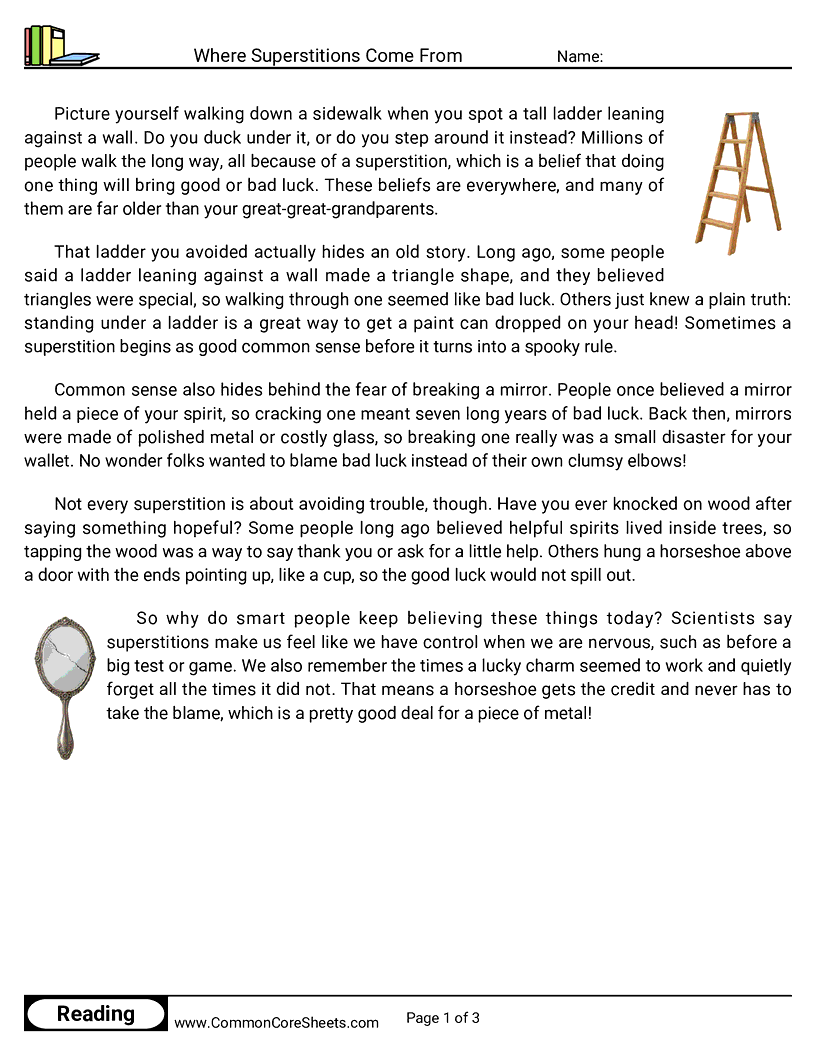
Picture yourself walking down a sidewalk when you spot a tall ladder leaning against a wall. Do you duck under it, or do you step around it instead? Millions of people walk the long way, all because of a superstition, which is a belief that doing one thing will bring good or bad luck. These beliefs are everywhere, and many of them are far older than your great-great-grandparents.
That ladder you avoided actually hides an old story. Long ago, some people said a ladder leaning against a wall made a triangle shape, and they believed triangles were special, so walking through one seemed like bad luck. Others just knew a plain truth: standing under a ladder is a great way to get a paint can dropped on your head! Sometimes a superstition begins as good common sense before it turns into a spooky rule.
Common sense also hides behind the fear of breaking a mirror. People once believed a mirror held a piece of your spirit, so cracking one meant seven long years of bad luck. Back then, mirrors were made of polished metal or costly glass, so breaking one really was a small disaster for your wallet. No wonder folks wanted to blame bad luck instead of their own clumsy elbows!
Not every superstition is about avoiding trouble, though. Have you ever knocked on wood after saying something hopeful? Some people long ago believed helpful spirits lived inside trees, so tapping the wood was a way to say thank you or ask for a little help. Others hung a horseshoe above a door with the ends pointing up, like a cup, so the good luck would not spill out.
So why do smart people keep believing these things today? Scientists say superstitions make us feel like we have control when we are nervous, such as before a big test or game. We also remember the times a lucky charm seemed to work and quietly forget all the times it did not. That means a horseshoe gets the credit and never has to take the blame, which is a pretty good deal for a piece of metal!
Why would anyone believe that a black cat crossing the road could ruin their whole day? Superstitions are beliefs that a certain action or object brings good luck or bad luck, even when there is no real proof it does anything at all. Some are cheerful, like crossing your fingers or wishing on a falling star, while others make people nervous, like spilling salt. Every one of them started somewhere, and the true stories behind them are stranger than the beliefs themselves.
Take one of the oldest bad-luck beliefs of all: walking under a ladder. Long before people worried about paint cans falling on their heads, a ladder leaning against a wall formed a triangle, a shape that many ancient people, including the Egyptians, treated as sacred. Passing through that triangle, folks once said, meant breaking something holy and inviting trouble. There was a practical reason to steer clear, too, since workers and tools really can tumble off a ladder onto whoever is standing below.
Broken things worried people just as much as ladders did, and nothing worried them more than a shattered mirror. The ancient Romans believed a mirror captured a piece of your very soul, so cracking one could damage you. They also decided that the body renews itself every seven years, which is how the famous "seven years of bad luck" got its number. Mirrors were once so costly that breaking one truly was a small disaster, so the warning may have started as a clever way to make people handle them carefully.
Not every superstition brings dread, though, and knocking on wood is one people still do for comfort. Some historians think it goes back to old European beliefs that spirits or good luck lived inside trees, so touching wood was like asking them for help. A horseshoe hung over a door became another good-luck charm, partly because iron was thought to keep bad spirits away, and partly because seven nails held it on. Even the fear of Friday the 13th mixes old ideas, since some groups long treated both Fridays and the number 13 as unlucky on their own.
So why do smart people keep these habits alive today? Scientists say superstitions can make us feel in control when life feels uncertain, like wearing "lucky" socks to a big test. Our brains also play a trick called noticing the hits and forgetting the misses, so we remember the one time our lucky charm "worked" and forget the many times it didn't. That means the next time you knock on wood, you are joining a habit older than your great-great-grandparents, kept alive by the very way your mind remembers the world.
Have you ever crossed your fingers before a big test, or refused to step on a crack in the sidewalk? If so, you are joining a club that stretches back thousands of years and includes almost everyone you know. Superstitions are beliefs that some action or object can change your luck, even when there is no real connection between the two. They come in every flavor: horseshoes nailed above doorways, coins tossed into fountains, and the nervous knock on a wooden table. The strangest part is not the beliefs themselves, but how stubbornly they cling to us.
That stubborn wooden table has a story of its own. People once told a tale that spirits lived inside trees, so touching or knocking on wood was a way to thank them or ask for protection. Ladders carry a legend too: a ladder leaning against a wall forms a triangle, and to some early Christians that shape stood for something sacred, so walking through it felt disrespectful. There is also a plainer reason to avoid ladders that any construction worker will tell you today, because something might fall on your head. Sometimes the practical warning came first, and the spooky story grew around it later.
Broken mirrors got an even gloomier reputation than broken ladders. Long ago, the Romans believed a mirror captured a piece of your very soul, so cracking one damaged part of you, and they added that the harm would last seven years. Why seven? They thought the body renewed itself every seven years, so that was how long your rotten luck was sentenced to stay. A horseshoe, on the other hand, was a lucky charm, partly because iron was thought to scare off evil and partly because blacksmiths were respected as near-magical workers.
The unluckiest idea of all may be Friday the 13th, a date some people dread so much they will not fly or sign contracts on it. No single event created this fear, but the number 13 has long been treated as an unwelcome guest, arriving right after the tidy, comfortable number 12. Friday was already considered an unlucky day in several old traditions, so pairing it with 13 stacked one worry on top of another. There is even a tongue-twisting name for the fear of this date: paraskevidekatriaphobia. Try saying that three times before your next unlucky Friday!
So why do smart people keep believing things that make no logical sense? Scientists who study the brain say superstitions give us a feeling of control when life feels uncertain, like a security blanket you can carry into a scary moment. We also fall for a trick of memory: we notice the times the lucky socks worked and quietly forget the many times they did not. That habit of remembering the hits and ignoring the misses is exactly how a harmless ritual grows into a rule we obey. The next time you knock on wood, you will be repeating a gesture older than any country on Earth, all because your brain loves a good story.
Here is a strange bit of math: some office buildings and hotels skip straight from the twelfth floor to the fourteenth, as if the thirteenth simply doesn't exist. It does exist, of course, but a fear of the number thirteen is so common that builders would rather pretend otherwise. That fear even has a jaw-breaking name, triskaidekaphobia, and it is just one of dozens of superstitions people carry around like invisible luggage. Where do these odd beliefs come from, and why do smart people keep them?
Take that unlucky thirteen, which grows especially spooky when it lands on a Friday. Historians point out that many cultures once considered twelve a tidy, "complete" number, so thirteen felt like the extra guest who ruined the neat arrangement. There is no scientific evidence that any date brings bad luck, yet the belief stuck so firmly that we invented a word for the dread of Friday the 13th. The story spread through books, movies and nervous conversations until the idea felt older and more official than it really is.
That habit of blaming a number is gentle compared to what people once feared about breaking a mirror. Long ago, before glass mirrors existed, people gazed at their reflection in still water or polished metal, and some told a story that a reflection held a piece of the soul. Later, when the Romans began making early glass mirrors, a legend grew that a person's health rose and fell over cycles of about seven years, so a shattered mirror meant seven years of misfortune. Real mirrors were once so expensive that breaking one truly was a small disaster for the wallet, which may be why the belief felt so serious.
Money worries also lurk behind the warning never to walk under a ladder, though the older reason is more surprising. A ladder leaning against a wall forms a triangle, and in some traditions the triangle was a sacred shape, so passing through it seemed disrespectful. There is also a far more practical explanation your parents would approve of: standing beneath a ladder is a great way to get a paint can or a hammer dropped on your head. Sometimes a superstition is just common-sense safety wearing a spooky costume.
Not every old belief is a warning, though; some are meant to invite good luck right through the front door. People still knock on wood when they say something hopeful, a custom possibly tied to ancient ideas that spirits or protective powers lived inside trees. A horseshoe nailed above a doorway was thought to catch and hold good fortune, especially with the open end pointing up like a cup. These cheerful superstitions survive because they cost nothing and, honestly, they feel kind of fun.
So why do clever humans cling to beliefs they know aren't true, even today? Psychologists explain that superstitions give us a comforting sense of control when life feels random, like a lucky pair of socks before a big test. There is also a mental trap called confirmation bias: we vividly remember the one time our lucky charm "worked" and quietly forget the hundred times it didn't. In one study, athletes who used a lucky ritual actually performed a little better, not because of magic but because believing they would succeed calmed their nerves. That may be the real spell behind every superstition: the power isn't in the horseshoe, it's in your own mind.
Picture a baseball player who refuses to wash his socks during a winning streak, or a gambler who blows on the dice before every roll. These people are usually smart, logical, and fully aware that dirty socks cannot win games. So why do they do it? The answer sits at the crossroads of history and psychology, where ancient stories collide with the way your brain is wired. A superstition is a belief that one thing causes another when there is no real link between them, and almost everyone holds at least one.
That gambler blowing on his dice has plenty of company across the centuries, because superstitions usually begin as somebody's attempt to explain the unexplainable. Take the fear of walking under a ladder. One common explanation points to the shape a leaning ladder makes against a wall: a triangle, which some cultures long treated as a symbol of life or the sacred, so passing through it felt like breaking something holy. A more practical explanation is simpler and probably older in spirit: walking under a ladder is genuinely dangerous, because tools or paint could fall on your head. When a belief has both a mystical story and a common-sense root, historians often argue about which came first.
Broken mirrors carry a similar double story, one rooted in belief and one rooted in cost. The Romans thought a mirror captured a piece of your spirit, and the idea of seven years of bad luck grew from a belief that the body renewed itself every seven years. But there is a down-to-earth angle too, because early mirrors were expensive luxury items, and telling servants that breaking one brought years of misfortune was a clever way to make them handle the glass carefully. Notice the pattern here: a spooky legend on the surface, a practical purpose hiding underneath. This is exactly why folklorists treat old sayings as evidence about how people once lived, not just as quaint nonsense.
If broken mirrors warned people away from carelessness, other superstitions promised protection, like the horseshoe nailed above a door. One legend credits a blacksmith named Dunstan, later a saint, who was said to have tricked a demon and won a promise that it would never enter a home marked with a horseshoe. Iron itself was long believed to repel evil spirits, and a horseshoe combined iron with a lucky crescent shape. People still argue about how to hang one: points up so the luck fills the shoe like a cup, or points down so it pours over everyone who enters. Knocking on wood works the same protective way, possibly tracing back to old beliefs that spirits lived inside trees and could be called on for help.
The most famous unlucky idea of all, Friday the 13th, shows how two separate fears can merge into one. Thirteen had a bad reputation in several traditions, and Friday was separately considered an unlucky day in parts of Europe, so combining them created a kind of double dose of dread. The specific fear of Friday the 13th, however, seems surprisingly modern, appearing mainly in the past hundred and fifty years or so rather than in ancient times. There is even a tongue-twisting name for the fear: paraskevidekatriaphobia. The fact that this particular fear is so young is strong evidence that superstitions are still being invented right now.
So if these beliefs have no real power, why do sensible people cling to them? Psychologists point to two habits of the human mind working together. The first is a hunger for control, because doing a small ritual before a stressful moment makes people feel less helpless, even when it changes nothing. The second is a trick of memory called confirmation bias: you vividly remember the one time your lucky shirt matched a win, and quietly forget the dozens of times it did not. Add those together and a harmless habit starts to feel like proof. Perhaps that is the real spell behind every superstition, not magic in the object, but the pattern-hunting brain that badly wants the world to make sense.
About this worksheet
Students read a nonfiction passage about where superstitions come from, written at 7 reading levels (2nd grade to 8th grade), and answer multiple-choice questions about it.
A reading comprehension worksheet about where superstitions come from with a different article for each reading level, 2nd grade to 8th grade, each with its own multiple-choice questions aligned to the Common Core Reading: Informational Text standards. Printable with an answer key, and available as an online assignment at any level.
Student objectives
- Read a passage about the origins of common superstitions
- Explain why some superstitions began as practical common sense
- Find details showing how scientists explain why people keep superstitions
- Determine the meaning of the word 'superstition' from the text
Everyday practice
- Notice whether people around you avoid walking under ladders or knock on wood
- Ask a family member which superstitions they grew up hearing about
- Keep track of a 'lucky' habit and count how often it really seems to work