Where Pumpkin Spice Comes From Worksheet Download
Free reading comprehension worksheet about the spices in pumpkin spice. Pick the reading level (3rd grade to 8th grade), print the passage with its questions, or assign it online.


Sheet Information >
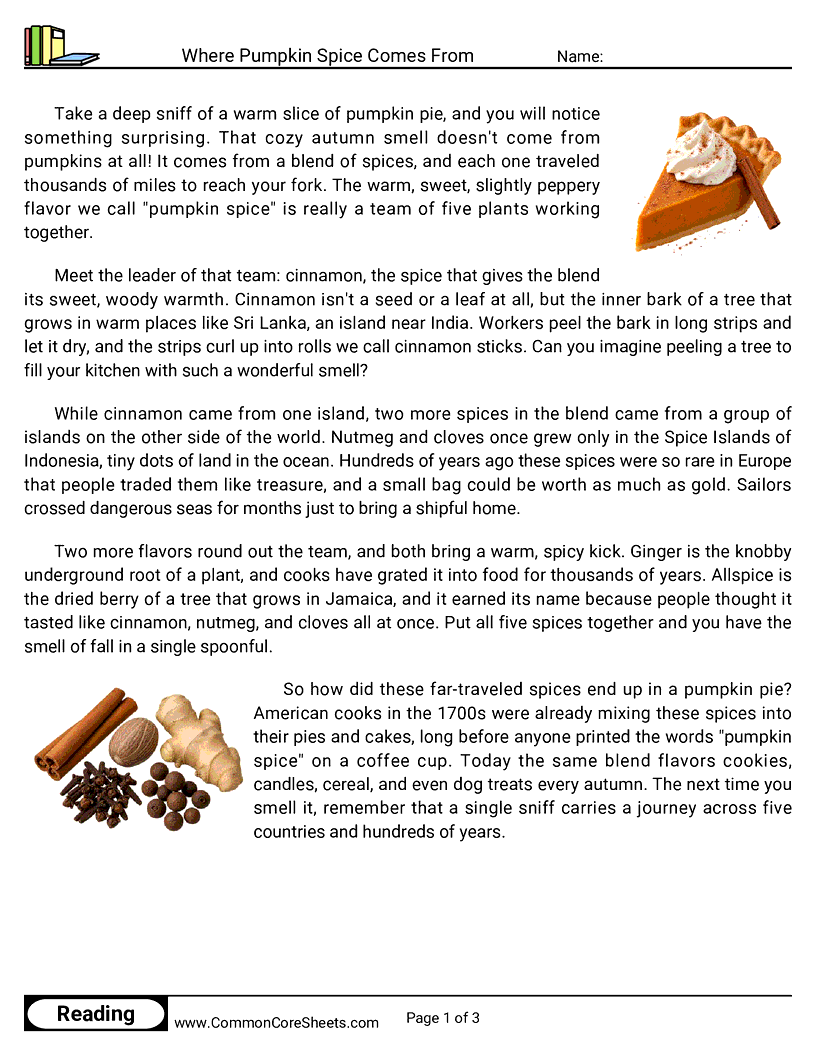
Available at 3rd grade, 4th grade, 5th grade, 6th grade, 7th grade and 8th grade reading levels.
Read the passage
Imagine you are holding a warm slice of pumpkin pie right under your nose. That cozy smell floating up is not really pumpkin at all! It comes from a mix of spices, and each one traveled a very long way to reach your fork. The spices are cinnamon, nutmeg, ginger, cloves, and sometimes allspice.
Those five spices did not grow in a kitchen down the street. Cinnamon comes from the curly bark of a tree that grows in a warm island country called Sri Lanka. Nutmeg and cloves grew far away on islands in Indonesia, which people once called the Spice Islands. Allspice is a little brown berry, and it grows on the sunny island of Jamaica.
Because these spices grew so far away, they were once as precious as gold. Long ago, sailors packed their ships and traveled across the ocean for months just to buy them. So a tiny bag of nutmeg could cost more than a farmer earned in a whole year! When the spices finally arrived, only rich families could afford to sprinkle them on their food.
Over time, ships and trains made those spices cheaper, so more people could buy them. Cooks began stirring them into pumpkin pie every autumn, and the warm smell became a sign that cold weather was near. Today you can find that same blend in muffins, cookies, and even frothy drinks. So the next time you smell pumpkin spice, remember it is really a tour of islands halfway around the world!
Take a deep sniff of a warm slice of pumpkin pie, and you will notice something surprising. That cozy autumn smell doesn't come from pumpkins at all! It comes from a blend of spices, and each one traveled thousands of miles to reach your fork. The warm, sweet, slightly peppery flavor we call "pumpkin spice" is really a team of five plants working together.
Meet the leader of that team: cinnamon, the spice that gives the blend its sweet, woody warmth. Cinnamon isn't a seed or a leaf at all, but the inner bark of a tree that grows in warm places like Sri Lanka, an island near India. Workers peel the bark in long strips and let it dry, and the strips curl up into rolls we call cinnamon sticks. Can you imagine peeling a tree to fill your kitchen with such a wonderful smell?
While cinnamon came from one island, two more spices in the blend came from a group of islands on the other side of the world. Nutmeg and cloves once grew only in the Spice Islands of Indonesia, tiny dots of land in the ocean. Hundreds of years ago these spices were so rare in Europe that people traded them like treasure, and a small bag could be worth as much as gold. Sailors crossed dangerous seas for months just to bring a shipful home.
Two more flavors round out the team, and both bring a warm, spicy kick. Ginger is the knobby underground root of a plant, and cooks have grated it into food for thousands of years. Allspice is the dried berry of a tree that grows in Jamaica, and it earned its name because people thought it tasted like cinnamon, nutmeg, and cloves all at once. Put all five spices together and you have the smell of fall in a single spoonful.
So how did these far-traveled spices end up in a pumpkin pie? American cooks in the 1700s were already mixing these spices into their pies and cakes, long before anyone printed the words "pumpkin spice" on a coffee cup. Today the same blend flavors cookies, candles, cereal, and even dog treats every autumn. The next time you smell it, remember that a single sniff carries a journey across five countries and hundreds of years.
Take a deep sniff of a pumpkin pie fresh from the oven, and here is a riddle for you: not one bit of that warm, cozy smell comes from pumpkin. The orange filling is soft and sweet, but on its own it tastes like plain squash. The scent that says "autumn" is really a team of five spices working together: cinnamon, nutmeg, ginger, cloves, and allspice. So where did this tiny team travel from to reach your plate?
Follow your nose first to cinnamon, which begins its life not as a seed or a berry but as bark. Workers on the island of Sri Lanka, off the coast of India, peel the inner bark from a certain tree, and as it dries it curls into the little brown scrolls we call cinnamon sticks. Ginger has a very different story, because it is the knobby underground stem of a leafy plant, and people have grown it in Asia for thousands of years. One plant grows on a tree and one grows in the dirt, yet both end up crushed into the very same jar of spice.
Two more members of the team once came almost entirely from a scattering of tiny islands in Indonesia known as the Spice Islands. Nutmeg is the hard seed inside a fruit that looks a bit like an apricot, and cloves are actually flower buds picked before they bloom and then dried until they turn dark and hard as little nails. For hundreds of years these islands were the only place on Earth where nutmeg and cloves grew, which made them worth a small fortune. Sailors crossed whole oceans for them, because a handful of these spices could once be traded for gold or land.
Because these flavors were once so precious, they became a way to show off, which brings us to the fifth spice and a pie. Allspice comes from a berry that grows in Jamaica, and it earned its name because people thought it tasted like cinnamon, nutmeg, and cloves all rolled into one. When cooks in early America wanted to make their pumpkin pies special for autumn feasts, they reached for exactly these treasured spices. Little by little, that blend became so tied to fall that companies began selling it already mixed in a single jar.
Once the mixture had a name, it did not want to stay inside a pie. Today that same warm blend is stirred into coffee drinks, cookies, cereal, candles, and even dog treats sold every autumn. The funny part is that most of these products contain no pumpkin at all, only the spices that once traveled across the world beside it. So the next time you smell "pumpkin" in October, remember you are really smelling a journey from Sri Lanka, Indonesia, and Jamaica, folded neatly into one cozy scent.
You probably think pumpkin spice comes from pumpkins, right? Here's the twist: there's usually no pumpkin in it at all. That warm, cozy smell wafting out of a coffee cup or a fresh pie is really a team of five spices—cinnamon, nutmeg, ginger, cloves, and allspice—blended together. Each one is a dried piece of a plant: bark, a seed, a root, a flower bud, and a berry. Together they make a flavor so tied to autumn that one sniff can practically make you picture falling leaves.
Those five little ingredients have traveled farther than most people ever will. Cinnamon is the dried inner bark of a tree that grows in warm places like Sri Lanka, an island off the coast of India. Nutmeg and cloves once came almost only from a tiny cluster of Indonesian islands nicknamed the Spice Islands, while ginger is the knobby underground stem of a tropical plant. Allspice is a dried berry native to the Caribbean, including the island of Jamaica, and early European explorers named it "allspice" because they thought it tasted like several spices at once. So your cup of coffee is basically a world map you can drink.
Long before anyone dreamed of a coffee shop, these spices were worth a small fortune. In medieval Europe, cloves and nutmeg were so rare and so hard to get that they could cost more than their weight in silver. Merchants carried them thousands of miles along trade routes by camel and by ship, and whoever controlled the Spice Islands controlled enormous wealth. People spent lives and fortunes searching for faster routes to these islands—Christopher Columbus was actually hunting for a shortcut to the spice lands of Asia when he bumped into the Americas. Can you imagine crossing an ocean just for something now sitting in your kitchen cabinet?
That kitchen cabinet is exactly where the story turns sweet. As trade grew and spices became cheaper, cooks in Europe and the American colonies started stirring these warm flavors into pies, cakes, and puddings. American cookbooks from the 1700s and 1800s already listed pumpkin pies seasoned with cinnamon, ginger, nutmeg, and cloves—the very same blend we love today. In the 1900s, spice companies began selling a ready-mixed "pumpkin pie spice," so a baker no longer had to measure out five jars. One shortcut in a bottle, and a centuries-old recipe was suddenly ready in seconds.
From that little bottle, the flavor escaped the pie entirely. Today you can find pumpkin spice in coffee drinks, cereal, candles, and even dog treats, and it returns like clockwork every fall. According to reporting on the trend, coffee shops have sold hundreds of millions of pumpkin spice lattes since the drink launched in the early 2000s. It's strange to think that a blend once guarded like treasure is now something you can buy at any corner store. The next time you smell that autumn aroma, remember you're breathing in bark from Sri Lanka, buds from Indonesia, and berries from the Caribbean, all in one warm breath.
Open a jar of pumpkin spice and take a deep breath: that single warm scent is actually five plants that grew thousands of miles apart, on islands and coastlines you may never have visited. There is no pumpkin in it at all. Instead, you are smelling cinnamon, nutmeg, ginger, cloves, and sometimes allspice, blended into one cozy cloud that means autumn to millions of people. Each of those spices has its own hometown, its own history, and once upon a time, its own eye-watering price.
That price is the first clue to how far these plants traveled to reach your kitchen. Take cinnamon, which is not a seed or a leaf but the dried inner bark of a tree that grows best in Sri Lanka, an island off the southern tip of India. For centuries, traders kept its true source a secret, and Sri Lanka became famous across the ancient world for shipping this curled, papery bark. Peel back a strip of true cinnamon and it rolls up on its own, like a scroll closing itself.
Cinnamon may have kept its secrets, but nutmeg hid on some of the most fought-over islands on Earth. Nutmeg and its lacy red partner, mace, both come from a single fruit that grew almost nowhere except the Banda Islands, a tiny cluster in Indonesia often called the Spice Islands. Because the trees grew in so few places, nutmeg was once worth more than its weight in gold in Europe, and nations fought bitterly to control those specks of land. Can you imagine going to war over a seed the size of a marble? People once did exactly that.
War made nutmeg costly, but the next spice was prized for a very different power: it seemed to fight off aches and pains. Ginger is not a fruit or a bark at all, but a knobby underground stem, or rhizome, that spreads beneath the soil in warm places like India and China. People chewed it, brewed it, and carried it along trade routes because it warmed the body and calmed upset stomachs. Cloves, meanwhile, are actually dried flower buds picked before they bloom, and for a long time they grew only on a few islands in eastern Indonesia.
Those clove-covered islands sit surprisingly close to where the last spice, allspice, does not grow at all. Allspice is the odd one out, because it came from the Americas rather than from Asia, and it grows mainly in Jamaica, where the tree's dried berries taste like cinnamon, nutmeg, and cloves all at once. When Spanish explorers first tasted it, they thought it was a kind of pepper, which is why its Spanish name means "pepper" even today. One little berry doing the work of three spices is exactly why bakers reached for it.
So how did all five spices end up crowded into one autumn flavor? Colonial cooks in America already used them in pies, and by the 1930s a company called McCormick was selling a ready-made "pumpkin pie spice" blend so bakers did not have to measure each one. Decades later, coffee shops borrowed that same blend, and suddenly the scent of the Spice Islands was in lattes, candles, cookies, and cereal every fall. According to a National Retail Federation survey, autumn is now one of the busiest times of year for spending on seasonal treats and decorations. Not bad for a mix of bark, seeds, buds, roots, and berries that once cost a fortune and started a few wars.
Pop the lid off a can of pumpkin pie spice and take a deep breath. That warm, woody scent hitting your nose right now is not the smell of pumpkin at all. In fact, most "pumpkin spice" contains no pumpkin whatsoever. What you are actually smelling is a blend of cinnamon, nutmeg, ginger, cloves, and sometimes allspice, a team of five plant parts that grew up thousands of miles apart. Each one arrived in your kitchen after a journey stranger than any story you could invent.
That woody warmth at the front of the blend usually comes from cinnamon, and it is not a seed or a fruit but bark. True cinnamon is the inner bark of a tree native to Sri Lanka, an island off the southern tip of India, where harvesters peel it in strips that curl into quills as they dry. Ginger, by contrast, is not a bark at all but an underground stem, or rhizome, that people have grown across tropical Asia for so long that no one is sure where it first grew wild. Notice the distinction: one spice comes from what a tree wears on the outside, the other from what a plant hides underground. Already two of your five spices come from completely different parts of completely different plants.
Ginger's underground trick is impressive, but two more spices in the blend pulled off something even sneakier by hiding on a single tree. For centuries nutmeg came from one place on Earth: the Banda Islands, a tiny cluster in Indonesia sometimes called the Spice Islands. Here is the wow: nutmeg and mace, long sold as two separate spices, both grow on the very same fruit, the nutmeg being the seed and mace being the lacy red webbing wrapped around it. Cloves, the fourth member of the blend, also came from that Indonesian region, but they are not a seed or bark either. A clove is a flower bud, picked before it blooms and dried until it turns hard and dark as a nail.
Because these buds and seeds grew in only a few small places, controlling them became worth risking your life over. During the 1600s, European trading companies fought bitterly to control the islands where nutmeg and cloves grew, since a spice that was cheap at its source could be sold in Europe for a fortune. Traders sometimes guarded the secret of where the spices came from, and buyers had no way to check. This is why historians describe the spice trade less as gentle commerce and more as a contest for monopoly, where whoever controlled the trees controlled the price. The distance between a clove tree in Indonesia and a wealthy buyer in Amsterdam is exactly what made the clove so precious.
That same appetite for rare flavors is how a fifth spice, one born in a different hemisphere entirely, joined the group. Allspice comes not from Asia but from the Caribbean, especially Jamaica, where it grows as a small dried berry. Its name is a clue and a bit of a trick: early Europeans thought it tasted like cinnamon, nutmeg, and cloves combined, so they called it "allspice," as if one berry could stand in for several. So the blend on your shelf gathers ingredients from Sri Lanka, Indonesia, and Jamaica, three regions that would never have shared a single dish without centuries of trade. Consider what that means: your autumn latte is really a map of the old spice routes, poured into a cup.
Those same five flavors landed in pumpkin pie because cooks already trusted them in sweet, custard-like dishes long before pumpkins came along. American cookbooks were pairing these spices with pumpkin as far back as the 1700s, so the flavor is genuinely old even if the marketing is new. What changed recently is the label: a spice company began selling a pre-mixed "pumpkin pie spice" in the 1900s, and decades later coffee shops turned that same blend into a seasonal drink. The taste you think of as fall was assembled from a Sri Lankan bark, an Asian root, an Indonesian seed and bud, and a Caribbean berry. So the next time someone hands you something "pumpkin spice," remember that the pumpkin is often the one ingredient not invited to the party.
About this worksheet
Students read a nonfiction passage about the spices in pumpkin spice, written at 6 reading levels (3rd grade to 8th grade), and answer multiple-choice questions about it.
A reading comprehension worksheet about the spices in pumpkin spice with a different article for each reading level, 3rd grade to 8th grade, each with its own multiple-choice questions aligned to the Common Core Reading: Informational Text standards. Printable with an answer key, and available as an online assignment at any level.
Student objectives
- Read a nonfiction passage about the spices in pumpkin spice and where they grow.
- Find details that explain why certain spices were once as valuable as gold.
- Explain how five spices from different countries came together in pumpkin pie.
- Determine the meaning of domain-specific words like bark, root, and knobby from context.
Everyday practice
- Smell the spices in your kitchen cabinet and try to find cinnamon, nutmeg, or ginger.
- Look at the ingredient list on a pumpkin-flavored food and count how many of the five spices you can spot.
- Find Sri Lanka, Indonesia, and Jamaica on a map to see how far the spices traveled.