Walking Sticks Worksheet Download
Free reading worksheets on Walking Sticks. Each worksheet has 20 problems with an answer key and are ideal for teachers and homeschooling. You can download the PDF, create a set of flash cards or set it up for online learning.


Sheet Information >
Available at 2nd grade, 3rd grade, 4th grade, 5th grade and 6th grade reading levels.
Read the passage
Walking sticks are fascinating insects that look like tiny branches. They come in many different colors and sizes, with some being as small as your pinky finger and others as long as your forearm. These cool creatures can be found living in forests, grasslands, and even your own backyard!
These insects have a very interesting life cycle and diet. Walking sticks lay their eggs on the ground, and when the young hatch, they look like tiny versions of their parents and grow by shedding their skin. They mostly munch on leaves, which makes them great friends to have around if you want to keep your plants healthy.
Walking sticks have some amazing ways to protect themselves from predators. One cool trick they have is their ability to blend in with their surroundings, making them very hard to spot. Some walking sticks can even release a smelly spray to keep enemies away!
In conclusion, walking sticks are incredible insects with unique features that help them survive in the wild. They may be small, but they are mighty in their own way, and they play an important role in the ecosystem. So next time you're exploring outside, keep an eye out for these amazing creatures!
Let's talk about the fascinating world of walking sticks! These incredible insects are masters of disguise and come in many different shapes and sizes. They are called walking sticks because they look just like real sticks or twigs. Walking sticks can be found in various habitats, such as forests, grasslands, and even your backyard!
Now, let's discover more about their life cycle and what they eat. Walking sticks begin their life as tiny eggs, which hatch into nymphs that look like smaller versions of the adults. As they grow, they shed their skin multiple times until they reach their full size. Walking sticks are herbivores, meaning they eat plants, particularly leaves from trees and bushes.
Lastly, let's explore their relationships with humans and other insects, their defenses, and some cool facts. Walking sticks are not harmful to humans and are usually kept as pets or used in educational settings. Their main defense against predators is their amazing camouflage, but some species can also release a foul-smelling spray. One interesting fact is that some walking sticks can regenerate lost limbs, making them even more unique in the insect world.
In conclusion, walking sticks are amazing creatures that can teach us a lot about adaptation and the wonders of the natural world.
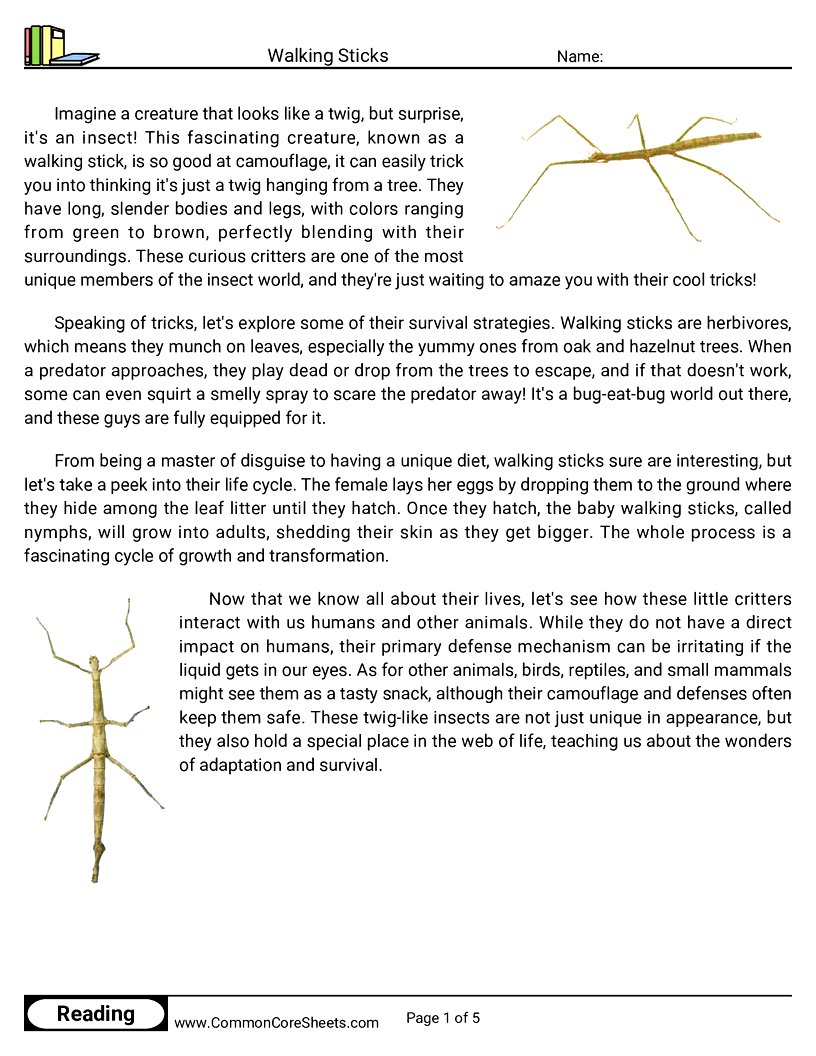
Imagine a creature that looks like a twig, but surprise, it's an insect! This fascinating creature, known as a walking stick, is so good at camouflage, it can easily trick you into thinking it's just a twig hanging from a tree. They have long, slender bodies and legs, with colors ranging from green to brown, perfectly blending with their surroundings. These curious critters are one of the most unique members of the insect world, and they're just waiting to amaze you with their cool tricks!
Speaking of tricks, let's explore some of their survival strategies. Walking sticks are herbivores, which means they munch on leaves, especially the yummy ones from oak and hazelnut trees. When a predator approaches, they play dead or drop from the trees to escape, and if that doesn't work, some can even squirt a smelly spray to scare the predator away! It's a bug-eat-bug world out there, and these guys are fully equipped for it.
From being a master of disguise to having a unique diet, walking sticks sure are interesting, but let's take a peek into their life cycle. The female lays her eggs by dropping them to the ground where they hide among the leaf litter until they hatch. Once they hatch, the baby walking sticks, called nymphs, will grow into adults, shedding their skin as they get bigger. The whole process is a fascinating cycle of growth and transformation.
Now that we know all about their lives, let's see how these little critters interact with us humans and other animals. While they do not have a direct impact on humans, their primary defense mechanism can be irritating if the liquid gets in our eyes. As for other animals, birds, reptiles, and small mammals might see them as a tasty snack, although their camouflage and defenses often keep them safe. These twig-like insects are not just unique in appearance, but they also hold a special place in the web of life, teaching us about the wonders of adaptation and survival.
Walking sticks are fascinating insects that you might have seen in your backyard or in the wild. They get their name because they look just like sticks, which helps them blend in with their surroundings. These insects are also known as stick insects or stick bugs and belong to the Phasmatodea family. Let's dive in and learn more about these amazing creatures!
The first thing you might want to know is what walking sticks eat. These insects are herbivores, which means they only eat plants. Their favorite food is leaves, and they especially enjoy munching on leaves from trees like oak, hazel, and bramble. Now that we know what they eat, let's find out where they live.
Walking sticks can be found in various parts of the world. Their habitat includes forests, grasslands, and even your own backyard. These insects prefer to live in areas with lots of trees and plants, as it provides them with plenty of food and places to hide from predators. Now, let's explore their life cycle.
The life cycle of a walking stick begins when a female lays her eggs. These eggs are often dropped onto the ground or stuck to leaves, where they will eventually hatch into tiny nymphs. As they grow, the nymphs will molt their exoskeletons several times, eventually becoming adult walking sticks. Now that we understand their life cycle, let's take a look at their relationship with humans and other insects.
Walking sticks are generally harmless to humans. They do not bite or sting, and they are not considered pests. In fact, some people even keep them as pets! When it comes to other insects, walking sticks use their excellent camouflage to avoid predators like birds and spiders.
There are many different species of walking sticks, each with its unique features. Some can change color to blend in better with their surroundings, while others have wings and can fly. Some species even have spines or emit a foul-smelling liquid as a defense. In conclusion, walking sticks are extraordinary insects with remarkable abilities to blend in with their environment and avoid predators.
Walking sticks are fascinating insects that have a unique appearance. These amazing creatures are known for their ability to blend in with their surroundings, making them masters of camouflage. Walking sticks can be found in various colors and sizes, usually resembling the branches and twigs of the plants they inhabit. Some species even have the ability to change their color to match their environment better. This helps them hide from predators and makes them a fascinating subject for young explorers.
These intriguing insects can be found in various habitats around the world. They mostly prefer warm, tropical and subtropical regions with plenty of vegetation. Walking sticks can be found in forests, grasslands, and even in some gardens. They spend most of their time hanging out on trees and bushes, munching on leaves. In fact, walking sticks are herbivores, which means they only eat plants.
The life cycle of a walking stick is quite interesting. They go through three stages: egg, nymph, and adult. Female walking sticks lay their eggs on the ground or on plants, and the tiny nymphs that hatch resemble smaller versions of the adults. As they grow, they shed their exoskeletons several times in a process called molting. It takes a few months for a walking stick to reach adulthood, depending on the species and the environment.
Walking sticks have a unique relationship with both humans and other animals. They are generally harmless to humans, and some people even keep them as pets. However, walking sticks can be a nuisance to farmers, as they can cause damage to crops by eating the leaves. In the wild, they have several predators, including birds, reptiles, and mammals. Their incredible camouflage abilities and ability to play dead help them avoid becoming a meal for these predators.
There are many fascinating facts about walking sticks that you might not know. For example, some species of walking sticks can reproduce without males, in a process called parthenogenesis. Additionally, some walking sticks possess small wings, enabling them to fly short distances to escape predators or find new habitats. There are over 3,000 known species of walking sticks, each with unique characteristics and appearances. With their remarkable abilities and intriguing life cycle, walking sticks are truly one of the most fascinating insects on our planet.
About this worksheet
Students read a passage about walking sticks and answer comprehension questions about the insect's traits and behavior.
This worksheet is designed to enhance children's reading skills and knowledge about walking sticks. It comprises 20 thought-provoking queries about this insect's diet, color, lifecycle, defense mechanisms, predators, and habitat. The worksheet can be tailored as per the learners' needs, transmuted into flashcards, or adapted for distance learning to make the educational experience more interactive and engaging.
Student objectives
- Read a nonfiction passage and understand the main idea
- Find specific facts about walking sticks in the text
- Answer questions using details from what you read
- Learn new vocabulary about insects and how they survive
Everyday practice
- Read a fact sheet at a zoo or nature center and remember what it says
- Answer questions about a book or article you just read
- Point out interesting bugs you learned about when you're outside
- Explain to a friend how an insect uses camouflage to hide