UNICEF Trick-or-Treat Boxes Worksheet Download
Free reading comprehension worksheet about the UNICEF trick-or-treat boxes. Pick the reading level (2nd grade to 8th grade), print the passage with its questions, or assign it online.


Sheet Information >
Available at 2nd grade, 3rd grade, 4th grade, 5th grade, 6th grade, 7th grade and 8th grade reading levels.
Read the passage
Did you know some kids trick-or-treat for coins instead of candy? On Halloween, some children carry little orange boxes and ask people to drop in pennies, nickels, and dimes. The coins are not for the kids at all, they help other children far away!
Those little orange boxes have a nice story behind them. In 1950, kids in Philadelphia collected coins on Halloween to help children who did not have food or medicine. They gave the money to a group called UNICEF, which helps children all over the world.
Because that first idea worked so well, UNICEF made special boxes for everyone to use. The boxes are bright orange and small enough to hold in one hand, like a little milk carton. Kids fill them with coins as they go from door to door, and the box gets heavier with every stop!
All those tiny coins add up to something big. The money can buy clean water, food, blankets, and shots that keep children from getting sick. So a handful of pennies from your neighborhood can help a child on the other side of the world feel better!
Imagine you are ringing a doorbell on Halloween night, but you are not holding a bag for candy. Instead, you carry a small orange box that jingles with coins! When the door opens, you say the treat words, and then you ask if the family has a few pennies to help kids far away. This is trick-or-treating for UNICEF, and it turns Halloween into a night of giving.
That jingling orange box got its start with a group of children in Philadelphia long ago. In 1950, kids there collected coins on Halloween and sent the money to help children after a big war had ended. They gathered about $17 that first year, which felt like a lot for a bunch of kids with cans and jars. Because the idea was so good, more and more children wanted to try it too.
Since that first night, the coins have traveled from front porches all the way around the world. UNICEF stands for the United Nations Children's Fund, and it helps kids in many countries. The money can buy things like clean water, medicine, and healthy food for children who need them. So a single handful of pennies from your street might help a child on the other side of the planet.
Today the little orange box is a Halloween helper that has been around longer than your grandparents were born. First a child fills it with coins, then a grown-up helps count the money, and finally it is sent off to do good. Over the years, kids in the program have collected many millions of dollars for other children. Not bad for a box that started with pennies and a big idea one Halloween night!
Picture a group of kids in Philadelphia on Halloween night in 1950, ringing doorbells with a jingling can instead of an empty candy bag. They weren't asking for chocolate at all. They were asking their neighbors to drop in spare coins to help children far away who had lost their homes after World War II. By the end of the night, those kids had collected about seventeen dollars in nickels and pennies!
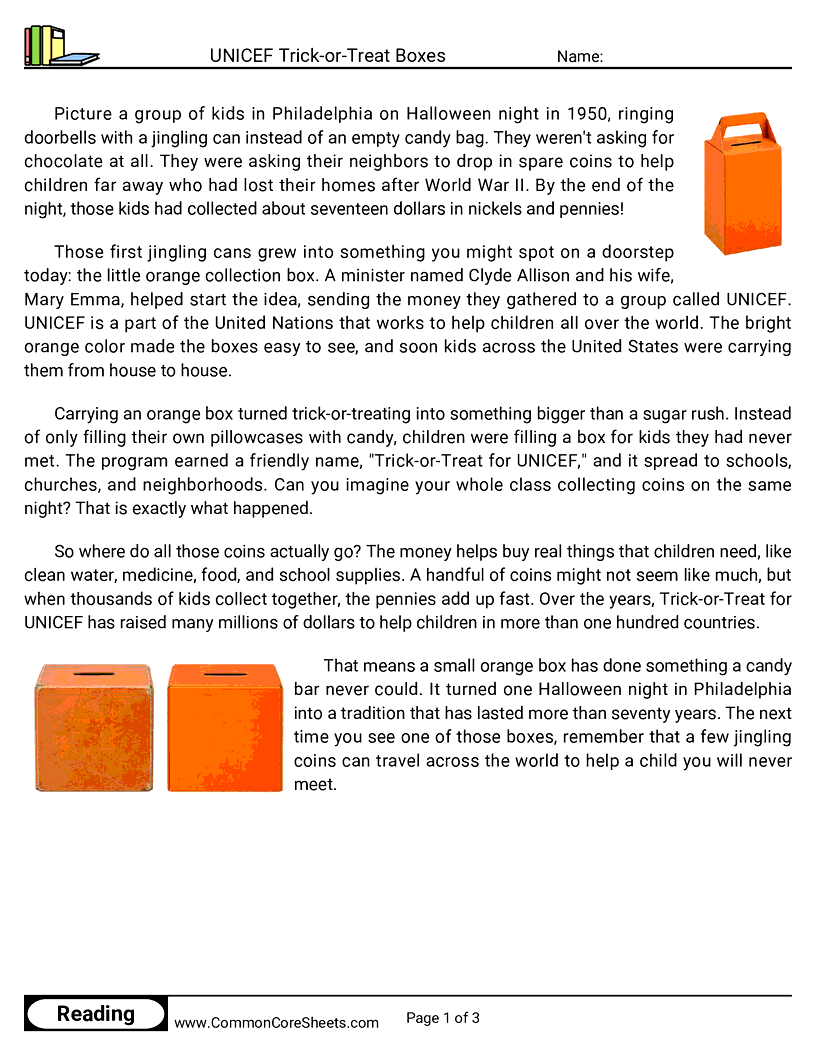
Those first jingling cans grew into something you might spot on a doorstep today: the little orange collection box. A minister named Clyde Allison and his wife, Mary Emma, helped start the idea, sending the money they gathered to a group called UNICEF. UNICEF is a part of the United Nations that works to help children all over the world. The bright orange color made the boxes easy to see, and soon kids across the United States were carrying them from house to house.
Carrying an orange box turned trick-or-treating into something bigger than a sugar rush. Instead of only filling their own pillowcases with candy, children were filling a box for kids they had never met. The program earned a friendly name, "Trick-or-Treat for UNICEF," and it spread to schools, churches, and neighborhoods. Can you imagine your whole class collecting coins on the same night? That is exactly what happened.
So where do all those coins actually go? The money helps buy real things that children need, like clean water, medicine, food, and school supplies. A handful of coins might not seem like much, but when thousands of kids collect together, the pennies add up fast. Over the years, Trick-or-Treat for UNICEF has raised many millions of dollars to help children in more than one hundred countries.
That means a small orange box has done something a candy bar never could. It turned one Halloween night in Philadelphia into a tradition that has lasted more than seventy years. The next time you see one of those boxes, remember that a few jingling coins can travel across the world to help a child you will never meet.
Picture a group of kids in Philadelphia on Halloween night in 1950, going door to door with a puzzle instead of a pillowcase. Instead of asking only for candy, they held out little cans and asked neighbors to drop in a few coins for children living far away. So how did a handful of pennies collected on one October night grow into a tradition that has helped kids in more than 150 countries? That story starts with a teacher, a Sunday school class, and a very good idea.
That good idea is often credited to Mary Emma Allison and her husband, who wanted their students to help children hurt by World War II. They connected with UNICEF, a part of the United Nations created in 1946 to feed and heal children after the war. On that first Halloween, the Philadelphia kids collected about seventeen dollars, which does not sound like much, yet it proved something powerful. A holiday famous for treats could also become a holiday for giving.
Because that first attempt worked, the idea needed something a kid could carry, and that is where the orange box came in. You have probably seen one: a small, folding cardboard box, bright orange like a pumpkin, with a slot on top for slipping coins inside. Trick-or-Treat for UNICEF handed these out to millions of children so they could collect while they collected candy. Orange became the signal that this trick-or-treater was working for more than a chocolate bar.
The coins clinking inside those boxes do more than make noise, because each one turns into real help on the other side of the world. Over the years, the program has raised many millions of dollars, money that buys vaccines, clean water, food, and school supplies. Think about it: a single dollar can buy packets of a special peanut paste that helps feed a hungry child. That means the change from your pocket can literally save a life.
Today the little box has grown up and gone digital, so you can now collect donations online as well as door to door. Schools hold coin drives, and some kids raise money through fun runs or by asking for pledges instead of coins. Yet the heart of the idea has not changed since those Philadelphia doorsteps more than seventy years ago. Isn't it wild that the smallest coin in your hand, given on a single night, can travel around the world to help a child you will never meet?
Picture a Halloween night where the treat isn't for you at all - it's for a kid you'll never meet, living halfway around the globe. That's the strange and wonderful idea behind the little orange collection boxes that once turned up in the hands of trick-or-treaters across America. Instead of only shouting "trick or treat!" for candy, children rattled these small cardboard cartons and asked neighbors to drop in coins. The boxes were bright orange, stamped with the letters UNICEF, and light enough for a first-grader to carry all night. By the end of the evening, they jingled like tiny piggy banks stuffed with nickels and dimes.
Those jingling boxes didn't appear out of nowhere - they grew from one clever idea in Philadelphia in 1950. A Presbyterian minister named Clyde Allison and his wife encouraged the children of their Sunday school to collect spare change for kids overseas who were still suffering after World War II. That first Halloween, the children gathered about $17 in a decorated milk carton and sent it to UNICEF, the United Nations agency created to help children. Can you imagine seventeen dollars starting a tradition that would last for generations? What began as a single decorated carton would soon become a nationwide custom.
From that one carton, the idea spread across the country faster than a rumor at recess. UNICEF began printing the official orange boxes, and by the 1960s the campaign was known as "Trick-or-Treat for UNICEF" from coast to coast. Schools, churches, and neighborhood groups handed out the cartons every October, and children learned that a single coin could travel thousands of miles. Over the decades, the program has collected many millions of dollars in change, one nickel and dime at a time. It turns out that pocket money, when pooled together, can add up to a serious pile of help.
That serious pile of help doesn't just sit in a bank - it turns into real things children need. The money UNICEF raises pays for lifesaving supplies like vaccines, clean water, nutritious food, and school materials in more than 190 countries and territories. A handful of coins might buy packets of therapeutic food for a hungry baby, or vaccines to protect a child from deadly diseases. In other words, the quarters you collect on one chilly October night can help a kid across the ocean stay healthy enough to grow up. That's a lot of power to pack into a cardboard box small enough to fit in a coat pocket.
Today those boxes have partly gone digital, but the heart of the idea beats as strongly as ever. Families can still order paper collection boxes, and many now raise money online through UNICEF's website instead. This matters because it teaches a lesson that outlasts any costume: helping others can be woven right into a night built around candy and fun. The next time you dump out your Halloween haul, remember that once, and still, kids turned that same night into a rescue mission for strangers. Not bad for a tradition that started with a decorated milk carton and about seventeen dollars.
Picture this: it's Halloween night in 1950, and instead of shaking a bag of candy, a group of children in Philadelphia is rattling something else at the door - a decorated milk carton stuffed with coins. That night, they collected about $17 in pennies, nickels, and dimes for children overseas who had lost everything in World War II. It doesn't sound like much, does it? Yet that single carton of loose change grew into one of the longest-running kids' fundraising traditions in American history. The idea was simple but powerful: while you fill your own bag with treats, you could also fill a box for a stranger halfway across the globe.
Behind that first rattling carton stood a Presbyterian minister named Clyde Allison and his wife, Mary Emma, who wanted trick-or-treaters to do a little good along the way. They connected the effort to UNICEF, the United Nations agency created in 1946 to help children after the war. Back then there was no famous orange box - just whatever container a family could decorate and carry. The Allisons' little experiment caught on because it asked almost nothing of children except a knock and a smile. Word spread from one Pennsylvania neighborhood to churches, schools, and towns across the country.
That plain milk carton eventually traded its cardboard for the color that would make the program instantly recognizable. By the mid-1950s, UNICEF was mailing out bright orange collection boxes, small enough to fit in a child's hand and printed with a friendly design. Orange was a clever choice - it matched the pumpkins and autumn leaves of Halloween, so the boxes felt like they belonged in the night. Teachers handed them out in classrooms, and children carried them alongside their candy bags from porch to porch. A box that small could still hold several dollars in coins, and thousands of boxes added up fast.
Those handfuls of dollars, multiplied by millions of children, turned into real help you could measure. UNICEF uses the money for things children around the world need most: clean water, vaccines, food, school supplies, and emergency aid after disasters. A surprising fact is how far a little goes - a few dollars can pay for packets of a lifesaving mixture that fights the dehydration behind many childhood deaths. Over the decades, Trick-or-Treat for UNICEF has raised many millions of dollars in the United States alone. Every dollar of it began as pocket change dropped through a slot on somebody's doorstep.
Raising that kind of money changed how many families think about Halloween itself. For some kids, the orange box turned a night about getting into a night about giving, without taking away a single piece of candy. Schools began using it to teach geography and generosity at the same time, pointing to a map and asking where the help would go. The program even hopped borders, running in Canada and other countries where children wanted to join in. It proved that a holiday costume and a good cause can walk up the same driveway together.
Today the tradition still knocks, though it has learned some new tricks of its own. The classic cardboard box now shares the stage with online donation pages and school fundraisers, so kids can collect without carrying coins at all. UNICEF has even teamed up with games and apps to reach children who do their trick-or-treating on a screen. Still, plenty of families print and fold the paper boxes the old-fashioned way, keeping a 1950 idea alive one penny at a time. Not bad for a tradition that started with a milk carton and about seventeen dollars in a Philadelphia neighborhood.
In the fall of 1950, a Sunday school class in Philadelphia had an unusual idea for Halloween. Instead of only collecting candy, the children carried decorated milk cartons from house to house and asked their neighbors to drop in spare coins for kids overseas who had survived World War II. That first night, their small cardboard cartons rattled home with about $17 in change. It doesn't sound like a fortune, but that jingling handful of nickels and dimes was the seed of a tradition that would spread to millions of children. The class was led by Reverend Clyde Allison and his wife, and their plan turned a night of candy into a night of giving.
That homemade milk carton eventually gave way to a symbol you might recognize: the little orange collection box. UNICEF, the United Nations agency created in 1946 to help children after the war, adopted the Philadelphia idea and turned it into a national campaign called Trick-or-Treat for UNICEF. The boxes were printed bright orange so they would stand out against dark costumes and be easy for neighbors to spot at the door. Over the decades, generations of American kids have carried these boxes alongside their candy bags, shaking them like tiny tambourines to encourage donations. Since the program began, it has raised many millions of dollars in the United States, all in small coins and bills.
Those coins, small as they seem, travel a surprisingly long way once they leave your doorstep. UNICEF pools the donations and spends them on things children in poorer countries urgently need: clean water, vaccines, food, and school supplies. A single dollar, for example, can buy packets of oral rehydration salts that treat a child sick with dehydration, one of the leading killers of young children worldwide. This is where the campaign reveals its logic: it asks the people with the least money in a household, kids, to give the smallest possible amount, coins, and then multiplies those tiny gifts across a whole nation. The result is that a night built around getting turns into a night built around giving.
That flip from getting to giving is exactly what makes some people call the campaign one of the most successful charity ideas in American history. Consider the contrast with ordinary trick-or-treating, where the goal is to fill your own bag as high as possible. The UNICEF box doesn't compete with the candy hunt; it rides right alongside it, so a child loses nothing by carrying one. Historians of charity point out that this design is clever precisely because it lowers the cost of doing good to almost zero. You keep your candy, you spend a few extra minutes, and a stranger's spare change becomes medicine for someone you will never meet.
The idea proved so portable that it eventually crossed borders and changed its shape along the way. In Canada, children carried their own versions of the boxes for years before that country retired the physical box in favor of school-based fundraising. In the United States, UNICEF has kept the campaign alive by adding online donations and even a version families can use while handing out candy at home. What began as one class's milk cartons in Pennsylvania has become an idea copied, adapted, and reinvented for more than seventy years. The orange box itself has become almost a Halloween icon, as familiar to some families as jack-o'-lanterns and plastic pumpkins.
Perhaps the most surprising thing about that little box is how ordinary its power looks up close. No single donation is large; the whole point is that no single donation needs to be. A dime here, a quarter there, multiplied by millions of doorsteps, quietly adds up to clinics stocked and wells dug on the other side of the planet. The children who shook those first milk cartons in 1950 could not have known they were inventing a way for kids to fight problems as huge as disease and hunger. And yet every October, somewhere, a child in a costume still holds out a box and turns a handful of coins into someone else's second chance.
About this worksheet
Students read a nonfiction passage about the UNICEF trick-or-treat boxes, written at 7 reading levels (2nd grade to 8th grade), and answer multiple-choice questions about it.
A reading comprehension worksheet about the UNICEF trick-or-treat boxes with a different article for each reading level, 2nd grade to 8th grade, each with its own multiple-choice questions aligned to the Common Core Reading: Informational Text standards. Printable with an answer key, and available as an online assignment at any level.
Student objectives
- Read a chronological passage about the history of Trick-or-Treat for UNICEF.
- Find specific details about who started the program and what the money buys.
- Explain how a small collection box changed what trick-or-treating could do.
- Determine the meaning of words and phrases used in the text.
Everyday practice
- Look for a UNICEF collection box or donation jar the next time you are out on Halloween.
- Count how many coins it would take you and your friends to reach ten dollars together.
- Notice other ways your community collects small amounts of money for a big cause.