Thrips Worksheet Download
Free reading worksheets on Thrips. Each worksheet has 20 problems with an answer key and are ideal for teachers and homeschooling. You can download the PDF, create a set of flash cards or set it up for online learning.


Sheet Information >
Available at 2nd grade, 3rd grade, 4th grade, 5th grade and 6th grade reading levels.
Read the passage
Have you ever heard of thrips? These tiny insects are usually brown, black, or yellow, and they can be as small as a grain of rice! Thrips like to live in plants, flowers, and trees, and they can be found all over the world.
Thrips are fascinating creatures because of what they eat and how they grow. They munch on leaves and flowers, and sometimes they even eat other tiny insects! Their life cycle begins as an egg, then they become a nymph, and finally, they grow into adult thrips.
Now you might be wondering how thrips relate to us and other insects. Thrips can be both helpful and harmful to humans; they help pollinate plants but can also damage crops. Some insects, like ladybugs, are natural predators of thrips and help keep their population under control.
In this fun article, we learned about the amazing world of thrips, their habitats, and their life cycle. It's interesting to see how these tiny insects can have such a big impact on our world!
Have you ever heard of thrips? These tiny insects are less than 1 millimeter long, and they can be found all around the world. Thrips come in many colors like yellow, brown, or black, and they have a unique straw-like mouth that they use to suck juices from plants and other insects. They usually live on plants, flowers, and sometimes even inside your home!
Now let's talk about the life cycle of thrips. Their life begins as an egg that hatches into a larva, which then turns into a pupa before finally becoming an adult. They grow and change quickly, completing their entire life cycle in just a few weeks. Some thrips are also known to have wings, which help them travel from one plant to another.
Finally, let's explore the relationships thrips have with humans and other insects. While some thrips can be helpful in pollinating flowers, others can damage plants and spread diseases, causing problems for farmers and gardeners. Thrips can be prey for other insects like ladybugs and lacewings, but they also have their own defenses, such as their small size and ability to hide in tiny spaces. One interesting fact is that there are over 6,000 different species of thrips, each with its own unique characteristics.
Thrips are fascinating little creatures with a lot to offer in terms of learning and discovery. So the next time you find one, take a moment to appreciate their unique abilities and role in our ecosystem.
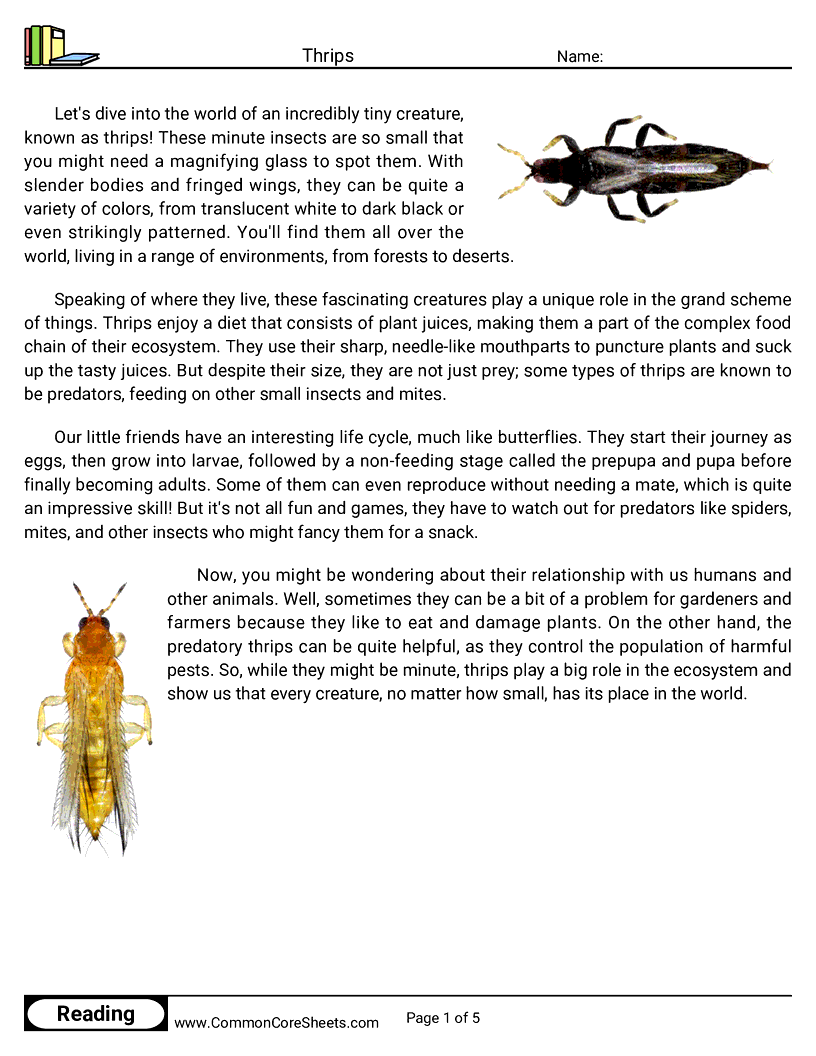
Let's dive into the world of an incredibly tiny creature, known as thrips! These minute insects are so small that you might need a magnifying glass to spot them. With slender bodies and fringed wings, they can be quite a variety of colors, from translucent white to dark black or even strikingly patterned. You'll find them all over the world, living in a range of environments, from forests to deserts.
Speaking of where they live, these fascinating creatures play a unique role in the grand scheme of things. Thrips enjoy a diet that consists of plant juices, making them a part of the complex food chain of their ecosystem. They use their sharp, needle-like mouthparts to puncture plants and suck up the tasty juices. But despite their size, they are not just prey; some types of thrips are known to be predators, feeding on other small insects and mites.
Our little friends have an interesting life cycle, much like butterflies. They start their journey as eggs, then grow into larvae, followed by a non-feeding stage called the prepupa and pupa before finally becoming adults. Some of them can even reproduce without needing a mate, which is quite an impressive skill! But it's not all fun and games, they have to watch out for predators like spiders, mites, and other insects who might fancy them for a snack.
Now, you might be wondering about their relationship with us humans and other animals. Well, sometimes they can be a bit of a problem for gardeners and farmers because they like to eat and damage plants. On the other hand, the predatory thrips can be quite helpful, as they control the population of harmful pests. So, while they might be minute, thrips play a big role in the ecosystem and show us that every creature, no matter how small, has its place in the world.
Let's learn about some fascinating tiny insects called thrips! Thrips are small insects, usually less than 1mm in length, and they come in various colors such as yellow, black, or brown. These tiny creatures have fringed wings that make them look like little feathers when they fly. You might not notice them at first, but if you look closely, you'll see that they are quite interesting!
Now, let's explore where thrips live and what they eat. Thrips can be found all over the world, living in various habitats such as gardens, greenhouses, and forests. They mostly feed on plants, but some species also eat pollen, spores, or other small insects. When it comes to plants, thrips prefer to munch on the leaves, flowers, and fruits, which can sometimes cause damage.
Let's dive into the life cycle of thrips. Thrips go through several stages in their life cycle: egg, larva, pupa, and adult. Females lay their eggs inside plant tissues, and after a few days, the larvae hatch and start feeding on the plant. Once they've grown enough, they enter the pupal stage before finally emerging as adults and starting the cycle all over again.
How do thrips interact with humans and other insects? Thrips can be both helpful and harmful to humans, as some species are considered pests because they damage crops, while others help pollinate plants. They can also transmit viruses to plants, but on the other hand, they can be a food source for beneficial insects such as ladybugs. So, their relationship with humans and other insects can be quite complicated!
Lastly, let's discuss some interesting facts and differences between thrips and other species. There are more than 7,000 species of thrips, each with unique characteristics and behaviors. Unlike many other insects, thrips don't have compound eyes, and their mouthparts are shaped like a cone, which they use to pierce plants and suck out the juices. One more cool fact: some thrips species can reproduce without males, a process called parthenogenesis!
Get ready to learn about thrips, tiny insects that are actually quite interesting! These little creatures are so small that they are often difficult to see with the naked eye. Thrips come in various colors such as black, brown, or yellow, and they have slender bodies with fringed wings. There are thousands of different species of thrips, each with its own unique characteristics. While they may be tiny, these insects have a big impact on the world around them.
Thrips can be found all around the world, living in a wide variety of environments. They prefer warm and humid climates, which makes tropical and subtropical regions ideal for them. These insects can be found in gardens, greenhouses, forests, and even inside homes. Thrips are quite adaptable and can survive in different habitats, making them a widespread insect species. No matter where you live, there's a good chance that thrips are nearby!
Let's take a closer look at the life cycle of a thrip. Thrips begin their lives as eggs, which are laid by females on plant tissues. After hatching, the young thrips, called nymphs, will go through several stages of development before becoming adults. Throughout their lives, they will shed their exoskeletons as they grow and change. The entire life cycle of a thrip can be as short as a few weeks or as long as several months, depending on factors like temperature and food availability.
Thrips have a unique relationship with both humans and other insects. Some species of thrips are considered pests because they feed on plants and can cause damage to crops or ornamental plants. However, other species of thrips are actually beneficial, as they help control the populations of other pests like mites and aphids. Thrips are also an important part of the food chain, serving as a nutritious meal for other insects, spiders, and even some birds. So while they may be small, they play a vital role in their ecosystems.
Finally, let's explore some interesting facts and differences between thrip species. Some thrips have unique mouthparts that allow them to puncture plant cells and suck out the contents, while others feed on pollen or other insects. Certain species of thrips are known to engage in social behaviors, such as grooming each other and forming groups. Some thrips are even capable of parthenogenesis, which means that females can reproduce without a male partner! As you can see, thrips are fascinating insects with a wide variety of behaviors and characteristics.
About this worksheet
Students read a passage about thrips and answer questions to show they understood the key facts and details.
This worksheet is designed to enhance children's reading and comprehension skills, focusing on the subject of 'Thrips.' It features 20 detailed questions about thrips, their habitats, characteristics and life cycle. Suitable for any reading level, it can be customized to individual student needs and transformed into interactive flashcards. It's also ideal for distance learning, making science engaging and accessible from home.
Student objectives
- Read a nonfiction passage carefully to understand the main topic
- Find specific facts and details in the text to answer questions
- Learn new vocabulary about insects like thrips
- Explain what the passage is mainly about in your own words
Everyday practice
- Read a fact card at a zoo or museum and answer questions about it
- Look up information about a bug you find in the garden
- Understand articles about insects in a kids' nature magazine
- Tell a family member what you learned after reading about an animal