The War of the Worlds Broadcast Worksheet Download
Free reading comprehension worksheet about the 1938 "War of the Worlds" radio broadcast. Pick the reading level (5th grade to 8th grade), print the passage with its questions, or assign it online.


Sheet Information >
Available at 5th grade, 6th grade, 7th grade and 8th grade reading levels.
Read the passage
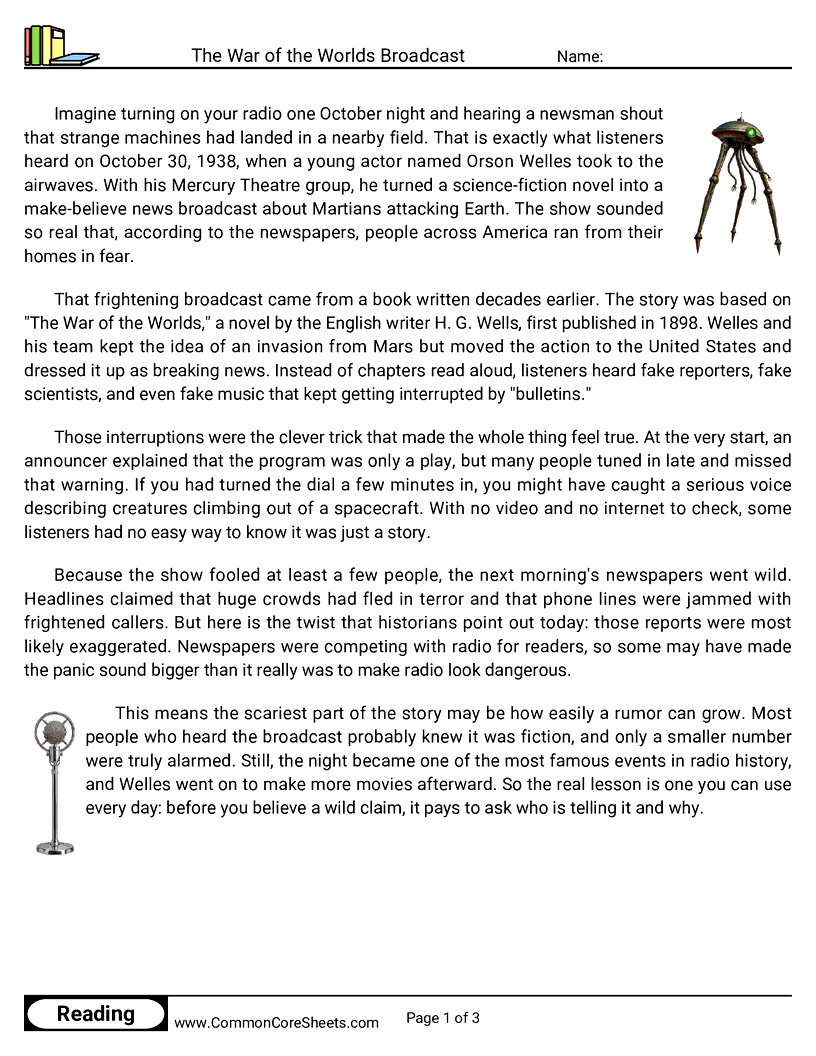
Imagine turning on your radio one October night and hearing a newsman shout that strange machines had landed in a nearby field. That is exactly what listeners heard on October 30, 1938, when a young actor named Orson Welles took to the airwaves. With his Mercury Theatre group, he turned a science-fiction novel into a make-believe news broadcast about Martians attacking Earth. The show sounded so real that, according to the newspapers, people across America ran from their homes in fear.
That frightening broadcast came from a book written decades earlier. The story was based on "The War of the Worlds," a novel by the English writer H. G. Wells, first published in 1898. Welles and his team kept the idea of an invasion from Mars but moved the action to the United States and dressed it up as breaking news. Instead of chapters read aloud, listeners heard fake reporters, fake scientists, and even fake music that kept getting interrupted by "bulletins."
Those interruptions were the clever trick that made the whole thing feel true. At the very start, an announcer explained that the program was only a play, but many people tuned in late and missed that warning. If you had turned the dial a few minutes in, you might have caught a serious voice describing creatures climbing out of a spacecraft. With no video and no internet to check, some listeners had no easy way to know it was just a story.
Because the show fooled at least a few people, the next morning's newspapers went wild. Headlines claimed that huge crowds had fled in terror and that phone lines were jammed with frightened callers. But here is the twist that historians point out today: those reports were most likely exaggerated. Newspapers were competing with radio for readers, so some may have made the panic sound bigger than it really was to make radio look dangerous.
This means the scariest part of the story may be how easily a rumor can grow. Most people who heard the broadcast probably knew it was fiction, and only a smaller number were truly alarmed. Still, the night became one of the most famous events in radio history, and Welles went on to make more movies afterward. So the real lesson is one you can use every day: before you believe a wild claim, it pays to ask who is telling it and why.
Imagine you're sitting by the radio on a chilly October night, tapping your foot to some dance music, when suddenly a breathless voice cuts in with "breaking news": Martians have landed in New Jersey! That's exactly what listeners heard on October 30, 1938, when a young actor named Orson Welles took over the airwaves. His radio program, performed by a group called the Mercury Theatre, sounded so much like a real news broadcast that some people forgot it was a show at all. There were fake reporters, fake scientists, and fake bulletins interrupting the music, one after another. It was Halloween eve, and the whole thing was meant to be a spooky treat.
That spooky treat was actually an old book brought roaring to life. Welles and his team had taken "The War of the Worlds," a science-fiction novel written by British author H. G. Wells back in 1898, and reshaped it for the radio. Instead of simply reading the story aloud, they told it as if it were happening right then, live, in towns Americans knew. Picture a play disguised as the evening news, with actors playing panicked officials and eyewitnesses describing strange machines. The clever trick was the format itself, because in 1938 the radio was where families gathered to learn what was truly going on in the world.
Because the radio felt so trustworthy, the newspapers the next morning were full of alarming stories. They claimed that people had fled their homes, jammed the phone lines, and prayed in the streets, all because they believed Martians were really invading. Headlines shouted about a nation gripped by terror, and the tale of the great panic spread far and wide. For years afterward, that image stuck: millions of Americans supposedly fooled by a single radio show. It made for a gripping story, and gripping stories have a way of sticking around.
Here's where that gripping story starts to wobble under a closer look. Many historians now argue that the panic was much smaller than the newspapers claimed, and that only a fraction of listeners were even tuned in that night. Some researchers point out that newspapers had a reason to exaggerate, because they were competing with radio for readers and advertisers and were happy to make their rival look dangerous. In other words, the story about people being fooled may itself have fooled us for decades. Sorting out what really happened means weighing the evidence instead of trusting the loudest headline.
Weighing evidence instead of trusting the loudest voice is exactly why this old broadcast still matters today. You live in a world flooded with posts, videos, and "breaking" alerts, some true and some not, all fighting for your attention. The 1938 broadcast is a reminder to ask who is telling you something, why, and whether the proof holds up, whether the message comes from a radio, a screen, or a shouting headline. Welles later became a famous filmmaker, but he never fully escaped the night he pretended aliens had landed. The strangest twist of all may be this: the biggest scare wasn't the invasion in the script, but the story people told afterward about being scared.
Picture this: it's a chilly October evening in 1938, and families across America are gathered around the radio like it's a glowing campfire. Suddenly a calm announcer breaks in with breaking news - strange explosions on Mars, then a metal cylinder crashing into a New Jersey field. What listeners were hearing wasn't real, but it was designed to sound exactly like the news bulletins they trusted. This was "The War of the Worlds," a radio drama that would become one of the most talked-about broadcasts in history.
That trusted-sounding voice belonged to a 23-year-old named Orson Welles, and he wasn't reporting anything at all. He and his group, the Mercury Theatre on the Air, were performing a play based on H. G. Wells's 1898 novel about invading Martians. To make it feel real, the writers turned the old book into a string of fake news updates, complete with reporters describing the creatures as the "invasion" unfolded. The broadcast aired on CBS on the night of October 30, 1938 - the evening before Halloween.
Turning a novel into fake news was a bold trick, and it worked partly because of how radio was woven into daily life. In the 1930s, radio was the main way most Americans got news, and a bulletin that interrupted regular programming meant something serious had happened. Welles's team copied that style precisely: an orchestra playing dance music, then an urgent voice cutting in, then a shaky report from the scene. If you tuned in a few minutes late, you missed the part that said it was only a story.
Missing that opening is exactly what newspapers claimed had thrown the country into chaos. The next morning, papers ran huge headlines describing terrified listeners fleeing their homes, jamming phone lines, and praying in the streets. The story of a nation tricked into panic was dramatic, and it spread fast across the front pages. For decades, that image of mass hysteria was retold in books and classrooms as simple fact.
Here's where the plot twist arrives, and it may surprise you more than the Martians did. Later historians who dug into the evidence argue that the panic was far smaller than the newspapers said. Most people were listening to a more popular show on another station that night, and surveys taken afterward suggested only a small share of the audience thought the attack was real. Some researchers think newspapers may have exaggerated the story on purpose, partly because they saw radio as a rival stealing their advertisers.
That rivalry hints at why we should always ask who is telling a story and why. The broadcast made Orson Welles famous almost overnight, and within a few years he was directing "Citizen Kane," often called one of the greatest films ever made. Today the 1938 program is studied not just as spooky Halloween entertainment but as a lesson in how easily a convincing format can fool an audience. The strangest part isn't that a radio play imitated the news - it's that the news, in turn, may have invented a panic that never quite happened.
Picture a young man of twenty-three standing in a New York radio studio on the night of October 30, 1938, headphones clamped over his ears, waving his arms like a conductor. That was Orson Welles, and his Mercury Theatre company was about to perform H. G. Wells's novel "The War of the Worlds" for the CBS radio network. But they didn't read it like an ordinary story. Instead, they disguised it as a series of breaking news bulletins, interrupting fake dance music to announce that strange explosions had been seen on Mars. If you had tuned in late, you might not have realized you were listening to a play at all.
That trick of "tuning in late" is exactly what turned a simple play into a legend. The broadcast used the sound of real radio journalism: an announcer describing a landing in Grovers Mill, New Jersey, breathless reporters, official-sounding experts, and moments of dead silence. Listeners who missed the opening credits heard what sounded like genuine reports of Martians attacking, complete with a supposed government statement. Welles later said the goal was to make the invasion feel immediate and terrifyingly ordinary. The performance was clever precisely because it borrowed the voice people trusted most in 1938.
That trusted voice mattered because radio, in 1938, was the beating heart of the American home. Most families gathered around a wooden set in the evening the way people now stare at phones, and radio was where they learned about a nervous world sliding toward war in Europe. When an urgent bulletin broke in, it carried real weight, because that was how genuine emergencies were announced. So when historians describe listeners believing the broadcast, they are pointing to a moment when the medium itself made the fiction convincing. The very realism that made the show brilliant is what made it dangerous.
The morning after, newspapers seized on that danger with enormous headlines. Papers across the country reported that terrified Americans had jammed phone lines, fled their homes, and prayed in the streets, and some claimed a nationwide panic had gripped millions. These stories made the broadcast instantly famous and helped launch Welles's career in Hollywood. But here is where you should slow down and ask a sharp question: how did reporters know how many people panicked? Mostly, they didn't; they collected a handful of dramatic anecdotes and stretched them into a national emergency.
That gap between anecdote and evidence is exactly what later researchers set out to close. Media historians, digging into the actual audience numbers, argue that relatively few people were even listening, because a far more popular show aired on a rival network at the same time. Some scholars suggest newspapers had a motive to exaggerate, since radio was stealing their advertisers and a story about reckless radio made the newer medium look irresponsible. This is a classic problem in evaluating claims: a vivid story spreads faster than a careful count. When you weigh the two accounts, ask which one rests on measured data and which rests on repeated retellings.
Weighing those two accounts is what keeps this eighty-year-old broadcast alive in classrooms today. The episode has become a favorite example of how a rumor can harden into "fact" simply by being printed often enough. It reminds you that a frightening claim deserves the same question whether it arrives by radio, newspaper, or a post on your phone: what is the evidence? Welles himself seemed almost delighted by the uproar, and it made him one of the most talked-about people in America overnight. The strangest twist of all may be this: the story of the panic turned out to be a bit like the broadcast itself, a gripping tale that far more people believed than the facts could support.
About this worksheet
Students read a nonfiction passage about the 1938 "War of the Worlds" radio broadcast, written at 4 reading levels (5th grade to 8th grade), and answer multiple-choice questions about it.
A reading comprehension worksheet about the 1938 "War of the Worlds" radio broadcast with a different article for each reading level, 5th grade to 8th grade, each with its own multiple-choice questions aligned to the Common Core Reading: Informational Text standards. Printable with an answer key, and available as an online assignment at any level.
Student objectives
- Read a nonfiction passage about the 1938 "War of the Worlds" broadcast and its aftermath
- Explain how the fake news format made the drama believable to listeners
- Trace and evaluate the claim that the broadcast caused mass panic
- Find the reasons historians give for doubting the newspaper reports
Everyday practice
- Notice how a news alert or headline is written to grab your attention, then ask what evidence supports it
- Try checking whether a surprising story appears in more than one reliable source before believing it
- Listen for the difference between reporting facts and telling a dramatic story