The Science of Being Scared Worksheet Download
Free reading comprehension worksheet about the science of fear. Pick the reading level (2nd grade to 8th grade), print the passage with its questions, or assign it online.


Sheet Information >
Available at 2nd grade, 3rd grade, 4th grade, 5th grade, 6th grade, 7th grade and 8th grade reading levels.
Read the passage
Boo! Did your heart just jump when something surprised you? When you get scared, a tiny part of your brain sends out a super-fast alarm. This little helper is called the amygdala, and it is smaller than a peanut!
That peanut-sized alarm tells your body to get ready in a flash. Your heart beats faster, your breath speeds up, and a special helper called adrenaline zooms through you. This burst of energy is your body saying, "Run away or stand strong!"
Running or standing strong sounds serious, but scary can also be a game. When you laugh through a spooky story or a costume that jumps out, your brain quickly learns you are safe. That is why a good scare can turn into giggles instead of tears!
After the giggles, your body needs a little time to slow back down. Taking slow, deep breaths tells your heart it is okay to relax again. Isn't it neat that the same alarm that scares you can also make Halloween fun?
Imagine you are walking through a dark hallway when something jumps out and yells, "Boo!" Your heart pounds, your breath comes fast, and you feel a tingly rush all over. In just a blink, your whole body has switched on like an alarm. That quick, jumpy feeling is called fear, and it is your brain's way of keeping you safe.
That alarm starts deep inside your head, in a little part of your brain called the amygdala. When the amygdala spots something scary, it acts like a tiny fire alarm and shouts, "Danger!" Then it tells your body to make a special chemical called adrenaline, which zooms through your blood. Believe it or not, all of this happens faster than you can even think the word "scared"!
Because adrenaline is racing around, your body gets ready to move in a hurry. Your heart beats faster to push blood to your muscles, and you breathe quicker to grab more air. People call this "fight or flight," because your body is packing up to either stand and fight or run away fast. Long ago, this helped people escape from real dangers, like a hungry animal in the woods.
So why would anyone pay to walk through a haunted house and feel all that? The secret is that your brain knows you are really safe, so the scare turns into fun instead of true danger. After the spooky part is over, you take slow breaths, your heart slows down, and you feel calm again. The wildest part is that the same alarm that once helped people run from wild animals is the reason a scary story can make you giggle!
You step into a dark haunted house, and suddenly something jumps out at you! Your heart pounds, your breath speeds up, and you might even scream before you know what is happening. That whole reaction takes less than a second, faster than you can blink. Believe it or not, your body has a built-in alarm system, and it just went off.
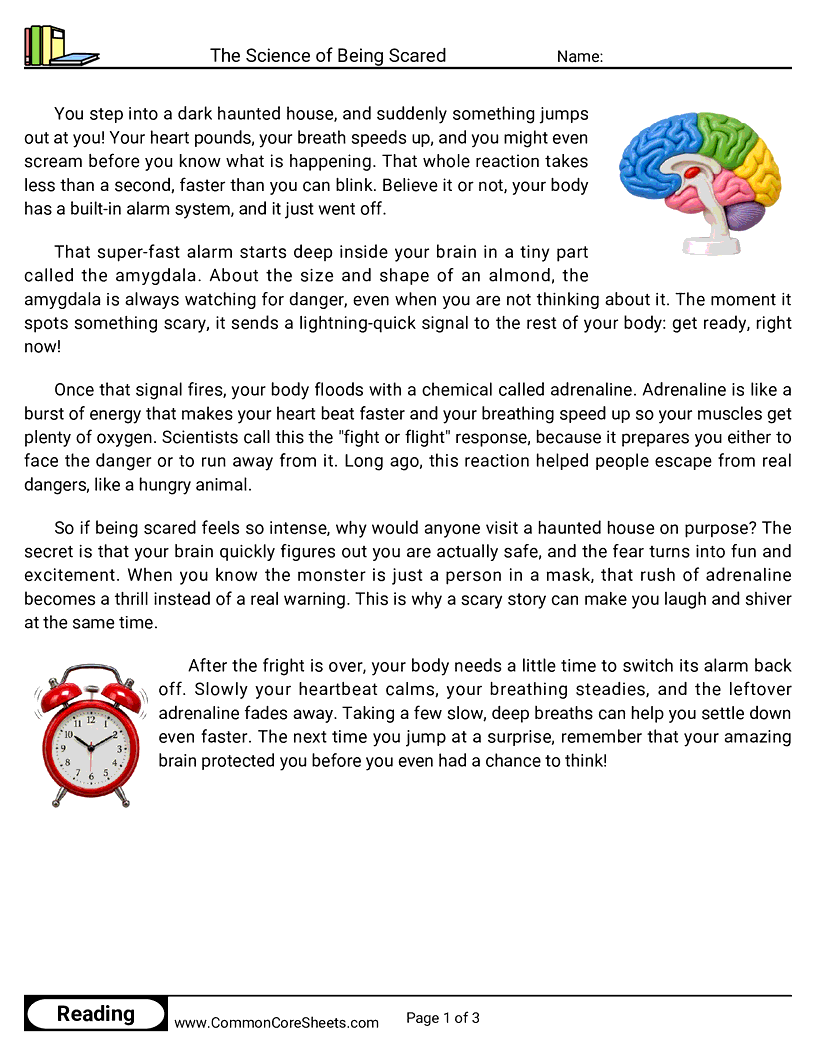
That super-fast alarm starts deep inside your brain in a tiny part called the amygdala. About the size and shape of an almond, the amygdala is always watching for danger, even when you are not thinking about it. The moment it spots something scary, it sends a lightning-quick signal to the rest of your body: get ready, right now!
Once that signal fires, your body floods with a chemical called adrenaline. Adrenaline is like a burst of energy that makes your heart beat faster and your breathing speed up so your muscles get plenty of oxygen. Scientists call this the "fight or flight" response, because it prepares you either to face the danger or to run away from it. Long ago, this reaction helped people escape from real dangers, like a hungry animal.
So if being scared feels so intense, why would anyone visit a haunted house on purpose? The secret is that your brain quickly figures out you are actually safe, and the fear turns into fun and excitement. When you know the monster is just a person in a mask, that rush of adrenaline becomes a thrill instead of a real warning. This is why a scary story can make you laugh and shiver at the same time.
After the fright is over, your body needs a little time to switch its alarm back off. Slowly your heartbeat calms, your breathing steadies, and the leftover adrenaline fades away. Taking a few slow, deep breaths can help you settle down even faster. The next time you jump at a surprise, remember that your amazing brain protected you before you even had a chance to think!
Your heart pounds, your palms sweat, and you jump before you even know why. What just happened inside you? In less than a second, your body flipped a switch you didn't even choose to flip, all because a shadow moved or a door creaked. That switch is one of the oldest and fastest alarm systems in nature, and you carry it around every single day.
The switch that made you jump lives deep inside your brain, in a small almond-shaped part called the amygdala. Think of it as a lookout that never sleeps, scanning for anything that might be dangerous. When it spots a possible threat, it doesn't wait to ask questions; it sounds the alarm before the thinking part of your brain has even caught up. That is why you leap away from a snake-shaped stick first and feel silly about it a moment later.
Once that alarm rings, your body floods with a chemical called adrenaline, and everything shifts into high gear. Your heart beats faster to rush blood to your muscles, and your breathing quickens to grab more oxygen. Scientists call this the "fight or flight" response, because it prepares you to either face the danger or run from it fast. Long ago, this reaction helped humans escape wild animals, and the very same system now makes you flinch at a jump scare in a movie.
If fear is meant to protect you, why would anyone pay to walk through a haunted house on purpose? The secret is that your brain can tell the difference between real danger and pretend danger, at least most of the time. When you know deep down that you are safe, the rush of adrenaline turns into excitement instead of terror, and your body even releases feel-good chemicals afterward. That mix of a racing heart and a giggling relief is exactly why scary stories around a flashlight can be so much fun.
That relief you feel afterward is your body switching the alarm back off and returning to calm. Slow, deep breaths tell your brain the danger has passed, which is why counting your breaths can steady you after a fright. Within a few minutes your heartbeat slows, the adrenaline fades, and you feel normal again. Here is the wild part: the whole roller coaster, from that first jump to your last calming breath, can be sparked by something as harmless as a friend saying "Boo!"
You think you decide when to be scared, but your brain jumps to that conclusion long before you do. Imagine walking through a haunted house when a figure lurches from a doorway. Before you can even think the word "ghost," your heart is already slamming, your hands are cold, and your legs are ready to run. That whole reaction takes about a tenth of a second, faster than you can blink. Your thinking brain didn't get a vote at all.
The tiny alarm bell that rings so fast has a name: the amygdala. It is an almond-shaped cluster deep inside your brain, and you actually have two of them, one on each side. The amygdala's job is to spot possible danger and shout "go!" before the slower, reasoning part of your brain has finished figuring out what you saw. Because it acts first and asks questions later, you might scream at a coat on a hook before you realize it isn't a monster. Scientists sometimes call this a shortcut, a low road that skips the long way around.
Once that alarm sounds, your body floods with a chemical messenger called adrenaline. This is the famous "fight or flight" response, and it turns your body into a machine built for one thing: getting away. Your heart beats faster to pump blood to your muscles, your breathing speeds up to grab more oxygen, and your pupils widen to let in more light. Sugar rushes into your blood for quick fuel, and things you don't need right now, like digesting lunch, get put on hold. All of this happens without you asking, which is why your body feels hijacked.
If fear feels this powerful, why would anyone pay to be scared inside a haunted house? The secret is a second opinion from your thinking brain, which quickly whispers, "You're safe, this is pretend." When your body is revved up but your mind knows there is no real danger, that leftover energy can flip into a rush of relief and even joy. Researchers who study people in "scare attractions" have found that many report feeling happier and less stressed afterward. It's the same reason a roller coaster is thrilling instead of terrifying: your brain gets the fireworks without the actual falling.
Long after the last jump scare, this ancient wiring still matters to you every single day. The same amygdala that flinches at a rubber spider once helped your distant ancestors leap away from real predators, which is why we still have it at all. Knowing how it works gives you a kind of power: when your heart pounds before a test or a big game, you can remind yourself it's just adrenaline doing its old job. Take a few slow breaths, and you signal your body that the danger has passed, letting your heartbeat drift back to normal. So the next time something makes you shriek, remember that a piece of your brain the size of an almond just decided you should run, all before you knew what happened.
Picture this: you're creeping through a haunted house when a figure lunges from the shadows, and before you can even think, your whole body reacts. Your heart slams against your ribs, your breath goes shallow, and your legs are ready to sprint for the exit. Here's the wild part—all of that happened in less than a second, faster than you could read this sentence. Fear isn't just a feeling; it's a lightning-fast chemical event your body launches to protect you, whether the threat is a masked actor or a real charging dog.
That split-second reaction starts deep inside your brain, in a pair of almond-shaped clusters called the amygdala. The amygdala acts like a smoke alarm, constantly scanning for danger, and when it senses a threat it sounds the alarm before the thinking part of your brain has even caught up. In fact, your amygdala can trigger a reaction before you consciously know what scared you. That's why you jump at a shadow first and figure out it was only a coat rack second.
Once that alarm blares, your body floods with a chemical messenger called adrenaline. Adrenaline is like flipping every switch in your body to "go," preparing you for what scientists call the fight-or-flight response. Your heart beats faster to pump blood to your muscles, your breathing speeds up to grab more oxygen, and your pupils widen to let in more light. Even your palms may sweat, which is one of the many ways your body responds to a sudden fright.
All that survival machinery raises a strange question: if fear feels so unpleasant, why do people line up and pay money to be scared? The answer is that your brain knows the difference between real danger and pretend danger, even while your body reacts to both. When you ride a roller coaster or walk through a haunted maze, part of your mind stays aware that you are safe, so the flood of adrenaline turns into a rush of excitement instead of terror. Scientists sometimes call this a "safe scare," and it can leave you laughing and buzzing with energy afterward.
That buzzing energy doesn't stick around forever, thankfully, because your body has a built-in brake. A separate part of your nervous system, called the parasympathetic system, works to calm you down once the danger passes. It slows your heartbeat, steadies your breathing, and clears the leftover adrenaline, usually within about twenty to thirty minutes. This is why taking slow, deep breaths after a fright genuinely helps—you're giving your body's brake pedal a push.
Understanding this two-part system, one that revs you up and one that cools you down, changes how you experience a scary night. The next time a friend jumps out and your heart takes off, you'll know your amygdala just beat your thinking brain to the punch. You'll know the pounding chest and quick breaths are adrenaline doing its ancient job, and that a few deep breaths can flip the switch back. And here's the strangest thought of all: the very same alarm that once helped humans flee from predators is now what makes a haunted house so much fun.
Picture yourself stepping into a haunted house with a friend. A door creaks, a figure lunges from the dark, and you both shriek and then burst out laughing. In that split second, your body ran an entire emergency drill without asking your permission. Your heart hammered, your breath quickened, and every muscle tensed to run. The strange part is that you paid money for exactly that feeling, and you would happily line up to do it again.
That flood of energy starts with a tiny alarm bell buried deep in your brain called the amygdala. About the size and shape of an almond, this cluster of cells sits near the center of each half of your brain, constantly scanning for danger. When it spots a threat, real or fake, it fires before your thinking brain has time to weigh the evidence. That is why you flinch at a jump scare a full moment before you realize it was only a person in a rubber mask. Scientists sometimes call this the brain's smoke detector, because it would rather sound off over burnt toast than miss a real fire.
Once that almond-shaped alarm rings, your body launches what researchers named the fight-or-flight response. Glands above your kidneys dump a hormone called adrenaline into your blood, and within seconds it reaches nearly every organ. Your heart speeds up to push blood to your muscles, your breathing quickens to grab more oxygen, and your pupils widen to let in more light. Blood even drains from your stomach and skin toward your arms and legs, which is one reason a good scare can leave you pale. All of this readies you to sprint away or stand and fight, a system your ancestors relied on when the threat was a predator rather than an actor in face paint.
Here is the puzzle that same racing body raises: if fear feels so unpleasant, why do millions of people chase it every October? The answer is that your brain runs two calculations at once, and the second one is the reason haunted houses stay in business. While the amygdala screams danger, your slower thinking brain, the prefrontal cortex, checks the facts and quietly reports that you are actually safe. That gap between the jolt of alarm and the relief of knowing better produces a rush some scientists call a "safe scare." You get the flood of energizing chemicals without any of the real risk, a bit like riding a roller coaster that only feels like it might fly off the tracks.
Because your body cannot tell a rubber mask from a real monster, calming down afterward takes a little time and a few tricks. When the danger passes, another branch of your nervous system steps in to hit the brakes, slowing your heart and settling your breath. Deep, slow breaths speed up that process, which is why people naturally exhale hard and laugh once a scare is over. Laughing with friends is not just relief, either; sharing the moment tells your brain the coast is clear and the threat was never real. Within a few minutes the adrenaline breaks down, your stomach unclenches, and you feel that pleasant, wrung-out calm.
That loop of jolt and recovery may explain why scary stories have survived for thousands of years around every campfire on Earth. Long before haunted houses, people gathered in the dark to trade ghostly tales, testing their fear in a circle where everyone knew they were safe. Some researchers argue that make-believe fright is practice, a way to rehearse handling danger before it ever finds us for real. Others suspect we simply enjoy the chemical high and the closeness of surviving something together. Either way, the next time a friend leaps out and your heart tries to escape your chest, you can thank an almond-sized alarm that has been keeping living things alive for millions of years.
About this worksheet
Students read a nonfiction passage about the science of fear, written at 7 reading levels (2nd grade to 8th grade), and answer multiple-choice questions about it.
A reading comprehension worksheet about the science of fear with a different article for each reading level, 2nd grade to 8th grade, each with its own multiple-choice questions aligned to the Common Core Reading: Informational Text standards. Printable with an answer key, and available as an online assignment at any level.
Student objectives
- Read a passage about how the body reacts to being scared
- Find details about the amygdala and adrenaline in the text
- Explain why a haunted house can feel fun instead of frightening
- Describe how the body calms down after a fright
Everyday practice
- Notice how your heart beats faster the next time something surprises you
- Try taking slow, deep breaths after a scare and see if it helps you calm down
- Watch how your body reacts during a spooky story and think about your amygdala at work