The Most Famous Haunted House Ride Worksheet Download
Free reading comprehension worksheet about the Haunted Mansion ride at Disneyland. Pick the reading level (2nd grade to 8th grade), print the passage with its questions, or assign it online.


Sheet Information >
Available at 2nd grade, 3rd grade, 4th grade, 5th grade, 6th grade, 7th grade and 8th grade reading levels.
Read the passage
Did you know a haunted house can be fun instead of scary? At Disneyland in California, there is a big white house called the Haunted Mansion. Inside, ghosts dance and sing, but they smile and want you to have a good time!
Those smiling ghosts took a long time to plan. Builders and artists worked for many years, and the ride opened in 1969. Some people wanted it to be very scary, while others wanted it to be silly and funny.
The funny side won, and that is why the ghosts feel friendly. To make them appear, workers use a clever trick with glass and light called Pepper's ghost. A big sheet of glass reflects a hidden room, so a see-through ghost seems to float right in front of you!
Mirrors help too, and one famous mirror makes it look like a ghost is sitting next to you in your car. Millions of people visit this ride every year, and it is one of the most loved rides in the park. Not bad for a house full of happy ghosts!
Imagine you are riding in a little black seat called a Doombuggy, gliding through a dark old house. Suddenly, glowing ghosts dance in a ballroom right below you! This is the Haunted Mansion, a famous ride at Disneyland in California. The ghosts look spooky, but they are friendly, and they seem to smile and wave as you float past.
Those smiling ghosts almost never happened the way you see them today. Long ago, the people who built the ride, called Imagineers, argued for years about it. Some wanted the house to be scary, and others wanted it to be silly and fun. In the end they picked both, so the ride opened in 1969 as a place that is spooky and giggly at the same time.
Once the doors opened, riders wanted to know how the ghosts could float in the air. The secret is an old stage trick from the 1800s called Pepper's ghost. Here is how it works: a hidden room holds real ghost figures, and a big sheet of clear glass reflects them into the ballroom. Because you cannot see the glass in the dark, the ghosts seem to appear out of thin air!
That clever glass trick is one big reason people love this ride so much. Families come back again and again to spot ghosts they missed before, hiding in mirrors, portraits, and shadows. One ghost even follows you home in the mirror at the end, riding in your Doombuggy! And here is the surprise: even though the whole place looks haunted, the floating ghosts are really just reflections you can see through.
Picture yourself climbing into a black "doombuggy" that swivels this way and that inside a big white house at Disneyland in California. The lights are dim, an organ moans, and a spooky voice welcomes you inside. Suddenly, in a grand ballroom below, dozens of see-through ghosts are dancing and swirling around a long table! This is the Haunted Mansion, and the ghosts are far more silly than scary.
Those dancing ghosts almost didn't turn out so friendly. When Walt Disney's designers, called Imagineers, first dreamed up the ride in the 1950s and 1960s, they argued for years about it. Some wanted a truly frightening, run-down house, while others wanted it to be funny and full of jokes. In the end they mixed both, so the ride is spooky enough to be exciting but light enough to make you laugh.
That mix of spooky and silly finally opened its doors in August 1969, after more than a decade of planning. Guests lined up right away to see what all the fuss was about. Word spread that this was a haunted house where you could smile instead of scream. Very soon it became one of the most popular rides in the whole park.
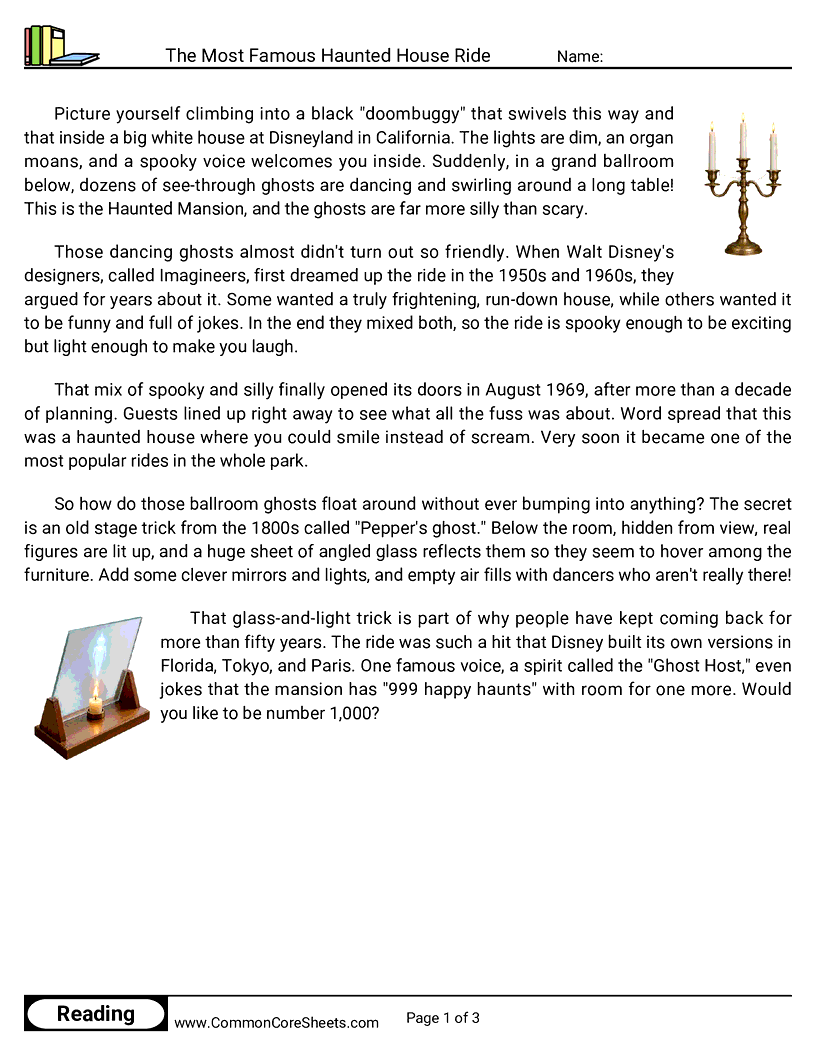
So how do those ballroom ghosts float around without ever bumping into anything? The secret is an old stage trick from the 1800s called "Pepper's ghost." Below the room, hidden from view, real figures are lit up, and a huge sheet of angled glass reflects them so they seem to hover among the furniture. Add some clever mirrors and lights, and empty air fills with dancers who aren't really there!
That glass-and-light trick is part of why people have kept coming back for more than fifty years. The ride was such a hit that Disney built its own versions in Florida, Tokyo, and Paris. One famous voice, a spirit called the "Ghost Host," even jokes that the mansion has "999 happy haunts" with room for one more. Would you like to be number 1,000?
Here is a riddle for you: how do you fill a house with 999 ghosts when ghosts are not real? That was the puzzle Walt Disney's designers had to solve when they built the Haunted Mansion at Disneyland in Anaheim, California. Step inside today and you'll drift past a ghostly ballroom where see-through figures waltz and swirl, a group of singing stone busts, and a bride who glows in the dark. None of them are ghosts at all, but you might have to look twice to be sure.
Those glowing figures took a surprisingly long time to appear, because the people making them couldn't agree on one big question. Should the mansion be truly scary, or should it be silly and fun? Some of Disney's artists, called Imagineers, wanted spooky chills, while others wanted jokes and grinning skeletons. They argued for years, which is one reason the ride wasn't finished until 1969, long after the building itself was standing empty.
When the doors finally opened, the winners of that argument had clearly chosen fun over fright. The ghosts you meet are cheerful, not cruel, and many of them seem to be inviting you to a party rather than chasing you out. A famous voice actor named Paul Frees played the "Ghost Host," who guides you through with a warm, teasing chuckle. That friendly feeling is the reason families with young children ride it again and again.
The friendliest ghosts of all are the ones dancing in that ballroom, and they hide a clever secret from the 1800s. The trick is called "Pepper's ghost," named after a showman who made it famous in London theaters in the 1860s. It works like this: a huge sheet of angled glass reflects brightly lit figures hidden off to the side, so they seem to float right in the middle of the room. Mirrors, colored light, and a little darkness do the rest, turning ordinary models into ghosts that shimmer in the air.
That old stage trick is exactly why the mansion still amazes people who visit it now. Disney later built copies at parks in Florida, Tokyo, and Paris, proving the idea traveled far beyond California. Millions of guests ride it every year, and many say the leaving is their favorite part, because a grinning "hitchhiking ghost" appears to climb right into the car beside you. And here's the strangest fact of all: the whole spooky wonder is built from mirrors, glass, and light, with not a single real ghost in sight.
Here is something that might surprise you: the most famous haunted house in the world was designed so you would laugh, not scream. When Disneyland's Haunted Mansion opened in California in 1969, guests expected to be terrified out of their sneakers. Instead they met dancing ghosts, a wall-eyed piano player, and a chatty spirit inside a crystal ball named Madame Leota. The building itself looks like a grand old Southern-style mansion, all white columns and shadows, but the mood inside is more prank than nightmare. You could call it the friendliest scary place ever built.
That friendly feeling did not happen by accident, and it certainly did not happen quickly. Walt Disney's designers, called Imagineers, argued for years about whether the ride should be genuinely frightening or mostly playful. One team wanted cobwebs, gloom, and real chills; another wanted humor and winks. In the end the funny side won, which is why the ride is packed with ghosts who wave at you instead of chasing you. Planning stretched across the 1950s and 1960s, and Walt himself died in 1966, three years before the doors finally opened.
Those waving ghosts bring us to the best question of all: how do you make a spirit appear out of thin air? The trick is a 150-year-old stage illusion called Pepper's ghost, named after a scientist who popularized it in the 1860s. It works with a huge sheet of angled glass and clever lighting; when a hidden figure below is lit up, its reflection seems to float in the room in front of you. Turn the light off, and the ghost simply vanishes, because there was never anything solid there at all. The Mansion's famous ballroom full of dancing spirits is really an empty room with reflections doing all the dancing.
If mirrors can make a ghost waltz, imagine what else they can pull off inside those walls. Throughout the ride, angled mirrors, painted scenes, and shifting light fool your eyes into seeing motion and depth that are not really there. One gravestone bust seems to follow you with its gaze no matter where you stand, a trick your own brain plays on a hollow, reversed face. The Imagineers understood that a hint of a ghost your mind completes is spookier, and more fun, than any monster shoved in your face. That is the real secret: the scariest thing in the room is often your own imagination.
That clever, gentle spookiness is exactly why the ride still draws long lines more than fifty years later. It proved that a haunted attraction could be witty rather than gory, and countless theme parks have borrowed the idea since. Every autumn the ride is even redecorated for the season in some Disney parks, blending its ghosts with a holiday makeover. Generations of families have ridden it, so the grandparents in line today may have first visited as kids. Here is the strangest part of all: a place built around make-believe death has become one of the liveliest, most beloved spots in any park.
Here's a riddle for you: how do you cram 999 ghosts into a single house and still have room for one more? At the Haunted Mansion in Disneyland, the answer is that the ghosts aren't really there at all - they're built from mirrors, glass, and cleverly aimed light. When the ride opened in California in 1969, guests floated past a ballroom where see-through spirits waltzed, spun, and sat down to dinner. The building looks like a grand old Southern mansion, but everything spooky inside is an illusion, stitched together by artists who spent years arguing over exactly how it should feel. And that argument is the real ghost story.
Those arguments started long before a single ghost ever danced. Walt Disney's designers, who called themselves Imagineers, split into two camps for nearly two decades. One group wanted a truly frightening house, dripping with dread and shadows so thick you'd want to run. The other group thought that was all wrong for a Disney park and pushed for something playful, where the ghosts wink at you instead of scaring you. In the end the funny side mostly won, which is why today's ride feels more like a party than a nightmare.
Winking ghosts need a trick to do the winking, and the mansion's best one is older than any Imagineer. It's called Pepper's ghost, an illusion first shown to audiences in London in the 1860s by an inventor named John Henry Pepper. The idea is simple but sneaky: a large sheet of angled glass reflects a brightly lit figure hidden off to the side, so the reflection seems to hover in empty space. Dim the hidden figure and the ghost fades away; brighten it and the ghost appears out of nowhere. In the ballroom scene, those dancing spirits are actually solid models below and to the side, bounced onto huge panes of glass right in front of your ride car.
That same magic with mirrors shows up in one of the ride's most talked-about surprises. As your car leaves the ballroom, you pass a mirror - and suddenly a grinning ghost is riding along in the seat beside you. It looks like the spirit hitched a ride into your very own car, but it's another reflection, thrown onto angled glass so it appears to share your seat. Little touches like this are why people ride again and again, hunting for details they missed the first time. The point was never to make you scream; it was to make you grin and look twice.
Making guests grin instead of scream is exactly why the mansion became a favorite rather than a fright. Families who avoided scarier attractions felt safe climbing aboard, and kids left feeling brave instead of shaken. The ride's success helped prove that spooky and welcoming could live under the same roof, and later Disney parks in Florida, Tokyo, and Paris built their own versions. Some of those cousins wear different names and stories, but they all lean on the same friendly, funny spirit. A whole style of gentle haunted attraction grew from the choices made in that long designers' debate.
Those choices still surprise the guests who file past the tombstones out front. Many of the names carved into them are jokes honoring the real Imagineers who built the place, hidden in plain sight for anyone who reads carefully. The organ groaning in the ballroom is a real prop borrowed from an old adventure film, and the swirling ghosts are lit models you could almost reach out and touch - if the glass weren't in the way. So the next time someone tells you a house is truly haunted, remember the mansion's secret: the most convincing ghost of all is just a beam of light bouncing off a tilted piece of glass.
Picture a Disney artist named Yale Gracey crouched in a dim workshop, aiming a spotlight at a sheet of angled glass and grinning as a see-through skeleton suddenly floats in midair. No wires, no computers, no magic - just light bouncing exactly where he planned it. That workshop chaos was the beginning of Disneyland's Haunted Mansion, a ride that has been fooling delighted visitors since it opened in August 1969. The building itself sits in the New Orleans Square area of the park, a stately white manor with black shutters and a strangely tidy lawn. From the outside it looks like it should be silent, but inside it hums with 999 grinning, dancing, singing ghosts.
Those 999 ghosts almost turned out very differently, because the people building them could not agree on what kind of house this should be. For years Disney's designers, known as Imagineers, argued over one big question: should the mansion terrify guests or make them laugh? One camp wanted cobwebs, shrieks, and genuine dread, the sort of place that leaves your heart pounding. The other camp, which eventually won, wanted playful spooks you could giggle at on the way out. Walt Disney himself reportedly leaned toward keeping the outside neat and welcoming, joking that the ghosts could handle the haunting on the inside.
That decision to choose giggles over screams shaped every trick the Imagineers then invented to bring their ghosts to life. The most famous of these is an old stage illusion called Pepper's ghost, first demonstrated by scientist John Henry Pepper back in the 1860s. The idea is surprisingly simple: a large pane of glass is tilted at an angle, and a brightly lit figure hidden off to the side reflects onto it. To your eye, that reflection appears to hover in the room beyond the glass, transparent and glowing, like a ghost you could walk right through. In the ballroom scene, this is how dozens of spirits seem to waltz around a banquet table that is actually empty.
Because that trick depends entirely on controlling light, the Imagineers became obsessed with what guests could and could not see. Mirrors, black paint, and careful lighting do most of the work, hiding the machinery while showing you only the illusion. A figure lit from the front looks solid, but the same figure lit from behind can seem to vanish, which is why the ride keeps its rooms so deliberately dark. The famous "hitchhiking ghosts" near the exit use mirrors to place a see-through spirit right beside you in your ride vehicle. Every effect is really a lesson in physics dressed up in a top hat and a cobweb.
All that careful engineering would mean little if visitors did not fall in love with the place, and love it they did. Part of the appeal is that the ride never talks down to you; it trusts you to enjoy being pleasantly, harmlessly spooked. A cheerful, booming narrator called the Ghost Host guides your journey, and the tune "Grim Grinning Ghosts" has become one of Disney's best-known songs. The mansion proved so popular that versions were later built at Walt Disney World in Florida and at Disney parks overseas. Each copy keeps the same core idea: friendly ghosts who would rather dance with you than scare you away.
Those dancing ghosts have even picked up a seasonal costume change that its 1969 builders never imagined. At Disneyland, the mansion is transformed each autumn into a holiday overlay themed to the movie The Nightmare Before Christmas, blending Halloween and Christmas decorations. The switch takes a crew weeks of work, swapping out props, projections, and music to create an entirely different mood. It is a fitting twist for a ride built on the idea that the same room can look terrifying or delightful depending on how you light it. After all, a mansion that spent years arguing over scary versus funny finally settled on the cleverest answer of all: be both.
About this worksheet
Students read a nonfiction passage about the Haunted Mansion ride at Disneyland, written at 7 reading levels (2nd grade to 8th grade), and answer multiple-choice questions about it.
A reading comprehension worksheet about the Haunted Mansion ride at Disneyland with a different article for each reading level, 2nd grade to 8th grade, each with its own multiple-choice questions aligned to the Common Core Reading: Informational Text standards. Printable with an answer key, and available as an online assignment at any level.
Student objectives
- Read a nonfiction passage about the Haunted Mansion ride and its history.
- Explain how the Pepper's ghost trick makes the dancers appear to float.
- Find details that show why the ride became popular so quickly.
- Explain how the designers combined spooky and funny ideas.
Everyday practice
- Notice how mirrors and reflections make objects appear where they are not, like a store window at night.
- Look for a movie or show that uses see-through ghost effects and think about how they were made.
- Talk about a ride or place you know that is meant to be spooky but fun, not truly scary.