The Monster Mash Worksheet Download
Free reading comprehension worksheet about the song "Monster Mash" and Halloween music. Pick the reading level (3rd grade to 8th grade), print the passage with its questions, or assign it online.


Sheet Information >
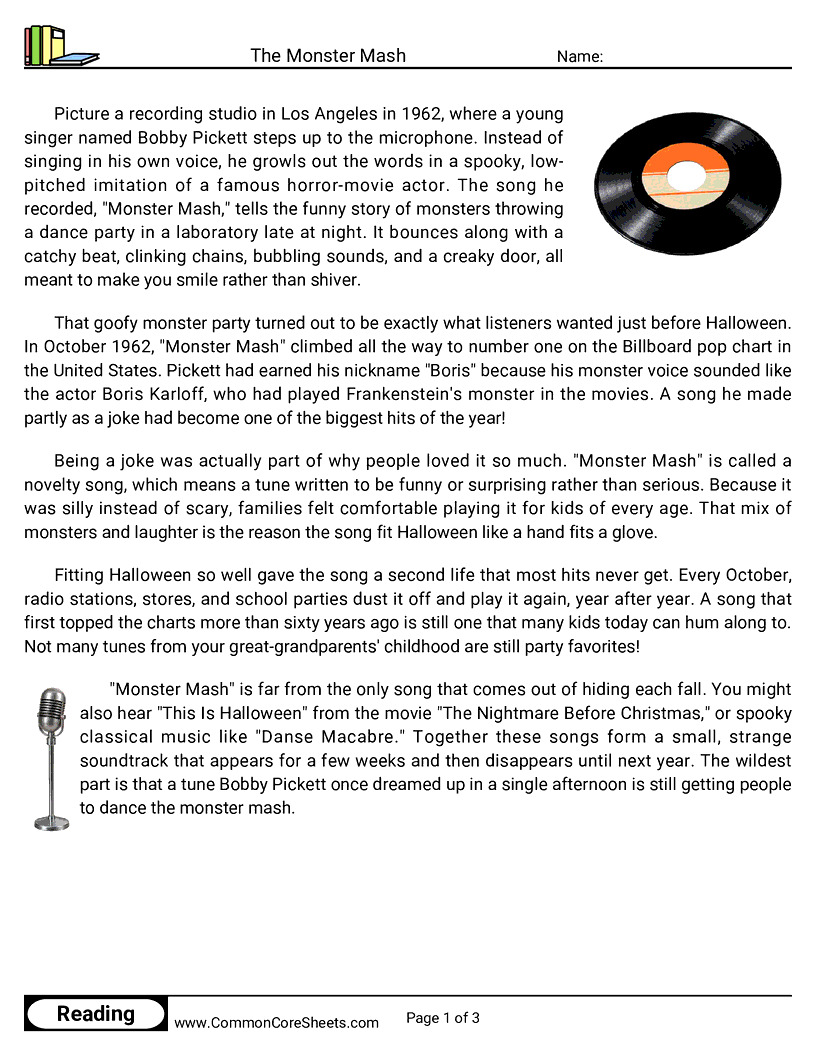
Available at 3rd grade, 4th grade, 5th grade, 6th grade, 7th grade and 8th grade reading levels.
Read the passage
Imagine you are at a party where every dancing guest is a friendly monster! That is the goofy idea behind "Monster Mash," a fun song that plays every October. In it, a singer pretends to be a mad scientist whose creations pop up and start a new dance. The music sounds spooky and silly at the same time, with clanking chains and bubbling sounds that make you giggle instead of shiver.
That giggly, spooky feeling was on purpose, and one clever singer knew just how to make it. A performer named Bobby "Boris" Pickett recorded the song in 1962. Bobby liked to copy the deep, growly voice of a famous movie actor, and he used that funny voice for the whole song. So a joke about monster movies became a real record that people could buy and play at home.
Because it was such a good joke, the record climbed all the way to number one right before Halloween in 1962. A song like that, made quickly just for fun, is called a novelty song. At first, some people thought it would be forgotten after a few weeks. Instead, it came back to the radio the next October, and the next, until playing it became a Halloween tradition.
It was not the only tune that families started singing when jack-o'-lanterns appeared. Today you might also hear "This Is Halloween" from a movie, or spooky songs made just for classrooms. Still, the old monster party song keeps dancing back every fall, more than sixty years after it was made. How wild that a silly voice recorded in one afternoon can still fill rooms with laughter each October!
Picture a recording studio in Los Angeles in 1962, where a young singer named Bobby Pickett steps up to the microphone. Instead of singing in his own voice, he growls out the words in a spooky, low-pitched imitation of a famous horror-movie actor. The song he recorded, "Monster Mash," tells the funny story of monsters throwing a dance party in a laboratory late at night. It bounces along with a catchy beat, clinking chains, bubbling sounds, and a creaky door, all meant to make you smile rather than shiver.
That goofy monster party turned out to be exactly what listeners wanted just before Halloween. In October 1962, "Monster Mash" climbed all the way to number one on the Billboard pop chart in the United States. Pickett had earned his nickname "Boris" because his monster voice sounded like the actor Boris Karloff, who had played Frankenstein's monster in the movies. A song he made partly as a joke had become one of the biggest hits of the year!
Being a joke was actually part of why people loved it so much. "Monster Mash" is called a novelty song, which means a tune written to be funny or surprising rather than serious. Because it was silly instead of scary, families felt comfortable playing it for kids of every age. That mix of monsters and laughter is the reason the song fit Halloween like a hand fits a glove.
Fitting Halloween so well gave the song a second life that most hits never get. Every October, radio stations, stores, and school parties dust it off and play it again, year after year. A song that first topped the charts more than sixty years ago is still one that many kids today can hum along to. Not many tunes from your great-grandparents' childhood are still party favorites!
"Monster Mash" is far from the only song that comes out of hiding each fall. You might also hear "This Is Halloween" from the movie "The Nightmare Before Christmas," or spooky classical music like "Danse Macabre." Together these songs form a small, strange soundtrack that appears for a few weeks and then disappears until next year. The wildest part is that a tune Bobby Pickett once dreamed up in a single afternoon is still getting people to dance the monster mash.
Picture a spooky song that has crawled back to life every single October for more than sixty years, like a ghost that just won't stay buried. That song is "Monster Mash," a goofy tune from 1962 about monsters throwing a dance party in a laboratory late at night. The singer pretends to be a mad scientist, describing how his creation climbs off the table and invents a brand-new dance that all the other creatures rush to copy. It sounds less scary than a cartoon, and that silliness is exactly why families still sing it today.
The man behind that laboratory voice was an actor named Bobby Pickett, who loved doing impressions of old horror-movie stars. People nicknamed him Bobby "Boris" Pickett because his monster voice sounded so much like the famous actor Boris Karloff, who once played Frankenstein's monster on screen. One night while singing with his band, Bobby slipped into that growly impression as a joke, and the crowd laughed and cheered. He realized the bit was too good to waste, so he and a friend wrote a whole song around it.
Turning that stage joke into a hit took only a few hours in a recording studio. Bobby and his bandmates used everyday objects to make the spooky sound effects, dropping chains onto the floor and pulling a rusty nail out of a board to imitate a creaking coffin lid. Bubbling water stood in for a mad scientist's laboratory, and chains rattled to add a shiver. The finished song reached number one on the American charts in late October of 1962, right in time for Halloween.
Reaching number one once would have been enough for most songs, but this one refused to stay put. Because it is tied so tightly to Halloween, radio stations pull it back out every autumn, and it has returned to the charts several times over the years. Few songs ever manage that trick, which is why people sometimes call it one of the most famous novelty songs ever recorded. A novelty song is a tune made mostly for fun and laughs rather than for serious feelings.
Of course, that one dancing monster never throws his party alone. Every October it joins a whole playlist of Halloween favorites, from the swooping organ of "Toccata and Fugue" to newer sing-along hits about ghosts and haunted houses. According to the National Retail Federation, most Americans plan to celebrate Halloween each year, and music is part of how they set the mood. Not bad for a song a comedian once tossed off as a joke between numbers on stage.
You'd probably guess the most stubborn Halloween hit ever recorded was written by a real musician who spent years perfecting it, right? Wrong. "Monster Mash" was tossed together in about an hour by a struggling actor doing a goofy voice, and it has haunted October radio for more than sixty years. The song is a bouncy dance tune where a mad scientist's laboratory experiment suddenly springs to life and invents a brand-new dance craze. Instead of terrorizing the village, the monster just wants to party, and soon every ghoul in the neighborhood is joining in. It sounds less like a horror movie and more like a costume party set to music.
That silly party in a laboratory came from a very real man named Bobby "Boris" Pickett. Back in 1962, Pickett was a young actor in Los Angeles who liked to imitate the deep, dramatic voice of horror star Boris Karloff during his band's shows. Audiences loved the impression so much that Pickett and a friend wrote a whole song around it, using the popular "Mashed Potato" dance as their inspiration. To make the spooky sound effects, they rattled chains and poured water for a bubbling-cauldron gurgle, all on a shoestring budget. The finished record was pure novelty, meaning it was made to be funny rather than serious.
Being funny turned out to be exactly what listeners wanted. In October of 1962, the goofy little record climbed all the way to number one on the Billboard chart, landing at the top just before Halloween. Record companies had figured that a comedy song about monsters would flop after the holiday, so almost nobody expected it to last. Instead, it came roaring back onto the charts in the years that followed, proving that a well-timed joke can outlive serious hits. Can you imagine writing something in an afternoon that people still play decades later? Pickett could.
Refusing to fade away is where this tune truly earned its reputation. Every autumn, as pumpkins appear on porches, radio stations dust it off and spin it again, right alongside other seasonal favorites. Some families sing "This Is Halloween" from a stop-motion movie, while others belt out "Ghostbusters" or the theme from an old vampire cartoon. These songs share a clever trick: they take something meant to be scary and make it fun enough for a school dance. That flip from frightening to festive is the whole point of Halloween music.
That flip is exactly why a sixty-year-old joke still matters. Halloween has grown into one of the biggest spending holidays in the United States, with a National Retail Federation survey reporting that Americans plan to spend billions of dollars on it each year. Music helps set the mood at parties, parades, and haunted houses, turning nervous giggles into dancing. "Monster Mash" proved that the scariest characters can be the friendliest hosts, and that a monster on the dance floor is far more fun than one under your bed. Not bad for a tune written faster than it takes to watch a cartoon.
Here is a song that has been climbing back onto the charts every October for over sixty years, which is longer than most of your grandparents have been alive. It is called "Monster Mash," and it is basically a comedy sketch set to music. A monster wakes up in a laboratory, invents a new dance craze, and soon a whole crowd of creatures is grooving along at a midnight party. The singer performs the whole thing in a low, croaky voice that sounds a lot like an old horror-movie actor. There is nothing scary about it at all; it is a joke that happens to have a beat you can dance to.
That famous croaky voice belonged to a struggling actor named Bobby Pickett, who recorded the song in 1962. Pickett had spent his childhood in his father's movie theater in Massachusetts, memorizing the voices of horror stars like Boris Karloff. One night, while performing with his band, he did his Karloff impression during a song, and the crowd loved it. He and a bandmate, Lenny Capizzi, wrote "Monster Mash" in about an hour, spinning the whole story around that spooky-but-silly voice. Because of his impression, Pickett gave himself a monster-sized nickname: Bobby "Boris" Pickett.
That homemade recording did something almost no one expected from a joke song. It reached number one on the Billboard Hot 100 in October 1962, just in time for Halloween. Radio stations across the country played it constantly, partly because it fit the season and partly because it was simply funny. At first, though, some British radio stations actually banned it, deciding it was too morbid for the airwaves. They eventually changed their minds, and the song became a hit there too, years after it was popular in America.
Being banned did not stop it; if anything, it turned the song into a legend. What makes "Monster Mash" unusual is that it keeps coming back, charting again and again in 1970 and 1973 as new listeners discovered it. Most number-one songs fade after a few months, but this one found a permanent home on the calendar. Every autumn, stores, parties, and school dances pull it out like a box of decorations from the attic. A song built as a one-time gag became something people expect to hear, the way you expect pumpkins on porches.
Pumpkins are not the only thing you will find alongside it, because Halloween now has a whole playlist of its own. Families sing along to spooky-fun tunes like "This Is Halloween" from a stop-motion film, or the theme from "Ghostbusters," or Michael Jackson's "Thriller." These songs share the same trick that made Pickett's hit work: they take something creepy and make it playful instead of frightening. According to National Retail Federation surveys, Americans spend billions of dollars on Halloween each year, and music is part of how they set the mood. A good Halloween song is like a costume for your ears, letting you enjoy a chill without any real fear.
That idea of enjoying a friendly scare is exactly why this old novelty song refuses to retire. Bobby Pickett kept performing it for the rest of his life, and he even released holiday-themed versions over the years. He once joked that the song was the graveyard smash that kept on giving, since it earned him a steady paycheck every single October. Think about that: a tune written in about an hour, mostly as a laugh, has now outlived its own creator and shows no sign of stopping. Not bad for a monster who just wanted to throw a dance party.
In the summer of 1962, a young actor named Bobby Pickett stood in front of a microphone in Los Angeles doing an impression of the horror-movie star Boris Karloff. His bandmates laughed so hard that they decided to build an entire song around the voice. The result was "Monster Mash," a bouncy little tune about a mad scientist whose laboratory creation rises from the slab and invents a brand-new dance craze. You can practically hear the creaky door and the clanking chains in the background, all set to a cheerful early-rock beat. It is silly, spooky, and completely harmless, which is exactly why it worked.
That harmless silliness is precisely what made the song a hit, because in 1962 dance crazes were everywhere. Teenagers were doing the Twist, the Mashed Potato, and a dozen other fads, so Pickett's joke was that even monsters wanted in on the fun. The record climbed to number one on the Billboard Hot 100 in late October 1962, arriving just in time for Halloween. Radio stations loved it, kids loved it, and Pickett suddenly had a smash hit built on an impression he had done for a laugh. Not bad for a song that reportedly took only a couple of hours to write.
A couple of hours of work turned into a lifetime of Halloweens, and that is the strange part of the story. Most number-one songs burn brightly and then fade, but this one refused to disappear. Every October it returns to the airwaves, streaming playlists, and school dances, as reliable as pumpkins on porches. It even re-entered the British charts more than once in the years after its release, a rare feat for a novelty record. Historians of pop music point out that very few songs become permanent seasonal fixtures the way "Silent Night" belongs to December.
Belonging to a season is what separates a hit from a tradition, and this is where the song earns its odd immortality. A regular pop song competes against every other song ever made, but a holiday song only has to be the best at its one job. Because Halloween produces very little new music each year, an old favorite faces almost no competition and simply keeps winning. Think of it like a small store on a street with no other shops: it does not have to be perfect, only present. That is why a 1962 recording can still out-haunt songs written decades later.
Present every October, it now shares the playlist with a small family of Halloween favorites that families sing together. There is the theme from "Ghostbusters," Michael Jackson's "Thriller," and the wobbly organ music people associate with old horror films. Retailers pay close attention to this, and a National Retail Federation survey has found that Americans spend billions of dollars on Halloween each year, including on parties where such songs play. Unlike scary movies, these songs invite everyone in, from toddlers in costume to grandparents handing out candy. That welcoming quality is the thread connecting nearly every song on the October playlist.
That welcoming spirit is also the real secret behind a monster who learned to dance. Pickett spent much of the rest of his career tied to that one song, performing it and even recording playful sequels, though none matched the original. He once joked that he was the Bing Crosby of Halloween, the way Crosby owned "White Christmas." The comparison is sharper than it sounds, because both men proved that a single seasonal recording can outlast almost everything else an artist makes. Somewhere out there, a song about a dancing laboratory monster has now survived longer than the careers of most serious rock stars who came after it.
About this worksheet
Students read a nonfiction passage about the song "Monster Mash" and Halloween music, written at 6 reading levels (3rd grade to 8th grade), and answer multiple-choice questions about it.
A reading comprehension worksheet about the song "Monster Mash" and Halloween music with a different article for each reading level, 3rd grade to 8th grade, each with its own multiple-choice questions aligned to the Common Core Reading: Informational Text standards. Printable with an answer key, and available as an online assignment at any level.
Student objectives
- Read a passage about the song "Monster Mash" and Halloween music.
- Find details that explain when and how the song became a hit.
- Explain why a silly song became a lasting Halloween tradition.
- Determine the meaning of the phrase "novelty song" from context.
Everyday practice
- Listen for Halloween songs playing in stores or on the radio this October and notice which ones return each year.
- Ask a grandparent or older adult which spooky songs they remember from when they were young.
- Try noticing whether a song is meant to be funny or serious by the way the singer uses their voice.