The Jack-o'-Lantern Candy Pail Worksheet Download
Free reading comprehension worksheet about the history of trick-or-treat bags and the plastic jack-o'-lantern pail. Pick the reading level (1st grade to 6th grade), print the passage with its questions, or assign it online.


Sheet Information >
Available at 1st grade, 2nd grade, 3rd grade, 4th grade, 5th grade and 6th grade reading levels.
Read the passage
Do you have a bag for your candy on Halloween? Long ago, kids used a pillowcase or a paper bag. Then came a fun orange pail shaped like a pumpkin!
That orange pumpkin pail has a happy face on it. People started using these plastic pails in the 1960s and 1970s. The pail has a handle, so you can carry lots of candy!
To make a pail, hot plastic is poured into a mold. A mold is a shape that makes the plastic look like a pumpkin. At night, kids carry glow sticks that shine so cars can see them.
Wow, look at that grinning orange bucket full of candy! That orange pail with a jack-o'-lantern face is one of the most famous shapes of Halloween. It has a triangle nose, spooky eyes, and a plastic handle so you can swing it as you walk.
Before that happy bucket, kids carried their treats in something much plainer. Long ago, children used old pillowcases or paper bags to hold their candy. A pillowcase could stretch as big as a laundry sack, but it did not have a fun smiling face!
The smiling pail came along and changed all of that in the 1960s and 1970s. Factories made the buckets from melted plastic that was poured into a metal shape called a mold. When the plastic cooled and got hard, out popped a shiny orange pumpkin, ready to fill with candy.
That new pail was fun, but staying safe in the dark matters too. Today many kids carry glow sticks or wear reflective bags that shine when car lights hit them. So the next time you see that grinning face, remember it once was just a plain old pillowcase!
Imagine you are walking down your street on Halloween night, and your hand is holding something orange and grinning up at you. It is a plastic pail shaped like a jack-o'-lantern, with a happy carved face and a handle that swings back and forth. Inside, candy clinks and rattles as you skip from door to door. This little orange bucket has been catching treats for many, many years!
Before that grinning pail came along, kids carried their treats in whatever they could find. Long ago, children used old pillowcases from their beds because they could hold heaps and heaps of candy. Others grabbed plain paper bags, though a heavy paper bag could rip and spill everything on the sidewalk! So people needed something stronger, and that is where the plastic pail comes in.
Because paper bags tore so easily, the orange plastic jack-o'-lantern pail became popular in the 1960s and 1970s. How do you make a bucket shaped like a pumpkin? Workers pour hot, melted plastic into a metal shape called a mold, and when it cools it becomes hard and keeps that pumpkin face forever. The mold squeezes the plastic into the same grinning shape again and again, so every pail looks like a cheerful twin. That is why you can find the same happy face on porches all across the country.
Today the grinning pail has some helpers that keep trick-or-treaters safe in the dark. Many kids snap glow sticks that shine bright green or blue, and some carry reflective bags that bounce car headlights right back so drivers can see them. Because dark clothes are hard to spot at night, these glowing tricks make a big difference. The next time your pail lights up under a streetlight, remember that this cheerful little bucket has been smiling on Halloween since your grandparents were kids!
Picture a chilly October evening in 1970, when a kid in a homemade ghost costume knocks on a door and holds up a bright orange bucket shaped like a grinning pumpkin. Its triangle eyes glow in the porch light, and its handle bends under the weight of candy already sloshing inside. That plastic jack-o'-lantern pail is one of the most famous Halloween objects ever made. Have you ever carried one yourself?
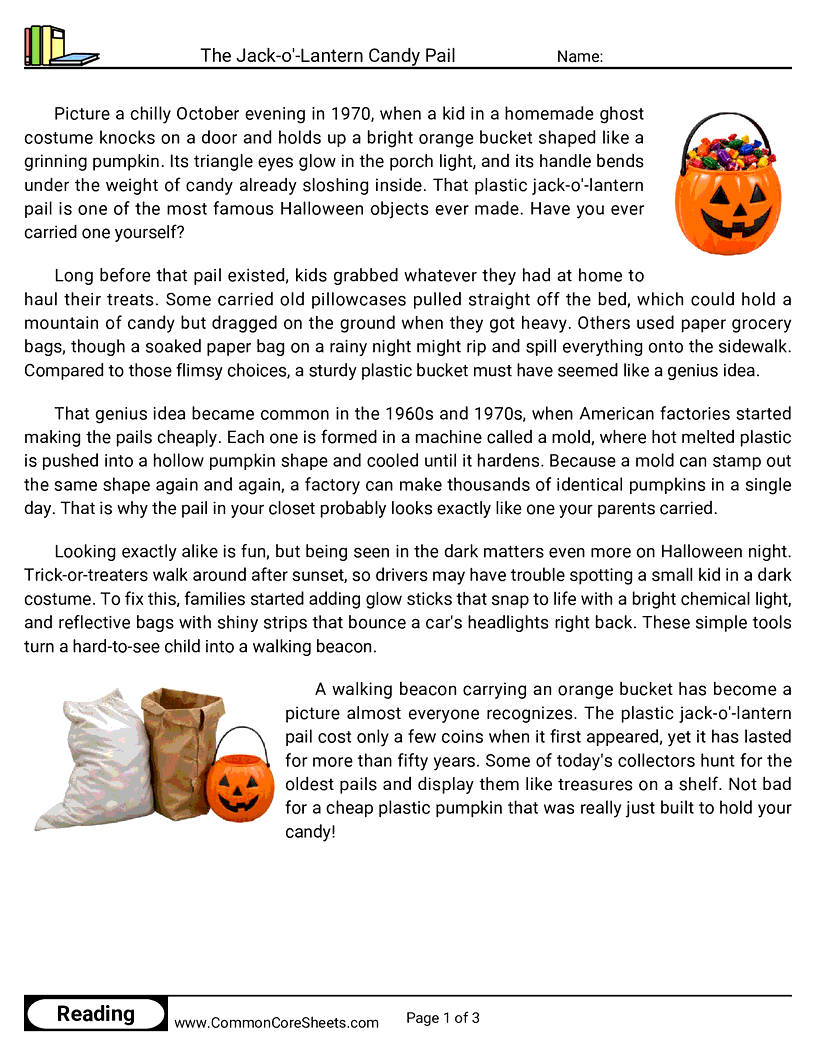
Long before that pail existed, kids grabbed whatever they had at home to haul their treats. Some carried old pillowcases pulled straight off the bed, which could hold a mountain of candy but dragged on the ground when they got heavy. Others used paper grocery bags, though a soaked paper bag on a rainy night might rip and spill everything onto the sidewalk. Compared to those flimsy choices, a sturdy plastic bucket must have seemed like a genius idea.
That genius idea became common in the 1960s and 1970s, when American factories started making the pails cheaply. Each one is formed in a machine called a mold, where hot melted plastic is pushed into a hollow pumpkin shape and cooled until it hardens. Because a mold can stamp out the same shape again and again, a factory can make thousands of identical pumpkins in a single day. That is why the pail in your closet probably looks exactly like one your parents carried.
Looking exactly alike is fun, but being seen in the dark matters even more on Halloween night. Trick-or-treaters walk around after sunset, so drivers may have trouble spotting a small kid in a dark costume. To fix this, families started adding glow sticks that snap to life with a bright chemical light, and reflective bags with shiny strips that bounce a car's headlights right back. These simple tools turn a hard-to-see child into a walking beacon.
A walking beacon carrying an orange bucket has become a picture almost everyone recognizes. The plastic jack-o'-lantern pail cost only a few coins when it first appeared, yet it has lasted for more than fifty years. Some of today's collectors hunt for the oldest pails and display them like treasures on a shelf. Not bad for a cheap plastic pumpkin that was really just built to hold your candy!
Picture a fall evening long before anyone owned a glowing orange bucket: kids raced down the sidewalk clutching wrinkled paper bags or lumpy pillowcases stuffed with candy. Have you ever wondered why so many children today carry the exact same grinning plastic pumpkin instead? That cheerful pail, with its curved handle and a face carved right into the mold, is one of Halloween's most familiar objects. The story of how kids went from grabbing whatever bag was lying around to swinging a molded jack-o'-lantern is a small mystery worth solving.
Before that pail existed, families used whatever they already had at home, and that is exactly the point. A pillowcase held a huge haul and cost nothing, while a paper grocery bag was free too, though it could rip open in the rain and spill every last treat onto the porch. Nobody sold a special Halloween container because nobody thought one was needed. So how did a single plastic pumpkin push those old bags aside and become the thing you picture first?
The change came with plastic itself, which grew cheap and popular in American homes during the 1950s and 1960s. Toy companies noticed that a bright, reusable pail shaped like a jack-o'-lantern would sell far better than a bag you threw away, and by the 1960s and 1970s the orange pail had spread across neighborhoods. Unlike a soggy paper sack, it would not tear, and its stiff handle meant a smaller child could carry it without help. Parents liked that it lasted for years, so the same pumpkin often trick-or-treated with a whole family of kids.
That sturdy shape comes from a clever factory trick called molding, which turns melted plastic into a perfect pumpkin every time. Workers heat plastic pellets until they flow like thick syrup, then push the goo into a metal mold carved with the pumpkin's face, ridges, and handle. When the plastic cools and hardens, the mold pops open and out drops a finished pail, identical to the thousands made before it. That is why every classic pail wears the very same toothy smile, as if they were all cousins from one pumpkin family.
Carrying candy safely matters just as much as carrying a lot of it, and that is where a few modern tricks come in. Many kids now clip a glow stick to their pail or wear a bag made of reflective material, the same shiny stuff on running shoes and road signs. When a car's headlights hit that reflective fabric, the light bounces straight back, making a walker easy to spot in the dark. So the next time you spot that grinning orange pail bobbing down the street, remember it started as nothing fancier than a borrowed pillowcase.
Grab the nearest bucket and picture it grinning back at you with a jagged orange smile. That's the plastic jack-o'-lantern pail, the little pumpkin-shaped bucket kids have swung down sidewalks for more than half a century. It has a black face molded right into the front, a plastic handle looped over the top, and a hollow belly just waiting to fill with candy. You might assume it has always been the star of Halloween night, but that grinning bucket is actually a newcomer to a very old tradition.
Long before that cheerful pail existed, kids hauled their loot in whatever they could grab from around the house. In the early and middle 1900s, trick-or-treaters in the United States carried pillowcases, paper grocery bags, or old baskets from door to door. A pillowcase was the greedy champion of the group, because it could stretch to hold enough candy to weigh down a small child. The trouble was that paper bags tore in the rain and pillowcases dragged in the mud, so the treats sometimes ended up on the ground.
Those soggy, ripping bags left plenty of room for a sturdier idea, and that idea arrived shaped like a pumpkin. Sometime in the 1960s, companies began selling hard plastic jack-o'-lantern pails, and by the 1970s they had become a common sight on porches across the country. Suddenly a kid could carry a rainproof, reusable bucket that looked like a tiny glowing gourd instead of a wrinkled sack. The orange color and carved-face design borrowed straight from the real carved pumpkins already sitting on doorsteps. Best of all, the pail could be dumped out, rinsed, and used again next October.
That reusable design starts its life not as a pumpkin but as a puddle of melted plastic. To make one, factories use a process called molding, where hot plastic is pushed into a hollow metal mold and then takes the mold's shape as it cools. The mold works a little like a cookie cutter shaping soft dough, giving the plastic its shape and its familiar face before the finished bucket pops out. Because a single mold can stamp out thousands of identical pails, that grinning face on your bucket is a twin of countless others.
The pail's job, though, is about more than holding candy in the dark. Trick-or-treating happens at dusk, so today many families add glow sticks or clip-on lights to bags and buckets, and some use reflective bags that bounce a car's headlights right back at the driver. These small touches turn a simple bucket into a safety tool that helps a moving car spot a kid crossing the street. So the next time you see that orange grin swinging along a sidewalk, remember it began as a rescue from muddy, torn pillowcases and grew into something that can help keep you safe.
About this worksheet
Students read a nonfiction passage about the history of trick-or-treat bags and the plastic jack-o'-lantern pail, written at 6 reading levels (1st grade to 6th grade), and answer multiple-choice questions about it.
A reading comprehension worksheet about the history of trick-or-treat bags and the plastic jack-o'-lantern pail with a different article for each reading level, 1st grade to 6th grade, each with its own multiple-choice questions aligned to the Common Core Reading: Informational Text standards. Printable with an answer key, and available as an online assignment at any level.
Student objectives
- Read a chronological passage about how Halloween treat containers changed over time
- Explain how a plastic pail is formed in a mold and why factories can make so many
- Find details that show why glow sticks and reflective bags make trick-or-treating safer
- Explain how the author compares older containers to the plastic pail
Everyday practice
- Notice what kind of container you or your friends carry for treats and whether it reflects light
- Look for a mold line or seam on a plastic toy or bucket at home
- Ask an adult what they carried candy in when they were your age