The Hunter's Moon Worksheet Download
Free reading comprehension worksheet about the harvest moon and the hunter's moon. Pick the reading level (kindergarten to 8th grade), print the passage with its questions, or assign it online.


Sheet Information >
Available at kindergarten, 1st grade, 2nd grade, 3rd grade, 4th grade, 5th grade, 6th grade, 7th grade and 8th grade reading levels.
Read the passage
Look up at the sky! There is a big round moon. It glows orange like a pumpkin.
That orange pumpkin moon has a special name in the fall. It is called the Harvest Moon. Farmers loved this bright moon because its light helped them pick their food at night.
The next big moon after the Harvest Moon is the Hunter's Moon. People named it long ago when they hunted by its light. Did you know the moon is not really orange? It looks orange when it hangs low near the ground!
Have you ever seen a big orange moon? In fall, the moon can look huge and round. It hangs low in the sky at night.
That low moon has a special name. People call the fall full moon the Harvest Moon. Long ago, farmers used its bright light to pick their crops at night.
The next full moon has a name too. People call it the Hunter's Moon. The moon looks orange near the ground because you see it through the thick air.
Have you ever looked up and seen a big orange moon just above the trees? That is a full moon, and in the fall it gets a special name! The autumn full moon can look so round and glowing that it seems close enough to touch.
That glowing ball is not really orange or extra big, even though your eyes may tell you so. When the moon sits low near the ground, you look at it through thick, dusty air, and that air can make it look orange. A moon low in the sky can also look larger than a moon high overhead, but it stays the same size all night.
Same size or not, that bright fall moon once did a real job for people. Long ago, farmers had no electric lights, so they used the moon's light to work late picking crops. The full moon closest to the start of fall got the name Harvest Moon, because it helped bring in the harvest.
The very next full moon after that one has a name too: the Hunter's Moon. People say it once lit the fields so hunters could spot animals after dark. So the next time a big orange moon peeks over the trees, remember it once worked the night shift for farmers!
Imagine you are outside on a cool fall night, and you look up to see a giant orange moon sitting right above the trees! It looks so big that you feel like you could almost reach out and touch it. That huge, glowing moon is one of the special full moons of autumn, and people have watched it for a very long time. Isn't it fun that the same moon can look tiny some nights and enormous on others?
The moon plays a little trick on your eyes when it hangs low near the horizon. When the moon is close to the ground, your brain compares it to trees and houses, so it seems much bigger than when it floats high in the sky. This trick is called the moon illusion, which just means your eyes are being fooled. The moon also looks orange because its light must pass through a thick layer of air near the ground, and that air scatters away the blue light.
Those low autumn moons got special names long ago because they helped people who worked outside. The full moon closest to the start of fall is called the Harvest Moon, because its bright light let farmers keep gathering their crops after the sun went down. The very next full moon is called the Hunter's Moon, since hunters could use its glow to search for food before winter came. Back then, there were no bright electric lights, so a full moon was like a giant flashlight in the sky!
The moon does not really change size or shape, even though it seems to. As the moon travels around Earth, we see different amounts of its sunny side, and these different looks are called phases. First it grows from a thin sliver to a round full moon, then it shrinks back down again over about a month. So the next time you spot a big orange Hunter's Moon low in the sky, remember it is the very same moon that will be a tiny sliver just two weeks later!
Picture yourself standing in a field on a cool October evening, right as the sun slips away. Suddenly, over the far edge of the world, a huge orange moon climbs into the sky. It looks so big you feel like you could reach out and touch it, and it glows like a giant pumpkin resting on the treetops. This is the moon that autumn is famous for, and people have watched it for thousands of years.
That pumpkin-colored glow has a surprising secret: the moon is not really orange at all. When the moon sits low near the horizon, its light has to pass through a thick blanket of air, dust, and water droplets, which scatters the blue light and lets the orange and red colors reach your eyes. It also looks enormous down low, but that is a trick your brain plays called the moon illusion. If you hold up your pinkie finger, you will see it covers the moon whether the moon is low or high, which proves it never really changes size.
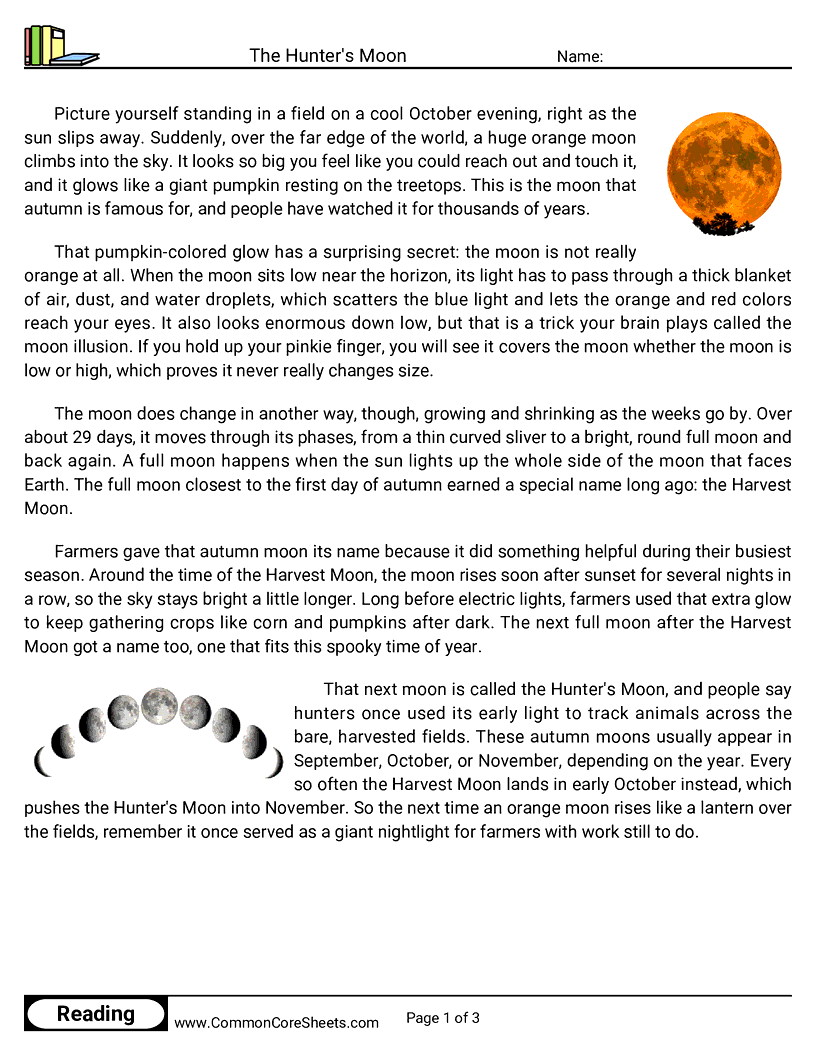
The moon does change in another way, though, growing and shrinking as the weeks go by. Over about 29 days, it moves through its phases, from a thin curved sliver to a bright, round full moon and back again. A full moon happens when the sun lights up the whole side of the moon that faces Earth. The full moon closest to the first day of autumn earned a special name long ago: the Harvest Moon.
Farmers gave that autumn moon its name because it did something helpful during their busiest season. Around the time of the Harvest Moon, the moon rises soon after sunset for several nights in a row, so the sky stays bright a little longer. Long before electric lights, farmers used that extra glow to keep gathering crops like corn and pumpkins after dark. The next full moon after the Harvest Moon got a name too, one that fits this spooky time of year.
That next moon is called the Hunter's Moon, and people say hunters once used its early light to track animals across the bare, harvested fields. These autumn moons usually appear in September, October, or November, depending on the year. Every so often the Harvest Moon lands in early October instead, which pushes the Hunter's Moon into November. So the next time an orange moon rises like a lantern over the fields, remember it once served as a giant nightlight for farmers with work still to do.
Have you ever spotted a giant orange moon hanging low over the treetops and wondered if the sky had somehow supersized it? That glowing pumpkin in the fall sky has puzzled people for thousands of years, and it even has special names. The full moon of early autumn is called the Harvest Moon, and the very next full moon is called the Hunter's Moon. Neither one is really bigger or a different color than any other moon, and that surprising fact is the first clue in a great sky mystery.
That trick your eyes play on you is exactly where the mystery begins. When the moon sits near the horizon, your brain compares it to trees, houses, and hills, and it looks huge next to them. Scientists call this the "moon illusion," because the moon is not actually any larger than when it rides high overhead. If you hold up your thumb at arm's length, you can cover a low moon just as easily as a high one, which proves the size is only in your head.
The color trick, though, is not an illusion at all. When the moon hangs low, its light has to travel through much more of Earth's air to reach your eyes, and that thick layer of atmosphere scatters away the bluer light. What is left over is the warm orange and red glow that makes an autumn moon look like a giant slice of cantaloupe. This is the very same reason sunsets blaze with color, so the low moon is really just borrowing the sunset's paintbox.
Speaking of borrowed light, the moon shines only because it reflects the sun, and that reflection changes shape all month long. As the moon circles Earth about once every month, we see different amounts of its sunlit side, and we call these shapes phases. It grows from a thin crescent to a bright full moon and then shrinks back again, a cycle lasting roughly 29 or 30 days. A full moon happens when Earth sits between the sun and the moon, so the whole face we can see is lit up like a lamp.
Those bright full moons of fall are why farmers gave them such useful names. Around the autumn equinox, the full moon rises soon after sunset for several evenings in a row, filling the early night with light. Long before electric lamps, farmers used that extra brightness to keep harvesting crops after dark, which is how the Harvest Moon earned its name. The next full moon lit the fields for hunters tracking game to store for winter, and here is the wonder of it all: an ordinary rock in space once decided how late people could work.
You've probably heard that the moon is bigger in October, glowing like a pumpkin low over the trees. Here's the twist: the moon isn't any larger, and it isn't really orange either. What you're seeing is a clever trick played by your eyes and the air itself. When a full moon hangs near the horizon, it looks huge and golden, but by midnight, when it climbs high overhead, it seems to shrink back to a plain white circle. Nothing about the moon changed at all.
That golden color comes from the same air you breathe every day. When the moon sits low, its light has to travel through a thick slice of atmosphere before it reaches you, and that layer scatters away the blue light while letting warm reds and oranges slip through. It's the very same reason a sunset blazes orange instead of white. The giant size, meanwhile, is called the "moon illusion," a puzzle so tricky that scientists still argue about exactly why it happens. One idea is that trees and rooftops near the horizon give your brain something to compare the moon to, fooling it into thinking the moon is enormous.
That enormous, glowing disk isn't the only face the moon shows you. Over about a month, the moon slides through its phases, from a thin crescent to a fat gibbous to the round full moon and back again. This happens because we only see the half of the moon lit by the sun, and as the moon orbits Earth, our view of that sunlit half keeps changing. A full moon rises right around sunset and glows all night long, which is exactly why some full moons became so important to people who worked the land.
Those hardworking farmers gave two autumn full moons their own names. The Harvest Moon is the full moon closest to the September equinox, and for several nights in a row it rises soon after sunset, laying down bright light just when crops are ready to be gathered. Before electricity, that extra glow let families keep bringing in wheat, corn, and pumpkins long after dark. The next full moon, the Hunter's Moon, arrives in October, when the light helped people spot deer and other animals fattened up for the coming winter. Both names were used by European farmers and later spread across North America.
It's easy to think those glowing names belong only to the past, but they still light up our calendars today. You'll see the Harvest Moon and Hunter's Moon printed in almanacs and splashed across the news every fall, even though most of us now flip a switch instead of racing the sunset. These names remind us that people once planned their whole year around the sky, reading the moon the way you read a clock. So the next time an October moon swells orange above the rooftops, remember you're looking at the same golden lantern that once told farmers it was time to bring the harvest home.
Have you ever watched the moon rise on a cool autumn night and wondered why it looked as huge and orange as a giant pumpkin balanced on the horizon? You are not imagining it, and you are not the first to stare. For thousands of years, people have given autumn's full moons their own names, because these particular moons seemed to hang low, glow warm, and stay useful long after sunset. Two of the most famous are the Harvest Moon and the Hunter's Moon, and both have a story that mixes real science with human need.
That pumpkin-colored glow is your first clue that something interesting is happening in the sky. When the moon sits near the horizon, its light travels through much more of Earth's thick lower atmosphere, and that air scatters away the blue light while letting red and orange pass through. It is the same reason a sunset burns orange instead of blue. The size, though, is a trick your brain plays: scientists call it the moon illusion, and the moon is really no bigger low in the sky than it is overhead.
If the moon can fool your eyes about its size, it can certainly change its shape from night to night. The moon does not make its own light; it reflects sunlight, and as it orbits Earth about once a month, we see different amounts of its lit half. These changing shapes are the phases, running from a thin crescent to a bright full moon and back to darkness at the new moon. A full moon happens when Earth sits roughly between the sun and the moon, so the whole face we can see is lit up like a spotlight.
That fully lit face is exactly what made one autumn full moon so precious to farmers. The Harvest Moon is the full moon closest to the autumn equinox, which falls around September 22 or 23 in the Northern Hemisphere. Around this time the moon rises only a short while later each night instead of the usual longer gap, so there is bright moonlight in the early evening for several nights in a row. Before electric lights, that extra glow let farmers keep gathering crops after the sun went down, racing to bring in the harvest before frost.
Once the harvest was safely in, that same reliable moonlight served a different purpose the following month. The next full moon after the Harvest Moon is called the Hunter's Moon, usually falling in October. People said it was the season to hunt game and store meat for winter, and the fields, now stripped of their crops, made it easier to spot animals moving in the open. The bright, early-rising moon gave hunters extra hours of light, which is how the name most likely stuck.
Those old names have proven surprisingly hard to shake, even in a world lit by streetlights. You will still hear Harvest Moon and Hunter's Moon on weather reports and calendars today, long after headlights replaced moonlight for anyone working late. Some years the two names line up in a rare way, and every few years the Harvest Moon actually falls in October instead of September. Here is the thought worth carrying home: the moon that looks biggest and warmest to you is playing a trick, yet the names we gave it were built on nights when that light truly meant the difference between a full winter pantry and an empty one.
Picture a farmer in nineteenth-century Ohio, straightening up after a long day of cutting wheat, when a swollen orange moon rolls up over the tree line like a giant pumpkin. That was no ordinary night, and he knew it. For a few evenings each autumn, the full moon seemed to rise early and shine long, buying him extra hours to bring in the harvest before frost. People gave that moon a name, the Harvest Moon, and the one after it a name too, the Hunter's Moon. Both are ordinary full moons, yet they became the most famous full moons of the year for a reason worth investigating.
That extra light was not magic, and it was not the moon burning brighter than usual either. Normally the moon rises about fifty minutes later each night, but near the autumn equinox the angle of the moon's path to the horizon shortens that delay to as little as thirty minutes or so. The result is several nights in a row when a bright, nearly full moon climbs into the sky soon after sunset, stitching daylight and moonlight together with barely a gap of darkness. For people harvesting crops by hand, that seam of light was worth more than gold. The Hunter's Moon, the next full moon after the Harvest Moon, does the same trick, which is why hunters could track game across open fields well into the night.
Convenient light, though, is only half of why that moon commands attention; the other half is how enormous and orange it looks. Have you ever noticed the moon seems gigantic near the horizon but shrinks once it climbs high? Here is the twist: it is exactly the same size in both places, as photographs measuring it will prove. Scientists call this trick the "moon illusion," and after centuries of debate they still argue about exactly why our brains fall for it. One leading explanation is that trees, hills, and buildings near the horizon give our minds a sense of distance, and the brain interprets the low moon as bigger because it seems farther away.
If the size is a trick your brain plays, the color is a trick the air plays. When the moon hangs low, its light must travel through a thick wedge of atmosphere packed with dust and moisture. That thick layer scatters away the blue wavelengths and lets the reddish and orange ones pass through, the very same physics that paints sunsets red. So the pumpkin-colored moon of October is not a special Halloween moon at all; it is simply low-hanging light filtered through more air than usual. Lift that same moon overhead and the color drains to a plain silvery white.
To understand why these particular full moons line up with autumn, it helps to remember that the moon is always changing shape on a schedule. Over about twenty-nine and a half days it cycles through its phases, from new moon to a thin crescent, then to first quarter, to the fully lit disk, and back again. We see phases because the moon does not make its own light; it reflects sunlight, and we only ever view the portion the sun is lighting at that moment. A full moon happens when Earth sits between the sun and moon, so the whole sunlit face points our way. The Harvest Moon is simply the full moon that falls closest to the September equinox, which is why it sometimes lands in October instead.
Those old names remind us that people once read the sky the way we now read a calendar. Long before electric lights and grocery stores, communities across Europe and North America timed their work to these moons, and the labels stuck for practical, not spooky, reasons. Colonial almanacs and later folklorists collected the names, and many trace them to traditions that predate the printed calendars themselves. Today you might glance up at that orange October moon and think of costumes and jack-o'-lanterns, but a farmer two centuries ago saw a clock, a lamp, and a deadline all at once. Here is the strangest part: the moon your great-great-grandparents harvested by is the very same one glowing over your neighborhood tonight, unchanged, only renamed.
About this worksheet
Students read a nonfiction passage about the harvest moon and the hunter's moon, written at 9 reading levels (kindergarten to 8th grade), and answer multiple-choice questions about it.
A reading comprehension worksheet about the harvest moon and the hunter's moon with a different article for each reading level, kindergarten to 8th grade, each with its own multiple-choice questions aligned to the Common Core Reading: Informational Text standards. Printable with an answer key, and available as an online assignment at any level.
Student objectives
- Read a nonfiction passage about the autumn full moons and how they work.
- Explain why the moon looks orange and large near the horizon.
- Find details about the Harvest Moon and the Hunter's Moon and how farmers used them.
- Identify the text structure the author uses to describe the moon's phases.
Everyday practice
- Watch the moon rise low on the horizon and notice its color, then look again when it is high.
- Hold up your pinkie to cover the moon low and high to test the moon illusion yourself.
- Keep a moon journal for a few weeks and draw how its shape changes.