The History of Trick-or-Treating Worksheet Download
Free reading comprehension worksheet about the history of trick-or-treating. Pick the reading level (kindergarten to 8th grade), print the passage with its questions, or assign it online.


Sheet Information >
Available at kindergarten, 1st grade, 2nd grade, 3rd grade, 4th grade, 5th grade, 6th grade, 7th grade and 8th grade reading levels.
Read the passage
Knock knock! Who is at the door in a costume? It is a kid saying "trick or treat!" Do you like to dress up and get candy? Many kids do!
Getting candy is fun but this was not always how it worked. Long ago in Ireland and Britain kids went door to door too. They sang or said a little poem and got a small cake called a soul cake.
Soul cakes turned into candy over time! Kids in America started saying "trick or treat" about a hundred years ago. Today people give out so much candy that it could fill many big trucks!
Do you love to knock on doors on Halloween? When you say "trick or treat," you get candy! Kids have knocked on doors for a very, very long time.
Long before candy, kids knocked for cakes. In old England and Ireland, children went door to door. They sang songs and got sweet soul cakes to eat.
Those songs grew into the words we say now. Kids in America began to say "trick or treat" about ninety years ago. By the 1950s, most towns had happy trick-or-treaters at every door!
Knock, knock! When you go to a door on Halloween night and shout "Trick or treat!", you are doing something children have done for hundreds of years. Long ago in Britain and Ireland, kids went door to door too, but they were not asking for candy. They sang songs and said little prayers, and people gave them small round cakes called soul cakes.
Those soul cakes came with a fun rule: sing first, then eat! This custom was called souling, and children carried lanterns and knocked on doors to get their treats. Some kids even dressed up in costumes and put on a little show, which people called guising.
Guising crossed the ocean and came to America with families who moved here. In the early 1900s, some kids played tricks and pranks on Halloween, so towns started giving parties and treats to keep everyone happy. By the 1930s and 1940s, kids all over the country were saying the words "trick or treat."
During World War II, there was not much candy because sugar was hard to get, so trick-or-treating slowed down for a while. Then in the 1950s, sweets came back and trick-or-treating grew bigger than ever. Can you believe your candy bag is part of a game that started with singing children and little round cakes?
Imagine you are a child living long ago in Britain or Ireland, knocking on doors on a cold autumn night. You are not asking for candy, though! Instead, you are asking for a soul cake, a little round treat made with spices, and in return you promise to say a prayer for the family. This custom was called "souling," and it happened around a holiday called All Souls' Day.
Some children traded their prayers for songs instead, and that leads to another old custom called "guising." When you went guising, you dressed up in a costume, or a "guise," and performed a little song or joke before you were given food or coins. People wore these disguises so that they looked different from their everyday selves. Long ago, families who came to America brought these door-to-door customs with them across the ocean.
Those old customs were fun, but by the early 1900s some American children had turned Halloween into a night of pranks. They tipped over fences and soaped windows, so towns decided to fight back with kindness. Grown-ups threw big parties and handed out treats, hoping that a happy child would not want to cause trouble. Because this plan worked, the phrase "trick or treat" began to spread in the 1930s and 1940s.
Just as trick-or-treating was catching on, World War II made sugar hard to get, so candy was rationed and the treats nearly stopped. When the war ended, sugar returned, and families were building new neighborhoods full of houses close together. In the 1950s, trick-or-treating boomed as children in costumes filled every sidewalk. Today, a National Retail Federation survey shows that candy is one of the things Americans spend the most on for Halloween, which the soulers of long ago could never have guessed!
Picture a cold October night in Ireland, hundreds of years ago. Children in ragged costumes shuffle from house to house, holding out empty hands and singing a little song for food. Sound familiar? It should! This old custom is one of the great-great-grandparents of the trick-or-treating you do today.
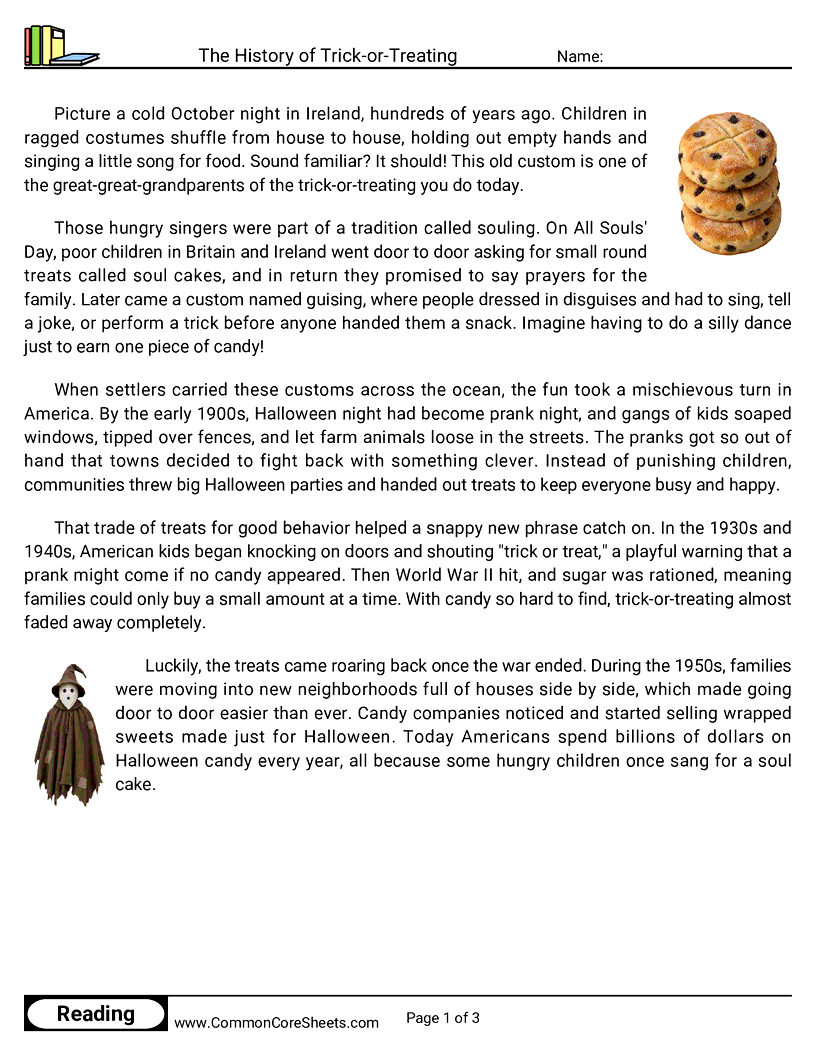
Those hungry singers were part of a tradition called souling. On All Souls' Day, poor children in Britain and Ireland went door to door asking for small round treats called soul cakes, and in return they promised to say prayers for the family. Later came a custom named guising, where people dressed in disguises and had to sing, tell a joke, or perform a trick before anyone handed them a snack. Imagine having to do a silly dance just to earn one piece of candy!
When settlers carried these customs across the ocean, the fun took a mischievous turn in America. By the early 1900s, Halloween night had become prank night, and gangs of kids soaped windows, tipped over fences, and let farm animals loose in the streets. The pranks got so out of hand that towns decided to fight back with something clever. Instead of punishing children, communities threw big Halloween parties and handed out treats to keep everyone busy and happy.
That trade of treats for good behavior helped a snappy new phrase catch on. In the 1930s and 1940s, American kids began knocking on doors and shouting "trick or treat," a playful warning that a prank might come if no candy appeared. Then World War II hit, and sugar was rationed, meaning families could only buy a small amount at a time. With candy so hard to find, trick-or-treating almost faded away completely.
Luckily, the treats came roaring back once the war ended. During the 1950s, families were moving into new neighborhoods full of houses side by side, which made going door to door easier than ever. Candy companies noticed and started selling wrapped sweets made just for Halloween. Today Americans spend billions of dollars on Halloween candy every year, all because some hungry children once sang for a soul cake.
Picture yourself standing on a cold doorstep hundreds of years ago, holding out an empty bag and singing a little song for food. No costumes covered in glow sticks, no plastic pumpkins, and definitely no chocolate bars. So how did knocking on a stranger's door for a sweet treat ever become a Halloween tradition? The answer is a story that stretches across an ocean and more than a thousand years.
That old doorstep scene actually has a name: it was called "souling," and it happened long ago in Britain and Ireland. On a day called All Souls' Day, poor people and children would go house to house offering to say prayers for a family in exchange for small round treats called soul cakes. Others took part in "guising," dressing up in costumes and performing songs, jokes, or poems before they were given food, coins, or nuts. So the two big pieces of trick-or-treating, wearing costumes and asking for treats, were already joined together centuries before the phrase even existed.
Those costumed visitors eventually sailed to America, but the tradition took a mischievous turn along the way. In the early 1900s, Halloween in the United States was famous for pranks, and some got out of hand as young people tipped over fences, soaped windows, and blocked roads. To calm things down, towns and parents started organizing parties, parades, and treats to give restless kids something better to do. The idea was simple: keep children happy with fun and food, and the wild pranks would fade.
That deal between kids and grown-ups is where the famous phrase finally appeared. By the 1930s and 1940s, the words "trick or treat" were spreading across America, a playful warning that a treat would keep a trick away. Then came a roadblock, because during World War II sugar was rationed, meaning families could only buy small amounts, so candy grew scarce and the custom slowed for a few years. Can you imagine Halloween without candy? For a little while, that was almost real.
Once the war ended and sugar returned to store shelves, trick-or-treating came roaring back. During the 1950s it boomed as new neighborhoods filled with children, candy companies sold treats made just for handing out, and the custom became the Halloween ritual we know today. What began as a song for a soul cake had become millions of kids racing door to door with pillowcases. The next time you drop a candy bar into a bag, remember it is the modern echo of a prayer sung on a doorstep a thousand years ago.
You probably think trick-or-treating has always been about candy, costumes, and polite kids saying "thank you" at the door. Believe it or not, the "trick" part of the phrase was once a real warning, and grown-ups spent years trying to stop it. Picture a chilly late-October night in an American town about a hundred years ago, porch lights glowing and leaves crunching underfoot. The custom you know today is really a peace treaty between mischievous kids and tired adults, wrapped in a chocolate bar.
Long before candy entered the story, that door-knocking habit crossed the ocean from Britain and Ireland. There, on days connected to All Souls' Day in early November, poor people and children went "souling," walking house to house and offering prayers in exchange for small spiced treats called soul cakes. Others practiced "guising," dressing up in disguises and singing songs, telling jokes, or reciting verses to earn a coin or a bite of food. Notice the deal hidden in both customs: you gave something, a prayer or a performance, before you got a treat. That old idea of earning your reward would sail with immigrants to North America and wait quietly for its moment.
That waiting ended noisily in early 1900s America, when Halloween had a reputation less for sweets and more for trouble. Instead of knocking politely, young people soaped windows, tipped over fences, and even lifted small wagons onto rooftops as pranks. By the 1920s and 1930s, some pranks caused real damage, and fed-up communities decided they had to do something. Towns and parents began throwing organized parties, parades, and treat-giving events, hoping that a fun night would keep bored kids from causing chaos.
Out of that clever bargain, a snappy new phrase began traveling from porch to porch in the 1920s and 1930s. The words "trick or treat" showed up in North American newspapers around that time, turning the old prank into a friendly threat: hand over a treat, or risk a trick. Then history threw a wrench into the fun, because during World War II sugar was rationed, and candy grew scarce. With sweets hard to find, trick-or-treating faded for a few lean years in the 1940s.
When the war ended and sugar flowed again, that faded custom came roaring back bigger than ever. In the booming 1950s, new suburbs filled with children, and candy companies realized that Halloween could sell an ocean of treats. Costumes, pumpkins, and doorbells became a national tradition, and today Halloween is one of the biggest spending holidays in the United States, according to National Retail Federation surveys. So the next time you drop a candy bar into a plastic pumpkin, remember it started as a truce, when a soul cake and a good prayer were the price of a treat.
Picture a chilly October night in a small English village more than 500 years ago, long before anyone owned a costume made of plastic. Children in ragged coats knock on doors, holding out cloth bags and singing for something called a soul cake. A soul cake was a small round biscuit, sweet with spices and marked with a cross on top, and it was handed out around All Hallows' season. This custom was known as "souling," and it is one of the oldest roots of the tradition you now call trick-or-treating. Did you know a treat could once be earned with a song instead of a costume? It could.
Singing for cakes was only half of the old story, because in Scotland and Ireland people added a trick that had nothing to do with mischief. There, young people went "guising," meaning they dressed in disguise and went door to door performing a poem, a joke, or a short song in exchange for food or coins. The disguise was the whole point: hidden behind soot, masks, or borrowed clothes, a neighbor could be anyone. Guisers had to earn their reward by doing something first, which is a rule that would follow the custom for centuries. So the deal was clear long ago, and it was simple: give me a treat, and I will give you a performance.
That give-and-take idea sailed across the Atlantic when Irish and Scottish families moved to the United States in the 1800s. In America, though, the polite performances slowly faded, and by the early 1900s Halloween had turned into a night of serious pranking. Bored teenagers tipped over outhouses, soaped windows, unhinged gates, and even led cows up onto porches, and towns grew tired of the damage. Can you imagine a whole city cleaning up after one night of chaos? Cities certainly could not enjoy it. The mischief had gotten out of hand, and grown-ups began searching for a way to calm it down.
Fixing that mess is exactly what led communities to invent a friendlier version of the holiday. In the 1920s and 1930s, towns and parents began organizing Halloween parties, parades, and games to give young people something fun to do besides causing trouble. The idea was a kind of bargain with the neighborhood's children: enjoy a treat, and skip the trick. Slowly the phrase "trick or treat" began appearing in newspapers and children's magazines during the 1930s and early 1940s. The words captured the old deal perfectly, promising a small threat but almost always ending in candy.
Just as the phrase was catching on, the whole country hit an unexpected roadblock called World War II. During the war, sugar was rationed, meaning families could only buy a limited amount, so candy became a rare luxury. With sweets so scarce, trick-or-treating nearly disappeared for a few Halloween nights in the early 1940s. When the war ended in 1945 and sugar flowed freely again, the custom came roaring back stronger than ever.
That comeback exploded in the 1950s, when America's booming suburbs turned out to be perfect trick-or-treating territory. Neighborhoods were packed with new houses standing close together, and families had more children and more spending money than before. Candy companies noticed the trend and began advertising bags of wrapped sweets made just for handing out at the door. Comic books, television shows, and cartoons featured the custom too, teaching every child exactly what to shout when a door opened. In only a few decades a quiet song for soul cakes had grown into a national holiday where, according to the National Retail Federation, Americans now spend billions of dollars on Halloween candy each year.
Picture a chilly October night in the 1920s, in a small American town where the streetlights flicker and a group of teenagers is quietly unhooking a farmer's gate. By morning, that gate might be found hanging from a telephone pole, and a wagon could be sitting on somebody's roof. This was Halloween mischief, and for a while it was less about candy than about causing trouble. The phrase "trick or treat" carries that history inside it, because once upon a time the "trick" was a genuine warning. How did a night of pranks turn into the friendly ritual of doorbells and doorstep candy you know today?
To answer that, you have to travel back much further than those pranksters, across the ocean to Britain and Ireland. Centuries ago, on the days around All Souls' Day, poor people and children would go from door to door in a custom called souling, offering to pray for a household's dead in exchange for small spiced cakes known as soul cakes. A related practice called guising involved young people dressing in disguise and performing a song, a poem, or a trick before they were given food, coins, or nuts. Notice the pattern historians point to here: a performance or a promise was traded for a treat, long before anyone rang a doorbell in Ohio. Both customs tied autumn nights to the idea that you gave something to get something.
That give-and-take idea crossed the Atlantic with immigrants, but in America it took a rowdier turn. By the early 1900s, Halloween in many towns had become a night of tipped outhouses, soaped windows, and jammed doors, and grown-ups were fed up. During the Great Depression, the pranks grew destructive enough that some cities considered banning the holiday altogether. Rather than cancel it, community leaders tried a clever trade of their own: they offered organized parties, parades, and treats in the hope that a well-fed child would leave the gate on its hinges. In other words, the treat was invented partly as a bribe to stop the trick.
That bribe needed a slogan, and the one that stuck first showed up in print in the 1920s and 1930s. Early newspaper mentions of the exact words "trick or treat" appear in Canada and the United States in that era, though the custom spread unevenly from town to town. At the door, a costumed child was really making a small deal: hand over a treat, or risk a harmless trick. You can hear the echo of guising in that bargain, the same swap of a little theater for a little food. By the end of the 1930s, the phrase was popping up in more and more places across the continent.
Just as the custom was finding its feet, history tripped it. When the United States entered World War II, sugar was rationed, meaning families could buy only a limited amount, and candy became scarce and precious. With sweets in short supply, trick-or-treating faded in many neighborhoods for a few years. Then rationing ended in the late 1940s, sugar flowed again, and a booming postwar economy filled stores with wrapped candy made just for the occasion. Suddenly the perfect treat was cheap, plentiful, and easy to hand out by the fistful.
That flood of affordable candy met a second wave rolling through 1950s America: the baby boom and the new suburbs. Streets full of young families and tidy rows of houses were almost designed for a child with a pillowcase and a costume. Popular radio shows, comic strips, and eventually television spread the ritual until it felt like something everyone had always done. Today a National Retail Federation survey each year finds that Americans plan to spend billions of dollars on Halloween, a large share of it on candy. Not bad for a night that towns once tried to shut down to stop kids from stealing gates!
About this worksheet
Students read a nonfiction passage about the history of trick-or-treating, written at 9 reading levels (kindergarten to 8th grade), and answer multiple-choice questions about it.
A reading comprehension worksheet about the history of trick-or-treating with a different article for each reading level, kindergarten to 8th grade, each with its own multiple-choice questions aligned to the Common Core Reading: Informational Text standards. Printable with an answer key, and available as an online assignment at any level.
Student objectives
- Read a chronological passage about the history of trick-or-treating
- Explain how and why the custom changed from souling to modern trick-or-treating
- Find details in the text that show cause and effect over time
- Determine the meaning of words like rationed and guising from context
Everyday practice
- Notice how the treats you collect on Halloween connect to a custom hundreds of years old
- Ask an older relative what trick-or-treating was like when they were a child
- Look up what a soul cake is and compare it to the candy handed out today