The History of Halloween Candy Worksheet Download
Free reading comprehension worksheet about the history of Halloween candy. Pick the reading level (1st grade to 8th grade), print the passage with its questions, or assign it online.


Sheet Information >
Available at 1st grade, 2nd grade, 3rd grade, 4th grade, 5th grade, 6th grade, 7th grade and 8th grade reading levels.
Read the passage
Do you love a big bag of candy on Halloween? Kids like you have loved sweet treats for a very long time. But the candy was not always in shiny wrappers!
Before wrapped candy, people gave homemade treats. Kids got apples, nuts, and popcorn balls at the door. Some folks even baked little cakes for the children!
Homemade treats slowly gave way to wrapped candy in stores. By the 1950s, more kids went out to trick-or-treat. Today, families in the United States spend a lot of money on Halloween candy each year!
Did you know that trick-or-treaters once got apples instead of candy bars? It's true! Long before candy came in shiny wrappers, kids might open their bags to find a fresh apple, a handful of nuts, or a sticky popcorn ball. Some neighbors even handed out homemade cakes and cookies right from the oven.
Those warm cakes smelled wonderful, but they took a lot of work to make for every child on the street. So when candy factories started wrapping sweets in bright, safe paper, families were happy to hand them out instead. Between the 1950s and the 1970s, wrapped factory candy slowly took over as more and more kids went trick-or-treating.
More kids in costumes meant more doorbells ringing, and neighbors needed easy treats they could buy in big bags. Wrapped candy was perfect because it stayed clean, lasted a long time, and was quick to drop into a pillowcase. Soon chocolate bars, chewy candies, and hard candies became the treats almost everyone expected.
Today those big bags add up to a mountain of sweets across the country. Americans spend about three billion dollars on Halloween candy each year, which is a huge pile of treats! Can you imagine how many popcorn balls that would have been long ago?
Imagine you knock on a neighbor's door on Halloween night, hold out your bag, and get a shiny red apple dropped inside! Long ago, that is exactly what trick-or-treaters got. Early Halloween treats were homemade, and they looked and tasted like a fall picnic. Kids happily carried home apples, handfuls of nuts, sticky popcorn balls, and slices of cake.
Those sticky popcorn balls came from busy kitchens where families made treats by hand. Long ago, people did not run to a store to buy bags of candy. Instead, they baked, popped, and rolled their treats at home because there was no other easy way to get them. So a child's Halloween bag was full of foods a grown-up had made that very day.
That homemade night began to change when candy started coming in shiny wrappers. Between the 1950s and the 1970s, more and more families lived close together in new neighborhoods, and trick-or-treating grew very popular. Companies saw all those knocking doors and began making small, wrapped candies just for handing out. Wrapped candy was easy to give, easy to store, and it slowly took the place of homemade treats.
Today those little wrappers are everywhere, and Americans buy a mountain of Halloween candy each fall. A National Retail Federation survey found that people plan to spend billions of dollars on candy for the holiday every year. Did you know candy corn, those tiny orange, yellow, and white kernels, has been made for over 100 years? That means your great-great-grandparents could have munched the very same candy you do!
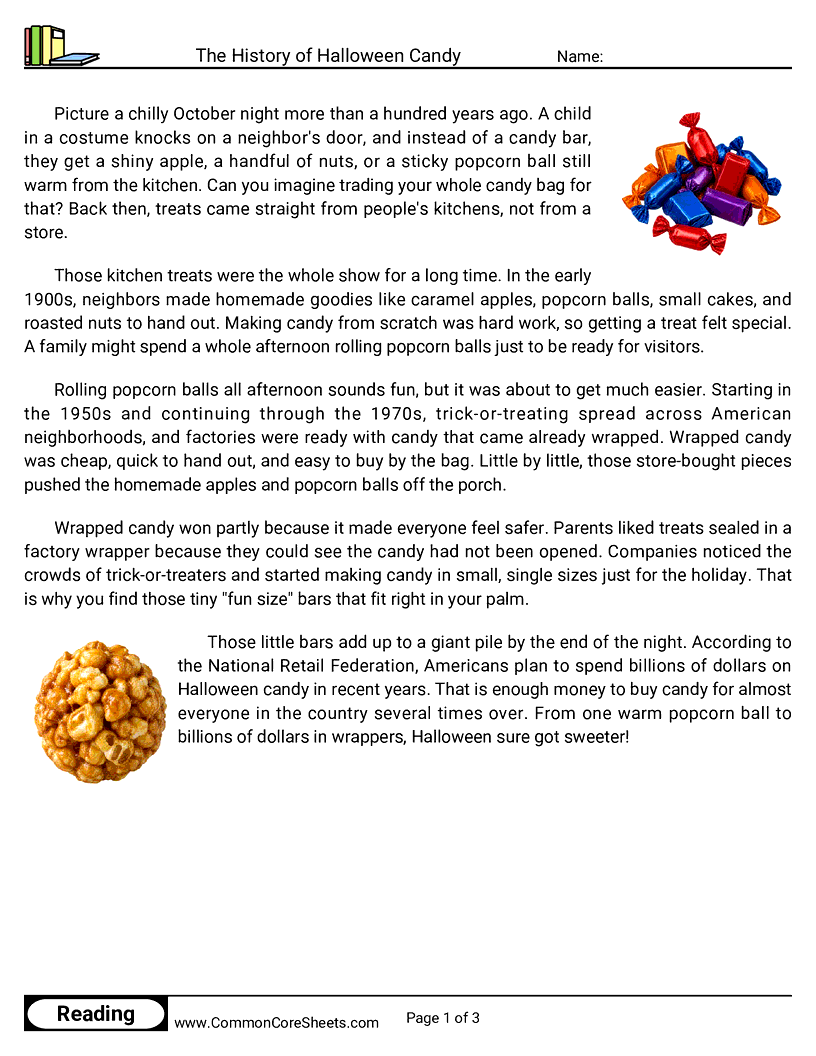
Picture a chilly October night more than a hundred years ago. A child in a costume knocks on a neighbor's door, and instead of a candy bar, they get a shiny apple, a handful of nuts, or a sticky popcorn ball still warm from the kitchen. Can you imagine trading your whole candy bag for that? Back then, treats came straight from people's kitchens, not from a store.
Those kitchen treats were the whole show for a long time. In the early 1900s, neighbors made homemade goodies like caramel apples, popcorn balls, small cakes, and roasted nuts to hand out. Making candy from scratch was hard work, so getting a treat felt special. A family might spend a whole afternoon rolling popcorn balls just to be ready for visitors.
Rolling popcorn balls all afternoon sounds fun, but it was about to get much easier. Starting in the 1950s and continuing through the 1970s, trick-or-treating spread across American neighborhoods, and factories were ready with candy that came already wrapped. Wrapped candy was cheap, quick to hand out, and easy to buy by the bag. Little by little, those store-bought pieces pushed the homemade apples and popcorn balls off the porch.
Wrapped candy won partly because it made everyone feel safer. Parents liked treats sealed in a factory wrapper because they could see the candy had not been opened. Companies noticed the crowds of trick-or-treaters and started making candy in small, single sizes just for the holiday. That is why you find those tiny "fun size" bars that fit right in your palm.
Those little bars add up to a giant pile by the end of the night. According to the National Retail Federation, Americans plan to spend billions of dollars on Halloween candy in recent years. That is enough money to buy candy for almost everyone in the country several times over. From one warm popcorn ball to billions of dollars in wrappers, Halloween sure got sweeter!
Picture yourself trick-or-treating a hundred years ago, holding out your bag with excitement. Instead of a shiny wrapped chocolate bar, a neighbor drops in a shiny red apple. At another door you might get a handful of nuts, a slice of homemade cake, or a sticky popcorn ball. Doesn't that sound like a strange Halloween haul? Back then, it was completely normal, because store-bought candy hadn't taken over yet.
Those homemade treats came from a time when candy was still a rare luxury. In the early 1900s, most families couldn't buy factory sweets whenever they wanted, so they gave what they had at home. A mother might spend an afternoon boiling sugar and popcorn together to shape treats by hand for every child who knocked. Because everything was made in the kitchen, no two houses handed out exactly the same thing.
Handmade goodies ruled the porch until trick-or-treating itself began to explode in popularity. After World War II, as new neighborhoods filled with families and children, going door to door in costume became a nationwide tradition. Suddenly there were far too many kids to bake for, and homemade cake for a whole street was simply impossible. Candy companies noticed this crowd of hungry trick-or-treaters and saw a golden opportunity.
That opportunity changed Halloween forever between the 1950s and the 1970s. Companies began selling candy in small, individually wrapped pieces, perfect for dropping one by one into passing bags. The wrappers made the treats easy to hand out, easy to carry, and easy for parents to trust. Little by little, the apple and the popcorn ball gave way to the wrapped chocolate bar we picture today.
Today that wrapped candy has grown into one of the biggest sweet-buying days of the whole year. According to the National Retail Federation, Americans plan to spend billions of dollars on Halloween candy each fall. That's a mountain of chocolate and gummies built from a holiday that once ran on apples and nuts! Next time you unwrap a piece of Halloween candy, remember it started with a neighbor handing you something warm from the oven.
Here's something that might surprise you: for most of Halloween's history, nobody handed out candy at all. If you had knocked on a neighbor's door a hundred years ago, you might have been given a shiny apple, a handful of nuts, or a sticky popcorn ball still warm from the kitchen. Homemade cakes and cookies were common too, wrapped in a napkin and pressed into your hands. Imagine a paper bag rattling with acorns and fruit instead of foil-wrapped chocolate bars. That was the treat of your great-great-grandparents' time.
Those homemade treats came from kitchens for a good reason: factory-made candy was expensive and not everyone could afford it. During the 1920s and 1930s, trick-or-treating as we know it was just taking shape in American neighborhoods. Families made do with what they had at home, so the doorstep gift depended on who lived inside. One house might offer a slice of cake, while another handed out roasted chestnuts or a coin. There was no rule that a treat had to be candy, and honestly, it rarely was.
The switch from that warm popcorn ball to a crinkly wrapper happened faster than you might think. By the 1950s, more American families were doing well enough to buy things they once made by hand, and candy companies noticed the crowd of costumed children at the door. Individually wrapped candies were cheap, easy to buy in big bags, and simple to hand out one piece at a time. Wrappers also made treats feel safer and cleaner, which parents liked. Between the 1950s and the 1970s, store-bought wrapped candy quietly pushed apples and homemade cakes off the porch for good.
Once candy took over the holiday, the numbers grew almost too big to picture. Today Americans spend billions of dollars on Halloween candy each year, according to the National Retail Federation, which surveys shoppers about their holiday plans. That is enough candy to fill warehouses, and much of it is bought in the last few weeks of October. Chocolate and fruity, chewy candies both rank near the top of what shoppers say they buy. If you lined up all that candy, it would stretch far beyond anything a single trick-or-treater could carry home in a lifetime.
So why does a bag of wrapped candy matter beyond one sugary night? Because it is a tiny time capsule of how a whole country changed. The move from a homemade apple to a factory wrapper tells the story of busier families, cheaper goods, and companies learning to sell to kids. The next time you drop a piece of candy into your bag, remember that you are holding a snapshot of history in your fist. And here is the part that sticks: the treat your great-great-grandparents most looked forward to might have been a plain apple.
Picture ringing a doorbell in 1920 and holding out your bag, only to have a neighbor drop in a warm popcorn ball, a shiny apple, or a handful of walnuts. No crinkly wrappers, no candy bars, no little foil-covered chocolates at all. For most of Halloween's history in America, the treat was whatever a family made in their own kitchen. If you could hop back a hundred years, your candy haul would look more like a bowl of snacks from grandma's pantry than the loot bag you know today.
That pantry-style treat wasn't random; it grew out of much older autumn customs that crossed an ocean to get here. Irish and Scottish immigrants brought traditions tied to the harvest and to All Hallows' Eve, when neighbors shared simple foods that the fall season made plentiful. Apples were everywhere in October, so bobbing for them and handing them out felt natural. Nuts, seeds, and homemade cakes were cheap and easy, which is exactly why they ended up in so many children's hands.
Those homemade goodies started to lose their grip once trick-or-treating spread across American neighborhoods in the 1930s and 1940s. As more kids knocked on more doors, families needed treats they could buy in bulk and hand out quickly, and factory-made candy fit the job perfectly. A store-bought sweet was faster to give than a batch of cakes and did not melt a homeowner's whole afternoon. Candy companies noticed the trend and began advertising their products for Halloween, nudging the holiday toward the checkout aisle.
Nudged along by those ads, wrapped factory candy truly took over between the 1950s and the 1970s. Individually wrapped pieces had a huge advantage: a sealed wrapper looked tidy, traveled well in a bag, and reassured parents that a stranger hadn't touched the treat inside. Chocolate bars and hard candies could be bought weeks ahead and stored, which suited busy families in growing suburbs. By the time your grandparents were kids, the homemade popcorn ball had mostly given way to the pre-packaged snack.
That shift from kitchen to factory helped turn Halloween into one of the biggest candy days on the American calendar. According to the National Retail Federation, people in the United States plan to spend billions of dollars on Halloween candy each year, a figure that has climbed over recent decades. Chocolate and sugary candies regularly top the list of what shoppers buy, though caramels, gummies, and hard candies each grab a share. All of that started with immigrants sharing apples and nuts on a chilly October night.
Even now, the old homemade spirit hasn't disappeared completely. Some families still make caramel apples or popcorn balls, and celebrations rooted in the same season, like Mexico's Day of the Dead, honor loved ones with their own special foods that are nothing like a candy bar. Day of the Dead is its own holiday with its own meaning, not a version of Halloween, and its sugar skulls and pan de muerto tell a different story. Here is the thought worth carrying home: the candy you unwrap tonight is a hundred-year-old idea in shiny new packaging.
Imagine ringing a neighbor's doorbell in 1930 and being handed a warm, sticky popcorn ball wrapped in wax paper. No factory-sealed chocolate bars, no rustling plastic wrappers, just something a grown-up made in their own kitchen that afternoon. For most of Halloween's history in America, that is exactly what a treat looked like. The candy aisle we picture today, glowing with bags of individually wrapped sweets, is actually a fairly recent invention. To understand how we got there, you have to follow a quiet argument historians still have about when and why the homemade treat disappeared.
That kitchen-made treat was rooted in a much older idea about food and the dead. Long before trick-or-treating, some communities in Britain and Ireland practiced a custom called "souling," in which people went door to door on All Souls' Day offering prayers in exchange for small spiced cakes. All Souls' Day is its own Christian observance, with its own meaning, and it should not be mistaken for Halloween itself. Still, historians point to souling as one thread that helped shape the later idea of exchanging food at the door. When these customs crossed the Atlantic with immigrants, the treats stayed handmade because that was simply how food worked before supermarkets.
Because food was homemade, early American Halloween "treats" were whatever a household could spare. Neighbors handed out apples, roasted nuts, small cakes, cookies, and those famous popcorn balls held together with molasses or syrup. Some families gave toys, coins, or fruit instead of anything sweet at all. Notice the distinction here: a treat was not yet a product you bought but a gift you assembled, which meant every doorstep offered something different. That variety is part of why trick-or-treating felt like an adventure long before candy companies got involved.
The move from that unpredictable doorstep to the predictable candy bag happened faster than you might guess. After World War II, as suburbs filled with families and trick-or-treating spread across the country in the 1950s, candy makers spotted an opportunity. They began marketing small, individually wrapped candies as the convenient, modern thing to hand out, and by the 1960s and 1970s these had largely replaced the homemade apple and popcorn ball. Wrapped candy was cheap, it did not need to be baked, and it could be bought in bulk weeks ahead. In roughly two decades, a holiday treat went from something you made to something you purchased.
That shift toward sealed wrappers was pushed along by more than just convenience. Beginning in the 1970s, worried rumors spread that strangers were tampering with homemade treats, and although investigations found almost no real cases, the fear stuck. Here is where historians disagree: some argue the wrapped candy takeover was mostly driven by clever marketing and cheaper prices, while others say public anxiety sealed the deal by making anything homemade seem suspicious. The evidence suggests both forces worked together, one economic and one emotional. Whatever the exact cause, the result was the same: by the 1980s, an unwrapped treat from a neighbor had become the exception rather than the rule.
Today that convenient candy has grown into a genuinely enormous business. Americans spend billions of dollars on Halloween candy each year, and a National Retail Federation survey has repeatedly found that chocolate and candy top people's shopping lists for the holiday. Think about that shift for a moment: a celebration once built on homemade cakes and prayers for the dead now moves mountains of factory-wrapped sugar every October. The popcorn ball, once the star of the doorstep, has become the rare vintage treat that surprises anyone who receives one. In just a few generations, the most ordinary Halloween gift of all quietly became the most unusual.
About this worksheet
Students read a nonfiction passage about the history of Halloween candy, written at 8 reading levels (1st grade to 8th grade), and answer multiple-choice questions about it.
A reading comprehension worksheet about the history of Halloween candy with a different article for each reading level, 1st grade to 8th grade, each with its own multiple-choice questions aligned to the Common Core Reading: Informational Text standards. Printable with an answer key, and available as an online assignment at any level.
Student objectives
- Read a chronological passage about how Halloween candy changed over time
- Find specific details and dates that show how treats changed
- Explain why wrapped candy replaced homemade treats
- Determine the meaning of words like "fun size" from context
Everyday practice
- Notice how many treats in your Halloween bag come already wrapped versus homemade
- Ask an older relative what treats they got trick-or-treating as a child
- Look at a candy wrapper and see if you can spot the words "fun size"