The Halloween Store That Pops Up Every Fall Worksheet Download
Free reading comprehension worksheet about Spirit Halloween and the history of pop-up Halloween stores. Pick the reading level (2nd grade to 8th grade), print the passage with its questions, or assign it online.


Sheet Information >
Available at 2nd grade, 3rd grade, 4th grade, 5th grade, 6th grade, 7th grade and 8th grade reading levels.
Read the passage
Wow, here comes a store that is here today and gone in a few months! It is called Spirit Halloween, and every fall it fills empty shops with costumes, wigs, and pumpkins. You can walk in and find capes, funny masks, and sparkly decorations, then blink, and by winter the store is gone.
That vanishing trick started small, in a single store in California in the early 1980s. One shop, full of Halloween costumes, sold so many that the owner opened more. Little by little, the idea spread to city after city across the country.
From one lonely shop, it grew to well over a thousand stores! These stores open in buildings that were empty, like an old clothing shop that closed. For about two months a year, workers fill the empty room with shelves, spooky music, and racks of costumes.
When those two months end, the whole store packs up and moves away. Workers take down the shelves, box the costumes, and leave the building empty again. Can you imagine a store that shows up like magic each fall and then disappears until next year?
Imagine you are walking past an empty store, one that has been dark and quiet for months. Then one morning you look again, and the windows are full of orange lights, giant spiders, and rows of costumes! This is Spirit Halloween, a store that seems to pop up out of nowhere every fall. Inside, you will find costumes, masks, glowing pumpkins, and decorations for making a spooky-but-silly party.
A store that appears so suddenly must have started somewhere, and this one began small. Long ago, in the early 1980s, a man named Joe Marver opened the very first Spirit Halloween in California. At first it was just one shop, but people loved shopping for costumes all in one place. Because the idea worked so well, more stores began to open in other towns.
Opening in new towns takes a clever trick, and this store found one that saves money. Instead of building brand-new buildings, it opens inside empty stores that other businesses have left behind. The store stays open for only about two months, then it packs up and disappears until the next fall. So a busy place full of shoppers in October becomes an empty room again by winter!
This come-and-go plan helped the little California shop grow into something huge. Today there are well over a thousand Spirit Halloween stores across the United States and Canada. Shoppers like them because they can find costumes, candy buckets, and decorations all in one trip. Isn't it funny to think that a store you visit in the fall might be gone before you even build your snowman?
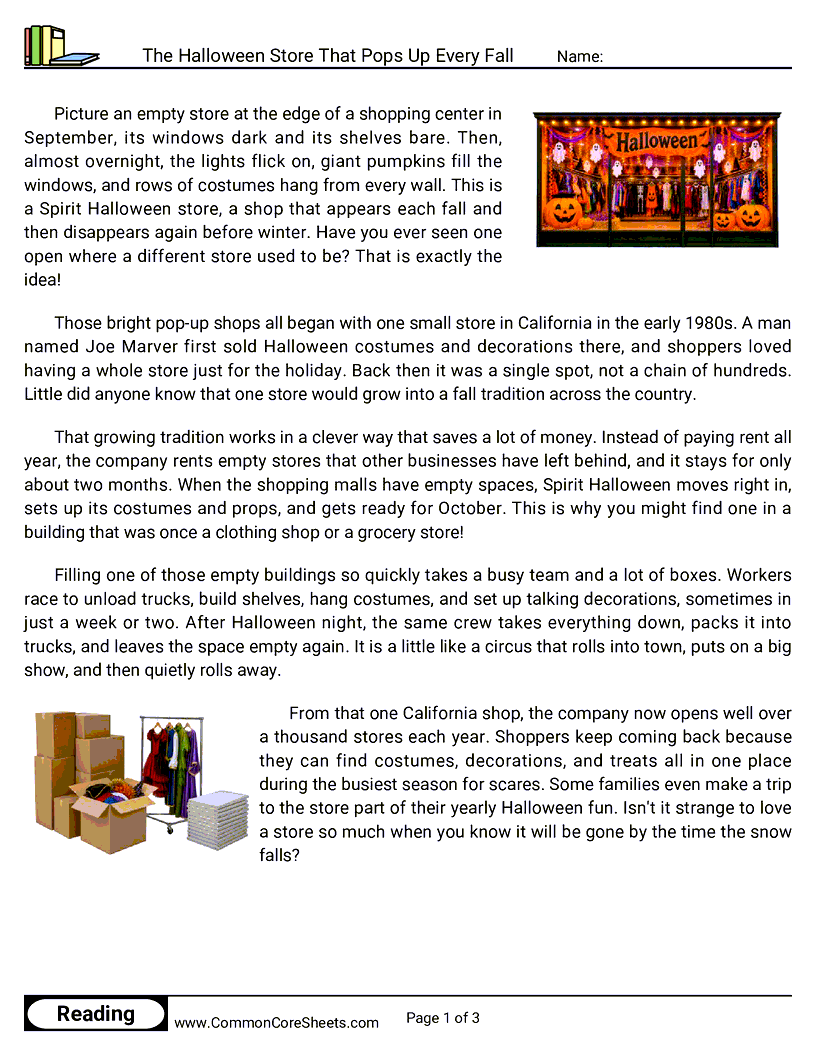
Picture an empty store at the edge of a shopping center in September, its windows dark and its shelves bare. Then, almost overnight, the lights flick on, giant pumpkins fill the windows, and rows of costumes hang from every wall. This is a Spirit Halloween store, a shop that appears each fall and then disappears again before winter. Have you ever seen one open where a different store used to be? That is exactly the idea!
Those bright pop-up shops all began with one small store in California in the early 1980s. A man named Joe Marver first sold Halloween costumes and decorations there, and shoppers loved having a whole store just for the holiday. Back then it was a single spot, not a chain of hundreds. Little did anyone know that one store would grow into a fall tradition across the country.
That growing tradition works in a clever way that saves a lot of money. Instead of paying rent all year, the company rents empty stores that other businesses have left behind, and it stays for only about two months. When the shopping malls have empty spaces, Spirit Halloween moves right in, sets up its costumes and props, and gets ready for October. This is why you might find one in a building that was once a clothing shop or a grocery store!
Filling one of those empty buildings so quickly takes a busy team and a lot of boxes. Workers race to unload trucks, build shelves, hang costumes, and set up talking decorations, sometimes in just a week or two. After Halloween night, the same crew takes everything down, packs it into trucks, and leaves the space empty again. It is a little like a circus that rolls into town, puts on a big show, and then quietly rolls away.
From that one California shop, the company now opens well over a thousand stores each year. Shoppers keep coming back because they can find costumes, decorations, and treats all in one place during the busiest season for scares. Some families even make a trip to the store part of their yearly Halloween fun. Isn't it strange to love a store so much when you know it will be gone by the time the snow falls?
Here's a riddle for you: what kind of store fills a building with costumes and pumpkins, sells for two months, and then completely disappears? The answer is Spirit Halloween, a chain that shows up every fall like clockwork. Walk inside and you'll see rows of witch hats, glowing decorations, fake spiderwebs, and costumes for everyone from tiny toddlers to grown-ups. Then, just after Halloween, the whole store empties out and is gone until next year.
That vanishing act didn't happen by accident, and it started with just one shop. Back in 1983, a man named Joe Marver opened the very first Spirit Halloween in the San Francisco Bay Area of California. At first he sold women's clothing, but he noticed that his Halloween items flew off the shelves faster than anything else. So he made a bold choice: he would sell Halloween gear and nothing else, turning a single idea into a whole business.
Selling only Halloween sounds risky, but it led to a clever trick that other stores now copy. Because people mostly shop for costumes in the weeks before October 31, the company opens what are called "pop-up" stores. A pop-up store moves into a building that is sitting empty, often a shop that recently closed, and rents it for only about two months. When the season ends, the store packs up and leaves, so it never has to pay rent for the long, quiet months when nobody is buying witch hats.
Filling an empty building that fast is a giant job that takes a small army of workers. Crews arrive at a bare space and, in a matter of days, build shelves, hang decorations, and stock thousands of costumes before opening the doors. From that one shop in California, the chain has grown to well over a thousand stores across the United States and Canada each fall. Can you imagine setting up a thousand stores and then taking them all down again in the same year?
All that setting up and tearing down happens because shoppers keep coming back for the thrill of it. Part of the fun is that the store is a surprise, appearing in a spot that was empty just weeks before. Halloween itself is big business, and a National Retail Federation survey found that Americans plan to spend billions of dollars on the holiday each year. So the next time an empty store suddenly fills with pumpkins overnight, you'll know a vanishing store has popped up right on schedule.
Drive past an empty store in September, and you might think it will stay empty forever. But blink, and by the first week of October that same dark shop is glowing purple and orange, its windows crammed with costumes, fog machines, and grinning skeletons. This is Spirit Halloween, a store built on a strange and brilliant idea: open in an abandoned space, sell all things spooky for about two months, then vanish like a ghost when November arrives. You won't find it in the summer, and you won't find it at Christmas. It appears only when the leaves turn, which is exactly why so many shoppers get excited when they spot one.
That vanishing act was there from the very beginning, back when the company was just one small store. Spirit Halloween opened in 1983 in the San Francisco Bay Area of California, started by a businessman named Joe Marver. The story goes that he noticed how a clothing shop made most of its money during the Halloween rush, so he decided to sell costumes and decorations and nothing else. Instead of paying rent all year for a shop that sat quiet for ten months, why not open only for the busy season? It was a clever bet, and it worked.
That bet has since ballooned into one of the biggest names in the holiday business. Today the chain runs well over a thousand pop-up stores across the United States and Canada each fall, a number that has grown steadily for decades. The company is now owned by Spencer's, and its stores fill spaces that other businesses left behind, from old bookstores to empty grocery buildings. Think of it as a retail hermit crab, moving into shells that other shops abandoned. Those big, cheap spaces are perfect for aisles stuffed with masks, wigs, and animatronic figures that wave their arms when you walk by.
Filling those giant shells is no simple trick, and it happens fast. A team can transform a bare, dusty space into a fully stocked store in a matter of weeks, unloading trucks, building shelves, and hanging thousands of costumes. When Halloween ends, they run the whole process in reverse, packing everything up and handing back the keys until next year. Imagine setting up an entire store, running it, and tearing it all down before you could finish a single school semester! That speed is part of why the stores can pop up in so many towns at once.
That yearly disappearing act is also the reason people can't stop talking about these stores. Because a Spirit Halloween is only around for a short window, spotting one feels like a signal that fall has truly begun, and shoppers race in before the good costumes sell out. The stores have even become a kind of internet joke, with people posting memes about empty buildings suddenly "becoming a Spirit Halloween." According to a National Retail Federation survey, Americans plan to spend billions of dollars on Halloween each year, so there is plenty of demand for a store that sells nothing but the holiday. Here is the strangest part of all: a business can succeed precisely because it refuses to stick around.
Picture a store that appears out of nowhere in September, fills an empty building with racks of costumes and towering decorations, and then vanishes like a ghost by November. That is exactly how Spirit Halloween works, and it might be the strangest business you shop at all year. For roughly two months each fall, spaces that sat empty come alive with wigs, capes, glowing pumpkins, and fog machines humming in the aisles. Then, almost as suddenly as it opened, the whole store packs up and disappears until the next autumn. Can you imagine running a business that spends most of the year not existing?
That disappearing act was not the plan when the company first opened its doors. Spirit Halloween began in 1983 as a single shop in Castro Valley, California, started by a retailer named Joe Marver. At first it sold women's clothing, but Marver noticed that Halloween costumes flew off the shelves far faster than anything else. So he made a bold bet: sell nothing but Halloween merchandise, and only during the season when people actually wanted it. That simple idea would eventually turn one small California store into a nationwide autumn tradition.
Selling only in season sounds risky, yet it turned out to be the company's secret weapon. Because the store operates for just a couple of months, it can move into buildings that other businesses have left behind, from shuttered department stores to vacant supermarkets. Landlords are happy to rent an empty space for a short stretch rather than let it sit dark, so the rent is often cheaper. This is called a "pop-up" store, and Spirit Halloween became one of the most famous examples of the model in the entire country. In 1999 the company was bought by Spencer's, a mall retailer, which helped it spread far beyond California.
Spreading across the map meant opening a staggering number of these temporary shops. Today the company runs well over a thousand locations across the United States and Canada, appearing each fall and then closing again. Setting up a single store is a race against the calendar: crews have only weeks to haul in shelving, unpack thousands of costumes, build displays, and hang decorations before the doors open. When the season ends, that same crew has to tear it all down, box up the leftover stock, and hand the empty building back. It is a little like a traveling circus that raises its tents, dazzles the crowd, and then rolls on.
What keeps the crowds coming back is a mix of two things shoppers genuinely love. The first is variety: the stores stack costumes and decorations from floor to ceiling, so browsing feels more like exploring a maze than shopping a list. The second is timing, because the store shows up right when people are hunting for a last-minute costume and cannot find one anywhere else. According to the National Retail Federation, Americans spend billions of dollars on Halloween each year, and a big slice of that goes toward costumes and decorations. A store that opens exactly when demand peaks, then leaves before demand dies, is perfectly built to catch that wave.
Catching that wave has made the empty-building trick a model other companies now copy. Toy sellers, fireworks stands, and other seasonal shops all use the same pop-up playbook, borrowing space for a short burst of business. But few have matched the way this Halloween giant turned disappearing into an advantage instead of a weakness. Every fall, a familiar orange sign lights up in a building that was dark all summer, promising costumes for a few short weeks. Here is the strangest part of all: the company earns nearly its entire year of sales in the one season when it actually exists.
Picture an empty storefront in a strip mall, its windows soaped over and its shelves gathering dust for most of the year. Then, sometime in late summer, trucks pull up, and within days that dead space bursts to life with orange banners, aisles of costumes, and grinning plastic pumpkins stacked to the ceiling. This is Spirit Halloween, a chain famous for a strange business trick: it appears out of nowhere, sells for about two months, and then vanishes as quickly as it came. By November it is gone, leaving the empty shell behind for someone else. Few stores have built an entire empire on the idea of not sticking around.
That vanishing act was not the original plan when the company began far from any strip mall. Spirit Halloween started in 1983 in Castro Valley, California, where a businessman named Joe Marver first opened it as a women's clothing store. He noticed that his best sales came in the fall, when shoppers wanted Halloween costumes rather than everyday clothes. Instead of ignoring that pattern, he leaned into it, and reshaped the whole store around the holiday. That single decision, to sell one thing at one time of year, became the seed of everything the company does today.
Leaning into a single season sounds risky, yet it turned out to be the company's greatest strength. Because Halloween lasts only a short window, Spirit does not pay year-round rent on expensive buildings. Instead, it moves into stores that recently closed, signing short leases for spaces that would otherwise sit empty and earn their landlords nothing. A shuttered department store, a former grocery, or an old electronics shop can each become a Halloween wonderland for a few weeks. This model saves enormous money, which is exactly why a temporary store can beat a permanent one.
Saving on rent is only useful if you can build and unbuild a store at lightning speed. Setting one up is a race: workers unload trucks, assemble hundreds of shelves, hang costumes, and wire up animated decorations, often in a matter of days. When the season ends, the whole thing runs in reverse, and the space is emptied out and handed back before the leftover candy is even on clearance. This constant setup and teardown means the company has become expert at logistics, the science of moving goods and people efficiently. In a sense, the real product is not just costumes but the ability to appear and disappear on command.
That skill at appearing everywhere helped a lone California shop multiply across a continent. The chain was bought by Spencer Gifts in 1999, and under new ownership it spread rapidly across the United States and into Canada. Today it operates well over a thousand pop-up locations each fall, making it one of the largest seasonal retailers in North America. According to the National Retail Federation, Americans spend billions of dollars on Halloween each year, and a chain built for that single holiday is perfectly placed to capture it. What began as one owner's hunch about autumn shoppers now unpacks itself in cities from coast to coast.
All that spending explains why shoppers keep hunting for the orange signs every September. Part of the draw is the treasure-hunt feeling: because the stores are temporary, you never know exactly what you will find or how long it will last. The costumes, masks, and towering animated figures turn a plain shopping trip into an event, almost like walking through a haunted attraction that happens to sell things. For families, spotting a new Spirit Halloween appear in a vacant building has become its own signal that the season has arrived. It is a curious thought that a company can succeed most by being the one store guaranteed to disappear.
About this worksheet
Students read a nonfiction passage about Spirit Halloween and the history of pop-up Halloween stores, written at 7 reading levels (2nd grade to 8th grade), and answer multiple-choice questions about it.
A reading comprehension worksheet about Spirit Halloween and the history of pop-up Halloween stores with a different article for each reading level, 2nd grade to 8th grade, each with its own multiple-choice questions aligned to the Common Core Reading: Informational Text standards. Printable with an answer key, and available as an online assignment at any level.
Student objectives
- Read a chronological passage about the history of pop-up Halloween stores
- Explain why the company rents empty stores for only about two months
- Find details about how workers set up and take down a store
- Determine the meaning of the phrase pop-up using context
Everyday practice
- Notice an empty store near you and imagine what could pop up there next season
- Look for a pop-up shop in your town and see what building it used to be
- Talk with your family about why a store might open for only part of the year