Spiders and Their Webs Worksheet Download
Free reading comprehension worksheet about spiders and the webs they spin. Pick the reading level (kindergarten to 8th grade), print the passage with its questions, or assign it online.


Sheet Information >
Available at kindergarten, 1st grade, 2nd grade, 3rd grade, 4th grade, 5th grade, 6th grade, 7th grade and 8th grade reading levels.
Read the passage
Look at that pretty web on the fence! A spider made it all by itself. Spiders spin webs out of silk.
That silk comes from little parts at the back of the spider's body called spinnerets. Some threads are sticky and some are not. The sticky threads catch bugs for the spider to eat.
Not every spider builds a web to catch food. Some spiders hop and pounce on bugs instead! Spiders help us by eating pesky bugs like flies.
Have you ever seen a fake spider web at Halloween? Real spiders spin webs too, and theirs are made of silk! A web can look like a shiny wheel with tiny threads.
Those threads come from the back of a spider's body. Little parts called spinnerets push the soft silk out. Some threads are sticky to catch bugs, and some are not.
Sticky or not, spider silk is very, very strong. For its weight, the silk is stronger than steel! Best of all, spiders eat pesky bugs that bite you.
Wow, look at that shiny web sparkling in the morning sun! A spider made it all by itself, using thread that comes right out of its body. This is not just a spooky Halloween decoration, it is a real trap for catching bugs.
That thread has a special name, and it is called silk. A spider makes silk inside its body and squeezes it out through tiny parts near its tail called spinnerets. Silk starts out wet, but it dries in the air and turns into a strong, thin string.
That thin string is stronger than you might think for something so light and small. Many spiders spin round webs called orb webs, with lines that spread out like the spokes of a wheel. Some of those lines are sticky to catch bugs, and some are not sticky, so the spider can walk on them without getting stuck.
Sticky or not, not every spider builds a web at all! Jumping spiders leap on their food instead, and wolf spiders chase it across the ground. The next time you see a spider, remember that it is a helpful hunter that eats bugs like flies and mosquitoes.
Imagine you are walking outside on a cool October morning, and there, hanging between two fence posts, is a shining wheel of silk covered in dewdrops! That's a spider web, and it's much more than a spooky Halloween decoration. A web is a trap made of silk that a spider spins to catch its food. When sunlight hits the tiny drops of water, the whole web sparkles like it is covered in glitter.
Those sparkling threads come from a surprising place on the spider's body. Spiders make silk inside their bodies and squeeze it out through little spouts called spinnerets, which sit near their back end. First the silk comes out as a wet goo, and then it hardens into a thread the moment it touches the air. Believe it or not, spider silk is so strong for its weight that a strand as thick as a pencil could be tougher than steel!
Not every thread in a web does the same job, which is one clever trick that keeps a spider from getting stuck. In a round web, called an orb web, the spider first makes lines that spread out like the spokes of a bike wheel, and these threads are dry so they are safe to walk on. Then it adds sticky, spiraling threads to catch bugs that fly or crawl into the trap. Because the spider remembers which lines are dry, it can run across its own web without ever getting caught.
As tricky as those traps are, some spiders skip webs altogether. Jumping spiders and wolf spiders hunt by chasing and pouncing on their meals instead of spinning a trap. Either way, spiders are a huge help to people because they eat insects like mosquitoes and flies that we do not want around. So the next time you spot a web glistening on your porch, remember it belongs to one of nature's best bug catchers!
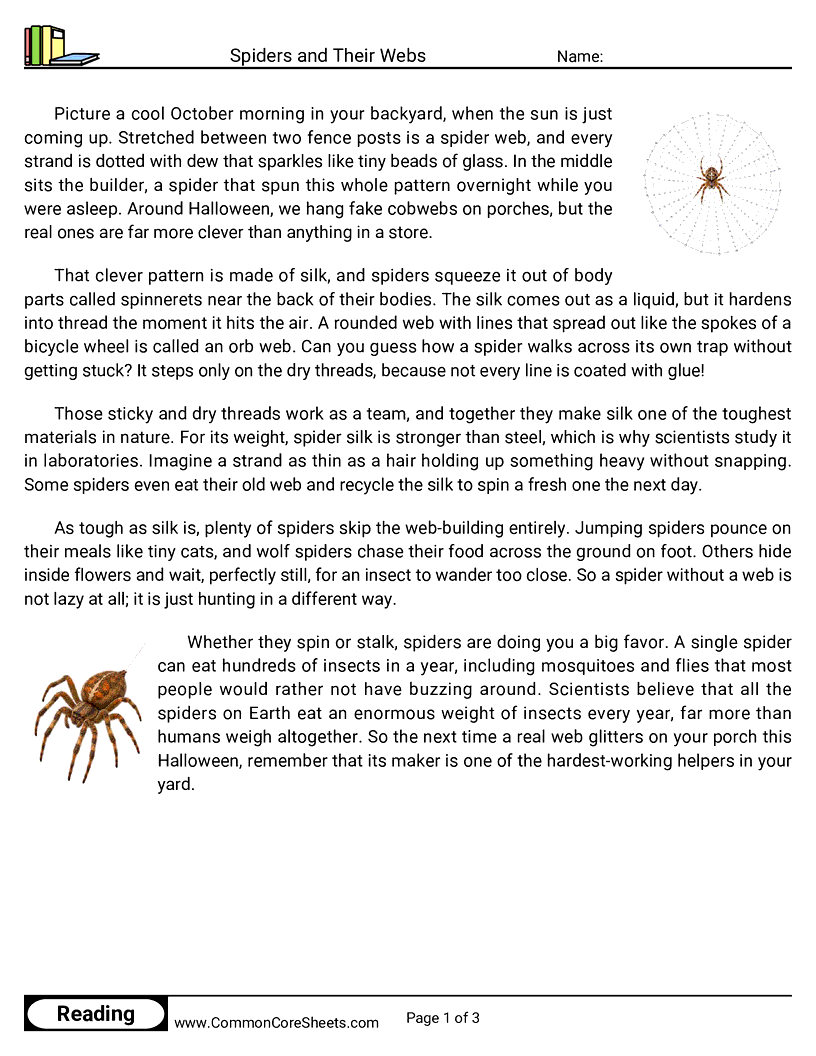
Picture a cool October morning in your backyard, when the sun is just coming up. Stretched between two fence posts is a spider web, and every strand is dotted with dew that sparkles like tiny beads of glass. In the middle sits the builder, a spider that spun this whole pattern overnight while you were asleep. Around Halloween, we hang fake cobwebs on porches, but the real ones are far more clever than anything in a store.
That clever pattern is made of silk, and spiders squeeze it out of body parts called spinnerets near the back of their bodies. The silk comes out as a liquid, but it hardens into thread the moment it hits the air. A rounded web with lines that spread out like the spokes of a bicycle wheel is called an orb web. Can you guess how a spider walks across its own trap without getting stuck? It steps only on the dry threads, because not every line is coated with glue!
Those sticky and dry threads work as a team, and together they make silk one of the toughest materials in nature. For its weight, spider silk is stronger than steel, which is why scientists study it in laboratories. Imagine a strand as thin as a hair holding up something heavy without snapping. Some spiders even eat their old web and recycle the silk to spin a fresh one the next day.
As tough as silk is, plenty of spiders skip the web-building entirely. Jumping spiders pounce on their meals like tiny cats, and wolf spiders chase their food across the ground on foot. Others hide inside flowers and wait, perfectly still, for an insect to wander too close. So a spider without a web is not lazy at all; it is just hunting in a different way.
Whether they spin or stalk, spiders are doing you a big favor. A single spider can eat hundreds of insects in a year, including mosquitoes and flies that most people would rather not have buzzing around. Scientists believe that all the spiders on Earth eat an enormous weight of insects every year, far more than humans weigh altogether. So the next time a real web glitters on your porch this Halloween, remember that its maker is one of the hardest-working helpers in your yard.
Have you ever spotted a fake spiderweb stretched across a doorway on Halloween and wondered how a real one gets made? A spider does not buy string at a store or borrow thread from a sewing kit. Instead, it builds a web from silk that it spins out of its own body, sometimes finishing the whole thing overnight. The next morning, dew clings to the strands like tiny beads of glass, showing off a design that took skill, not scissors.
That silk comes from an organ most people have never heard of, called a spinneret. Spiders have several spinnerets near the back of their body, and these little nozzles squeeze out liquid silk that hardens into thread the moment it hits the air. A single spider can make different kinds of silk for different jobs, from a safety line it dangles on to the framework of a web. Think of it as a builder who carries lumber, rope, and glue all inside one toolbox.
Speaking of glue, that is the trick behind the most famous web shape of all, the orb web. An orb web looks like a wheel, with straight spokes reaching out from the center and a spiral wrapping around them. Here is the clever part: the spokes are made of dry, non-sticky silk, while the spiral is coated in tiny drops of glue that trap insects. Because the spider knows which lines are safe, it can walk across its own trap without getting stuck.
The silk holding that trap together is far tougher than it looks. For its weight, spider silk is stronger than steel and can stretch without snapping, which is why scientists have studied it for years. If you could scale up a strand of it to the thickness of a pencil, a web made from it could catch a jet airplane in a story engineers love to imagine. Yet the real thread is so thin that hundreds of strands together are still narrower than a single human hair.
As impressive as webs are, not every spider bothers to build one. Jumping spiders and wolf spiders hunt by pouncing on prey, using sharp eyesight instead of a sticky trap. Web or no web, these eight-legged hunters are on your side, because a single spider can eat hundreds of insects like flies and mosquitoes in one year. So the next time a paper web decorates your window for Halloween, remember that the real spinner behind it is one of nature's finest little engineers.
Look up at that fake cobweb stretched across a porch this October, all messy and tangled like cotton candy pulled apart by a monster. Real spider webs, it turns out, are almost nothing like those Halloween props. A true web is a piece of engineering so precise that scientists study it to build stronger materials. The spider that made it is not a lazy monster lurking in the shadows, but one of nature's most skilled builders. Once you know how a web actually works, those store-bought decorations start to look pretty sloppy.
That precision begins inside the spider itself, in organs called spinnerets near the tip of its abdomen. Spinnerets squeeze out liquid silk that hardens into thread the instant it hits the air, sort of like glue that dries in a blink. A single spider can make several different kinds of silk from these nozzles, each with its own job. Some threads are dry and tough, while others are coated in tiny beads of glue. The spider itself walks on the dry threads on purpose, which is why it does not get stuck in its own trap.
Those two kinds of thread come together in the most famous design of all: the orb web, that classic wheel shape you might sketch on a Halloween card. The spider first lays down the dry "spokes" like the frame of a bicycle wheel, then spirals the sticky threads around them to catch dinner. When an insect blunders into the sticky spiral, it sticks fast while the spider races out along its safe, dry paths. Here is the part that sounds made up: for its weight, spider silk is stronger than steel and can stretch far more before it snaps. If you could scale up a strand to the thickness of a pencil, it could stop a jet in flight.
As strong as that silk is, plenty of spiders skip the web entirely and hunt in other ways. Jumping spiders stalk their prey and pounce like tiny cats, while wolf spiders chase their meals down on foot. Trapdoor spiders build a hidden hinged door and burst out to grab whatever wanders too close. So the next time someone insists that all spiders sit around waiting in webs, you can set the record straight. The world holds tens of thousands of spider species, and they have invented a startling number of ways to catch a meal.
Whether they spin or stalk, these eight-legged hunters matter far more than their spooky reputation suggests. Spiders eat enormous quantities of insects each year, including mosquitoes, flies, and the pests that chew up crops. Without them, gardens and farms would be overrun by the very bugs we complain about all summer. So the plastic web on your door is really a thank-you note to a creature that quietly protects your food. Not bad for an animal most people would rather scream at than shake hands with.
Imagine a building material five times stronger than steel of the same weight, so light you could stretch a strand around the whole planet and it would weigh less than a bar of soap. You are picturing spider silk, the same shimmering thread you brush off your porch every October. Around Halloween, people drape fake cottony webs across fences and doorways, but the real thing is a feat of engineering that scientists still cannot fully copy. Look closely at a dew-covered web in the morning light and you are seeing one of nature's oldest inventions.
That oldest invention starts inside the spider's body, in organs called spinnerets located at the rear of the abdomen. A spider can have several spinnerets, each pushing out liquid protein that hardens into thread the instant it hits the air. What is remarkable is that many spiders make more than one kind of silk from the same body: a stiff thread for the frame, a stretchy thread for the spiral, and even a wrapping silk for storing food. Some species can spin seven different types of silk, choosing the right one for each job like a builder reaching into a toolbox.
Reaching into that toolbox, an orb weaver builds the classic wheel-shaped web you probably picture when you hear the word. It first lays down strong, dry spokes that radiate from the center, a scaffold that does not stick to anything. Then it spirals outward laying a second thread dotted with tiny beads of glue, and this sticky spiral is the trap that holds insects. Here is the clever part: the spider remembers which threads are safe and walks only on the dry ones, and its legs are coated with an oily substance that keeps it from gluing itself down.
Not every spider bothers with that careful construction at all. Wolf spiders and jumping spiders build no snares, instead hunting their prey on foot with sharp eyesight and quick pounces. Jumping spiders can leap many times their own body length, roughly like you clearing a school bus from a standing start. These wanderers still produce silk, but they use it as a safety line, trailing a dragline behind them the way a rock climber trails a rope.
That rope-like strength is exactly why researchers are so interested in the stuff. Engineers have studied spider silk hoping to design lightweight body armor, surgical stitches, and cables that bend without snapping. The trouble is that spiders are hard to farm, since crowding them together tends to end with fewer spiders, so labs have inserted spider genes into goats and bacteria to harvest silk proteins another way. No factory has yet matched the delicate spinnerets that a spider carries around for free.
Free pest control might be the most underrated gift these builders offer. A single spider can eat hundreds of insects in a year, and together the world's spiders consume an estimated 400 to 800 million tons of prey annually, more than the total weight of every human on Earth. So the next time a paper web decorates your classroom, remember that the living version is a hunter, an engineer, and a silent helper all at once. The scariest thing about spiders, it turns out, is how much we would miss them if they were gone.
On a foggy October morning, a scientist named Cheryl Hayashi crouched in her lab, spooling out a single thread of spider silk thinner than a human hair. She pulled it, stretched it, and measured how much force it could take before snapping. Her findings stunned engineers: ounce for ounce, some spider silk is tougher than the steel used in bridges. That decoration draped across a doorway every Halloween is a cheap imitation of one of nature's finest materials. The real thing, spun in silence by a creature smaller than your thumb, has puzzled and impressed humans for centuries.
That impressive strength begins not in a factory but in an organ most people have never heard of. Spiders produce silk in glands inside the abdomen and push it out through tiny nozzles called spinnerets, usually found in clusters of two to eight near the rear of the body. The silk leaves as a liquid protein and hardens into a solid thread the instant it meets the air and is pulled. What makes this remarkable is that a single spider can produce several different kinds of silk from the same body, each tuned for a different job. Some threads are dragline silk, strong enough to hold the spider's weight as it drops; others are stretchy and coated in glue.
Those two kinds of thread, the strong and the sticky, work as a team in the web you probably picture first: the orb web. An orb weaver builds it in stages, first laying down a frame and a set of spokes made from dry, non-sticky silk that the spider can safely walk on. Then it spirals inward, laying down a second thread studded with droplets of glue to catch flying insects. Here is the clever part: the spider remembers which threads are which, stepping only on the dry lines and avoiding its own trap. Building the whole structure can take under an hour, and many orb weavers tear it down and eat it each night to recycle the protein.
If eating your own home sounds strange, consider that many spiders skip web-building entirely. Scientists estimate there are more than 45,000 known spider species, and only a fraction of them spin the classic orb. Wolf spiders chase down their prey on foot like tiny sprinters, while jumping spiders stalk and pounce, using excellent eyesight rather than a net. Trapdoor spiders build burrows with hinged lids and ambush whatever wanders past. This variety tells us something important: the web is a brilliant tool, but it is one strategy among many, not the definition of what a spider is.
Whatever hunting method they use, all these predators share a job humans rarely thank them for: pest control. A single spider can eat hundreds of insects in a year, including mosquitoes, flies, and the aphids that damage crops. Researchers have estimated that the world's spiders together consume something on the order of 400 to 800 million tons of prey annually, a quantity that rivals what all humans eat in meat and fish. Without them, our homes and fields would be far buggier places. The spider in your basement corner, in other words, is less a monster than an unpaid exterminator.
That gap between fear and fact is exactly why spiders make such interesting Halloween guests. We hang fake webs and plastic eight-legged decorations to feel a pleasant chill, borrowing the spider's spooky reputation without meeting the real animal behind it. Yet the real animal is the more astonishing story: a chemist, an architect, and a hunter rolled into a body the size of a coin. Engineers today are still trying to copy spider silk in laboratories, hoping to make everything from surgical thread to bulletproof fabric. After millions of years of practice, the little weaver in the corner is still holding on to secrets our best scientists cannot fully unravel.
About this worksheet
Students read a nonfiction passage about spiders and the webs they spin, written at 9 reading levels (kindergarten to 8th grade), and answer multiple-choice questions about it.
A reading comprehension worksheet about spiders and the webs they spin with a different article for each reading level, kindergarten to 8th grade, each with its own multiple-choice questions aligned to the Common Core Reading: Informational Text standards. Printable with an answer key, and available as an online assignment at any level.
Student objectives
- Read a nonfiction passage about spiders and the silk webs they spin
- Explain how spiders make silk and why it is so strong
- Find details showing how spiders help people by eating insects
- Describe how the author compares spiders that build webs with those that do not
Everyday practice
- Look for a real spider web outdoors in the morning and notice the pattern of its threads
- Watch how dew or raindrops collect on a web and make it easier to see
- Notice which spiders in your home or yard build webs and which ones move around to hunt