Skeletons: The Bones Inside You Worksheet Download
Free reading comprehension worksheet about the human skeleton. Pick the reading level (kindergarten to 8th grade), print the passage with its questions, or assign it online.


Sheet Information >
Available at kindergarten, 1st grade, 2nd grade, 3rd grade, 4th grade, 5th grade, 6th grade, 7th grade and 8th grade reading levels.
Read the passage
Feel your arm and give it a squeeze! Deep inside you is something hard and strong. That is a bone and you have lots of them!
Those bones make a frame called a skeleton. A grown-up has about 206 bones inside. Your bones hold you up and let you run and jump.
Here is a fun fact about your bones. Your bones are alive and they can grow! When you eat milk and cheese and play outside your bones get big and strong.
Have you ever seen a skeleton on Halloween night? It has a big skull and lots of white bones. You have a real skeleton right inside your body!
Those bones do more than help you stand and jump. Your skull is like a hard hat that guards your brain. Your ribs are bones that curve around your heart.
Bones are alive, and they can grow and heal. If a bone breaks, it can mend itself again. A grown-up has about 206 bones, but a baby has even more!
Knock, knock! Reach up and tap the top of your head, and you can feel something hard right under your hair. That is your skull, and it is made of bone, just like the grinning skeletons hanging up at Halloween. Bones are hard and strong, but they are not just for spooky decorations!
Those hard bones do a very important job inside you. Your skull is like a helmet that keeps your soft brain safe, and your curved ribs work like a cage that guards your heart and lungs. Down your back, a bumpy line of bones called your spine helps you stand up tall and bend to tie your shoes.
Standing tall takes a lot of bones, more than you might guess. A grown-up has about 206 bones, but a tiny baby is born with even more, close to 300! As the baby grows, some little bones join together, or fuse, into bigger ones.
Here is something that will surprise you: your bones are alive and growing right now. When you drink milk, the calcium in it helps your bones grow strong, and running and jumping make them tougher too. If you ever break a bone, it can slowly heal and grow back together all by itself, which is more than any Halloween decoration can do!
Imagine you could take an x-ray of your own hand right now, holding this worksheet. You would see rows of long white bones, all connected and moving as you turn the page! Those bones are your skeleton, the strong frame hiding inside you. Every dancing paper skeleton you see at Halloween is a copy of the real thing you carry everywhere.
That paper skeleton probably has fewer bones than you do, though. A grown-up's body has about 206 bones, but a baby is born with around 300! How can that be? As a baby grows, some soft little bones slowly join, or fuse, together into bigger ones. So the older you get, the fewer, bigger bones you actually have.
Some of those bones have a very important job: keeping the soft parts of you safe. Your skull is a hard bony helmet that guards your brain, and your curved ribs form a cage around your heart and lungs. Down your back runs your spine, a stack of small bones that lets you bend and twist. Because these bones protect you, they need to be tough.
Here is the surprising part: your bones are not dead sticks at all, but living tissue that grows and even heals. When you break a bone, it slowly mends itself, like a crack in a sidewalk filling back in. To stay strong, bones need a mineral called calcium, which is in milk and leafy greens, plus lots of exercise like running and jumping. So the next time you dance like a Halloween skeleton, remember you are making your real bones stronger!
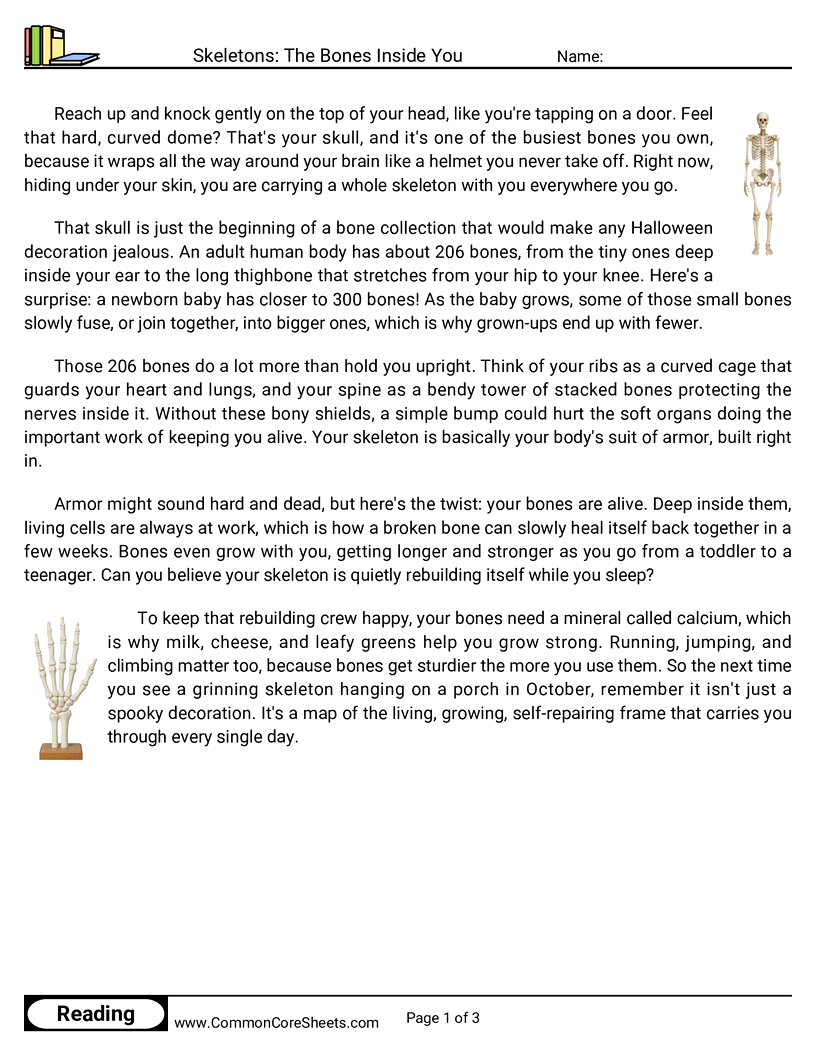
Reach up and knock gently on the top of your head, like you're tapping on a door. Feel that hard, curved dome? That's your skull, and it's one of the busiest bones you own, because it wraps all the way around your brain like a helmet you never take off. Right now, hiding under your skin, you are carrying a whole skeleton with you everywhere you go.
That skull is just the beginning of a bone collection that would make any Halloween decoration jealous. An adult human body has about 206 bones, from the tiny ones deep inside your ear to the long thighbone that stretches from your hip to your knee. Here's a surprise: a newborn baby has closer to 300 bones! As the baby grows, some of those small bones slowly fuse, or join together, into bigger ones, which is why grown-ups end up with fewer.
Those 206 bones do a lot more than hold you upright. Think of your ribs as a curved cage that guards your heart and lungs, and your spine as a bendy tower of stacked bones protecting the nerves inside it. Without these bony shields, a simple bump could hurt the soft organs doing the important work of keeping you alive. Your skeleton is basically your body's suit of armor, built right in.
Armor might sound hard and dead, but here's the twist: your bones are alive. Deep inside them, living cells are always at work, which is how a broken bone can slowly heal itself back together in a few weeks. Bones even grow with you, getting longer and stronger as you go from a toddler to a teenager. Can you believe your skeleton is quietly rebuilding itself while you sleep?
To keep that rebuilding crew happy, your bones need a mineral called calcium, which is why milk, cheese, and leafy greens help you grow strong. Running, jumping, and climbing matter too, because bones get sturdier the more you use them. So the next time you see a grinning skeleton hanging on a porch in October, remember it isn't just a spooky decoration. It's a map of the living, growing, self-repairing frame that carries you through every single day.
Here's a riddle for you: what part of your body is hard as a rock, hidden from view, yet growing, healing, and very much alive right now? The answer is your skeleton, the framework of bones holding you upright. Those grinning cardboard skeletons hanging on doors every October look stiff and lifeless, but the real thing is anything but. Inside you, bones are busy tissue, laced with blood vessels and cells that repair damage like a tiny road crew.
That road crew has plenty of pieces to keep in order, because an adult skeleton has about 206 bones. Strangely, you were born with more than that, closer to 300, and that's not a mistake. As you grow, some of those little bones slowly fuse, or join together, into single larger bones. Your skull, for example, starts as several separate plates that knit together as your brain grows to fit.
Those skull plates aren't just growing, they're guarding, and protection is one of the skeleton's most important jobs. The skull works like a helmet around your soft brain, while your spine forms a bony tube shielding the nerves inside it. Wrapped around your heart and lungs is your rib cage, a curved basket of about 12 pairs of ribs. Give your chest a gentle tap and you can feel that armor doing its quiet work with every breath.
Armor that strong needs the right materials, and your bones build themselves largely from a mineral called calcium. That's why milk, cheese, leafy greens, and beans matter so much while you are still growing. But food alone won't do it, because bones get stronger when you use them, just like muscles. Running, jumping, and climbing send a signal that tells your body to pack more calcium into your bones.
If bones can grow stronger, can they also fix themselves after they break? They can, and it's remarkable. When a bone cracks, special cells rush to the spot and slowly build a bridge of fresh bone across the gap. That's why a cast simply holds the pieces still while your body does the real mending over several weeks. So the next time you pass a plastic Halloween skeleton, remember the real one under your skin is far more alive than anything hanging on the door.
Picture a Halloween skeleton dangling from a doorway, all still and stiff, like a puppet made of chalk-white sticks. You might think that's what your own skeleton is like: dead, dry, and unchanging. Here's the twist that decoration gets completely wrong. The skeleton inside you right now is alive, busy, and rebuilding itself while you read this sentence. Far from being a lifeless prop, it is one of the most active tissues in your body.
That active tissue is doing something your cardboard decoration never could: it grows and heals. Bones are living organs, laced with blood vessels and nerves, and they are constantly broken down and rebuilt by tiny cells that work like a demolition crew and a construction crew rolling around the clock. When you break an arm, the bone actually knits itself back together, sealing the crack with new tissue. Deep inside the largest bones, soft marrow acts like a factory, pumping out billions of new blood cells every single day. Try getting that from a plastic prop!
Because your skeleton is alive, the number of bones you carry hasn't stayed the same your whole life. A newborn baby starts out with around 270 bones, but an adult ends up with about 206. Where did the missing ones go? They didn't vanish; separate bones simply fused together as the child grew, the way the plates of a baby's skull knit into one solid dome. So the grinning Halloween skeleton, with its neat 206 pieces, is really showing you a grown-up, not a kid.
Those 206 bones do far more than hold you upright, and this is where the spooky decoration hides a serious job. Your ribs form a curved cage that shields your heart and lungs like armored bars. Your skull is a helmet of bone locking your brain safely inside, and your spine is a stack of small bones guarding the nerve highway that runs down your back. Without this built-in armor, a simple bump could damage the organs you need to survive. The next time you see cartoon rib bones on a costume, remember they are drawn over the exact spot where a real cage does life-or-death work.
Protecting all that hard work is why your skeleton still needs your help today. Bones store most of the body's calcium, so drinking milk or eating leafy greens hands them the raw material they use to rebuild. Exercise matters just as much, because bones respond to being used by growing denser and stronger, like a muscle that answers a challenge. Skip both, and the same living tissue that heals a break can slowly grow thin and fragile over the years. So that cheerful skeleton on the porch is quietly reminding you of something wild: the frame holding you up will keep remaking itself for as long as you feed it and move it.
Here's a riddle for you: what part of your body is alive, keeps changing all your life, and yet ends up hanging on classroom walls every October? Your skeleton, of course! Those grinning cardboard decorations make bones look dry and dead, but the real thing is anything but. Right now, inside you, a hidden framework of about 206 bones is holding you upright, and it is very much alive. Think of it as scaffolding that can also repair itself.
That number, 206, might surprise you, because you actually started out with more. A newborn baby has around 300 separate bones, many of them made partly of soft, bendy cartilage. As a child grows, some of these bones slowly fuse together, which is why the count drops by adulthood. Your skull, for example, begins as several plates with soft gaps between them so a baby's head can squeeze through birth and leave room for the brain to grow. By your twenties, those plates have knit into one solid, protective helmet of bone.
That helmet is only one of the skeleton's clever shields. Curved around your chest, twelve pairs of ribs form a cage that guards your heart and lungs while still flexing every time you breathe. Running down your back, the spine stacks up from about 33 small bones called vertebrae, which protect the delicate spinal cord threading through them. Bend forward and touch your toes, and you can feel those bones sliding and shifting like beads on a string. A structure this strong that can also twist and bow is a piece of engineering no builder has fully copied.
Copying it is hard because bone is not a lifeless material like steel or stone. It is living tissue, laced with blood vessels and nerves, and packed with busy cells. Some cells constantly break old bone down while others build fresh bone in its place, so your skeleton is quietly rebuilding itself year after year. This is also why a broken bone can heal: the body floods the crack with new cells that knit the pieces back together, something a snapped ruler could never do. Deep inside your larger bones, soft marrow even manufactures the red blood cells that carry oxygen everywhere you go.
Because these bones are alive, the choices you make can actually shape them. Your skeleton stores most of the body's calcium, the mineral that keeps bones hard and dense, which is one reason milk, leafy greens, and beans matter at your age. Exercise sends a message too: when you run, jump, or lift, the stress signals your bones to grow thicker and stronger, much like a muscle. Scientists say the teenage years are prime bone-building time, so the framework you strengthen now supports you for decades. Skip the movement and the calcium, and bones can slowly grow thin and brittle.
That thinning is exactly what those Halloween skeletons never show, because a decoration is frozen while the real thing is a lifelong work in progress. The largest bone in your body, the femur in your thigh, is stronger than concrete for its weight and can bear loads far heavier than you. The smallest, deep in your ear, is smaller than a grain of rice and helps you hear this very sentence read aloud. So the next time a paper skeleton stares down at you from a wall, remember that the one wearing your skin is the far stranger marvel.
Reach up and knock gently on your own head, right above your ear. That hard shell you feel is your skull, and beneath the Halloween decorations grinning from porches every October sits the real thing: a bony architecture that has been quietly holding you together since before you were born. A plastic skeleton dangling from a doorway is meant to spook you, but the genuine version is doing something far more interesting than hanging still. Right now, inside you, roughly 206 separate bones are supporting your weight, letting you move, and even manufacturing blood. The decoration is a caricature; the original is one of the most sophisticated structures in the natural world.
That count of about 206 hides a strange fact: you were actually born with more bones than you have today. A newborn's skeleton contains somewhere around 270 to 300 bones, many of them small and soft, and over the years a number of them fuse together into single, larger bones. The skull is the clearest example, since a baby's is made of separate plates with gaps between them that slowly knit shut as the child grows. This is not a design flaw but a clever compromise: separate plates let a baby's head flex during birth and leave room for a rapidly expanding brain. So the adult skeleton is not simply a bigger version of the infant one; it is a rearranged one, with fewer and stronger pieces.
Fewer pieces, but far from fragile ones, because several of those bones are built specifically to be shields. Consider the ribs, which curve around the chest like the slats of a barrel to guard the heart and lungs from a blow. Above them, the skull encases the brain in a rounded case of bone, while the spine's stacked vertebrae form a bony tunnel protecting the spinal cord that carries signals between brain and body. Engineers describe this as a balance of protection and mobility, and the spine shows the trade-off perfectly. It must be rigid enough to hold you upright yet flexible enough to let you bend and twist, so it is built not as one solid rod but as a column of small bones cushioned by soft discs.
That combination of hardness and flexibility hints at something people often forget: bone is not dead rock but living tissue. A common misconception is that your skeleton is finished and unchanging, like the framing timbers of a house. In reality, your bones are constantly being dismantled and rebuilt by cells, so that the skeleton you have now is not made of the same material it was made of a decade ago. This is exactly why a broken bone can heal, knitting itself back together in a way a cracked plastic prop never could. The living tissue also stores minerals and, deep inside certain bones, the marrow produces millions of new blood cells every single second.
Because bone is alive and remodeling itself, what you do actually shapes how strong it becomes. Doctors point to two main pieces of evidence for building strong bones: getting enough calcium and doing exercise that makes bones bear weight. Calcium is the mineral that gives bone much of its hardness, and it arrives through foods like milk, leafy greens, and beans. Weight-bearing activity, meanwhile, sends a signal that a bone is needed, prompting the rebuilding cells to lay down extra material where the stress is greatest. The evidence points one direction: a skeleton is not a fixed inheritance but a structure you help engineer through ordinary daily habits.
Those habits matter partly because you build your bone bank early and draw on it for the rest of your life. People reach most of their peak bone mass by their late twenties, after which the account is harder to add to. It is a curious thought that the skeleton hanging on a Halloween door, all bare and finished-looking, represents the least honest part of the story. The real thing is anything but finished: it grows with you, mends its own fractures, and quietly restocks your blood while you sleep. The scariest-looking part of the season turns out to be the busiest, most alive machine you own.
About this worksheet
Students read a nonfiction passage about the human skeleton, written at 9 reading levels (kindergarten to 8th grade), and answer multiple-choice questions about it.
A reading comprehension worksheet about the human skeleton with a different article for each reading level, kindergarten to 8th grade, each with its own multiple-choice questions aligned to the Common Core Reading: Informational Text standards. Printable with an answer key, and available as an online assignment at any level.
Student objectives
- Read an informational passage about the human skeleton and its bones.
- Find specific details, such as bone counts and the minerals bones need.
- Explain why bones are described as living tissue that grows and heals.
- Describe how the author uses description to show how bones protect organs.
Everyday practice
- Gently feel your own ribs, spine, and skull and notice what soft parts each one protects.
- Count how many calcium-rich foods, like milk or cheese, you eat in one day.
- Look at a Halloween skeleton decoration and try to name the skull, ribs, and spine.