Scarecrows Around the World Worksheet Download
Free reading comprehension worksheet about scarecrows. Pick the reading level (kindergarten to 8th grade), print the passage with its questions, or assign it online.


Sheet Information >
Available at kindergarten, 1st grade, 2nd grade, 3rd grade, 4th grade, 5th grade, 6th grade, 7th grade and 8th grade reading levels.
Read the passage
Look at that man in the field who never moves! That is a scarecrow. A scarecrow can wear an old hat and a big shirt full of straw.
That straw man has one job to do. Farmers make scarecrows to scare hungry birds away from their plants. Long ago people in many places made scarecrows to keep birds from eating their food.
But birds are smart and soon they see that a scarecrow does not move! In Japan a scarecrow is called a kakashi. Today some towns have fun scarecrow festivals where people make lots of silly straw friends.
Have you ever seen a scarecrow in a field? It is a person made of straw and old clothes. Farmers put them up to scare hungry birds away.
Those hungry birds love to eat seeds and corn. Long ago, farmers in Japan made scarecrows called kakashi. Farmers in old Egypt and Greece made them too!
Today many scarecrows wear a big floppy hat. Some birds are smart and stop being scared of them. Did you know towns have scarecrow parties every fall?
Have you ever seen a person standing still in a field, wearing an old hat and never moving? That is a scarecrow, and it is not a real person at all! Farmers make them from straw, sticks, and old clothes to keep hungry birds away from their crops.
Those straw helpers are much older than you might think. Long, long ago, farmers in Egypt and Greece put up figures to guard their fields, and people in Japan made scarecrows called kakashi to protect the rice. Back then, some scarecrows were only a stick with an old coat, waving in the wind.
Waving clothes can trick a bird, but only for a little while. Smart birds, like crows, soon learn that a scarecrow will not chase them, so they land nearby and eat anyway! That is why many farmers today use shiny tape or loud noises to scare birds instead.
Even though real birds are not always fooled, people still love making these funny figures. In many towns, families gather for scarecrow festivals, where they build silly scarecrows and line them up along the streets. Some look like clowns, some look like animals, and some are taller than a grown-up!
Imagine you are a farmer waking up at sunrise, and you see a whole flock of hungry crows swooping down to eat your seeds! That is exactly why people made scarecrows. A scarecrow is a make-believe person, often stuffed with straw and dressed in old clothes, that stands in a field to scare hungry birds away. With its floppy hat and its arms spread wide, it looks just enough like a real person to keep the birds nervous.
Those nervous birds have been bothering farmers for a very, very long time. Long ago in ancient Egypt, farmers along the Nile River set up wooden frames in their wheat fields to keep birds from the crops. In ancient Greece, people carved wooden figures and placed them in their gardens, hoping to protect the plants. So the idea of a field guard is much older than your great-great-grandparents!
Different countries made their field guards in their own special ways. In Japan, farmers made scarecrows called kakashi, and long ago some were built to look fierce so animals would stay away. In medieval Britain, young children sometimes worked in the fields as living scarecrows, running around and shooing birds with noise. Then, over time, straw-stuffed dummies took over that job so the children could do other work.
Here is a surprising secret: scarecrows do not always work very well! Because birds are clever, they slowly figure out that a still, silent figure will never chase them, so they come back. Today many people build scarecrows just for fun, and towns hold cheerful scarecrow festivals where families make their own funny figures. So a lumpy pile of straw that started as a bird guard is now a favorite fall decoration around the world!
Picture a farmer in ancient Egypt, standing beside the Nile River more than 3,000 years ago, waving his arms at a cloud of hungry quail. He couldn't chase every bird away by hand, so he came up with a clever trick. He set up wooden frames along the riverbank to scare the flocks off his wheat. That trick may be one of the very first scarecrows the world ever knew!
Those Egyptian farmers weren't the only ones losing crops to feathered thieves. In ancient Greece, farmers carved wooden figures to stand guard in their fields, hoping the statues would frighten birds and even bring a good harvest. Farmers in medieval Britain took a different path, sending young children called "bird-scarers" to run through the fields shouting and throwing stones. Can you imagine that being your job before school?
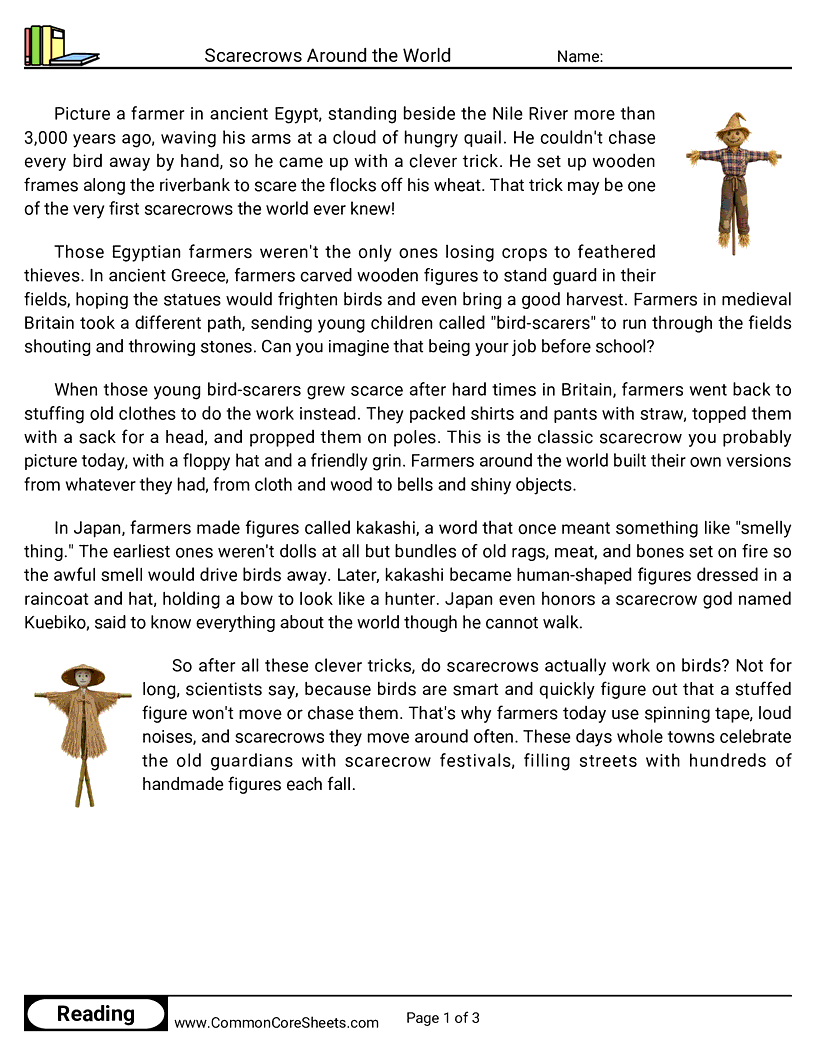
When those young bird-scarers grew scarce after hard times in Britain, farmers went back to stuffing old clothes to do the work instead. They packed shirts and pants with straw, topped them with a sack for a head, and propped them on poles. This is the classic scarecrow you probably picture today, with a floppy hat and a friendly grin. Farmers around the world built their own versions from whatever they had, from cloth and wood to bells and shiny objects.
In Japan, farmers made figures called kakashi, a word that once meant something like "smelly thing." The earliest ones weren't dolls at all but bundles of old rags, meat, and bones set on fire so the awful smell would drive birds away. Later, kakashi became human-shaped figures dressed in a raincoat and hat, holding a bow to look like a hunter. Japan even honors a scarecrow god named Kuebiko, said to know everything about the world though he cannot walk.
So after all these clever tricks, do scarecrows actually work on birds? Not for long, scientists say, because birds are smart and quickly figure out that a stuffed figure won't move or chase them. That's why farmers today use spinning tape, loud noises, and scarecrows they move around often. These days whole towns celebrate the old guardians with scarecrow festivals, filling streets with hundreds of handmade figures each fall.
Picture a field at dawn, where a ragged figure in a floppy hat stands perfectly still, arms flung out toward the rising sun. A crow circles, thinks twice, and flaps away to a safer tree. That silent field guard is a scarecrow, and people have been building them for far longer than you might guess. So who came up with the idea of scaring birds with a fake person, and does the trick actually work?
The answer takes us back thousands of years to the banks of the Nile River in ancient Egypt. Farmers there strung wooden frames and nets along their wheat fields to protect the grain from hungry flocks of quail. Across the Mediterranean, the ancient Greeks carved wooden figures of Priapus, a garden god, and set them among the vines to guard the harvest. Even that long ago, people had figured out that a still, human-shaped shape in a field could keep birds nervous.
Those wooden guardians eventually traveled far beyond Egypt and Greece, taking on new shapes wherever they went. In Japan, farmers built the kakashi, a straw figure once hung with old rags and even bits of fish, then set on fire so the smoke and smell would drive birds off. Over in medieval Britain, young children called "bird scarers" or "crow-scarers" walked the fields waving rattles and clappers to frighten the flocks away. In other words, before farmers stuffed a shirt with straw, a real live child often did the scarecrow's job!
A child could not stand in a field all day, so people slowly built the stuffed straw figures we know today. A classic scarecrow is really just old clothes packed with straw, propped on a wooden cross, and topped with a hat or a turnip-and-cloth head. Here is the surprising part: birds are clever, and a crow will often figure out within a few days that the motionless figure never moves or hurts it. That is why farmers now add spinning tape, shiny objects, and loud noisemakers, because a scarecrow that changes and startles works far better than one that just stands there.
Even though real crows learn to ignore them, scarecrows have found a whole new life as a reason to celebrate. Towns across the United States, Britain, and Japan now hold scarecrow festivals in the fall, where neighbors build funny, creative figures and line them along the streets. In the English village of Kettlewell, families have made hundreds of scarecrows for a summer festival that draws visitors from all over. So the next figure you see guarding a garden may fool no birds at all, yet still do exactly what those Egyptian nets did long ago: make people stop and look.
You've probably pictured a scarecrow as a floppy stuffed figure in a cornfield, tipping its hat at crows that flap away in terror. Here's the twist: birds are a lot smarter than that old image suggests, and scarecrows are far older and stranger than a friendly farmer's dummy. The word itself gives away the job: to scare the crow. For thousands of years, people around the world have propped up figures, hung shiny objects, and rigged up noisemakers, all in a running battle to keep hungry birds off their crops. A scarecrow, at its heart, is a bluff aimed at a beak.
That bluff is ancient, older than almost anything else in farming. Along the Nile in ancient Egypt, farmers set wooden frames in their wheat fields to trap and frighten quail, and paintings from that time show people guarding the harvest. In ancient Greece, growers are said to have carved figures of Priapus, a minor garden god, and stood them among the vines to protect the fruit. Move ahead to the Middle Ages in Britain, and children called "bird-scarers" were sent into the fields to shout, wave rattles, and throw stones at flocks. So before the stuffed dummy ever slouched on its pole, the real scarecrow was often a living, yelling kid.
Those noisy children eventually gave way to figures that could stand watch all day without getting tired. In Japan, farmers built figures they called kakashi to guard their rice paddies, and the name is telling. It comes from a word meaning something that smells so bad it drives creatures away, because early versions were rags and old fish or meat burned to make an awful stink. Later kakashi looked more like people, dressed in a straw raincoat and a wide hat, sometimes armed with a bow to look fierce. In Japanese tradition, one famous kakashi was even honored as a mountain deity who, though it could not walk, knew everything happening in the world.
Knowing everything is one thing; actually fooling a bird is another, and this is where the honest truth gets a little embarrassing. Studies of crows and other birds show they are quick learners, and a scarecrow that never moves is soon treated like a handy perch rather than a threat. That is why farmers today mix things up with reflective tape, propane cannons that bang like fireworks, and figures that flap or shift in the wind. The old wisdom was right about one thing: the trick is movement and surprise, not a face made of straw. In other words, a scarecrow works best when the bird can't quite figure out what it is.
If a straw figure can't reliably outsmart a crow, why do we still build them by the thousands each autumn? Because somewhere along the way the scarecrow stopped being only a tool and became a character we actually like. Towns from England to Japan to the United States now hold scarecrow festivals, lining streets and yards with clever, funny, and downright artistic figures for people to admire. Some villages build hundreds of them, turning quiet lanes into crowds of silent straw neighbors. The creature invented to keep company away has ended up drawing crowds of its own.
Picture a farmer standing perfectly still in a field for three thousand years, never blinking, never eating, arms flung wide against the wind. That is basically the job description of the scarecrow, a figure so old that it was already ancient when your great-great-great-grandparents were kids. Most look like a person stuffed with straw, dressed in old clothes, and propped on a wooden cross so the sleeves flap like waving arms. From a distance the effect is meant to fool a hungry bird into thinking a human guard is on patrol.
Fooling birds, it turns out, is a very old worry, and the Egyptians may have been among the first to try it. Along the Nile River, farmers are believed to have set wooden frames and nets in their wheat fields to trap or frighten flocks of quail before the birds could strip the grain. The ancient Greeks took a different approach, carving wooden figures of a minor god named Priapus, who was said to protect gardens, and standing them among the vines. People told a story that Priapus was so ugly the birds fled at the sight of him, which is probably the earliest scarecrow that was meant to be scary on purpose.
Ugliness was optional, but the idea of a human-shaped guardian traveled surprisingly far. In medieval Britain, records suggest that young children called "bird-scarers" were hired to walk the fields waving rattles and hurling stones at crows. When plague swept through and left fewer workers to spare, farmers began stuffing old clothes with straw and standing those up instead, letting a still figure do the shift a child once worked. So the classic straw scarecrow you imagine today partly exists because there simply weren't enough hands to chase the birds by then.
Halfway around the world, farmers in Japan had reached the very same idea on their own. There the field guardian is called a kakashi, a word that comes from a term meaning "something that smells bad," because the earliest versions were rags and old fish bones set on fire to drive off birds with their stink. Later the kakashi became a straw figure dressed in a farmer's coat and a round hat, sometimes given a bow to look ready for a fight. In Japanese folklore a mountain deity called Kuebiko was even imagined as a scarecrow who cannot walk but knows everything in the world, having stood watching the fields forever.
A guardian that knows everything sounds impressive, but here is the uncomfortable truth: scarecrows aren't very good at their one job. Birds are clever, and researchers have found that crows in particular quickly learn a straw figure never actually moves or throws anything, so they go right back to feasting. That is why modern farms mix things up with reflective tape, propane cannons that pop like fireworks, and shapes that flap or spin unpredictably. The lesson scientists keep repeating is that a scare only works if it keeps changing, which a motionless dummy never does.
If they don't guard the corn, why do people still build them by the thousands every autumn? The answer is that the scarecrow has quietly changed jobs, trading farm work for festival fame in places like Nagoro, Japan, and countless small towns across Britain and the United States. At these fall gatherings neighbors stuff burlap and flannel into whole villages of figures, staging them fishing, riding bikes, or reading newspapers for crowds of visitors. The oldest guardian in the field has become one of the friendliest faces of the harvest season, which may be the strangest trick a straw person ever pulled.
Picture a lone figure standing in a field at dawn, arms flung wide, a battered hat tilted over a face of stuffed cloth. You know exactly what it is, and so does a crow perched on the fence a few feet away - which is precisely the problem. A scarecrow is a human-shaped decoy that farmers set up to frighten birds away from their crops, usually a wooden cross draped in old clothes and packed with straw. For thousands of years, people have trusted this quiet guardian to protect the harvest, yet the story of the scarecrow is really a debate: does it actually work, and how did such a strange custom spread across the whole world?
That debate is much older than you might guess, because the first scarecrows were not scarecrows at all. Along the Nile around 3,000 years ago, Egyptian farmers stretched nets over wooden frames to trap quails that raided their wheat, turning pest control into dinner. The ancient Greeks took a different route, carving wooden statues of Priapus, a minor god of gardens, and standing them among the vines to guard the grapes. Notice the distinction: the Egyptians built a trap, while the Greeks built an image meant to warn intruders away. Both ideas survive in today's scarecrow, which is part figure and part bluff.
That idea of a guardian figure took on strikingly different shapes depending on where farmers lived. In Japan, rice farmers hung old rags, fish bones, and meat on tall poles and set them smoking, creating a smelly deterrent they called kakashi, a word that comes from a verb meaning "to stink." Later the kakashi became a full human figure with a straw hat and a bow, but the old name stuck, a reminder of its reeking beginnings. In medieval Britain, meanwhile, landowners are said to have sent young children called "bird-scarers" into the fields to run about, clap, and throw stones at crows. When plague swept through and left fewer workers in the 1300s, some historians argue, stuffed figures began replacing the missing children.
Whether or not a shortage of children truly created the modern scarecrow, the finished figure clearly borrowed from all these traditions. European settlers carried the custom to North America, where Indigenous farmers had long used their own methods, including people who sat on raised platforms to shout at birds. The classic straw-stuffed dummy you imagine - crossed poles, flannel shirt, painted burlap face - really took shape in these fields, cheap to build from whatever was lying around. Here the object had become pure image, no trap and no smoke, relying entirely on the bluff the Greeks had started. And a bluff, as any crow will tell you, has a short shelf life.
That short shelf life is exactly what makes scientists doubt the scarecrow's reputation. Crows and other birds are clever enough to notice that the silent figure never moves or threatens them, so within days they treat it as a convenient perch rather than a danger. Researchers who study bird control generally agree that a stationary scarecrow loses its effect quickly unless it is moved often, changed, or paired with noise, motion, or reflective objects. In other words, the very thing that makes a scarecrow comforting to us - its stillness - is what makes it useless to the birds it is supposed to fool. The evidence suggests the scarecrow may have survived less because it works and more because we love the sight of it.
Loving the sight of it is why the scarecrow refuses to retire, even now that machines and lasers do the real work of guarding crops. Towns across Britain, the United States, and Japan hold scarecrow festivals each autumn, where residents build hundreds of figures dressed as superheroes, celebrities, and storybook characters and line the streets with them. Japan's village of Nagoro became famous for a different reason: a woman named Tsukimi Ayano filled her nearly empty village with life-sized straw dolls, far outnumbering the human residents. What began as a smoky pole on the Nile has ended up as folk art posed on porches and paraded down Main Streets. Not bad for a bundle of straw that, by most scientific accounts, the birds figured out long ago.
About this worksheet
Students read a nonfiction passage about scarecrows, written at 9 reading levels (kindergarten to 8th grade), and answer multiple-choice questions about it.
A reading comprehension worksheet about scarecrows with a different article for each reading level, kindergarten to 8th grade, each with its own multiple-choice questions aligned to the Common Core Reading: Informational Text standards. Printable with an answer key, and available as an online assignment at any level.
Student objectives
- Read a nonfiction passage about the history of scarecrows in different cultures
- Find specific details that explain how and why scarecrows were made
- Explain why scarecrows do not keep birds away for long
- Describe how the passage is organized as a chronology through time
Everyday practice
- Look for scarecrows or other bird-scaring tricks, like spinning tape or shiny ribbons, in gardens and fields near you
- Notice how birds react to still objects versus things that move
- Ask an adult whether your town holds a fall or scarecrow festival