Word Probability Worksheets
Free probability worksheets with answer key. No login or account needed. From spinners to dice and even word problems, we've got you covered. A grading column and quick grade scale make grading a breeze, and modified pages help with lower level learners or when just introducing a topic. Great for teachers or for homeschool.
Filter By Grade
Problem Type


About these worksheets
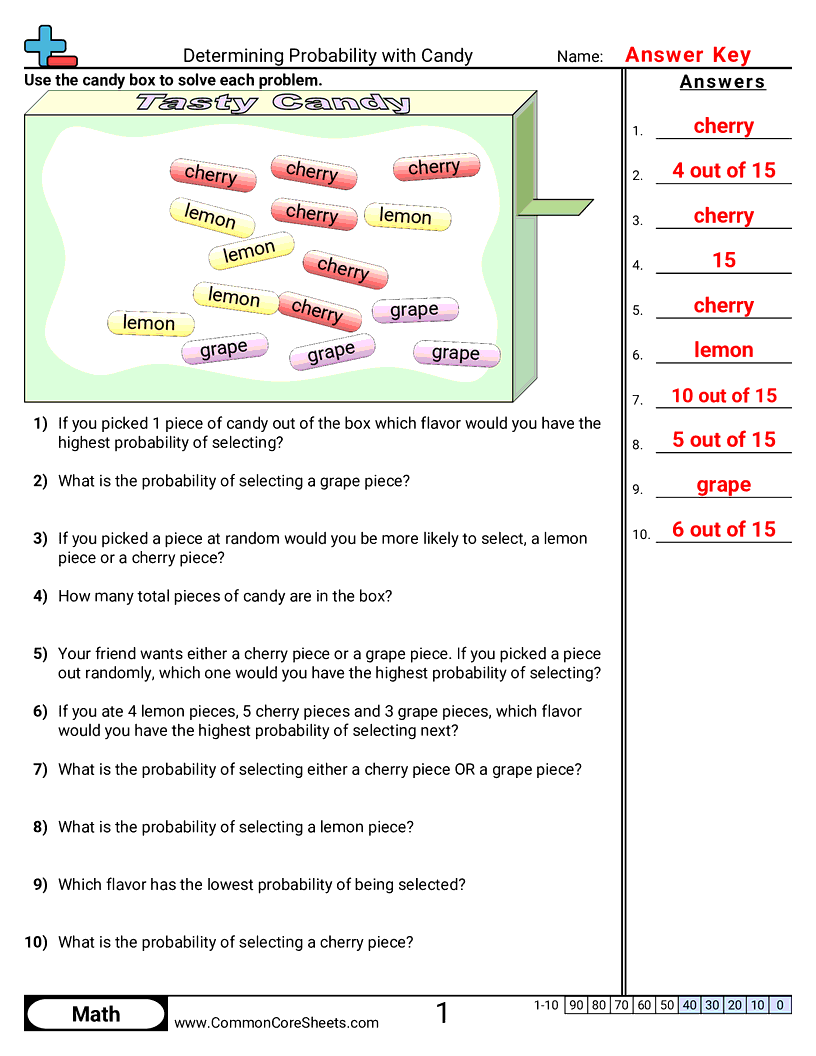
These worksheets introduce basic probability concepts through hands-on scenarios. Students determine the likelihood of selecting specific items from a set, identify most and least probable outcomes, and calculate probability using spinners, dice, and object arrays. Activities build an intuitive understanding of chance and likelihood.


One Atta Time

Flash Cards

Distance Learning

Create New Sheet

Select a Worksheet >
Version 1
Version 2
Version 3
Version 4
Version 5
Version 6
Version 7
Version 8
Version 9
Version 10
Grab 'em All
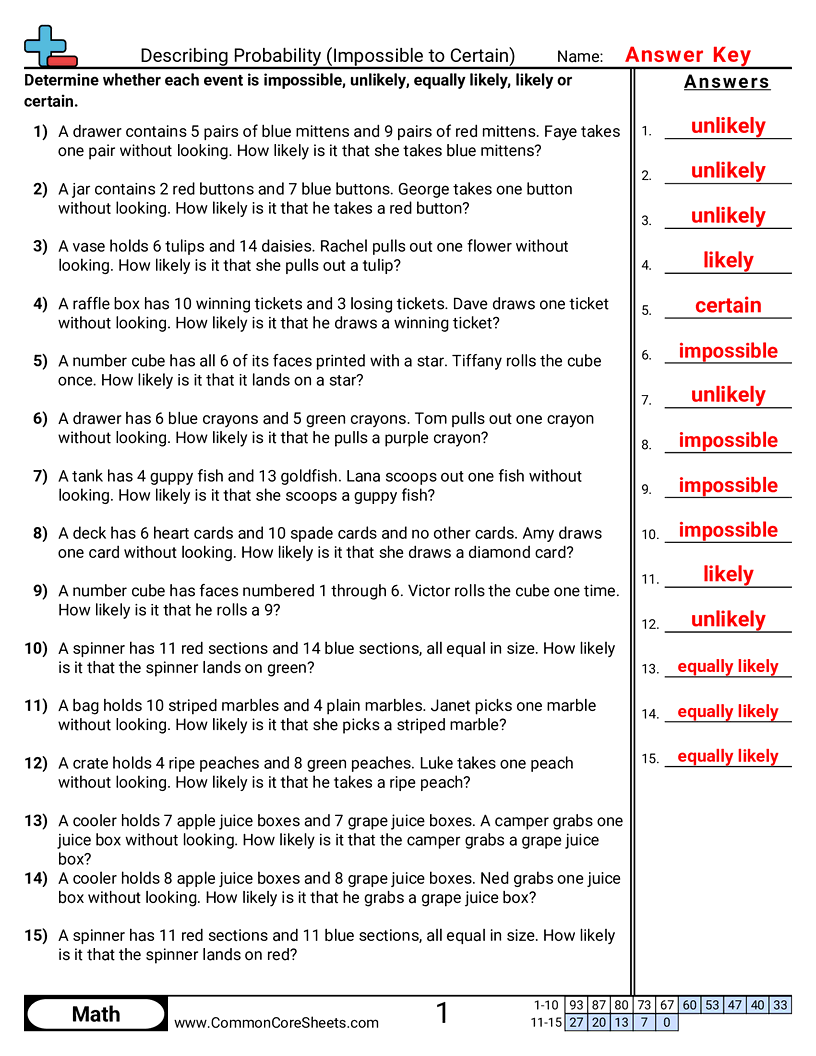
Describing Probability from Impossible to Certain (Word Problems)

- Describe the likelihood of an event using the words impossible, unlikely, equally likely, likely, and certain.
- Compare the number of favorable outcomes to the total outcomes to judge likelihood.
- Recognize events with probability 0 (impossible) and 1 (certain).


One Atta Time
Flash Cards
Distance Learning
Create New Sheet
Select a Worksheet >
Version 1
Version 2
Version 3
Version 4
Version 5
Version 6
Version 7
Version 8
Version 9
Version 10
Grab 'em All
Predicting Outcomes from Theoretical Probability (Word Problems)
- Predict how many times an outcome should occur from its theoretical probability.
- Multiply the number of trials by the probability of the event.
- Work with probabilities given as fractions, ratios, and percents.
One Atta Time
Flash Cards
Distance Learning
Create New Sheet
Select a Worksheet >
Version 1
Version 2
Version 3
Version 4
Version 5
Version 6
Version 7
Version 8
Version 9
Version 10
Grab 'em All
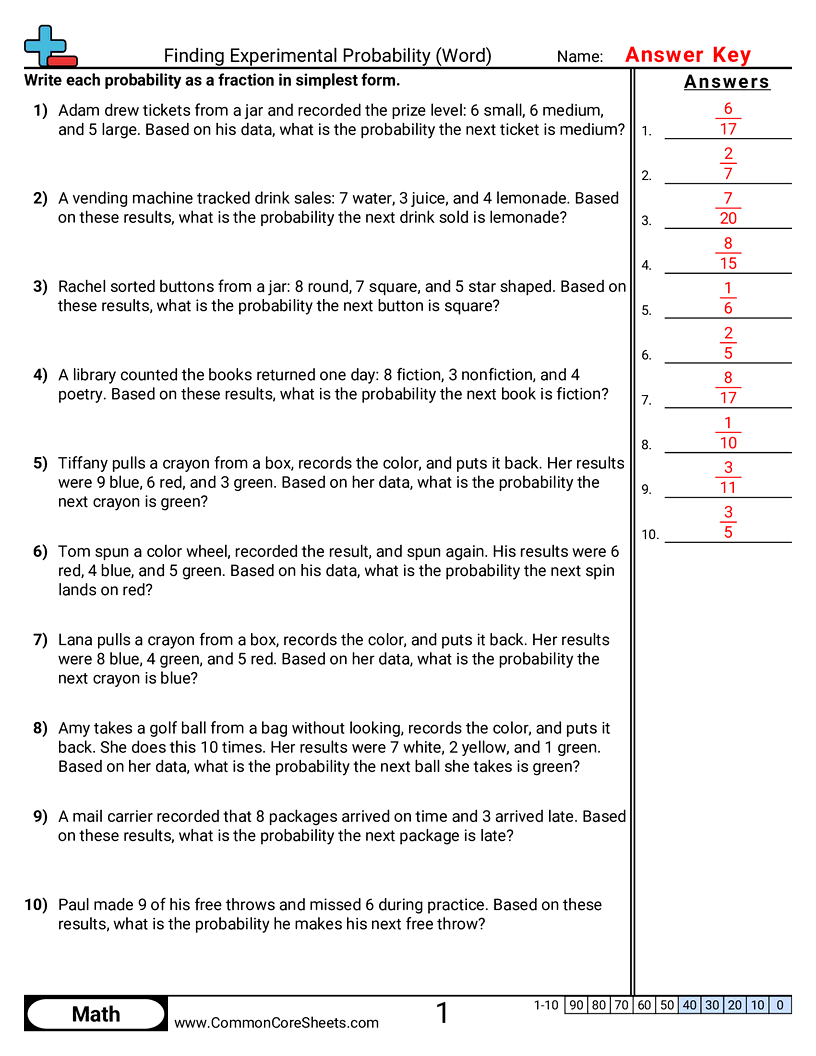
Finding Experimental Probability from Recorded Results (Word Problems)
- Calculate experimental probability from recorded results.
- Write probabilities as fractions in simplest form.
- Use experimental results to predict future outcomes when actual probabilities are unknown.