Praying Mantis Worksheet Download
Free reading worksheets on Praying Mantis. Each worksheet has 20 problems with an answer key and are ideal for teachers and homeschooling. You can download the PDF, create a set of flash cards or set it up for online learning.


Sheet Information >
Available at 2nd grade, 3rd grade, 4th grade, 5th grade and 6th grade reading levels.
Read the passage
Hey there, did you know that praying mantises are fascinating insects? They have long, bendy bodies and big eyes which make them look very cool. These insects are great hunters and they love to eat other insects like flies, mosquitoes, and sometimes even small birds!
Praying mantises are found all around the world, living in gardens, forests, and grasslands. These insects go through a life cycle called metamorphosis, starting as an egg, then turning into a nymph and finally, growing into an adult praying mantis. Although they might look a bit scary, praying mantises are not harmful to humans and can actually be helpful by eating pests in our gardens.
One interesting thing about praying mantises is their ability to defend themselves. They use their strong front legs to capture their prey and can even camouflage themselves to blend in with their surroundings. There are over 2,400 different species of praying mantises, each with their own unique features and colors.
In conclusion, praying mantises are amazing insects with fascinating hunting skills, an interesting life cycle, and a great ability to protect themselves.
Meet the praying mantis, a fascinating insect that has a unique appearance and interesting behaviors. These amazing creatures have a triangular head, large eyes, and front legs that are perfect for grabbing their prey. Praying mantises can be found in many different habitats, including gardens, forests, and grasslands. They are known for their incredible camouflage abilities, which help them blend in with their surroundings and surprise their prey.
A praying mantis's diet mainly consists of other insects, such as flies, crickets, and even other mantises. Their life cycle starts as an egg, which hatches into a tiny nymph that looks like a miniature adult. As they grow, they molt and shed their exoskeleton multiple times before becoming a fully grown adult. These fascinating insects are known to be beneficial to humans because they eat pests that can harm our plants and gardens.
When it comes to defending themselves, praying mantises have several strategies. Their excellent camouflage helps them hide from predators, and their spiny front legs can help them capture and hold onto their prey tightly. One interesting fact is that there are over 2,000 different species of praying mantises, each with their own unique features and behaviors. Next time you see a praying mantis, remember these amazing facts and appreciate the incredible world of insects that surrounds us.
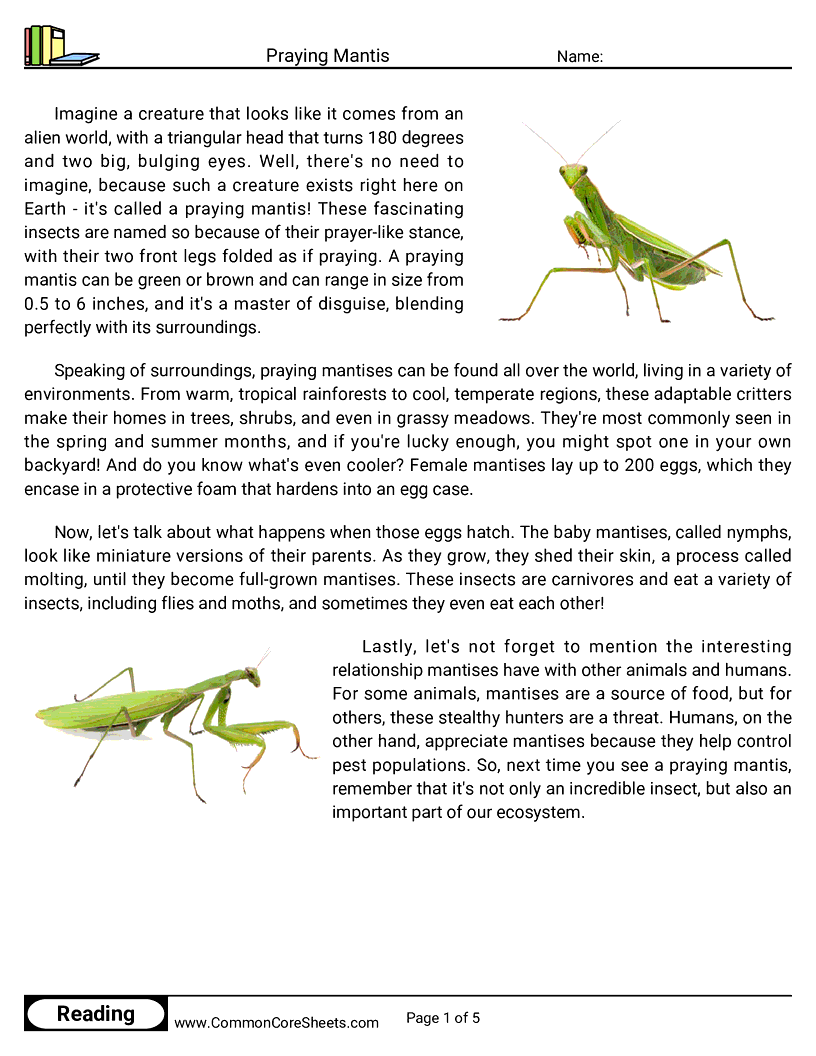
Imagine a creature that looks like it comes from an alien world, with a triangular head that turns 180 degrees and two big, bulging eyes. Well, there's no need to imagine, because such a creature exists right here on Earth - it's called a praying mantis! These fascinating insects are named so because of their prayer-like stance, with their two front legs folded as if praying. A praying mantis can be green or brown and can range in size from 0.5 to 6 inches, and it's a master of disguise, blending perfectly with its surroundings.
Speaking of surroundings, praying mantises can be found all over the world, living in a variety of environments. From warm, tropical rainforests to cool, temperate regions, these adaptable critters make their homes in trees, shrubs, and even in grassy meadows. They're most commonly seen in the spring and summer months, and if you're lucky enough, you might spot one in your own backyard! And do you know what's even cooler? Female mantises lay up to 200 eggs, which they encase in a protective foam that hardens into an egg case.
Now, let's talk about what happens when those eggs hatch. The baby mantises, called nymphs, look like miniature versions of their parents. As they grow, they shed their skin, a process called molting, until they become full-grown mantises. These insects are carnivores and eat a variety of insects, including flies and moths, and sometimes they even eat each other!
Lastly, let's not forget to mention the interesting relationship mantises have with other animals and humans. For some animals, mantises are a source of food, but for others, these stealthy hunters are a threat. Humans, on the other hand, appreciate mantises because they help control pest populations. So, next time you see a praying mantis, remember that it's not only an incredible insect, but also an important part of our ecosystem.
Have you ever seen a praying mantis? These fascinating insects are known for their unique appearance and interesting behaviors. Let's learn more about their lives, including what they eat, where they live, and how they relate to humans and other insects. We'll also discover some fun facts about these amazing creatures.
First, let's talk about what praying mantises eat. These insects are carnivores, which means they eat other insects and small animals. Their diet includes flies, crickets, and even small birds. They use their strong front legs to catch and hold their prey while they eat.
Now, let's explore where praying mantises live. Praying mantises can be found in many parts of the world, including North America, Europe, and Asia. They prefer to live in warm, tropical areas with lots of plants. You might find them in your garden, hiding among the leaves and waiting for their next meal.
Let's learn about the life cycle of a praying mantis. The female praying mantis lays her eggs in a special protective case called an ootheca. After a few weeks or months, the eggs hatch into tiny nymphs that look like miniature versions of adult mantises. As they grow, they shed their exoskeletons several times before reaching their full adult size.
Finally, let's talk about the praying mantis's relationship with humans and other insects. Humans often enjoy having praying mantises in their gardens, as they help control insect pests. However, they can also be a threat to other beneficial insects, like bees and butterflies. Praying mantises use their excellent camouflage and lightning-fast reflexes to protect themselves from predators and catch their prey.
In conclusion, praying mantises are fascinating insects with unique behaviors and appearances. They play important roles in ecosystems and can be helpful to humans by controlling insect pests. However, they can also pose a threat to other beneficial insects. Overall, these amazing creatures are an essential part of the natural world.
Praying mantises are fascinating insects that capture the attention of kids and adults alike. They have a unique appearance, with triangular heads and long, spiny front legs that are used for catching prey. Praying mantises can be found all around the world, from the United States to Africa, Europe, and Asia. There are more than 2,400 species of mantises, each with their own unique features and behaviors. Let's dive into the world of the praying mantis and learn more about these intriguing creatures.
Mantises are carnivorous insects, meaning they eat other insects and even small animals. They are known as ambush predators, waiting patiently for their prey to come close before striking with lightning speed. A praying mantis's diet includes flies, crickets, grasshoppers, and even other mantises! Sometimes, larger mantises will catch and eat small birds, frogs, or lizards. Their impressive hunting skills make them a valuable ally for gardeners, as they help control populations of harmful insects.
The life cycle of a praying mantis is quite fascinating. Female mantises lay up to 300 eggs in a protective case called an ootheca. After several weeks, the baby mantises, called nymphs, hatch from the ootheca and resemble tiny versions of adult mantises. As they grow, they shed their exoskeletons in a process called molting, eventually reaching adulthood after several molts. The average lifespan of a praying mantis is about 12 months, with females often dying shortly after laying eggs.
Praying mantises have several defense mechanisms to protect themselves from predators. Their natural camouflage helps them blend in with their surroundings, making it difficult for predators to spot them. When threatened, a mantis may rear up on its hind legs and spread its wings, making itself appear larger and more intimidating. Some species also have brightly colored patterns on the inside of their wings, which they can display to startle predators. Lastly, mantises are known for their agility and quick reflexes, allowing them to escape from dangerous situations.
There are many interesting facts about praying mantises that make them unique among insects. For example, they are one of the few insects capable of turning their head and looking over their shoulder. Also, the word 'mantis' comes from the Greek word for 'prophet' or 'seer', due to their praying-like posture. While many people believe that it's illegal to kill a praying mantis, this is actually a myth. Now that you know more about these amazing creatures, you can appreciate their role in our ecosystem and share your knowledge with others.
About this worksheet
Students read an informational passage about praying mantises and answer questions to check their understanding of the details.
This worksheet is designed to enhance children's reading and comprehension skills through entomology. It features the praying mantis, covering intriguing topics from lifecycles, habitat, characteristics, to its ecological impact. The 20-question format can be customized, converted into flashcards, or utilized in distance learning. Makes learning fun and flexible while supporting your child's understanding of nature's intricacies.
Student objectives
- Read a nonfiction passage about praying mantises and understand the main ideas
- Find specific facts and details in the text to answer questions
- Learn new vocabulary related to insects and their behavior
- Practice using evidence from the reading to support answers
Everyday practice
- Read facts about an animal you find in the backyard and tell someone what you learned
- Look up information about a bug you spotted and answer a friend's questions about it
- Explain to a family member why praying mantises are interesting after reading about them
- Compare what you read about mantises to other insects you know