Popular Halloween Costumes Through the Decades Worksheet Download
Free reading comprehension worksheet about the most popular Halloween costumes through the decades. Pick the reading level (2nd grade to 8th grade), print the passage with its questions, or assign it online.


Sheet Information >
Available at 2nd grade, 3rd grade, 4th grade, 5th grade, 6th grade, 7th grade and 8th grade reading levels.
Read the passage
Did you ever wonder what kids wore on Halloween a long, long time ago? Way back in the 1930s, when your great-great-grandparents were young, children liked to dress up as spooky ghosts and pointy-hatted witches! A ghost costume was easy to make, because you could just cut two holes in an old white sheet.
Ghosts and witches were fun, but soon kids wanted to be brave heroes too. In the 1950s, lots of children dressed as cowboys, with hats, boots, and pretend horses to gallop around the yard. Yee-haw, those cowboys were everywhere on Halloween night!
After the cowboys came a costume that shot way up high. In the 1960s, when real rockets first blasted people toward the moon, kids wanted to be astronauts in shiny space suits. Can you picture a whole street full of little astronauts, ready to blast off for candy?
Today, kids still love dressing up, but the costumes have changed again. A group called the National Retail Federation asks people every year what they will wear, and superheroes and princesses are often on the list. So the next time you put on a cape or a crown, remember that kids have been dressing up for almost a hundred years!
Imagine you are opening a big trunk in your grandma's attic, and out tumbles a bedsheet with two holes cut for eyes! Long ago, that was one of the easiest Halloween costumes a kid could make. In the 1930s and 1940s, many children dressed as ghosts and witches using old sheets, dark hats, and things they already had at home. A witch needed only a pointy hat and a broom, so almost anyone could join the fun.
Sheets and pointy hats were just the beginning, because soon costumes started copying the heroes kids saw and dreamed about. In the 1950s and 1960s, lots of children ran around dressed as cowboys with hats and toy holsters. Then something happened in the sky that changed play forever. Countries were racing to send rockets and people into space, and this "space race" made astronaut and alien costumes wildly popular.
Rockets pointed kids toward the stars, but movies and comics soon gave them a whole new kind of hero to become. Superhero costumes, with capes and bright masks, became a favorite way to feel strong and brave. Princess costumes, with sparkly dresses and shiny crowns, became just as loved. Did you know grown-ups joined in too? Adults began throwing costume parties and dressing up right alongside the kids.
Adults still love dressing up today, and now we can actually count which costumes win each year. Since the 2000s, a group called the National Retail Federation has asked thousands of people what they plan to wear for Halloween. Their survey often shows superheroes, princesses, witches, and even pumpkins near the top of the list. So the spooky sheet from grandma's attic and today's shiny superhero cape are really part of the same long, dress-up story!
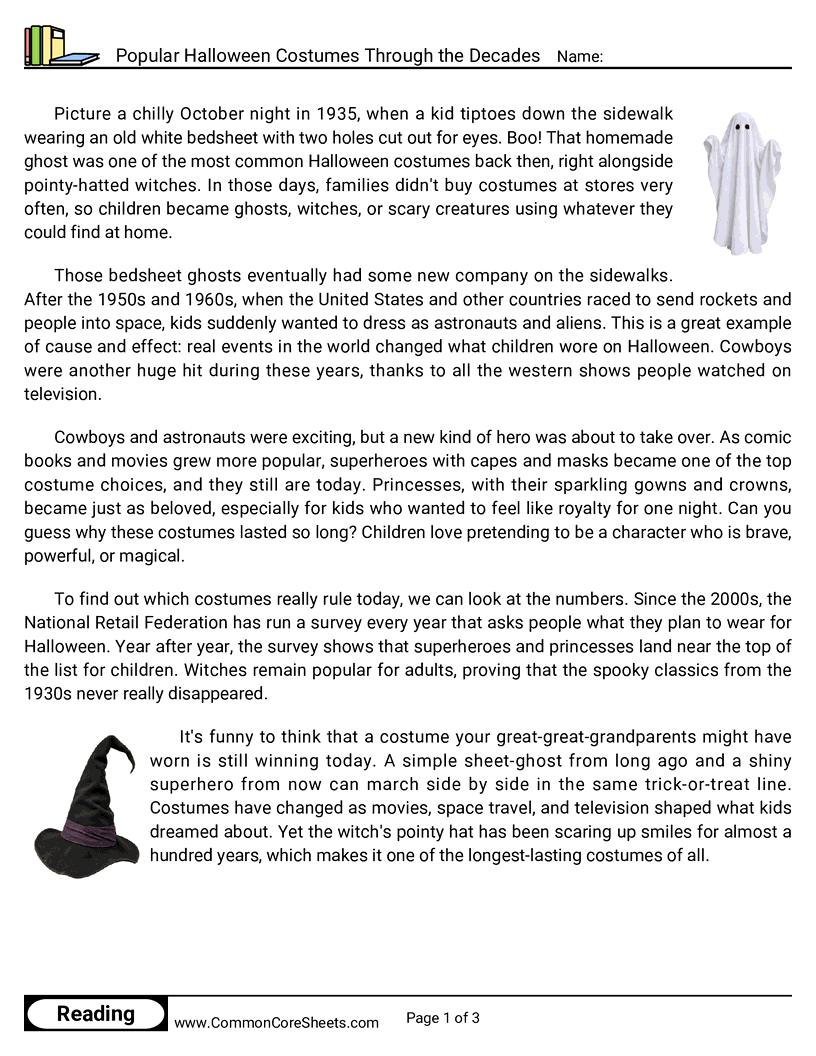
Picture a chilly October night in 1935, when a kid tiptoes down the sidewalk wearing an old white bedsheet with two holes cut out for eyes. Boo! That homemade ghost was one of the most common Halloween costumes back then, right alongside pointy-hatted witches. In those days, families didn't buy costumes at stores very often, so children became ghosts, witches, or scary creatures using whatever they could find at home.
Those bedsheet ghosts eventually had some new company on the sidewalks. After the 1950s and 1960s, when the United States and other countries raced to send rockets and people into space, kids suddenly wanted to dress as astronauts and aliens. This is a great example of cause and effect: real events in the world changed what children wore on Halloween. Cowboys were another huge hit during these years, thanks to all the western shows people watched on television.
Cowboys and astronauts were exciting, but a new kind of hero was about to take over. As comic books and movies grew more popular, superheroes with capes and masks became one of the top costume choices, and they still are today. Princesses, with their sparkling gowns and crowns, became just as beloved, especially for kids who wanted to feel like royalty for one night. Can you guess why these costumes lasted so long? Children love pretending to be a character who is brave, powerful, or magical.
To find out which costumes really rule today, we can look at the numbers. Since the 2000s, the National Retail Federation has run a survey every year that asks people what they plan to wear for Halloween. Year after year, the survey shows that superheroes and princesses land near the top of the list for children. Witches remain popular for adults, proving that the spooky classics from the 1930s never really disappeared.
It's funny to think that a costume your great-great-grandparents might have worn is still winning today. A simple sheet-ghost from long ago and a shiny superhero from now can march side by side in the same trick-or-treat line. Costumes have changed as movies, space travel, and television shaped what kids dreamed about. Yet the witch's pointy hat has been scaring up smiles for almost a hundred years, which makes it one of the longest-lasting costumes of all.
Picture a photograph from the 1930s: kids in bedsheet ghosts and pointy witch hats, standing on a porch in black and white. Now flip to a photo from today, packed with superheroes, princesses, and glowing space explorers. How did trick-or-treaters go from plain white sheets to whole armies of dazzling characters? The answer is a costume story that stretches across almost a hundred years, changing right alongside the country that wore them.
Back when those bedsheet ghosts ruled the neighborhood, most costumes were made at home from whatever a family had. A witch was easy: an old dress, a broom from the closet, and a hat cut from paper or cardboard. People chose spooky classics like ghosts, witches, skeletons, and black cats because those images were tied to Halloween for centuries. There were no costume aisles at the store yet, so imagination and scissors did most of the work.
Those scissors got a rest in the 1950s and 1960s, when store-bought costumes and a new kind of hero took over. Cowboys galloped through the decade, copying the Western movies and TV shows kids watched every week. Then something happened far above the trick-or-treaters' heads: the United States and the Soviet Union raced to reach outer space. Suddenly astronauts and rockets were front-page news, and children begged to dress as spacemen for Halloween.
That leap into space showed how the real world sneaks straight into costumes, and characters soon leaped in too. As comic books and movies grew popular, superheroes with capes and masks became some of the most-wanted costumes of all. Princesses did the same, turning porches into a parade of sparkling gowns and plastic crowns. Instead of only spooky classics, kids now dressed as the heroes and characters they cheered for on screen.
So which costumes win today? Since the 2000s, a National Retail Federation survey has asked people every year what they plan to wear. Superheroes, princesses, witches, and animal costumes usually crowd the top of the list, mixing brand-new favorites with those centuries-old classics. The survey even tracks pet costumes, because millions of Americans now dress up their dogs and cats too. From a homemade bedsheet ghost to a pug in a tiny superhero cape, Halloween has always let you become anything you can imagine.
Quick, what would you guess was the very first Halloween costume kids in America wanted most? If you pictured a caped superhero or a glittering princess, you're about eighty years too early. Back in the 1930s, the closet held homemade sheets turned into ghosts and pointed hats that turned kids into witches. Costumes were stitched at kitchen tables from whatever was lying around, because store-bought outfits were a luxury few families could afford during the Great Depression.
Those ghostly sheets and witch hats didn't stay in fashion forever, and the reason they changed says a lot about what Americans were watching. By the 1950s and 1960s, kids clomped down sidewalks dressed as cowboys, and then, as the United States and the Soviet Union raced to launch rockets and reach the Moon, astronauts and aliens took over the night. Can you imagine a whole neighborhood of tiny space explorers in silver suits? That's exactly what the space race did to trick-or-treating, turning headlines about rockets into ideas for costumes.
If the space race sent kids to the stars, television and movies soon pulled them into other worlds entirely. Superheroes with capes, princesses in flowing gowns, and characters from popular films began to fill doorsteps every October. A costume, it turns out, is a little like a mirror held up to whatever a country is excited about that year. When a new movie became a hit, you could practically count on seeing its heroes ringing doorbells the very next Halloween.
Wondering how anyone actually keeps track of all these changing trends? Since the 2000s, a National Retail Federation survey has asked thousands of Americans each year what they plan to dress as, then ranks the most popular choices. Some answers barely budge: superheroes, witches, and princesses show up near the top again and again, like old friends who never leave the party. The survey also counts costumes for pets, because plenty of dogs and cats spend the holiday dressed as pumpkins and hot dogs, whether they like it or not.
That yearly survey matters for more than just bragging rights about the coolest costume. The choices people make reveal what a generation loves, fears, and celebrates, which is why historians and companies pay close attention to them. Your grandparents once pulled a bedsheet over their heads; you might zip into a superhero suit; and someday kids will dress as things nobody has invented yet. A costume is only cloth and cardboard, yet it captures a moment in time as neatly as a photograph. The wildest part is that the humble ghost sheet, one of the oldest costumes of all, still haunts doorways today, refusing to go out of style.
Grab a bedsheet, cut two eyeholes, and you have the oldest Halloween costume trick in the book! For almost a hundred years, a plain white ghost has haunted American doorsteps, and it barely costs a thing. Back in the 1930s, most children didn't buy costumes at a store at all. They pieced them together at home from whatever the family could spare, turning old clothes, scraps, and imagination into witches, hobos, and skeletons. A costume, it turns out, is a kind of time capsule that tells you exactly what a decade was dreaming about.
Those homemade witches and ghosts got some polished company once factories entered the game. In the 1930s and 1940s, companies began printing costumes based on comic-strip and cartoon characters, and kids suddenly wanted to be somebody famous instead of something spooky. The costumes were often stiff masks with a printed smock, cheap enough that many families could finally buy rather than sew. Suddenly Halloween was less about scaring the neighbors and more about becoming your favorite hero for one glowing night. That shift, from spooky to celebrity, would only speed up as the twentieth century roared on.
If heroes were climbing to the top, cowboys came galloping right alongside them. During the 1950s, Westerns filled movie screens and the brand-new glow of television, so children everywhere strapped on holsters and pretended to ride the range. Then the world looked up: the space race between the United States and the Soviet Union sent rockets skyward, and by the 1960s kids were trading cowboy hats for astronaut helmets and shiny silver suits. Can you guess why? When real astronauts became national heroes, dressing as one let an ordinary kid feel part of something enormous.
Silver spacesuits eventually made room for capes, and superheroes swooped in to stay. From the 1970s onward, movies and comics turned caped crusaders and masked defenders into some of the most requested costumes year after year. Princesses gowns billowed up right beside them, especially as animated films gave children a whole gallery of royalty to imitate. Notice the pattern: whatever stories the country was watching, children wore to the door the very next October. A costume rack, in other words, is really a shelf of the year's biggest hits.
To find out which of those hits is winning today, retailers actually keep score. Since the early 2000s, the National Retail Federation has run a yearly survey asking Americans what they plan to dress as, and the results read like a popularity contest for the imagination. Superheroes, princesses, witches, and spooky classics like ghosts and vampires trade places near the top from year to year. The survey also tracks something furrier: pet costumes, because millions of owners now dress up their dogs and cats too. The most common pet costume, the survey has found, is often a simple pumpkin.
A dog dressed as a pumpkin may be new, but that stitched-together spirit is as old as the holiday itself. The very first trick-or-treaters in the 1930s and the kid zipping up a superhero suit today are chasing the same thrill: becoming someone else for a single evening. What changes is only the mirror the costume holds up, reflecting cowboys, astronauts, heroes, and royalty as each rises and fades. Peel back any Halloween costume and you're really looking at a snapshot of what a whole country was excited about that year. And a bedsheet ghost, the cheapest costume of all, has quietly outlasted every trend that ever tried to replace it.
Picture a chilly October evening in the early 1930s, when a child in a small American town pulls a bedsheet over their head, cuts two eyeholes, and becomes a ghost. That homemade sheet is one of the oldest costume tricks around, and it hints at something bigger: for almost a hundred years, what people wear on Halloween has quietly recorded what they were dreaming about, afraid of, or obsessed with. In the 1930s and 1940s, most costumes were stitched at home from whatever was lying around, so ghosts, witches, and skeletons ruled the night. Those choices weren't random—they were the spooky figures folklore had handed down for generations. In other words, a costume is a kind of message, and the message changes as the world does.
If early costumes leaned on old fears, the middle of the century swapped them for brand-new heroes. After World War II, store-bought costumes became cheaper, and suddenly children could buy a whole outfit instead of raiding the closet. Cowboys galloped to the top of the popularity list in the 1950s, riding the wave of Western movies and TV shows that filled American screens. Then something remarkable happened overhead: the Soviet Union launched Sputnik in 1957, and the United States raced to catch up. As rockets and astronauts dominated the news, kids traded their cowboy hats for space helmets, dressing up as the explorers they saw reaching for the stars.
That leap from cowboys to astronauts shows a pattern worth noticing: costumes tend to mirror whatever story a culture is telling itself. When comic-book superheroes exploded into movies and television, capes and masks followed close behind, and they have refused to leave. Princess costumes rose alongside a boom in animated films, giving many children a fantasy world to step into for one evening. Historians who study popular culture argue that these shifts are evidence, not coincidence—the costume aisle reflects what the entertainment industry is selling most loudly. You could almost predict a decade's biggest movies by looking at what filled the trick-or-treat bags.
To move past guessing and actually measure these trends, we can turn to a survey run every year since the early 2000s: the National Retail Federation survey. Each fall, it asks thousands of Americans what they plan to dress as, then ranks the most popular answers for both children and adults. Year after year, the same broad categories crowd the top of the children's list: a superhero, a princess, a witch, a ghost, and an animal such as a cat or dinosaur. What makes the survey valuable is that it separates opinion from fact—instead of arguing about which costume feels popular, we can point to real numbers. It even tracks pet costumes, because yes, plenty of people dress up their dogs, too.
Those steady rankings reveal a surprising truth: some costumes never really go out of style. The witch, for example, has stayed near the top for decades, outlasting cowboys, astronauts, and dozens of movie trends that came and went. Its endurance suggests that the oldest folklore figures still hold a grip on our imagination, even in an age of blockbuster superheroes. Meanwhile, adult costumes tell their own story, leaning toward humor, clever wordplay, and last-minute group ideas that friends put together. The two lists, side by side, show how differently children and grown-ups approach the same holiday.
Set all of these lists next to each other and the decades start to look like a timeline you can wear. A ghost points back to the handmade 1930s, a space helmet remembers the Sputnik-era race to the moon, and a superhero cape captures the movie-obsessed present. Each costume is a tiny time capsule, sealed for one night and then folded away in a closet. That is why researchers pay attention to something as playful as a costume survey: it quietly documents what an entire country was excited about. So the next time you choose a costume, remember that you're not just picking an outfit—you're adding one more entry to a history that stretches back before your great-grandparents were born.
About this worksheet
Students read a nonfiction passage about the most popular Halloween costumes through the decades, written at 7 reading levels (2nd grade to 8th grade), and answer multiple-choice questions about it.
A reading comprehension worksheet about the most popular Halloween costumes through the decades with a different article for each reading level, 2nd grade to 8th grade, each with its own multiple-choice questions aligned to the Common Core Reading: Informational Text standards. Printable with an answer key, and available as an online assignment at any level.
Student objectives
- Read a chronological passage about Halloween costumes from the 1930s to today
- Find details that explain why certain costumes became popular
- Explain how real world events, like the space race, changed what children wore
- Identify the main idea and the text structure the author uses
Everyday practice
- Notice which costumes friends and neighbors wear this year and see if superheroes or princesses show up
- Ask an older family member what they dressed as when they were your age
- Look for a movie or show that might explain why a costume is popular right now