Pillbugs Worksheet Download
Free reading worksheets on Pillbugs. Each worksheet has 20 problems with an answer key and are ideal for teachers and homeschooling. You can download the PDF, create a set of flash cards or set it up for online learning.


Sheet Information >
Available at 2nd grade, 3rd grade, 4th grade, 5th grade and 6th grade reading levels.
Read the passage
Hey there, kiddos! Let's talk about pillbugs, also known as roly-polies or woodlice! These fascinating little creatures are not actually insects, but are crustaceans, more closely related to shrimp and lobsters. You can easily recognize them by their oval-shaped, segmented bodies that allow them to roll into a tight ball when they feel threatened.
Now, let's explore the world of pillbugs and find out where they live and what they like to eat. You can often find them under rocks, logs, and leaf litter in moist, dark places. These tiny creatures are nature's recyclers, munching on decaying plant material and returning nutrients to the soil.
Lastly, let's learn about the life cycle of pillbugs and how they interact with humans and other insects. Their life cycle starts with eggs, which are kept in a special pouch on the mother's body, and they go through several molts before reaching adulthood. While they don't harm humans or plants, they sometimes help keep your garden healthy by eating dead leaves and other organic matter. So, remember, pillbugs are unique little critters that play an important role in our ecosystem, and now you know all about them!
Meet the pillbug, a tiny, fascinating creature that you might have seen crawling around in your garden. These little insects, often called roly-polies or doodlebugs, are actually not insects at all, but rather a type of crustacean called an isopod. Pillbugs are usually grey or brown and have a hard outer shell with several segments, making them look like tiny armadillos. They have seven pairs of legs, two pairs of antennae, and can roll into a tight ball when they feel threatened.
Pillbugs are quite helpful to the environment and play an important role in decomposition. They mostly eat decaying plants and other organic matter, which helps to break down and recycle nutrients back into the soil. You can often find them in damp, dark places like under rocks, logs, or leaves, where they can stay moist and find food. These little creatures are harmless to humans and do not bite or sting, so there’s no need to be afraid of them.
The life cycle of a pillbug is quite interesting and unique. Female pillbugs carry their eggs in a pouch called a marsupium, similar to how kangaroos carry their babies. Once the eggs hatch, the tiny pillbug babies, called mancae, stay in the marsupium for a few weeks before venturing out into the world. Pillbugs can live up to two years, and during that time, they will molt or shed their exoskeleton several times as they grow.
Now that you know more about these amazing little creatures, you might appreciate the important role they play in our ecosystem and enjoy observing them in their natural habitats.
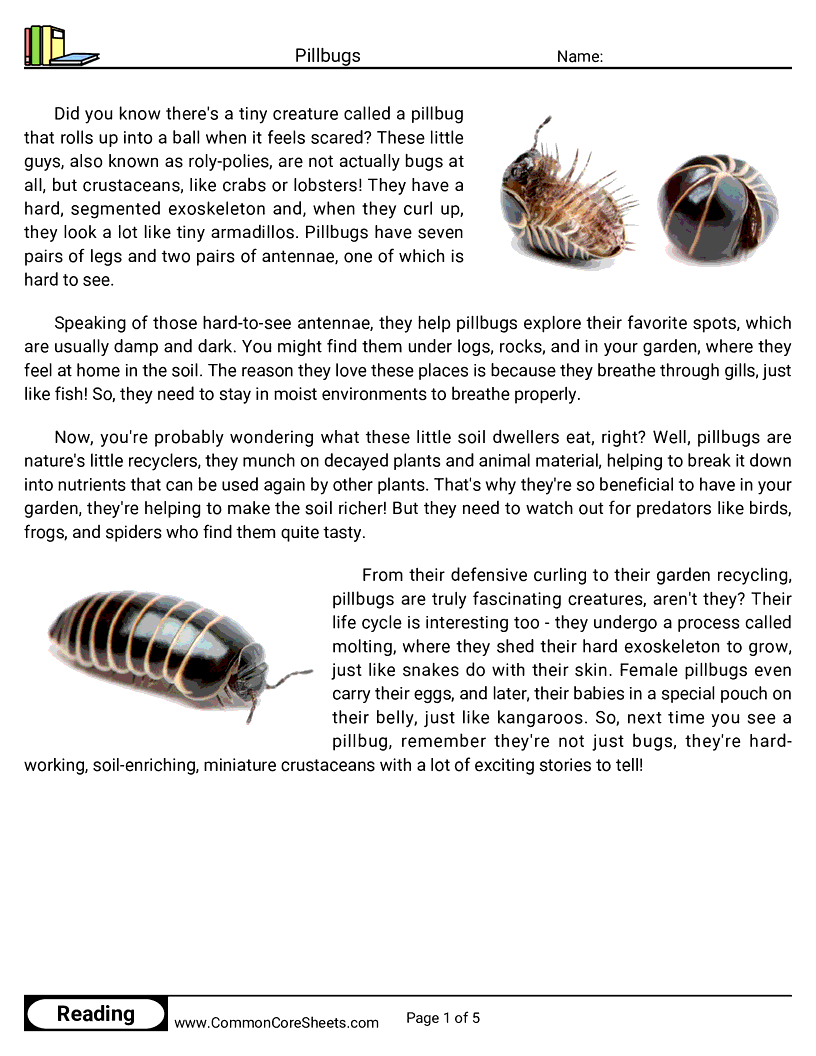
Did you know there's a tiny creature called a pillbug that rolls up into a ball when it feels scared? These little guys, also known as roly-polies, are not actually bugs at all, but crustaceans, like crabs or lobsters! They have a hard, segmented exoskeleton and, when they curl up, they look a lot like tiny armadillos. Pillbugs have seven pairs of legs and two pairs of antennae, one of which is hard to see.
Speaking of those hard-to-see antennae, they help pillbugs explore their favorite spots, which are usually damp and dark. You might find them under logs, rocks, and in your garden, where they feel at home in the soil. The reason they love these places is because they breathe through gills, just like fish! So, they need to stay in moist environments to breathe properly.
Now, you're probably wondering what these little soil dwellers eat, right? Well, pillbugs are nature's little recyclers, they munch on decayed plants and animal material, helping to break it down into nutrients that can be used again by other plants. That's why they're so beneficial to have in your garden, they're helping to make the soil richer! But they need to watch out for predators like birds, frogs, and spiders who find them quite tasty.
From their defensive curling to their garden recycling, pillbugs are truly fascinating creatures, aren't they? Their life cycle is interesting too - they undergo a process called molting, where they shed their hard exoskeleton to grow, just like snakes do with their skin. Female pillbugs even carry their eggs, and later, their babies in a special pouch on their belly, just like kangaroos. So, next time you see a pillbug, remember they're not just bugs, they're hard-working, soil-enriching, miniature crustaceans with a lot of exciting stories to tell!
Let's explore the fascinating world of pillbugs, also known as roly-polies or woodlice! These little creatures have a hard, segmented exoskeleton and are usually grey or brown in color. They have seven pairs of legs and two pairs of antennae, and they can roll into a tight ball when they feel threatened. Pillbugs are not insects, they are actually crustaceans, which means they are related to animals like crabs and shrimp.
Now, let's take a look at where you can find pillbugs and their preferred living conditions. They are usually found in damp, dark places like under rocks, logs, or leaf litter. Pillbugs need moisture to survive, so they avoid direct sunlight and stay hidden during the day. They are most active during the night, which makes them nocturnal creatures.
Pillbugs have an interesting diet that makes them very important for the environment. They mainly eat decaying plant material, which helps to break down and recycle nutrients back into the soil. Sometimes, they also munch on living plants, but they usually don't cause much damage. Pillbugs also eat feces and even their own molted exoskeletons for extra nutrients.
Let's learn about the life cycle of these fascinating little creatures. The female pillbug carries her eggs in a pouch, called a marsupium, underneath her body. After about 2-3 weeks, the eggs hatch and tiny, white baby pillbugs emerge, already in a similar shape to their parents. As they grow, they molt multiple times, gradually gaining their adult color and size, which can take up to a year.
Finally, let's talk about the relationship between pillbugs, humans, and other creatures. Pillbugs are generally harmless to humans and can even be beneficial in gardens, where they help break down organic matter. Some creatures, like birds, frogs, and spiders, like to eat pillbugs as a tasty snack. Their main defense mechanism is rolling into a ball, which helps protect them from predators.
In conclusion, pillbugs are fascinating and helpful little crustaceans that play an important role in our ecosystem.
Pillbugs are fascinating little creatures that you may have seen crawling around your backyard. They are small, usually about half an inch long, and have a grey or brownish-grey color. These bugs are also known as 'roly-polies' or 'woodlice' because they can roll up into a tiny ball when they feel threatened. Pillbugs have seven pairs of legs and a hard exoskeleton to protect their soft insides. Believe it or not, pillbugs are not insects, but rather, they are crustaceans, which means they are more closely related to shrimp and crabs!
Now let's discover where these tiny critters make their homes and what they like to eat. Pillbugs prefer dark, damp environments, so you will often find them under rocks, logs, and leaf litter. They are also known as 'decomposers' because they feed on decaying plant material, which helps break down organic matter and recycle nutrients back into the soil. Occasionally, they may also munch on small insects, algae, and fungi. By doing all of this, pillbugs play an essential role in maintaining a healthy ecosystem.
Let's explore the life cycle of a pillbug, from egg to adult. The female pillbug carries her eggs in a special pouch called a marsupium, where they remain until they hatch into tiny, white baby pillbugs. After hatching, the young pillbugs will go through several stages of growth called 'molts', shedding their exoskeleton and growing a new one each time. As they grow, they will gradually develop their color and look more like adult pillbugs. It takes about one year for a pillbug to reach adulthood, and they can live for up to three years.
Pillbugs have an interesting relationship with both humans and other insects. While they are generally harmless to humans and do not bite or sting, they can sometimes become a nuisance if they find their way into homes or gardens. However, as decomposers, they help break down and recycle organic matter, which is beneficial for our gardens and the environment. When it comes to other insects, pillbugs can serve as a food source for predators like spiders, centipedes, and some birds. In turn, these predators help keep the pillbug population in check.
Lastly, let's take a look at some unique features and interesting facts about pillbugs. As mentioned earlier, they are crustaceans, not insects, which makes them quite unique among the tiny creatures we find in our gardens. Another interesting fact is that pillbugs do not have lungs, but instead, they breathe through gill-like structures called 'pseudotracheae'. This is why they need to live in moist environments to prevent their gills from drying out. Furthermore, when pillbugs consume food, they can also absorb heavy metals like lead and zinc, making them useful in cleaning up contaminated soil.
About this worksheet
Students read a passage about pillbugs and answer questions to show their understanding of the key details and facts.
This worksheet is designed to boost children's reading and comprehension skills, with a focus on the world of Pillbugs. Covering 20 distinct problems, the concepts range from understanding pillbug behaviors, their anatomy, habitats, predators, and diet. This customizable tool is ideal for distance learning and can easily be converted into flashcards, making learning interactive, fun and accessible.
Student objectives
- Read an informational passage about pillbugs and understand the main ideas
- Find specific facts and details in the text to answer questions
- Understand new vocabulary words used to describe pillbugs
- Explain what pillbugs eat, where they live, and how they behave
Everyday practice
- Read a fact card at a zoo or nature center and remember what it said
- Look up information about a bug you found in the yard
- Answer questions about an article you just read
- Share interesting facts about pillbugs with a friend or family member