Owls: Hunters of the Night Worksheet Download
Free reading comprehension worksheet about owls. Pick the reading level (kindergarten to 8th grade), print the passage with its questions, or assign it online.


Sheet Information >
Available at kindergarten, 1st grade, 2nd grade, 3rd grade, 4th grade, 5th grade, 6th grade, 7th grade and 8th grade reading levels.
Read the passage
Whooo said that? Look up in the dark and you might see an owl! An owl is a bird with big round eyes and soft feathers. Owls like to fly and hunt at night.
Those soft feathers do a special trick. They let an owl fly very quietly. A mouse below may not hear the owl coming!
An owl can hear that mouse very well too. Its round face works like a cup to catch sounds. Did you know an owl cannot roll its eyes? It turns its whole head to look around!
Have you ever heard an owl in the dark? Owls are birds that fly at night to hunt for food. They have big round eyes, soft feathers, and sharp claws called talons.
Those soft feathers hold a cool secret. The edges of an owl's feathers are fuzzy, so it flies without a sound. A mouse cannot hear the owl come, and that helps the owl catch its meal!
An owl needs sharp eyes to hunt, but its eyes cannot move. So the owl turns its whole head to look side to side and even behind. Can you turn your head that far? You cannot, but an owl can!
Swoosh! An owl just flew right over your head, and you did not hear a single sound. Owls are birds that hunt at night, and they have soft feathers with fluffy edges that hush the noise of their wings. In autumn stories, you might see an owl sitting on a spooky branch, but real owls are quiet helpers who catch mice.
Those quiet wings help them sneak, and their round faces help them listen. An owl's face is shaped like a curved dish, and it works like a cup that funnels sound straight to its ears. Some owls even have ears that sit lopsided, one a little higher than the other, so they can tell exactly where a tiny mouse is hiding.
Once an owl hears its dinner, it needs sharp eyes to see it too. Owl eyes are so big that they cannot roll or move the way yours do, so an owl turns its whole head instead. It can twist its neck almost all the way around, which lets it look behind itself without moving its body at all!
After an owl eats, it makes something very surprising called a pellet. A pellet is a small, dry lump of bones and fur that the owl cannot digest, so it spits it back out. Scientists open up these little lumps to learn what owls eat, so one tiny gray blob can tell a big story!
Imagine you are standing in a dark forest on a chilly autumn night. A mouse rustles in the leaves, but nothing seems to be moving above you. Then, without a single sound, an owl swoops down out of the shadows! With its round face and big, glowing eyes, this feathered night hunter is one of the quietest fliers in the whole animal world.
That silent swoop is no accident, because an owl's feathers are built like nothing else. The front edge of each wing feather is soft and fringed, like the teeth of a tiny comb. This fluffy edge breaks up the rushing air, so the owl flies without the whooshing sound other birds make. That means a mouse never hears the owl coming until it is too late!
Flying quietly is only half the trick, because an owl also needs to find its dinner in the dark. Its wide, flat face works like a satellite dish, funneling every tiny sound straight to its ears. In some owls, one ear sits higher than the other, which helps them figure out exactly where a sound is coming from. Their huge eyes cannot roll or move at all, so an owl must turn its whole head to look around.
After all that hunting, an owl leaves behind a surprising clue. Because it swallows small animals whole, the parts it cannot digest, like bones and fur, get squished into a little ball called a pellet. Later, the owl coughs the pellet back up and drops it to the ground. Scientists love to pull these pellets apart, because inside they can find tiny skeletons that tell them exactly what the owl ate for dinner!
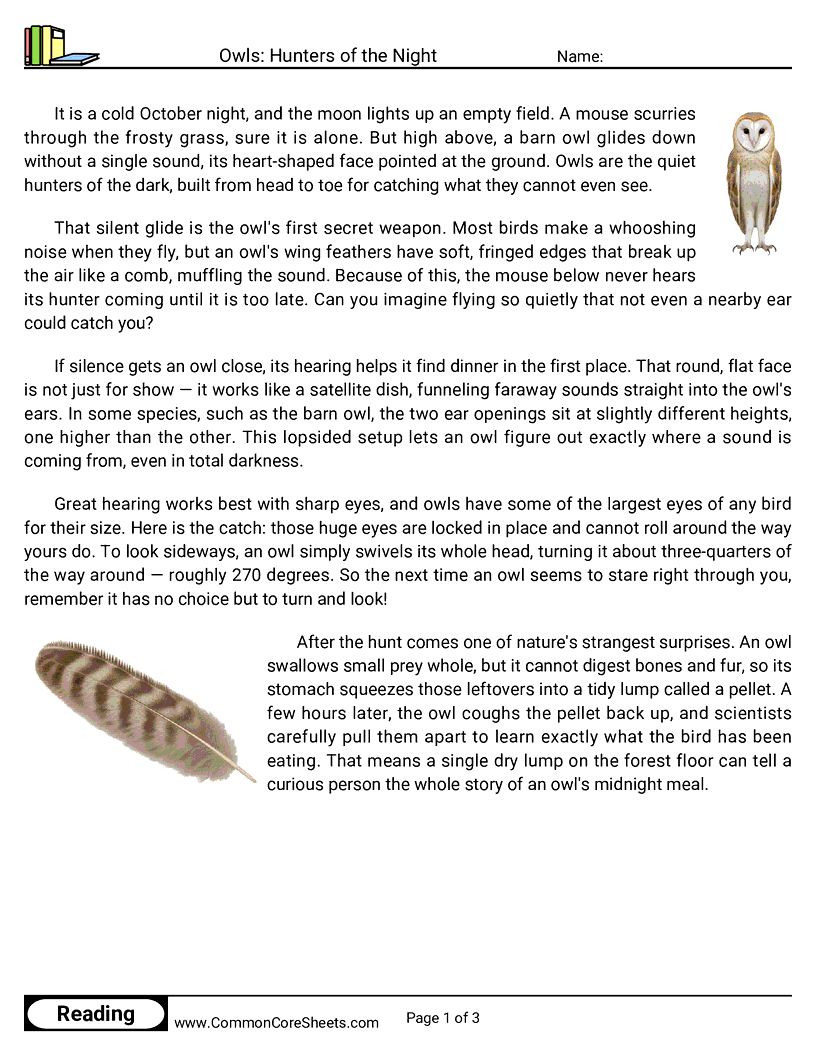
It is a cold October night, and the moon lights up an empty field. A mouse scurries through the frosty grass, sure it is alone. But high above, a barn owl glides down without a single sound, its heart-shaped face pointed at the ground. Owls are the quiet hunters of the dark, built from head to toe for catching what they cannot even see.
That silent glide is the owl's first secret weapon. Most birds make a whooshing noise when they fly, but an owl's wing feathers have soft, fringed edges that break up the air like a comb, muffling the sound. Because of this, the mouse below never hears its hunter coming until it is too late. Can you imagine flying so quietly that not even a nearby ear could catch you?
If silence gets an owl close, its hearing helps it find dinner in the first place. That round, flat face is not just for show — it works like a satellite dish, funneling faraway sounds straight into the owl's ears. In some species, such as the barn owl, the two ear openings sit at slightly different heights, one higher than the other. This lopsided setup lets an owl figure out exactly where a sound is coming from, even in total darkness.
Great hearing works best with sharp eyes, and owls have some of the largest eyes of any bird for their size. Here is the catch: those huge eyes are locked in place and cannot roll around the way yours do. To look sideways, an owl simply swivels its whole head, turning it about three-quarters of the way around — roughly 270 degrees. So the next time an owl seems to stare right through you, remember it has no choice but to turn and look!
After the hunt comes one of nature's strangest surprises. An owl swallows small prey whole, but it cannot digest bones and fur, so its stomach squeezes those leftovers into a tidy lump called a pellet. A few hours later, the owl coughs the pellet back up, and scientists carefully pull them apart to learn exactly what the bird has been eating. That means a single dry lump on the forest floor can tell a curious person the whole story of an owl's midnight meal.
Picture a mouse creeping across a frosty autumn field at midnight, sure it is alone. Then, without a single sound, a shadow drops from the sky and the mouse never hears it coming. That shadow is an owl, and its total silence is not luck or magic at all. It is the result of some of the cleverest body engineering in the animal world.
The secret to that silence begins with the owl's feathers, which are built unlike any other bird's. The front edge of each wing feather has tiny comb-like teeth, and the back edge is soft and fringed, so the air slides through instead of slapping against it. This breaks up the whooshing sound that most birds make when they flap, muffling their flight like a pillow muffles a sound. Because prey cannot hear the attack, the owl can listen carefully the whole time it is closing in.
That listening is the owl's real superpower, and its face is shaped to make it work. The flat, round face you see is actually a pair of dish-shaped feather disks that funnel sound toward the ears, the way a cupped hand funnels sound toward yours. Stranger still, some owls, like the barn owl, have lopsided ears, with one set slightly higher than the other. That tiny difference lets the bird tell whether a sound is above or below it, so it can pinpoint a mouse even in total darkness.
Sharp ears would not be enough without sharp eyes, and here the owl faces a strange problem. Its huge eyes are packed with light-gathering cells that work in dim light, but the eyes are shaped like tubes and cannot roll around in their sockets at all. To make up for it, an owl can swivel its head around about 270 degrees, roughly three-quarters of a full circle, to look behind itself. So the next time an owl seems to be staring straight through you, remember it simply cannot glance sideways the way you can.
After all that hunting, owls leave behind a clue that scientists love to study. An owl swallows small prey whole, and the parts it cannot digest, like bones and fur, get squeezed into a tidy lump called a pellet, which the bird coughs back up. People once told stories about owls as spooky messengers of the night, which is why they show up on so many Halloween decorations. But a scientist pulling apart a gray pellet sees something better than a ghost story: a complete record of exactly what that silent hunter ate.
You've probably seen owls perched in autumn stories, gazing out from spooky book covers as if they know something you don't. People once believed a hooting owl was a warning, a sign that trouble was on its way. But strip away the legends and you'll find something far stranger than any ghost story: a bird built like a piece of flying machinery. Its round face, huge eyes, and eerie silence aren't magic at all. They're the results of millions of years of quiet, deadly engineering.
That silence is the first trick worth understanding. Most birds swoosh through the air, but an owl can glide past your head without you hearing a thing. The secret hides in its feathers, which have soft, comb-like edges that break up the rushing air into tiny currents instead of one loud whoosh. Imagine sneakers that muffle your footsteps so completely you could cross a creaky floor unheard. Thanks to those hushed wings, a mouse in the grass never knows what's coming until it's far too late.
Silence would be useless, though, if an owl couldn't find the mouse in the first place. This is where that flat, dish-shaped face becomes a tool rather than just a cute feature. The curved feathers act like a satellite dish, funneling faint sounds straight toward the owl's ears. Even more surprising, some species like the barn owl have lopsided ears, with one set slightly higher than the other. That crooked design lets the bird pinpoint a sound in total darkness, judging both how far away it is and exactly how high or low.
Their ears may be uneven, but it's their eyes that really break the rules. An owl's eyes are so enormous that they can't roll around in their sockets the way yours do. To look sideways, the bird must swivel its whole head, and it can rotate roughly 270 degrees, about three-quarters of a full circle. Picture trying to see behind you without moving your shoulders, just spinning your head like a doorknob. Those giant eyes also gather so much light that an owl can spot prey on a night when you'd be stumbling around blind.
So what happens after the hunt ends? Here's the part that fascinates scientists and grosses out everyone else. Owls swallow their prey whole, and since they can't digest bones and fur, they cough it all back up in a tidy lump called a pellet. Researchers pull these pellets apart to learn exactly what an owl has been eating, like reading a diary written in tiny skeletons. That's why owls still matter far beyond Halloween decorations: they keep rodent populations in check and give scientists a window into whole ecosystems. Not bad for a bird that people once mistook for a feathered fortune-teller.
Imagine a predator that can drop out of the dark and snatch a mouse before it hears a single flap of wings. That is an owl, one of nature's quietest killers, and it does its best work when most animals are asleep. With a flat, round face and eyes that seem to stare straight into you, an owl looks a little spooky, which is exactly why it turns up in so many autumn stories. But the real bird is far stranger than any legend, and every part of its body is a tool built for the hunt.
Those creepy nighttime stories start with a sound, or rather, the lack of one. Most birds whoosh when they fly, but an owl glides in near silence because the front edges of its wing feathers are broken into soft, comb-like teeth. These fringes chop the rushing air into tiny swirls instead of one loud rush, and a velvety coating on the feathers muffles the noise even more. The result is a hunter that can hear its prey while the prey cannot hear the hunter, an advantage few animals get.
Silence would be useless, though, if the owl could not find dinner in the first place. That is where the face comes in: those wide, dish-shaped feathers around the eyes act like a satellite dish, funneling faint sounds toward the ears on either side of the head. Even weirder, in some species such as the barn owl, one ear sits higher than the other. Because the sounds reach the lopsided ears at slightly different moments, the owl's brain can pinpoint a rustling mouse in total darkness, judging both its direction and its height.
If the ears are doing the searching, the eyes handle the aiming, and they come with a strange rule. An owl's eyes are so huge and tube-shaped that they are locked in their sockets and cannot roll around the way yours do. To make up for it, the bird swivels its whole head, turning it about 270 degrees, roughly three-quarters of the way around, without hurting itself. Extra bones in the neck and a clever blood-vessel layout let it spin that far and still keep blood flowing to the brain.
All that hunting leaves a messy problem: what happens to the parts of a mouse an owl cannot digest? Instead of passing bones and fur through its body, the owl coughs them back up as a tightly packed lump called a pellet. Scientists and students love these gray, fuzzy pellets, because pulling one apart is like opening a tiny time capsule of everything the bird recently ate. Careful pickers have found whole rodent skulls, beetle shells, and even the bones of small birds inside a single pellet.
Given all these tricks, it is no wonder people once wove owls into their tales. In ancient Greece the owl was linked to Athena, goddess of wisdom, which is why we still call a thoughtful person "wise as an owl." Elsewhere, people told stories that a hooting owl carried messages or warnings, simply because it appeared at night when imaginations run wildest. The bird itself was never plotting anything, of course; it was just using silent wings, a sound-catching face, and eyes that never blink away from a hunt.
Picture a barn owl gliding across a moonlit field at midnight, and here is the strangest part: you would not hear a thing. A pigeon flapping past your window sounds like a beating rug, yet an owl the size of that pigeon slips through the dark in near-perfect silence. That silence is not luck or magic, even though people once believed owls carried messages from the world of the dead. In truth, the owl is a hunting machine assembled from clever solutions to one hard problem: how do you catch a mouse that can hear you coming? Answer that question, and you understand why owls have haunted autumn stories for centuries.
The first solution is written into every feather on an owl's wing. Most birds have stiff, smooth feather edges that slice the air and produce that familiar whooshing sound, but an owl's leading feathers are fringed with tiny comb-like teeth. These serrations break up the rushing air into smaller, quieter swirls, and a velvety surface on the wing muffles whatever noise is left. Engineers have taken notes: designers of quieter airplane wings and wind turbines have studied these fringes to soften the roar of moving air. Silence, though, only matters if you can pinpoint exactly where your prey is hiding, which is the owl's next trick.
That pinpointing begins with the owl's face, which is not merely spooky but functional. The flat, dish-shaped disc of stiff feathers around an owl's eyes works like a satellite dish, funneling faint sounds toward the ears on either side of the head. Some species take this further with a feature that sounds almost impossible: lopsided ears. In a barn owl, one ear opening sits slightly higher than the other, so a sound reaches each ear at a fractionally different moment and angle. The owl's brain compares those tiny differences and builds a three-dimensional map of where a mouse is rustling, even under snow or fallen leaves.
Ears that precise would be wasted without eyes to match, and here the owl made a surprising trade. Its eyes are enormous, packed with light-gathering cells that let it see in conditions we would call pitch dark, but those eyes are so large they cannot roll or swivel in their sockets. To look around, an owl must move its whole head, which is why it can rotate its neck roughly 270 degrees, about three-quarters of a full circle. Extra bones in the neck and a special arrangement of blood vessels keep the brain supplied even when the head is cranked far to the side. So the owl trades one ability for another: it gives up moving eyes in exchange for eyes powerful enough to hunt by starlight.
All this equipment leads to a meal, and the meal leaves behind one of nature's oddest calling cards. An owl usually swallows small prey whole, bones, fur, and all, but its stomach cannot digest the tough bits. Instead, it packs the leftovers into a tidy bundle called a pellet and coughs it back up, often hours later from a favorite roost. Scientists prize these pellets because tweezing one apart reveals a complete menu of tiny skulls and bones, revealing which animals live in an area without anyone ever seeing them. A single pellet can hold the remains of several rodents, making it a small, dry time capsule of a night's hunting.
Given all these talents, it is easy to see why cultures across the world attached meaning to the bird beyond the barnyard. The ancient Greeks connected the owl with Athena, goddess of wisdom, which is why we still call a smart person wise as an owl. Elsewhere and in later centuries, people told stories that an owl's night cry warned of misfortune, and the bird slipped into the shadowy imagery of autumn and Halloween. The reality is quieter and more remarkable than any legend: the owl is not an omen but an engineer, solving in feathers and bone the problem of hunting in the dark. The next time one glides overhead without a sound, remember that the eeriest thing about it is how precisely everything works.
About this worksheet
Students read a nonfiction passage about owls, written at 9 reading levels (kindergarten to 8th grade), and answer multiple-choice questions about it.
A reading comprehension worksheet about owls with a different article for each reading level, kindergarten to 8th grade, each with its own multiple-choice questions aligned to the Common Core Reading: Informational Text standards. Printable with an answer key, and available as an online assignment at any level.
Student objectives
- Read a nonfiction passage about how owls hunt at night.
- Explain how silent flight, hearing, and eyesight help an owl catch prey.
- Find details in the text that describe what an owl pellet is and why scientists study it.
- Describe how a cause-and-effect paragraph is organized.
Everyday practice
- Watch and listen for birds outside and notice which ones make noise when they fly.
- Turn your head as far as you can and compare it to an owl's 270-degree turn.
- Look up a photo of a barn owl's heart-shaped face and think about how it funnels sound.