Mummies of Ancient Egypt Worksheet Download
Free reading comprehension worksheet about the mummies of ancient Egypt. Pick the reading level (2nd grade to 8th grade), print the passage with its questions, or assign it online.


Sheet Information >
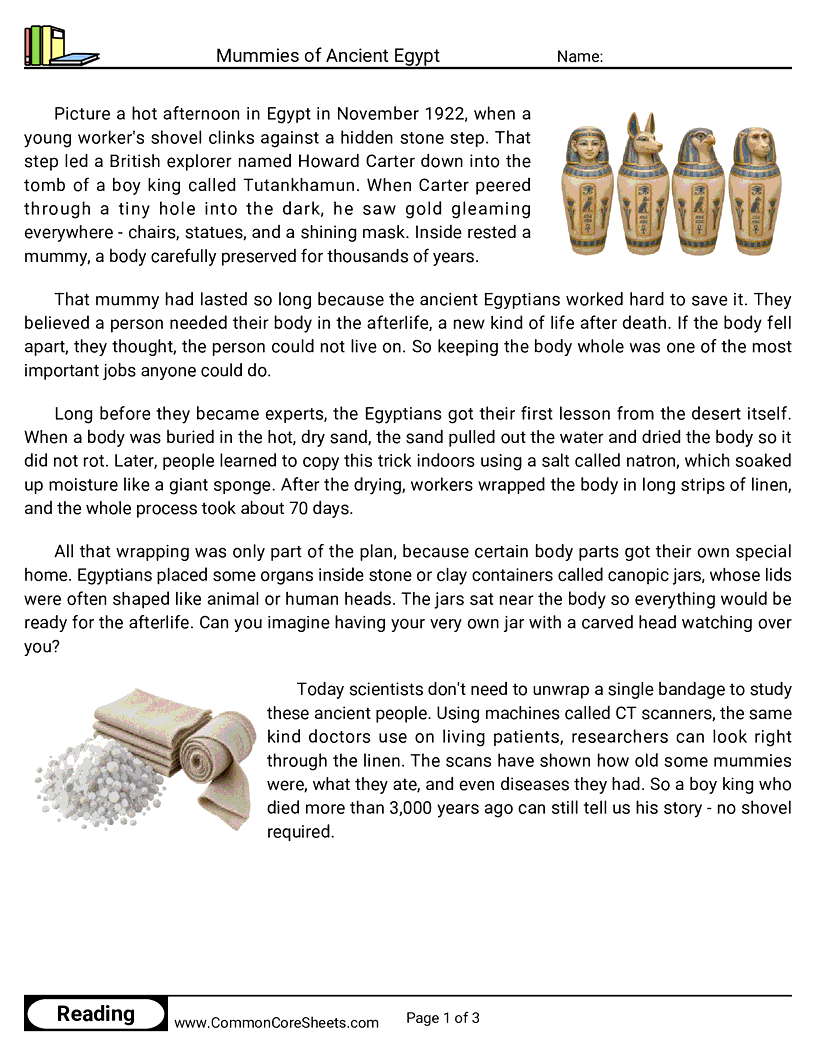
Available at 2nd grade, 3rd grade, 4th grade, 5th grade, 6th grade, 7th grade and 8th grade reading levels.
Read the passage
Did you know that some Egyptian mummies are older than the pyramids you see in pictures? A mummy is a body that was kept safe from rotting away, often wrapped in long strips of cloth. Egyptians made mummies because they believed the person would need their body in the next life.
To get ready for that next life, the wrappers had to dry the body first. Long ago, hot desert sand dried bodies all by itself, but later Egyptians used a special salt called natron to dry them out. Then they wrapped the body in soft linen cloth, again and again, and the whole job took about 70 days!
All that wrapping was only part of the work, because certain body parts were saved too. Egyptians put them in pretty containers called canopic jars, each with a carved lid shaped like an animal or a person. The lids kept watch, like little guards standing over the jars.
Those guarded jars sat quietly in tombs for thousands of years, waiting to be found. In 1922, a man named Howard Carter opened the tomb of a young king named Tutankhamun and found treasures of gold inside! Today scientists use special X-ray machines called CT scanners to peek inside a mummy without ever unwrapping it.
Imagine you are walking through a hot Egyptian desert thousands of years ago. In front of you is a huge stone building called a tomb, and inside rests a mummy wrapped in white cloth. A mummy is a body that has been kept from rotting away, sometimes for thousands of years! The ancient Egyptians made mummies on purpose, and today we still find them under the sand.
Why would anyone want to keep a body for so long? The Egyptians believed that after a person died, they went on to a new life, and they thought the body was needed for that journey. So keeping the body safe was very important to them. Long ago, people noticed that the hot, dry desert sand naturally dried out bodies and kept them from falling apart.
Because the desert did such a good job, Egyptians learned to dry bodies themselves in a careful way. First, they used a special salt called natron to pull all the water out, which took about 40 days. Then they wrapped the body in long strips of linen cloth, layer after layer, and the whole process took around 70 days. They even placed certain organs inside special containers called canopic jars to keep them safe.
Wrapped and hidden away, some mummies waited a very long time to be found. In 1922, a man named Howard Carter opened the tomb of a young king named Tutankhamun, and it was filled with gold treasures. Today, scientists use machines called CT scanners to peek inside a mummy without unwrapping it. With these pictures, they can learn how old a person was and even what food they ate, all without touching the bandages!
Picture a hot afternoon in Egypt in November 1922, when a young worker's shovel clinks against a hidden stone step. That step led a British explorer named Howard Carter down into the tomb of a boy king called Tutankhamun. When Carter peered through a tiny hole into the dark, he saw gold gleaming everywhere - chairs, statues, and a shining mask. Inside rested a mummy, a body carefully preserved for thousands of years.
That mummy had lasted so long because the ancient Egyptians worked hard to save it. They believed a person needed their body in the afterlife, a new kind of life after death. If the body fell apart, they thought, the person could not live on. So keeping the body whole was one of the most important jobs anyone could do.
Long before they became experts, the Egyptians got their first lesson from the desert itself. When a body was buried in the hot, dry sand, the sand pulled out the water and dried the body so it did not rot. Later, people learned to copy this trick indoors using a salt called natron, which soaked up moisture like a giant sponge. After the drying, workers wrapped the body in long strips of linen, and the whole process took about 70 days.
All that wrapping was only part of the plan, because certain body parts got their own special home. Egyptians placed some organs inside stone or clay containers called canopic jars, whose lids were often shaped like animal or human heads. The jars sat near the body so everything would be ready for the afterlife. Can you imagine having your very own jar with a carved head watching over you?
Today scientists don't need to unwrap a single bandage to study these ancient people. Using machines called CT scanners, the same kind doctors use on living patients, researchers can look right through the linen. The scans have shown how old some mummies were, what they ate, and even diseases they had. So a boy king who died more than 3,000 years ago can still tell us his story - no shovel required.
Imagine finding a wooden box, older than the pyramids you've seen in pictures, and inside it a person wrapped in layer after layer of yellowed cloth. That is a mummy, and it has been waiting for thousands of years to tell its story. A mummy is a body that was carefully dried and wrapped so it would not rot away over time. The ancient Egyptians made them on purpose, and they have puzzled and delighted people ever since.
Why would anyone go to so much trouble for the dead? The Egyptians believed that a person needed their body to live on in the afterlife, a kind of second life beyond this one. If the body fell apart, they feared the person's spirit would have no home to return to. So keeping the body whole was not spooky to them at all, it was a way of caring for someone they loved.
That care began, oddly enough, with nothing but sand and sun. The earliest Egyptians buried people in the hot desert, and the dry sand naturally soaked up moisture and preserved the bodies almost by accident. Later, embalmers learned to do the work themselves using a special salt called natron, which dried the body over about 40 days before it was wrapped in linen bandages. From start to finish, making one mummy could take around 70 days, longer than a whole summer vacation!
All that wrapping was not the only clever part of the process. Embalmers placed certain organs into special containers called canopic jars, whose lids were often shaped like the heads of gods or animals. These jars were tucked into the tomb beside the mummy so the person would have everything they needed later on. Can you picture a row of little painted jars, each with a jackal or falcon face, standing guard in the dark?
The most famous tomb of all stayed hidden in that dark for over three thousand years. In 1922, an English archaeologist named Howard Carter found the tomb of a young king named Tutankhamun, still filled with golden treasures. Today scientists don't even need to unwrap a mummy to study it, because CT scans let them peer inside with X-ray pictures. From those scans they have learned what ancient people ate, how old they were, and even the illnesses they lived with, secrets the mummies have kept for ages.
You've probably pictured a mummy shuffling around in torn bandages, arms out, moaning through the dark. Forget that movie version for a minute, because the real story is stranger and far more clever. A mummy is simply a body that was preserved on purpose, wrapped in linen and meant to last for thousands of years. The ancient Egyptians weren't trying to make monsters at all. They were trying to build a bridge to forever.
That bridge to forever started with a belief that shaped everything. Egyptians thought a person needed their body to live on in the afterlife, so the body had to be saved from rotting away. Long before they invented any tricks, the burning desert did the job for them, drying out bodies buried in the hot sand. Can you imagine noticing that the sand kept people looking almost the same for ages? That surprising discovery gave embalmers the idea to copy nature on purpose.
Copying the desert turned into a careful, roughly 70-day process performed by skilled workers. First they packed the body in natron, a natural salt that pulls out moisture the way rice soaks up water in a shaker. After the drying, they wrapped it in layer upon layer of linen strips, sometimes tucking small charms between the folds for protection. The lungs, stomach, and other organs were stored separately in special containers called canopic jars, each topped with the head of a protective god. Only then was the wrapped body placed inside its coffin, ready for the journey it was built to survive.
A journey built to survive is exactly what one boy king got, and the world barely noticed him for over 3,000 years. In 1922, an English archaeologist named Howard Carter dug through a hidden stairway in Egypt's Valley of the Kings and found the nearly untouched tomb of Tutankhamun. Peering in by candlelight, Carter reportedly saw "wonderful things" glinting gold in the dark. Because grave robbers had emptied most royal tombs long before, an intact one like this was the find of a lifetime. King Tut had been just a teenager when he died, yet his golden mask made him the most famous pharaoh of all.
That famous mask hides a body that scientists are still questioning today. Instead of unwrapping mummies and destroying them, researchers now slide them into CT scanners, the same machines that photograph the inside of your body at a hospital. These scans can reveal a person's age, old injuries, and even what they ate, all without disturbing a single bandage. Studying King Tut this way, experts have argued for years about how the young pharaoh actually died. So a boy who ruled Egypt more than three thousand years ago is still teaching us things, one careful scan at a time.
Picture a body wrapped so carefully that it survives for more than three thousand years, longer than any building on your street will ever stand. That is a mummy, and ancient Egypt made thousands of them. A well-preserved Egyptian mummy is a human body dried and bound in narrow strips of linen, sometimes with a painted mask laid over the face. To the people who made them, these were not spooky objects at all; they were passports to a life after death.
That belief in a life after death is exactly why anyone went to so much trouble. The Egyptians thought a person needed their body to survive in the next world, so letting it rot was unthinkable. Long before priests got involved, the desert did the work for free: bodies buried in hot, dry sand simply dried out and lasted. When Egyptians began using tombs to honor important people, those tombs were cooler and damper, and bodies decayed, so a problem was born that only skill could solve.
Solving that problem turned drying into a craft that took about seventy days. Embalmers packed the body in natron, a natural salt found near desert lakes, which pulled out moisture the way rice pulls water from a wet phone. After roughly forty days of drying, workers wrapped the body in layer upon layer of linen, sometimes tucking small charms between the folds. Reasons backed every step: the salt stopped decay, and the wrappings held everything in shape for the journey ahead.
Those careful workers also had a clever answer for the organs they removed. Certain organs were stored in four special containers called canopic jars, because Egyptians believed a person would want them back in the afterlife. The stoppers on the jars were often carved as heads, each one a guardian meant to protect what was inside. Can you imagine keeping something so ordinary as an organ under the watch of a stone falcon or jackal? To the Egyptians, it made perfect sense.
Guardians and treasures like those made one 1922 discovery the talk of the world. That year, the British archaeologist Howard Carter found the tomb of the young king Tutankhamun, nearly untouched after more than three thousand years. Inside lay a dazzling gold mask and rooms crammed with objects, a rare peek at a royal burial that robbers had missed. Newspapers spun tales of a deadly "mummy's curse," but that was a story sold to readers, not a fact found in the tomb.
Today scientists chase real answers instead of curses, and they do it without unwrapping a thing. Using CT scanners, the same machines that image patients in hospitals, researchers can look inside a mummy and study bones, teeth, and even old injuries. From these scans they have learned how people ate, what illnesses they suffered, and roughly how old they were when they died. So the next time someone calls a mummy scary, remember it is really a three-thousand-year-old message, patiently waiting for us to learn how to read it.
In November 1922, a British archaeologist named Howard Carter crouched in a dark Egyptian tunnel and chiseled a small hole into a sealed doorway. When he held a candle to the opening, the warm air flickered and gold seemed to glow back at him from the darkness. His companion asked whether he could see anything, and Carter reportedly answered, "Yes, wonderful things." Beyond that wall lay the nearly untouched tomb of a boy king named Tutankhamun, dead for more than 3,000 years. At the center of it all rested a mummy, and mummies are among the most carefully engineered objects the ancient world ever produced.
A mummy is a body that has been deliberately preserved instead of allowed to decay, and the Egyptians did not invent the idea so much as improve on an accident. In the earliest days, bodies buried in shallow desert graves dried out naturally, because the hot sand pulled the moisture away before decay could begin. When Egyptians later built fancier tombs to protect their dead, they discovered a strange problem: sealed away from the drying sand, the bodies rotted. This contrast between the simple grave that preserved and the grand tomb that destroyed pushed embalmers to recreate the desert's drying power by hand. In other words, technology was invented to solve a problem that fancier technology had caused.
Solving that problem meant borrowing the desert's most powerful tool, which was salt. Embalmers packed and covered the body in natron, a natural salt found in dry lake beds, and left it to dry for about 40 days until every trace of moisture was gone. They then wrapped it in many layers of linen bandages, sometimes tucking small charms between the folds, in a process that took around 70 days from start to finish. Certain organs were removed and stored separately in four containers called canopic jars, each guarded by a different protective figure. The whole procedure was less a religious ceremony than a demanding craft, one that combined chemistry, anatomy, and patience.
All of that patience was aimed at a single destination the Egyptians believed in completely: the afterlife. They held that a person needed a recognizable body in order to live again beyond death, so preserving the body was not decoration but survival itself. This belief explains a puzzle that might otherwise seem strange, which is why so much wealth and effort went into the dead rather than the living. To an ancient Egyptian, the tomb was not an ending but a doorway, and the mummy was the traveler who had to arrive intact. Understanding that goal turns the whole strange craft into something logical.
Logic, however, has not stopped mummies from collecting legends the way old houses collect dust. After Tutankhamun's tomb was opened, newspapers spread a story that a "curse" struck down those who disturbed it, pointing to the death of one wealthy sponsor as proof. Historians and scientists have long treated this as folklore rather than fact, noting that most people present at the opening lived long, ordinary lives afterward. The tale survived anyway, because a curse makes a better headline than a careful study of who happened to get sick. Here the evidence and the entertainment simply parted ways, and entertainment usually shouts louder.
Real science, it turns out, is stranger than any curse story. Today researchers slide mummies into CT scanners, the same machines that photograph living patients, and build detailed images without unwrapping a single bandage. These scans have revealed old injuries, clues about diet, and even hints about illnesses that troubled people thousands of years ago. In this way the Egyptians got a version of the immortality they wanted, just not the kind they expected. A body preserved to walk into an afterlife is instead teaching strangers, across more than three millennia, exactly how its owner once lived.
About this worksheet
Students read a nonfiction passage about the mummies of ancient Egypt, written at 7 reading levels (2nd grade to 8th grade), and answer multiple-choice questions about it.
A reading comprehension worksheet about the mummies of ancient Egypt with a different article for each reading level, 2nd grade to 8th grade, each with its own multiple-choice questions aligned to the Common Core Reading: Informational Text standards. Printable with an answer key, and available as an online assignment at any level.
Student objectives
- Read a nonfiction passage about how the ancient Egyptians made mummies
- Explain why the Egyptians preserved bodies and how the desert first helped them
- Find details about canopic jars, natron, and how long the process took
- Explain how scientists study mummies today using CT scanners
Everyday practice
- Notice how salt keeps foods like beef jerky or crackers dry and fresh at home
- Look for pictures of Tutankhamun's golden mask in a library book or museum website
- Watch how a doctor's X-ray or scan lets people see inside without opening anything