Mayflies Worksheet Download
Free reading worksheets on Mayflies. Each worksheet has 20 problems with an answer key and are ideal for teachers and homeschooling. You can download the PDF, create a set of flash cards or set it up for online learning.


Sheet Information >
Available at 2nd grade, 3rd grade, 4th grade, 5th grade and 6th grade reading levels.
Read the passage
Mayflies are fascinating little insects that can be found all around the world. These small creatures have delicate wings and can often be seen near rivers and lakes. Did you know that there are over 3,000 different species of mayflies?
Let's learn about the life cycle of a mayfly. They start out as tiny eggs that hatch into nymphs, and these nymphs live underwater for about a year, munching on plants and tiny animals. When they're ready, they rise to the surface and transform into adult mayflies, which only live for a few days to find a mate and lay eggs.
Mayflies have some interesting relationships with other creatures. For example, they play an important role in the food chain, as their nymphs are a tasty meal for fish and other aquatic animals, while adult mayflies are food for birds and bats. Humans find mayflies to be helpful for fishing, as their presence indicates clean water, and their imitation can be used as bait in fly-fishing.
In this multidimensional PHP array, each paragraph is introduced with a topic sentence, followed by additional information and a concluding sentence. The array is structured to be easily accessed and modified as needed.
Say hello to the mayflies, unique little insects that can be found all around the world! These fascinating creatures are known for their short lives and can often be seen flying around in swarms. Mayflies live in clean, freshwater areas like rivers, ponds, and lakes, where they can find their favorite food: algae and other tiny plants. These insects come in many different colors, such as green, brown, and even yellow, and have two pairs of wings that make them great at flying.
Now let's take a look at the life cycle of a mayfly. They start as eggs that are laid in the water, which then hatch into small creatures called nymphs. Nymphs live underwater, eating and growing until they're ready to emerge as adults, which takes about one year. Once they become adults, they live for a very short time, usually just a day or two, to mate and lay eggs before they pass away.
How do mayflies interact with humans and other insects? Well, they don't harm humans or bite, but they can be a nuisance when there are lots of them around. Other insects, like dragonflies and birds, love to eat mayflies, so they play an important role in the food chain. Mayflies don't have strong defenses, so they rely on their large numbers to survive and reproduce. One interesting fact about mayflies is that they are one of the oldest living species of insects, with fossils dating back over 300 million years!
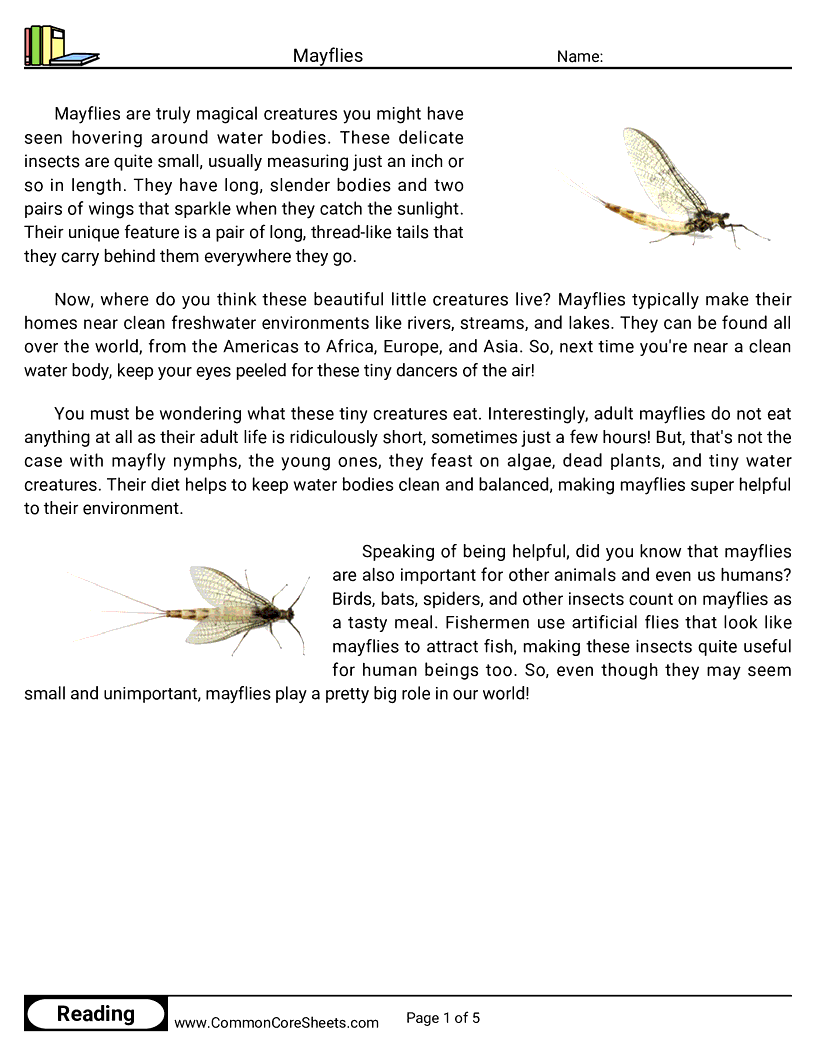
Mayflies are truly magical creatures you might have seen hovering around water bodies. These delicate insects are quite small, usually measuring just an inch or so in length. They have long, slender bodies and two pairs of wings that sparkle when they catch the sunlight. Their unique feature is a pair of long, thread-like tails that they carry behind them everywhere they go.
Now, where do you think these beautiful little creatures live? Mayflies typically make their homes near clean freshwater environments like rivers, streams, and lakes. They can be found all over the world, from the Americas to Africa, Europe, and Asia. So, next time you're near a clean water body, keep your eyes peeled for these tiny dancers of the air!
You must be wondering what these tiny creatures eat. Interestingly, adult mayflies do not eat anything at all as their adult life is ridiculously short, sometimes just a few hours! But, that's not the case with mayfly nymphs, the young ones, they feast on algae, dead plants, and tiny water creatures. Their diet helps to keep water bodies clean and balanced, making mayflies super helpful to their environment.
Speaking of being helpful, did you know that mayflies are also important for other animals and even us humans? Birds, bats, spiders, and other insects count on mayflies as a tasty meal. Fishermen use artificial flies that look like mayflies to attract fish, making these insects quite useful for human beings too. So, even though they may seem small and unimportant, mayflies play a pretty big role in our world!
Mayflies are fascinating little insects that have a lot to offer. They come in various sizes and colors, but most of them are small and have two pairs of wings that help them fly around. Mayflies can be found all over the world, especially near lakes, rivers, and streams. They are an important part of the ecosystem and have a unique life cycle.
An interesting aspect of mayflies is their short and eventful life cycle. Mayflies start as eggs that are laid in the water, and within a few weeks, they hatch into nymphs. The nymphs live underwater and molt several times before they become adult mayflies. Adult mayflies only live for a few days, just long enough to mate and lay eggs.
Mayflies have a unique diet during their various life stages. As nymphs, they feed on algae, plants, and other small organisms in the water. Once they reach adulthood, they do not eat at all! This is because their main purpose is to reproduce, so they focus all their energy on finding a mate. Their short life span means they need to be efficient in completing their life's purpose.
These little insects have a special relationship with humans and other insects. Fishermen often use mayflies as bait because they are a favorite food for many fish. Mayflies also play a vital role in the food chain, as they are a source of food for other insects, birds, and amphibians. Their presence in a body of water can be an indicator of good water quality, which is helpful to both humans and the environment.
Lastly, mayflies have some unique features that set them apart from other insect species. For instance, they have large, compound eyes that help them see better in low light conditions. Additionally, they are known for their synchronized mating swarms, where thousands of mayflies gather together to mate, creating an impressive sight. These fascinating insects are a testament to the beauty and diversity of nature.
Have you ever heard of mayflies? These fascinating little insects are an important part of our ecosystems and have some interesting features that set them apart from other bugs. Mayflies belong to the order Ephemeroptera and are found all over the world, with over 3,000 different species! They are delicate creatures, with two pairs of wings and two or three long, thread-like tails called cerci. You'll often find them near water, as they lay their eggs in lakes, rivers, and streams. Let's dive into the world of mayflies and learn more about these fascinating insects.
Mayflies have a unique life cycle that is quite different from other insects. They undergo an incomplete metamorphosis, which means they don't go through the usual stages of egg, larva, pupa, and adult like other insects do. Instead, they hatch from their eggs as nymphs, and live underwater for months or even years, depending on the species. When they are ready, they emerge from the water, molt into a subimago stage, and then molt again to become a full-fledged adult. Unfortunately, adult mayflies don't live very long – often only a day or two – which is why they are called ‘ephemeral’ or short-lived insects.
Let's talk about what mayflies eat and their relationships with other animals. Mayfly nymphs are herbivores, feeding on algae and other plant material in the water. As adults, they don't eat at all! Their main purpose is to reproduce, so they don't have functional mouthparts or digestive systems. Many animals, such as fish, birds, and other insects, enjoy feasting on mayflies, making them an important food source in their ecosystems. In fact, some anglers even use mayfly patterns on their fishing lures to attract fish!
Mayflies have some interesting ways of protecting themselves from predators. When they are nymphs, they can release a cloud of ink-like substance to confuse and deter predators. As adults, their short lifespans can actually be considered a defense mechanism, as they don't have to worry about predators for very long! Additionally, their ability to fly quickly and erratically can help them avoid being caught by birds and other predators. Despite these defenses, mayflies still serve as a tasty snack for many animals.
Finally, let's compare mayflies to other insects and share some fun facts. One unique feature of mayflies is their two life stages as winged insects, with the subimago stage being a rare trait among insects. Another interesting fact is that some species of mayflies have synchronized mass emergences, where thousands or even millions of mayflies emerge from the water at the same time. This phenomenon can create huge swarms that can even be seen on weather radar! So, while mayflies might not be the most well-known insects, they certainly are fascinating creatures with unique features and important roles in their ecosystems.
About this worksheet
Students read a passage about mayflies and answer comprehension questions about their life cycle, habitat, and characteristics.
This worksheet is designed to introduce children to the fascinating world of mayflies through 20 engaging reading problems. It delves into their lifespan, eating habits, physical features, and habitat, offering insights that can encourage critical thinking. The worksheet is highly versatile, allowing customization and conversion into flashcards for effective learning. Perfectly adapted for distance learning, it is an ideal resource to enhance children’s reading comprehension and knowledge about insects.
Student objectives
- Read a nonfiction passage and understand the main ideas
- Find specific facts about mayflies in the text
- Answer questions using details from what you read
- Learn new vocabulary related to insects and their life cycles
Everyday practice
- Read a nature guide and remember facts about insects you spot near a pond
- Explain to a friend what you learned about mayflies from a book
- Look up answers to your questions when reading about animals
- Pull key details out of an article for a school report