How Glow Sticks Glow Worksheet Download
Free reading comprehension worksheet about how glow sticks and glow-in-the-dark toys work. Pick the reading level (2nd grade to 8th grade), print the passage with its questions, or assign it online.


Sheet Information >
Available at 2nd grade, 3rd grade, 4th grade, 5th grade, 6th grade, 7th grade and 8th grade reading levels.
Read the passage
Snap! You bend a plastic tube and suddenly it glows in your hand, with no battery and no plug! A glow stick makes soft, cool light that you can wear as a bracelet on Halloween night. Even in a dark yard, the little tube shines like a tiny, colorful moon.
That glow starts when you snap the tube. Snapping breaks a thin glass tube hidden inside, and two special liquids mix together. When the liquids meet, they make light instead of heat, so the stick stays cool to touch.
Because the light comes from mixing, warmth can make your glow stick shine brighter. If you hold it in your warm hands, the liquids mix faster and the glow looks brighter. But if you leave it out in the cold, it grows dim and sleepy, like it needs a nap.
Not every glowing thing needs a snap, though. Glow-in-the-dark stars and paint soak up light first, then let it back out slowly in the dark. Reflective tape on your costume works too, bouncing car lights back so drivers can spot you and keep you safe!
Imagine you are trick-or-treating on a dark night, and you snap a small plastic tube. Suddenly it glows bright green in your hand, like a tiny lightning bug you can carry! This is a glow stick, and the light it makes is cool to the touch, not hot like a lightbulb. People wear them on their wrists or around their necks so friends can spot them in the dark.
That cool light hides a neat trick inside the tube. When you snap a glow stick, you break a thin piece of glass hidden in the middle. This lets two liquids mix together, and the mixing makes light without heat, which scientists call chemiluminescence. Because no fire or electricity is used, the light is safe to hold and will not burn you.
The mixing that makes light can go fast or slow, and temperature is the boss of it. When a glow stick is warm, the chemicals mix faster, so it glows brighter but runs out sooner. When it is cold, the mixing slows down, so the glow gets dim but lasts longer. This is why some people put a glow stick in the freezer to save it for another night!
Not every glow needs snapping, because some toys and stickers store light instead. Glow-in-the-dark paint soaks up light while it sits in a bright room, then slowly gives it back in the dark. Trick-or-treaters also wear reflective tape, which does not glow but bounces a car's headlights right back so drivers can see them. So the next time you glow, remember you are holding a little bit of science that shines without a spark of fire.
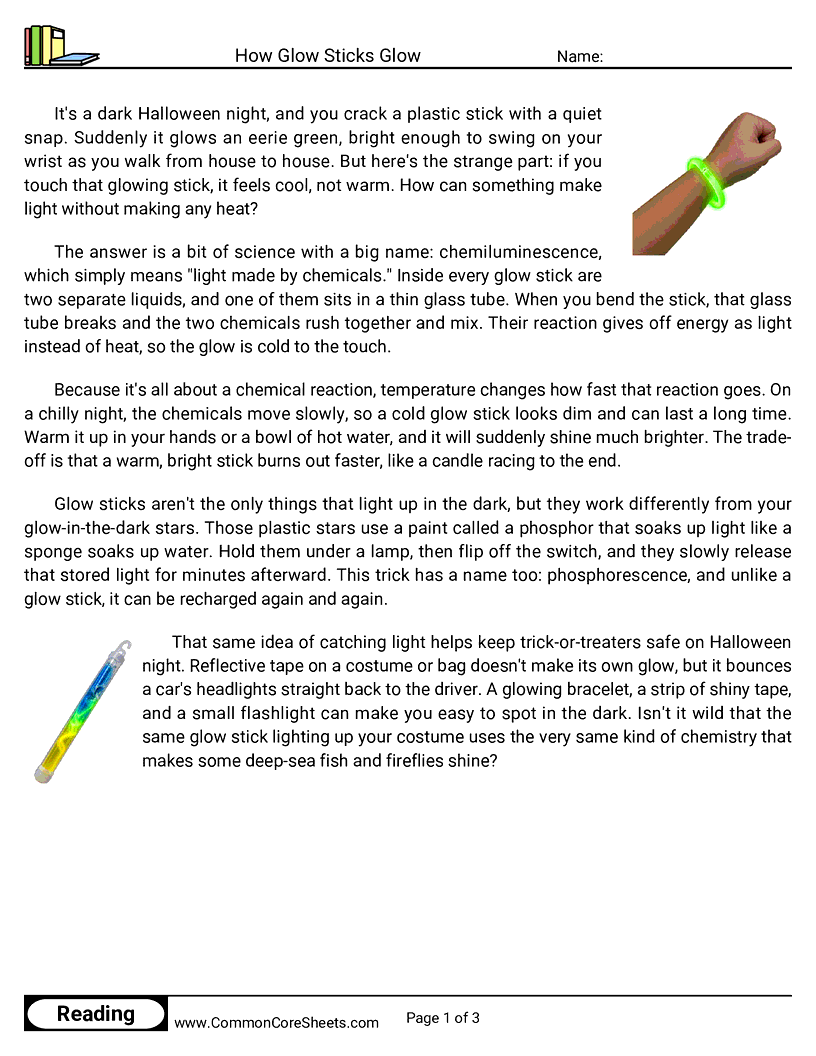
It's a dark Halloween night, and you crack a plastic stick with a quiet snap. Suddenly it glows an eerie green, bright enough to swing on your wrist as you walk from house to house. But here's the strange part: if you touch that glowing stick, it feels cool, not warm. How can something make light without making any heat?
The answer is a bit of science with a big name: chemiluminescence, which simply means "light made by chemicals." Inside every glow stick are two separate liquids, and one of them sits in a thin glass tube. When you bend the stick, that glass tube breaks and the two chemicals rush together and mix. Their reaction gives off energy as light instead of heat, so the glow is cold to the touch.
Because it's all about a chemical reaction, temperature changes how fast that reaction goes. On a chilly night, the chemicals move slowly, so a cold glow stick looks dim and can last a long time. Warm it up in your hands or a bowl of hot water, and it will suddenly shine much brighter. The trade-off is that a warm, bright stick burns out faster, like a candle racing to the end.
Glow sticks aren't the only things that light up in the dark, but they work differently from your glow-in-the-dark stars. Those plastic stars use a paint called a phosphor that soaks up light like a sponge soaks up water. Hold them under a lamp, then flip off the switch, and they slowly release that stored light for minutes afterward. This trick has a name too: phosphorescence, and unlike a glow stick, it can be recharged again and again.
That same idea of catching light helps keep trick-or-treaters safe on Halloween night. Reflective tape on a costume or bag doesn't make its own glow, but it bounces a car's headlights straight back to the driver. A glowing bracelet, a strip of shiny tape, and a small flashlight can make you easy to spot in the dark. Isn't it wild that the same glow stick lighting up your costume uses the very same kind of chemistry that makes some deep-sea fish and fireflies shine?
Picture yourself walking down a dark sidewalk on Halloween night, and suddenly a plastic tube in your hand starts to glow a bright, spooky green. There is no battery inside, no bulb, and no switch to flip. When you touch the glowing stick, it doesn't feel hot at all, even though it shines like a tiny neon sign. So how does a simple plastic tube make light out of thin air?
The secret starts the moment you snap that stick and hear a quiet crackle. Inside the plastic tube sits a thin, fragile glass tube, and each holds a different chemical. Bending the stick shatters the glass and lets the two chemicals mix, which sets off a reaction that releases energy as light. Scientists call this trick chemiluminescence, a long word that simply means "making light with chemistry."
Because that light comes from a chemical reaction instead of heat, a glow stick can shine while staying cool to the touch. This is why it is called "cold light," and it explains a puzzle many kids have noticed on chilly nights. Have you ever seen a glow stick go dim in the cold and shine brighter in warm hands? Heat speeds the reaction up while cold slows it down, so warming a stick makes it glow harder, and popping one in the freezer can save its glow for later.
Snapping chemicals is not the only way to make objects glow after dark. Glow-in-the-dark paint on stars, stickers, and toys works differently, soaking up light like a sponge soaks up water. The paint stores energy from a lamp or the sun, then slowly leaks it back out as a soft green shine, a process called phosphorescence. That is why you have to "charge" those plastic stars under a light before they will glow on your bedroom ceiling.
There is one more Halloween glow worth knowing, and it makes no light of its own at all. Reflective tape on costumes and trick-or-treat bags bounces a car's headlights straight back to the driver, helping keep walkers safe in the dark. Unlike a glow stick or a painted star, the tape only shines when light hits it and instantly disappears when the light moves away. So the next time your green glow stick lights up your candy, remember you are holding a chemistry experiment that lives right in your fist!
You've probably been told that making light means making heat, like a light bulb that burns your fingers or a campfire that glows orange. So how can a plastic tube in your hand shine bright green in the dark and stay perfectly cool? That trick is called chemiluminescence, which is just a fancy word for light made by a chemical reaction instead of by heat. A fresh glow stick looks like an ordinary tube of colored plastic, but inside it hides a tiny sealed glass vial floating in liquid. Snap it, shake it, and suddenly it beams like a captured firefly.
That snap you hear is the whole secret cracking open. Inside the tube are two separate chemicals, and the little glass vial keeps one of them apart from the other until you bend the plastic and shatter it. When the chemicals mix, their molecules trade energy and release it as glowing light rather than warmth. Real fireflies use almost the same idea, blinking their bodies on and off with a natural chemical reaction called bioluminescence. So when you wave a glow stick on Halloween, you're basically holding a battery-free flashlight powered by chemistry.
Because that glow comes from a reaction, its speed depends on temperature, and here's where things get surprising. Warm the tube in your hands or drop it in hot water, and the chemicals react faster, so it burns brighter but fades sooner. Chill it in the refrigerator, and the reaction slows to a crawl, making the light dim but stretching it out for hours. Some trick-or-treaters even tuck a used glow stick in the freezer overnight to save a little light for the next night. It won't glow forever, but the cold really does hit the pause button on the chemistry.
Not every glow needs a snap, though, and the stars stuck on some kids' ceilings prove it. Glow-in-the-dark paint and plastic use phosphorescence, meaning they soak up light like a sponge soaks up water and then leak it back out slowly in the dark. Hold one under a lamp for a few minutes, flip off the lights, and the stored energy escapes as a soft green shine. This is a completely different trick from a glow stick: no chemicals get used up, so the same star can charge and glow thousands of times. The catch is that it needs a fresh drink of light every time before it can perform.
All this cool glowing does more than decorate a costume, and that's why it still matters today. Reflective tape on a trick-or-treater's bag or sleeves bounces a car's headlights straight back at the driver, making a small kid easy to spot on a dark street. Doctors, deep-sea scientists, and search teams all rely on chemiluminescent light sticks because they need bright light with no spark, no battery, and no heat. Astronauts have even carried glow sticks into space as a safe emergency light source. The next time you crack one open and it hums to life in your palm, remember you're not lighting a fire, you're mixing one.
Crack, shake, glow! With one satisfying snap, a plain plastic tube bursts into color that can last for hours, and it does it all without a single spark of fire. Firefighters, deep-sea divers, and trick-or-treaters have all relied on this trick, because the light is completely cold to the touch. How can something shine so brightly yet stay cool enough to hold in your hand? The answer is a chemical reaction hiding inside that skinny plastic tube.
That cool glow comes from a process scientists call chemiluminescence, which simply means "light from chemistry." Inside every glow stick, a thin glass vial floats in a liquid, keeping two chemicals apart until you are ready. When you bend the stick, you shatter that glass and let the two liquids finally meet and react. The reaction releases energy, but instead of escaping as heat like a flame does, almost all of it leaves as visible light. A dye mixed into the liquid decides whether you see green, blue, pink, or orange.
Because it runs on chemistry rather than heat, this reaction obeys the same rules as chemistry class. Have you ever noticed that a glow stick fades fast in the summer but seems to last forever in the fridge? Warmth speeds the reaction up, so the stick burns brighter but wears out sooner, like a candle with a bigger flame. Cold slows the reaction down, dimming the glow while stretching it out over a much longer time. Some campers even freeze old glow sticks overnight to squeeze a little more light out of them the next day.
That fading race between brightness and time is one reason glow-in-the-dark toys work in a completely different way. Instead of mixing chemicals, they use a phosphorescent powder that soaks up light and stores it like a tiny battery. Hold a plastic star up to a lamp for a minute, then flick off the switch, and it keeps shining because it is slowly releasing the light it absorbed. Many of these toys contain a compound called strontium aluminate, which can glow for hours after just a short charge. Unlike a glow stick, a phosphorescent toy can be recharged again and again, as long as there is light to feed it.
Storing light is clever, but bouncing it back is what actually keeps trick-or-treaters safe on dark streets. Reflective tape and strips do not glow on their own at all; instead, they hurl a car's headlights straight back toward the driver's eyes. Tiny glass beads or angled mirrors inside the tape send the light back the way it came, so a costume seems to light up the instant a car approaches. Safety experts often suggest adding reflective strips or a glow stick to dark costumes for exactly this reason. A single strip of tape can make a walker visible from far enough away to give a driver time to slow down.
From reactions to reflections, all these tricks share one surprising goal: making light behave the way we want it to. A glow stick spends its energy in a single burst, a phosphorescent toy hoards light and doles it out slowly, and reflective tape simply refuses to keep any light at all. Firefly light works much like a glow stick's, using chemistry to shine without heat, which is why some people call the effect "living light." Scientists have even borrowed these ideas to design glowing markers for medicine and safety gear worn by road crews. So the next time you snap a glow stick on Halloween, remember you are holding a controlled chemical reaction cool enough to wear around your neck.
Picture yourself on a chilly October night, holding a plastic tube that isn't glowing at all. You bend it until you hear a tiny, satisfying *snap*, give it a shake, and suddenly it blazes with an eerie green light. No flame, no battery, no bulb - just a stick of soft light in your hand. This is chemiluminescence, which simply means "light made by chemistry," and it is one of the few ways in the world to make light that gives off almost no heat. Unlike a candle or a light bulb, a glow stick stays cool enough to hold all night long.
That coolness is exactly what makes a glow stick so clever, and it starts with what's hidden inside. Before you snap it, the tube holds two separate chemicals: a liquid mixture sitting in the plastic, and a fragile glass vial floating inside that liquid. When you bend the stick, the glass breaks and the two chemicals finally meet and react. The reaction rearranges the molecules and releases energy - but instead of escaping as heat, that energy is handed to a dye molecule, which promptly gives it off as visible light. Change the dye and you change the color, which is why the same basic reaction can glow green, pink, orange, or blue.
Because that light comes from a chemical reaction, its speed obeys the same rules as any other reaction, and temperature is the biggest rule of all. Have you ever noticed a glow stick fading fast in warm hands or lasting longer in the cold? Heat makes molecules move faster and collide more often, so a warm glow stick burns brilliantly but exhausts its chemicals quickly. Cold slows those collisions, so a stick left in the freezer glows dimly but can keep going for many extra hours. In other words, you can trade brightness for time - a bright, short show or a faint, long one, depending on the temperature.
Trading energy back and forth is also the secret behind a very different kind of glow you may own: glow-in-the-dark stars stuck to your ceiling. Those stars use phosphorescence, not chemiluminescence, and the distinction matters. A glow stick makes its own energy by mixing chemicals, but a plastic star makes no energy at all - it only stores light it already absorbed. Hold it under a lamp and its atoms soak up energy, then release it slowly as a greenish glow for minutes after you flip the switch off. That is why the stars fade by morning and need a fresh dose of light before the next night's show, while a spent glow stick is simply done.
Both tricks depend on special glowing materials, and one of the most common is a compound called strontium aluminate. This modern phosphor, which came into wide use in the 1990s, can glow for hours and vastly outshines the older zinc-based paints that faded within minutes. You'll find such phosphors in watch hands, exit signs, toy stars, and the swirls painted on Halloween costumes. Not every glowing safety product works this way, though, and the difference is worth knowing on a dark street. Reflective tape on a trick-or-treater's bag makes no light of its own; it simply bounces a car's headlights straight back at the driver, which is why it seems to flash to life only when a car approaches.
That last point is more than trivia - it may be the most useful science on this whole page. A glowing stick helps you see the sidewalk, but it does almost nothing to help a driver see you, because its light is too faint to travel far. Reflective tape, by contrast, throws a driver's own bright beams back at full strength, turning you into a bright signal from far down the block. So the safest costume pairs both: chemistry you can carry and physics that answers the headlights. The next time you snap a glow stick and watch it flare, remember you're holding a tiny, cold chemical fire - a flame that will never burn you.
About this worksheet
Students read a nonfiction passage about how glow sticks and glow-in-the-dark toys work, written at 7 reading levels (2nd grade to 8th grade), and answer multiple-choice questions about it.
A reading comprehension worksheet about how glow sticks and glow-in-the-dark toys work with a different article for each reading level, 2nd grade to 8th grade, each with its own multiple-choice questions aligned to the Common Core Reading: Informational Text standards. Printable with an answer key, and available as an online assignment at any level.
Student objectives
- Read a passage about how glow sticks and glow-in-the-dark toys make light
- Explain why a glow stick feels cool and how temperature changes its brightness
- Find details that show how phosphorescence and reflective tape differ from a glow stick
Everyday practice
- Notice how a glow stick gets brighter in warm hands and dimmer when it's cold outside
- Look for reflective tape or bright colors on jackets and bags that help drivers see people at night
- Charge a glow-in-the-dark toy under a lamp, then watch how long it keeps glowing in a dark room