Horse Flies Worksheet Download
Free reading worksheets on Horse Flies. Each worksheet has 20 problems with an answer key and are ideal for teachers and homeschooling. You can download the PDF, create a set of flash cards or set it up for online learning.


Sheet Information >
Available at 2nd grade, 3rd grade, 4th grade, 5th grade and 6th grade reading levels.
Read the passage
Hey there, do you know what horse flies are? They are large, buzzing insects that can be found all around the world. Horse flies are known for their painful bite and are a bit bigger than regular house flies.
Now let's dive into their life cycle and eating habits. Horse flies lay their eggs near water and their larvae grow by eating small insects and organic matter. Adult horse flies feed on the blood of large mammals, like horses and cows, which is why they have such a strong bite.
Horse flies are quite interesting when it comes to their relationships with humans and other insects. While they can be a nuisance to humans and animals because of their bite, they also help control other insect populations by eating their larvae. Some species of horse flies even have colorful, shiny eyes which make them look fascinating!
In conclusion, horse flies are unique creatures that play a role in our ecosystem, even though they can be bothersome at times.
Horse flies are fascinating insects that can be found all around the world. They are large flies with big, bright eyes and a wingspan of about 1 inch (2.5 cm). These insects live near water sources like ponds, marshes, and rivers, where they lay their eggs on plants or other surfaces. Horse flies are known for their painful bites, which they use to feed on the blood of animals like horses, cows, and sometimes even humans.
The life cycle of a horse fly is quite interesting. It starts with eggs that are laid on plants near water, from which larvae emerge and fall into the water or moist soil to grow and develop. In this stage, the larvae eat other small insects and organic matter in the water. After several weeks, the larvae transform into pupae and then into adult horse flies, ready to continue the cycle.
Humans and other animals have a love-hate relationship with horse flies. While their bites can be painful and annoying, horse flies play an important role in the ecosystem by helping to control the populations of other insects. Additionally, they serve as food for other animals like birds, bats, and spiders. An interesting fact about horse flies is that only the females bite to feed on blood, while males mostly feed on nectar from flowers.
In conclusion, horse flies are intriguing creatures that have unique features and play a vital role in the ecosystem. Despite their painful bites, it's essential to remember how crucial they are in maintaining balance in nature.
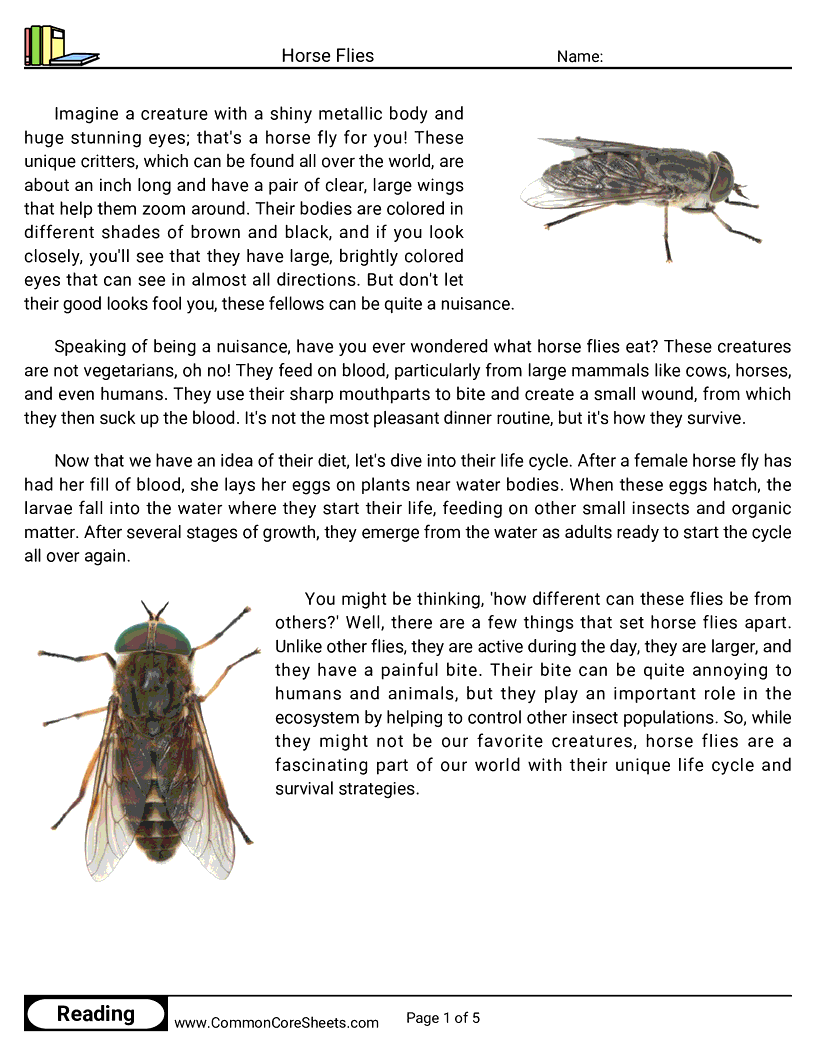
Imagine a creature with a shiny metallic body and huge stunning eyes; that's a horse fly for you! These unique critters, which can be found all over the world, are about an inch long and have a pair of clear, large wings that help them zoom around. Their bodies are colored in different shades of brown and black, and if you look closely, you'll see that they have large, brightly colored eyes that can see in almost all directions. But don't let their good looks fool you, these fellows can be quite a nuisance.
Speaking of being a nuisance, have you ever wondered what horse flies eat? These creatures are not vegetarians, oh no! They feed on blood, particularly from large mammals like cows, horses, and even humans. They use their sharp mouthparts to bite and create a small wound, from which they then suck up the blood. It's not the most pleasant dinner routine, but it's how they survive.
Now that we have an idea of their diet, let's dive into their life cycle. After a female horse fly has had her fill of blood, she lays her eggs on plants near water bodies. When these eggs hatch, the larvae fall into the water where they start their life, feeding on other small insects and organic matter. After several stages of growth, they emerge from the water as adults ready to start the cycle all over again.
You might be thinking, 'how different can these flies be from others?' Well, there are a few things that set horse flies apart. Unlike other flies, they are active during the day, they are larger, and they have a painful bite. Their bite can be quite annoying to humans and animals, but they play an important role in the ecosystem by helping to control other insect populations. So, while they might not be our favorite creatures, horse flies are a fascinating part of our world with their unique life cycle and survival strategies.
Horse flies are fascinating insects that you may have seen buzzing around during the summer months. These large, fast-flying creatures are known for their painful bites, but there's a lot more to learn about them. In this article, we'll explore their diet, habitat, appearance, life cycle, and relationships with humans and other insects. So, let's dive into the world of horse flies and discover some interesting facts about these unique creatures.
Let's start with what horse flies eat and where they live. Adult horse flies feed on nectar from flowers, but female horse flies also need blood from animals like horses, cows, and even humans to produce their eggs. These insects can be found in various environments, such as forests, meadows, and near bodies of water, where their larvae can thrive. Horse flies are most commonly found in warm, humid areas and are more active during the day.
Now, let's talk about the life cycle of a horse fly. Their life cycle consists of four stages: egg, larva, pupa, and adult. Female horse flies lay their eggs on plants or stones near water, and the larvae emerge to feed on other insects, small animals, or decaying organic matter. After going through several growth stages, the larvae transform into pupae, and finally, they emerge as adult horse flies ready to start the cycle over again.
Horse flies have a unique relationship with humans and other insects. While they can be considered pests due to their painful bites, they also play a vital role in pollination by feeding on nectar. Horse flies are also part of the food chain and serve as prey for various animals, such as birds and spiders. In terms of defenses, their speed and agility make them difficult for predators to catch, and their bites can be a deterrent to potential threats.
Lastly, let's discuss the differences between horse flies and other similar species. Horse flies are often confused with deer flies, which are smaller and have different patterns on their wings. Both types of flies are part of the Tabanidae family, but horse flies are generally larger and have stouter bodies. One interesting fact about horse flies is that their eyes are often brightly colored and can look like beautiful, intricate patterns.
After exploring the world of horse flies, it's clear that these insects are not only fascinating but also play an essential role in our ecosystem. From their feeding habits to their unique appearances, horse flies are truly remarkable creatures.
Horse flies are fascinating insects that you may have come across during your outdoor adventures. These large, buzzing creatures are known for their painful bites and can be found all around the world. They have big, colorful eyes and a strong, sturdy body, making them quite a sight to behold. Horse flies are part of the Tabanidae family, which consists of over 4,500 different species! Now, let's dive into the intriguing world of horse flies and learn more about these fascinating creatures.
First, let's talk about what horse flies eat and how they survive. Female horse flies need blood meals to produce eggs, so they feed on mammals like horses, cows, and sometimes humans. Their mouthparts are specialized for cutting through the skin and sucking up blood. On the other hand, male horse flies feed on nectar and plant juices. This difference in diet between the sexes is a unique aspect of horse fly biology.
Horse flies can be found in a variety of habitats, but they're most commonly found around water. This is because their larvae need moisture to survive and grow. You might spot horse flies near ponds, marshes, or slow-moving streams. They're most active during the day and prefer warm, sunny weather. If you're out exploring in these conditions, you might just come across a horse fly or two.
The life cycle of a horse fly is quite fascinating, as it goes through four stages: egg, larva, pupa, and adult. Female horse flies lay their eggs near water, and the larvae hatch and feed on small insects or organic material. After several molts, the larva then forms a pupa, which is a protective casing where it transforms into an adult horse fly. The whole process can take anywhere from a few weeks to a few months, depending on the species and environmental conditions. Once the adult emerges, it's ready to begin the next generation of horse flies.
Now that we've covered the basics, let's explore some interesting facts and relationships horse flies have with humans and other insects. While their bites can be painful and irritating to humans, horse flies play an important role in pollination as they visit flowers for nectar. They also serve as a food source for other insects, birds, and spiders. Some species of horse flies are known to mimic the appearance of bees or wasps, which may deter potential predators. It's important to remember that, despite their reputation, horse flies are a crucial part of our ecosystem.
About this worksheet
Students read a passage about horse flies and answer comprehension questions about the details and main ideas in the text.
This worksheet is designed to enhance reading comprehension for children with an intriguing exploration into the world of horse flies. Covering aspects from their physical characteristics, diet, lifecycle to their role in the ecosystem, the worksheet features 20 customizable multiple-choice questions. Ideal for distance learning, this resource can also be conveniently converted into flashcards for an engaging educational experience.
Student objectives
- Read an informational passage and understand the key facts
- Answer questions using details from the text
- Identify the main idea of what you read
- Learn new facts and vocabulary about horse flies
Everyday practice
- Read a fact page about an insect and remember what it said
- Answer a friend's question about a bug you just read about
- Pull out the important details from an article you read online
- Explain to a family member what a horse fly is after reading about it