Hickory Horned Devil Caterpillars Worksheet Download
Free reading worksheets on Hickory Horned Devil Caterpillars. Each worksheet has 20 problems with an answer key and are ideal for teachers and homeschooling. You can download the PDF, create a set of flash cards or set it up for online learning.


Sheet Information >
Available at 2nd grade, 3rd grade, 4th grade, 5th grade and 6th grade reading levels.
Read the passage
Have you ever heard of the hickory horned devil caterpillar? They are one of the largest and most interesting caterpillars you can find in North America. These fascinating creatures have bright colors and big spikes, but don't worry, they're harmless to humans.
Let's talk about their life cycle and where they live. The hickory horned devil caterpillar starts out as a tiny egg laid on a leaf and grows into a big, beautiful caterpillar that loves to munch on leaves from hickory, walnut, and sweetgum trees. After eating and growing for about a month, they form a cocoon and eventually emerge as a stunning royal walnut moth.
Now let's explore their relationship with other insects and their defenses. These caterpillars might look scary to some insects with their spiky horns and bright colors, but they mostly just use these features to scare away any creatures that want to eat them. In fact, they're quite different from other caterpillars because they don't have any venom or stinging hairs.
In conclusion, the hickory horned devil caterpillar is a unique and fascinating insect that teaches us that appearances can be deceiving. Even though they might look a little scary, they're actually harmless and play an important role in their ecosystem. So, next time you see one of these amazing creatures, remember that they're just trying to live their lives and grow into beautiful moths!
Let's talk about the fascinating hickory horned devil caterpillar! These fascinating creatures are known for their unique appearance, with spiky horns and bright colors. They love to munch on leaves from hickory, walnut, and sweet gum trees. You can find them living in the eastern parts of the United States, like Pennsylvania, Florida, and Texas.
Now, let's learn about their life cycle and relationships with other insects. The hickory horned devil caterpillar starts as an egg and grows into a large, colorful caterpillar before transforming into a regal moth. During their time as caterpillars, they can be eaten by some birds, but their spiky horns help protect them. These creatures don't really bother humans, but it's important not to touch them because their horns might feel a little prickly.
Finally, let's discover some interesting facts and differences between the hickory horned devil and other species! One cool fact is that they are one of the largest caterpillars in North America, growing up to six inches long. Their vibrant colors and spiky horns make them look different from many other caterpillars. While they may look a little scary, they're actually harmless and play an important role in the ecosystem by eating the leaves of certain trees.
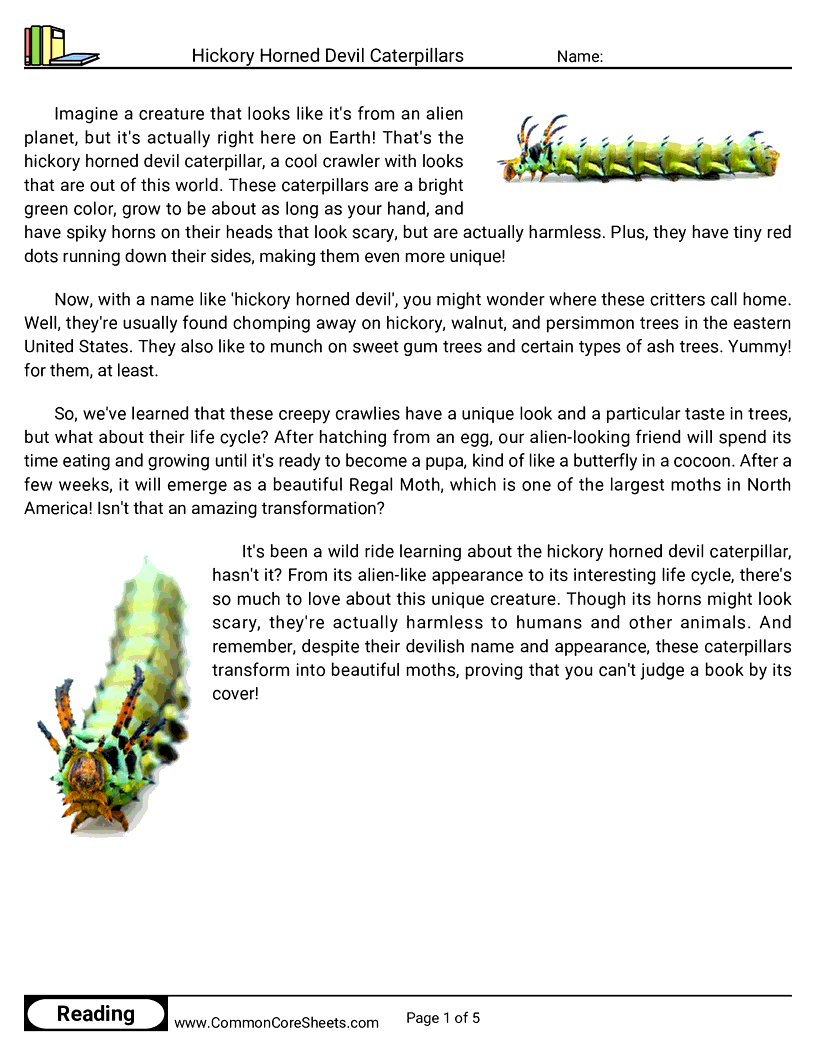
Imagine a creature that looks like it's from an alien planet, but it's actually right here on Earth! That's the hickory horned devil caterpillar, a cool crawler with looks that are out of this world. These caterpillars are a bright green color, grow to be about as long as your hand, and have spiky horns on their heads that look scary, but are actually harmless. Plus, they have tiny red dots running down their sides, making them even more unique!
Now, with a name like 'hickory horned devil', you might wonder where these critters call home. Well, they're usually found chomping away on hickory, walnut, and persimmon trees in the eastern United States. They also like to munch on sweet gum trees and certain types of ash trees. Yummy! for them, at least.
So, we've learned that these creepy crawlies have a unique look and a particular taste in trees, but what about their life cycle? After hatching from an egg, our alien-looking friend will spend its time eating and growing until it's ready to become a pupa, kind of like a butterfly in a cocoon. After a few weeks, it will emerge as a beautiful Regal Moth, which is one of the largest moths in North America! Isn't that an amazing transformation?
It's been a wild ride learning about the hickory horned devil caterpillar, hasn't it? From its alien-like appearance to its interesting life cycle, there's so much to love about this unique creature. Though its horns might look scary, they're actually harmless to humans and other animals. And remember, despite their devilish name and appearance, these caterpillars transform into beautiful moths, proving that you can't judge a book by its cover!
Hickory horned devils are fascinating creatures that are definitely worth learning about. These caterpillars are one of the largest in North America, measuring up to six inches long and sporting a bright green body with black-tipped red and yellow horns. They may look a bit scary, but don't worry, they're completely harmless to humans. In this article, you'll learn all about these interesting insects and the role they play in nature.
First, let's talk about the hickory horned devil's diet and habitat. These caterpillars love to eat the leaves of different trees, such as hickory, walnut, sweet gum, and sumac. They can usually be found in the eastern United States, from New Jersey down to Florida and west to Texas. When they're not munching on leaves, they like to hang out in the trees where they're safe from predators.
The life cycle of the hickory horned devil is a fascinating process. It all starts when the adult female moth lays her eggs on a tree's leaves. After about two weeks, the eggs hatch into tiny caterpillars that will eat and grow for about a month. Once they're big enough, they'll bury themselves in the ground and transform into a cocoon, eventually emerging as a regal moth.
These caterpillars have unique relationships with other insects and humans. Although they may look intimidating, their horns are actually soft and pose no threat to humans or other creatures. In fact, their bright colors and horns serve as a defense mechanism, warning off potential predators like birds. As for other insects, they mostly coexist peacefully as they all play their part in the ecosystem.
Finally, let's talk about some interesting facts and differences between hickory horned devils and other caterpillars. One unique feature of these caterpillars is their size, as they're much larger than most other species. Another interesting fact is that the adult regal moth has a wingspan of up to six inches, making it one of the largest moths in North America. These amazing insects remind us that even the smallest creatures can have a big impact on the world around them.
Hickory horned devil caterpillars are one of the most fascinating insects you'll ever come across. These amazing creatures are known for their unique appearance, featuring bright colors and scary-looking horns. But don't worry, they're not dangerous at all! In fact, they're quite harmless and are simply trying to survive in their natural habitat. So, let's dig a little deeper and learn more about these interesting caterpillars.
First, let's explore where these creatures live and what they eat. Hickory horned devil caterpillars are native to the eastern United States, primarily living in deciduous forests. They have a particular taste for hickory, walnut, and sweetgum trees, which is where they get their name. These caterpillars munch on the leaves of these trees to grow and develop before turning into a moth. It's important for them to eat a lot because they'll need the energy to transform!
The life cycle of a hickory horned devil caterpillar is an exciting journey. They start out as tiny eggs laid by the adult female moth on the leaves of their favorite trees. After about 10 days, the eggs hatch, and the small caterpillars begin to grow and eat leaves. As they grow, they go through several stages called instars, each time shedding their skin and growing bigger. Finally, after about a month, they're ready to transform into a cocoon, where they'll change into an adult regal moth.
Hickory horned devil caterpillars have unique relationships with humans and other insects. While they may look scary, they pose no threat to humans and are actually quite docile. However, their intimidating appearance is a defense mechanism to ward off potential predators like birds and smaller insects. These caterpillars are also important to the ecosystem, as they help with the decomposition of leaves and the spread of seeds. Without them, our forests would look quite different!
Lastly, let's touch on some interesting facts and differences between hickory horned devil caterpillars and other species. These caterpillars are one of the largest in North America, growing up to six inches in length. The adult regal moth, which they transform into, is also one of the largest moths in the region. Unlike some other caterpillars, hickory horned devil caterpillars do not spin a silk cocoon; instead, they create a burrow in the ground to pupate. This unique trait sets them apart from many other caterpillar species.
About this worksheet
Students read a short passage about hickory horned devil caterpillars and answer comprehension questions about the text.
This worksheet is designed to engage children in reading comprehension through a focus on Hickory Horned Devil Caterpillars. It features 20 multiple-choice questions centered around the lifecycle, characteristics, and habitat of these fascinating insects. Concepts like metamorphosis, color identification, and habitat recognition are covered. Versatile in format, it can be customized for individual needs, formatted into flashcards for active learning, or seamlessly integrated into distance learning platforms.
Student objectives
- Read a nonfiction passage about an insect and understand the main ideas
- Find specific facts and details stated in the text
- Use context to figure out the meaning of new words
- Answer questions using evidence from what they read
Everyday practice
- Read a sign at a zoo or nature center about an animal and understand it
- Learn facts from a magazine article about bugs or wildlife
- Look up information about a caterpillar you spotted outside
- Explain to someone what you just read about an animal