Harry Houdini and Halloween Worksheet Download
Free reading comprehension worksheet about Harry Houdini. Pick the reading level (4th grade to 8th grade), print the passage with its questions, or assign it online.


Sheet Information >
Available at 4th grade, 5th grade, 6th grade, 7th grade and 8th grade reading levels.
Read the passage
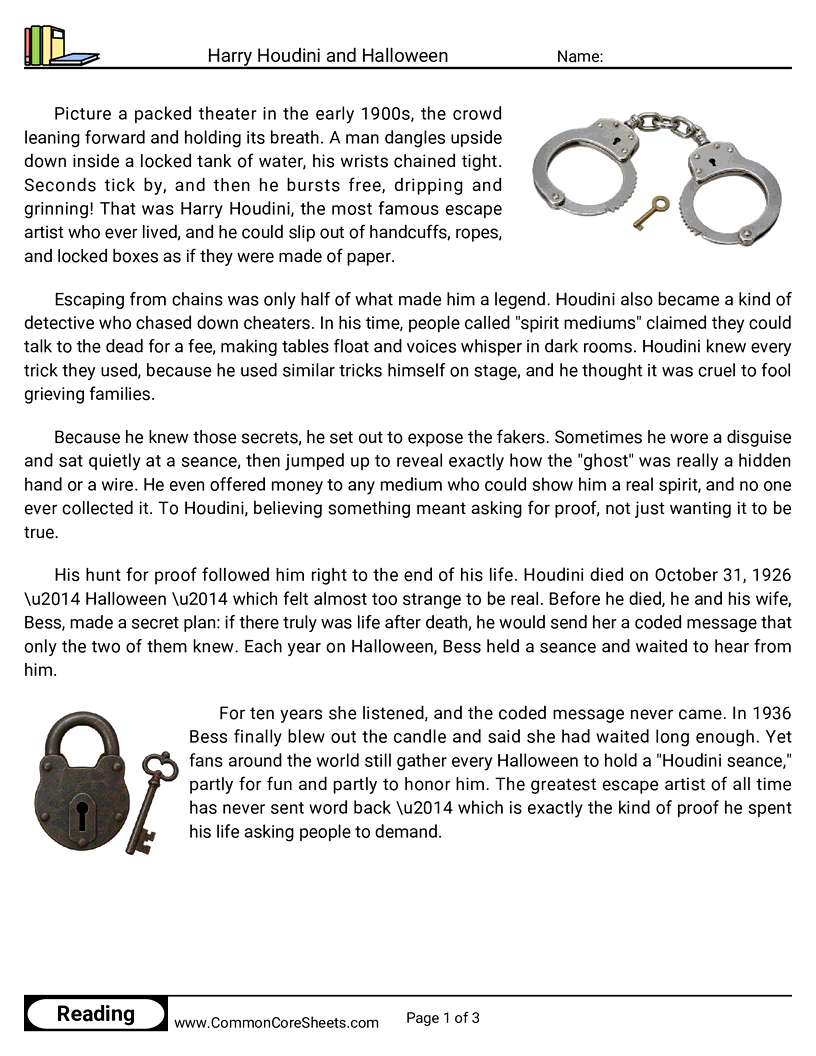
Picture a packed theater in the early 1900s, the crowd leaning forward and holding its breath. A man dangles upside down inside a locked tank of water, his wrists chained tight. Seconds tick by, and then he bursts free, dripping and grinning! That was Harry Houdini, the most famous escape artist who ever lived, and he could slip out of handcuffs, ropes, and locked boxes as if they were made of paper.
Escaping from chains was only half of what made him a legend. Houdini also became a kind of detective who chased down cheaters. In his time, people called "spirit mediums" claimed they could talk to the dead for a fee, making tables float and voices whisper in dark rooms. Houdini knew every trick they used, because he used similar tricks himself on stage, and he thought it was cruel to fool grieving families.
Because he knew those secrets, he set out to expose the fakers. Sometimes he wore a disguise and sat quietly at a seance, then jumped up to reveal exactly how the "ghost" was really a hidden hand or a wire. He even offered money to any medium who could show him a real spirit, and no one ever collected it. To Houdini, believing something meant asking for proof, not just wanting it to be true.
His hunt for proof followed him right to the end of his life. Houdini died on October 31, 1926 \u2014 Halloween \u2014 which felt almost too strange to be real. Before he died, he and his wife, Bess, made a secret plan: if there truly was life after death, he would send her a coded message that only the two of them knew. Each year on Halloween, Bess held a seance and waited to hear from him.
For ten years she listened, and the coded message never came. In 1936 Bess finally blew out the candle and said she had waited long enough. Yet fans around the world still gather every Halloween to hold a "Houdini seance," partly for fun and partly to honor him. The greatest escape artist of all time has never sent word back \u2014 which is exactly the kind of proof he spent his life asking people to demand.
Picture a man locked in chains, dropped into icy water, or sealed inside a milk can, escaping every single time. That was Harry Houdini, the most famous escape artist who ever lived, and he had a secret talent for slipping out of anything. But here is the real puzzle: the master who could escape from any trap died on the one day of the year he might have chosen himself. Houdini took his last breath on Halloween, October 31, 1926.
That spooky timing is only the beginning of why his name still floats around every Halloween. Long before he died, Houdini spent his final years chasing something far trickier than handcuffs: fake spirit mediums. These were people who charged grieving families money, claiming they could talk to the dead during dark meetings called seances. Houdini, who missed his own mother deeply, wanted to believe them, but instead he discovered they were tricking everyone.
Because he had spent his life fooling audiences, Houdini knew exactly how a good trick worked. He went to seances in disguise, then jumped up to reveal the hidden wires, secret taps, and floating trumpets the mediums used. A ghostly voice, he showed, was often just an assistant hidden in the dark or a hand freed from a loose knot. He was teaching people a powerful idea: before you believe something wild, look for the evidence.
Testing claims for evidence was so important to him that he planned one final experiment beyond the grave. Houdini and his wife, Bess, agreed on a secret code of words that only the two of them knew. If there really was life after death, he promised, he would send that exact message back to her. For ten years Bess held a seance every Halloween, waiting to hear the words, and every year they never came.
After a decade of silence, Bess blew out the candle and said her husband had given the spirit world a fair test. People still gather each Halloween for the "Official Houdini Seance," partly for fun and partly to honor him. No one has ever delivered the code, which is exactly the result Houdini the investigator would have expected. The greatest escape artist of all time may have proven his final point by not escaping death at all.
Here's a puzzle worthy of a magician: how does a man become more famous for the way he died than for anything he did while alive? Meet Harry Houdini, the most celebrated escape artist who ever lived, a performer who could slip out of handcuffs, straitjackets, and locked boxes as if the metal simply gave up. Picture a small, muscular man dangling upside down from a crane above a crowded street, wrapped in a straitjacket, twisting free while thousands gasped below. His real name was Erik Weisz, and he was born in Hungary in 1874 before his family moved to the United States. By the 1920s, his name was practically a synonym for the impossible.
That word "impossible" is exactly what got Houdini into his second, lesser-known career. In the years after World War I, grieving families flocked to "spirit mediums" who claimed they could contact the dead for a fee. Houdini, who knew every trick in the book because he used them onstage, was furious that these performers preyed on people's sorrow. He began attending seances in disguise, then leaping up to expose how the medium made a table "float" or produced a ghostly voice. A magician, it turned out, was the perfect person to catch a fake magician.
Catching fakes was one thing, but Houdini had a personal reason to keep looking. He desperately wanted to believe someone could reach the dead, because he longed to speak with his beloved mother again. In every seance, though, he found only wires, hidden assistants, and clever sleight of hand rather than proof. So he made a plan with his wife, Bess: they agreed on a secret code word that only the two of them knew. If he could send that word back from beyond the grave, it would be evidence no trickster could fake.
That code word became the heart of a strange yearly tradition after Houdini died on Halloween in 1926, from peritonitis caused by a ruptured appendix. For ten years, Bess held a seance on the anniversary of his death, waiting for the secret message to come through. It never did, and in 1936 she finally blew out the candle she had kept burning for him, saying ten years was long enough to wait. Yet fans refused to let the ritual end, and "Official Houdini Seances" are still held on Halloween in different cities to this day. Each year the message stays silent, which is perhaps the most fitting trick of all from a man who spent his life proving that silence means the trick simply hasn't been explained yet.
Why should a magician's empty mailbox from beyond still matter to you? Because Houdini left behind something sturdier than any illusion: a way of thinking. He insisted that extraordinary claims demand extraordinary evidence, and that wanting something to be true is not the same as it being true. When you see a headline promising a miracle cure or a video swearing something is real, you are using Houdini's tools whether you know it or not. Not bad for a man whose greatest unsolved mystery is whether he ever escaped at all.
Picture the greatest showman of his day chained inside a locked crate, dropped into an icy river, and popping up unharmed while the crowd roars. That was Harry Houdini, a man who escaped handcuffs, straitjackets, and sealed milk cans as if locks were only suggestions. Born Erik Weisz in Budapest in 1874, he came to America as a poor immigrant and turned his own body into the most famous escape machine on Earth. Newspapers called him the Handcuff King, and audiences from New York to London packed theaters just to watch him wriggle free. Yet the most surprising trick of his life had nothing to do with chains at all.
Those chains made him rich, but a different kind of trickery made him furious. After his mother died, Houdini visited people called spirit mediums who claimed they could carry messages from the dead for a fee. He desperately wanted to believe, but instead he noticed the tricks: hidden helpers, tapping toes, and trumpets floated on thin wires in the dark. Because he was a magician, he recognized stage illusions dressed up as miracles, and it made him angry that grieving families were being robbed. So the King of Escapes became something new, a professional debunker who exposed frauds.
Being a debunker meant Houdini turned detective, and he was ruthless about it. He would sneak into seances in disguise, sometimes bringing a reporter and a police officer to catch the medium in the act. On stage he then repeated the very same "ghostly" effects, showing a stunned audience exactly how the wires, magnets, and secret knocks worked. He even testified before the United States Congress, urging lawmakers to fight fortune-telling scams. His point was simple and sharp: if a magician could fake it, a spirit did not need to be involved.
That demand for proof followed him right to the end, because Houdini died on Halloween itself. On October 31, 1926, he passed away in Detroit from a burst appendix, at only 52 years old. Before his death, he and his wife Bess had made a secret pact, agreeing on a coded message that only the two of them knew. If life continued after death, he promised, he would send those exact words back to her from the other side. It was a test designed by a man who trusted evidence more than hope.
That coded message turned his fans into hopeful listeners every single year. Bess held a seance on the anniversary of his death, waiting for the agreed-upon words, and for about ten years none ever came. In 1936, after a final rooftop seance in Hollywood, she blew out a candle and said, "Ten years is long enough to wait for any man." She had loved him deeply, yet she accepted that no genuine message had arrived. Even so, fans refused to let the ritual die.
Refusing to quit, magicians around the world still gather each Halloween to hold what they call the Official Houdini Seance. They knock on tables and call his name, partly in tribute and partly as a friendly experiment that has never once succeeded. In a way, the silence is the point, because it honors a man who spent his career demanding real proof instead of clever tricks. The Handcuff King who could escape any box left behind the one lock no one has picked. And that, more than any river or crate, may be his greatest escape of all.
Picture a packed theater in the 1910s, the lights dimmed, and a man hanging upside down over the stage, wrapped in chains and locked inside a water-filled tank. The crowd holds its breath—thirty seconds, a minute, longer—until suddenly he bursts free, dripping and grinning. That man was Harry Houdini, and he was the most famous escape artist the world had ever seen. But here's the twist you might not expect: the same performer who thrilled audiences with impossible escapes spent the last years of his life trying to prove that something else was fake.
Those "impossible" escapes taught Houdini exactly how illusions are built—and that knowledge turned him into a ghost hunter of an unusual kind. In the 1920s, a movement called Spiritualism was booming, and self-proclaimed mediums charged grieving families money to "contact" their dead loved ones during dark gatherings called seances. Because Houdini knew every trick of misdirection, he could spot how a medium made a table tap, a trumpet float, or a ghostly voice whisper in the dark. He began attending seances in disguise, then exposing the mediums onstage and in writing. He even testified before the United States Congress in 1926 in support of a bill to stop fraudulent fortune-telling.
What made his crusade so personal was not showmanship but grief of his own. Houdini had adored his mother, and after she died he desperately wanted to believe a medium could reach her. When he saw how easily fakes preyed on that hope, his disappointment hardened into a mission. He offered a cash reward to any medium who could produce a supernatural effect he could not explain by natural means, and no one ever collected it. To him, wanting something to be true was not the same as it being true—a distinction that sits at the heart of his whole story.
That very question—how do we tell a real signal from a clever trick?—followed Houdini right to his death, which came on Halloween of 1926. Historians generally agree he died of a ruptured appendix, though a legend grew that a college student's sudden punches to his stomach played a role. Before he died, he and his wife, Bess, had made a pact: if it were truly possible to send a message from beyond, he would try, using a secret code only the two of them knew. This was itself a test, a kind of experiment designed by a skeptic. If a message came through with the wrong words, it would be proof of a fake, not proof of an afterlife.
That secret code turned his death into an ongoing experiment that outlived him by decades. For ten years Bess held a seance every Halloween, waiting for the coded words, and in 1936 she finally declared the vigil over, saying ten years was long enough to wait for any man. "The Houdini shrine has burned for ten years," she reportedly said as she put out a candle she had kept lit. Yet fans refused to let the tradition die, and magicians around the world still hold "Official Houdini Seances" each Halloween. No verified message in the secret code has ever been received—which is exactly the result a careful skeptic would predict.
That yearly ritual reveals something surprising about the man being remembered on it. People gather each Halloween not to celebrate a believer, but to honor someone who demanded evidence and refused to accept a comforting story without it. In a way, the seances have become the opposite of what a seance is supposed to be: a public reminder that no proof has arrived. Houdini spent his life escaping locks, ropes, and tanks, but the trap he cared most about breaking was the one built from wishful thinking. And so the escape artist who could slip out of any chains left behind a challenge no one has managed to unlock—a message that, so far, has stayed silent.
About this worksheet
Students read a nonfiction passage about Harry Houdini, written at 5 reading levels (4th grade to 8th grade), and answer multiple-choice questions about it.
A reading comprehension worksheet about Harry Houdini with a different article for each reading level, 4th grade to 8th grade, each with its own multiple-choice questions aligned to the Common Core Reading: Informational Text standards. Printable with an answer key, and available as an online assignment at any level.
Student objectives
- Read a nonfiction passage about Harry Houdini and his life's work
- Explain why Houdini worked to expose fake spirit mediums
- Find details in the text that show Houdini valued proof over belief
- Describe how the author organizes the passage in time order
Everyday practice
- Notice when someone makes a big claim and ask what proof supports it
- Look up a simple magic trick and figure out how it might work
- Talk with your family about the difference between wanting something to be true and knowing it is true