Halloween Postcards Long Ago Worksheet Download
Free reading comprehension worksheet about vintage Halloween postcards. Pick the reading level (3rd grade to 8th grade), print the passage with its questions, or assign it online.


Sheet Information >
Available at 3rd grade, 4th grade, 5th grade, 6th grade, 7th grade and 8th grade reading levels.
Read the passage
Imagine you open your mailbox on a chilly October morning and find a card covered with a wide-eyed black cat, a grinning pumpkin, and a witch flying past the moon. Long ago, that was a real treat for children and grown-ups alike! These were Halloween postcards, small pieces of stiff paper printed with spooky-but-friendly pictures. People mailed millions of them to say, in a cheerful way, that Halloween was on its way.
Those bright pictures started arriving during a time people now call the golden age of postcards. From about 1900 to 1915, mailing cards was one of the most popular things to do in America, because it was cheap and fun. Back then a postcard cost only about a penny to send. So instead of a text message, your great-great-grandparents might have mailed a little pumpkin to a friend!
Printing all those pumpkins was harder than it sounds. First an artist painted the picture, then printers copied it using many layers of colored ink, one color pressed onto the paper at a time. Many of the finest cards were printed far away in Germany, because German printers were famous for their bright, glowing colors. When the cards crossed the ocean by ship and landed in mailboxes, they looked almost like tiny paintings.
Those little paintings did not disappear, even after people stopped mailing so many of them. Today collectors hunt for old Halloween postcards the way other people hunt for baseball cards, and some rare ones sell for more than a hundred dollars each. The most wanted cards show black cats, witches, and owls, the very same creatures artists loved to draw over a hundred years ago. Can you imagine your own birthday card being kept safe and treasured when you are as old as your great-great-grandparents?
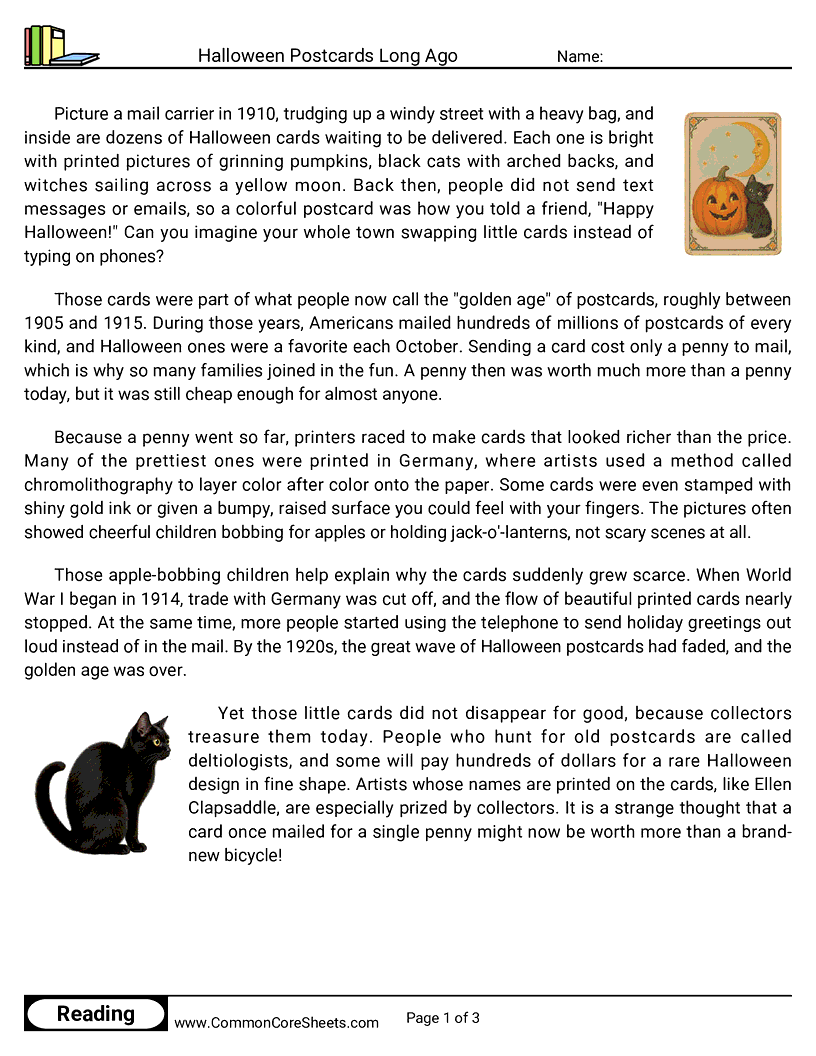
Picture a mail carrier in 1910, trudging up a windy street with a heavy bag, and inside are dozens of Halloween cards waiting to be delivered. Each one is bright with printed pictures of grinning pumpkins, black cats with arched backs, and witches sailing across a yellow moon. Back then, people did not send text messages or emails, so a colorful postcard was how you told a friend, "Happy Halloween!" Can you imagine your whole town swapping little cards instead of typing on phones?
Those cards were part of what people now call the "golden age" of postcards, roughly between 1905 and 1915. During those years, Americans mailed hundreds of millions of postcards of every kind, and Halloween ones were a favorite each October. Sending a card cost only a penny to mail, which is why so many families joined in the fun. A penny then was worth much more than a penny today, but it was still cheap enough for almost anyone.
Because a penny went so far, printers raced to make cards that looked richer than the price. Many of the prettiest ones were printed in Germany, where artists used a method called chromolithography to layer color after color onto the paper. Some cards were even stamped with shiny gold ink or given a bumpy, raised surface you could feel with your fingers. The pictures often showed cheerful children bobbing for apples or holding jack-o'-lanterns, not scary scenes at all.
Those apple-bobbing children help explain why the cards suddenly grew scarce. When World War I began in 1914, trade with Germany was cut off, and the flow of beautiful printed cards nearly stopped. At the same time, more people started using the telephone to send holiday greetings out loud instead of in the mail. By the 1920s, the great wave of Halloween postcards had faded, and the golden age was over.
Yet those little cards did not disappear for good, because collectors treasure them today. People who hunt for old postcards are called deltiologists, and some will pay hundreds of dollars for a rare Halloween design in fine shape. Artists whose names are printed on the cards, like Ellen Clapsaddle, are especially prized by collectors. It is a strange thought that a card once mailed for a single penny might now be worth more than a brand-new bicycle!
Picture opening your mailbox and finding a card with a grinning black cat riding a broomstick, or a jolly witch stirring a bubbling pot, printed in bright orange and gold. More than a hundred years ago, that was a real treat that millions of Americans looked forward to each October. Between about 1905 and 1915, sending Halloween postcards was so popular that people call it the golden age of postcards. These little pieces of cardboard, smaller than your hand, carried spooky-but-friendly pictures across the whole country.
Those cheerful pictures did not appear by magic, though it might have seemed that way. Most of the finest Halloween postcards were designed by artists and then printed in Germany, which had the best color-printing shops in the world at the time. Printers used a method called chromolithography, layering one color at a time from separate stones or plates until the pumpkins glowed and the owls' eyes gleamed. The results were so rich and glossy that a card mailed for a penny looked like a tiny painting.
A penny may sound like nothing, but it helped explain why these cards spread so fast. Postcards were cheap to buy and cheap to mail, so ordinary families could send holiday greetings the way we send texts today. Popular artists such as Ellen Clapsaddle drew thousands of holiday designs, and her cheerful children and pumpkins made her one of the most collected postcard illustrators. People saved the prettiest cards in albums, propping them open in the parlor so visitors could admire the artwork.
Those saved albums are exactly why we can still enjoy the cards more than a century later. When World War I began in 1914, printing in Germany was cut off, and the flood of beautiful imported postcards slowed to a trickle. Styles changed too, and by the 1920s the golden age had faded, making the older cards harder and harder to find. That scarcity is what turns an old card into a treasure hunt for collectors.
Today those treasure hunters gather at shows and online, and a single rare Halloween card can sell for hundreds of dollars. Collectors prize the ones in the best shape, with unbent corners and colors that never faded, and cards showing unusual scenes are worth the most. The images tell us about a time when Halloween was a neighborly holiday of parties and fortune-telling games rather than costumes and candy. Somewhere in an attic, a penny postcard your great-great-grandparents mailed may still be waiting, its black cat as bright as the day it was printed.
You probably think of Halloween as a night for candy and costumes, not something you'd find in your mailbox. But rewind about a hundred years, and October meant a flood of Halloween postcards landing in homes across America. Picture a stiff piece of cardstock, no bigger than your hand, printed with a grinning jack-o'-lantern, a black cat with an arched back, or a witch riding across a golden moon. The colors were rich and glowing, the borders were fancy, and the messages on the back wished friends a happy, playful Halloween. These little cards were the text messages of their day.
Those glowing colors didn't happen by accident, and they came from an unexpected place. Many of the finest Halloween postcards were designed in the United States but printed in Germany, which had the best color printing presses in the world in the early 1900s. Printers used a technique called chromolithography, layering ink from several stones or plates so that a single card could shine with many colors. Some cards were even embossed, meaning the pumpkins and owls were pressed to bulge slightly off the surface so you could feel them with your fingertip. A postcard that cost a penny to mail could look like a tiny painting.
A card that looked like a painting was exactly what people wanted to collect, and collect they did. The years from about 1900 to 1915 are often called the golden age of postcards, when Americans mailed and saved cards by the millions. Instead of scrapbooks full of photos, families kept postcard albums on the parlor table, and visitors would flip through them the way you might scroll a phone. Halloween cards were a favorite because the artwork was bold and the symbols were fun: cats, owls, bats, and smiling moons. Sending one told a friend you were thinking of them during the spookiest season of the year.
Those bold symbols carried older ideas that most senders never stopped to think about. The black cats and witches came from centuries of European folklore, and the glowing pumpkin traced back to an Irish legend about a wanderer named Stingy Jack who was said to roam with a carved turnip lantern. When Irish immigrants came to America, they found pumpkins easier to carve than turnips, and the jack-o'-lantern we know was born. Postcard artists took these old stories and made them cheerful, trading anything frightening for winking cats and friendly witches. In a way, the cards helped turn Halloween into the playful holiday you celebrate today.
That playful spirit is exactly why collectors still hunt for these cards more than a century later. At flea markets, estate sales, and online auctions, people search for rare examples, and a single well-preserved card by a sought-after artist can sell for far more than the penny it once cost. Collectors prize cards signed by illustrators like Ellen Clapsaddle, whose sweet, detailed designs made her one of the most beloved postcard artists of the era. Each surviving card is a small time capsule, carrying a handwritten note from someone who lived generations ago. When you hold one, you're holding a Halloween greeting that outlived everyone who first touched it.
Picture your grandparents' grandparents standing at a mailbox, dropping in a penny postcard printed with a grinning jack-o'-lantern or a black cat arching its back. In the early 1900s, this was one of the most popular ways Americans wished each other a happy Halloween. Millions of these cards traveled through the mail, carrying witches on broomsticks, wide-eyed owls, and pumpkins with cheerful faces. They were small, only about the size of a postcard you might send today, yet they were bursting with color and detail. Would you believe that a scrap of cardboard could become a treasure worth real money a century later?
That penny you imagined buying a postcard with was not a small thing at the time, and neither was the mania for mailing them. Historians often call the years from about 1900 to 1915 the "golden age" of postcards, when people collected and swapped them the way kids trade cards or stickers now. Families kept fancy albums on their parlor tables, filled with cards for every holiday and season. Sending a Halloween greeting was as normal then as sending a text today, and the postal system made it cheap and easy. No wonder companies raced to print holiday cards that people would want to buy in stacks.
Racing to print the prettiest cards meant using the best technology of the day, and much of it came from far across the ocean. Many of the finest Halloween postcards were printed in Germany, where workers used a method called chromolithography to layer ink in rich, glowing colors. The process pressed the paper against a series of stones or plates, one for each color, until the image looked almost painted. German printers were famous for this craft, and American publishers ordered huge quantities from them. Because so much skill went into each design, those early cards still look vivid more than a hundred years later.
That reliance on German printing presses turned out to be the tradition's weak spot. When World War I began in 1914, trade with Germany was cut off, and the flow of beautifully printed cards slowed to a trickle. At the same time, the telephone was spreading into homes, letting people share holiday wishes with their voices instead of the mail. Slowly the postcard craze faded, and the albums on parlor tables were tucked away in attics and closets. An invention that once fueled a custom was quietly replaced by a newer one.
Those forgotten albums are exactly why collectors get excited today. People who hunt for vintage Halloween postcards are sometimes called deltiologists, which is simply a fancy word for postcard collectors. They search flea markets, estate sales, and online auctions for cards from the golden age, and the rarest ones can sell for surprising sums. A card's value depends on things like its artist, its condition, and how unusual its design is. A black cat printed by a well-known artist can be worth far more than a plain pumpkin, even though both are the same age.
Artists, it turns out, are the reason certain cards command such attention. Illustrators like Ellen Clapsaddle designed thousands of holiday cards, and her cheerful Halloween images are prized by collectors to this day. Her work reminds us that behind every witch and owl was a real person imagining how to make a stranger smile. The next time you see a spooky image that feels friendly rather than frightening, remember that a whole industry once existed just to mail a little seasonal joy. Somewhere in an attic, a penny postcard from 1910 may still be waiting to say happy Halloween.
Imagine your great-great-grandmother sitting at her kitchen table in 1910, dipping her pen in ink to write a quick note on the back of a brightly colored card. On the front, a plump orange pumpkin grins beside a black cat with an arched back, all outlined in gleaming gold. For a single penny in postage, she could drop it in the mail and it might arrive that very afternoon. This little rectangle of cardboard was a Halloween postcard, and for about twenty years around the turn of the century, Americans mailed them by the millions. Today those same cards sell for far more than a penny, and collectors chase them the way other people chase baseball cards.
That penny stamp was no small detail, because cheap postage is exactly what made these cards explode in popularity. Historians often call the years from roughly 1900 to 1915 the "golden age" of the picture postcard, when sending one was the fastest, cheapest way to say hello. There were no telephones in most homes and certainly no text messages, so a postcard filled the gap between a letter and a phone call. People mailed them for every holiday, and Halloween earned its own colorful lineup of witches, owls, bats, and jack-o'-lanterns. Can you imagine mailing a friend a card just to say you'd see them tomorrow? People did exactly that.
The images on those cards were not simply drawn and printed down the street, and this is where the story crosses an ocean. Much of the finest work came from Germany, where printers had mastered a technique called chromolithography that layered ink from several stones to build up rich, glowing color. German presses could add embossing, so a pumpkin or a moon actually rose off the surface under your fingertips. American publishers such as Raphael Tuck and John Winsch commissioned artists, then shipped the designs overseas to be printed and shipped back. The result was a card that looked almost jewel-like, far beyond what most local print shops could manage.
Those glowing German colors help explain why the artists behind the cards mattered as much as the printers. One name collectors prize above the rest is Ellen Clapsaddle, an American illustrator who designed thousands of holiday postcards, including many Halloween scenes of rosy-cheeked children with pumpkins. Because artists were rarely credited by name at the time, spotting a Clapsaddle style became a kind of detective work for later collectors. Her cards, and those signed by other identifiable artists, now command higher prices than anonymous ones. The value, in other words, is not only in the ink and gold but in whose imagination first shaped the scene.
The imagination behind those scenes also borrowed heavily from older beliefs, which is why the same symbols appear again and again. Long before the postcards, people had told stories linking black cats, owls, and bats to witchcraft and bad luck, so those creatures became a visual shorthand for the holiday. The jack-o'-lantern traces back to Irish and Scottish folklore about a wandering figure named Stingy Jack, a tale immigrants carried to America. Card artists took this tangle of old symbols and made them cheerful and playful rather than frightening, aiming to charm buyers, not scare them. That gentle, decorative tone is a big reason the cards still look festive to us more than a century later.
That festive charm faded fast once the world changed around it, and the cards nearly vanished as quickly as they had appeared. World War I disrupted the flow of German printing after 1914, cutting off the very presses that made the best cards. At the same time, telephones spread and the folding greeting card grew popular, so the humble postcard slipped out of fashion. Millions were tossed out over the years, which is precisely why survivors can be valuable today, with rare examples selling for well over a hundred dollars. The next time you see a faded orange card in an antique shop, remember that you may be holding a penny message that outlived the century it was mailed in.
About this worksheet
Students read a nonfiction passage about vintage Halloween postcards, written at 6 reading levels (3rd grade to 8th grade), and answer multiple-choice questions about it.
A reading comprehension worksheet about vintage Halloween postcards with a different article for each reading level, 3rd grade to 8th grade, each with its own multiple-choice questions aligned to the Common Core Reading: Informational Text standards. Printable with an answer key, and available as an online assignment at any level.
Student objectives
- Read a nonfiction passage about vintage Halloween postcards and their history
- Find details that explain how the cards were made and mailed
- Explain why the postcards became scarce and why collectors value them today
- Determine the meaning of words like scarce and deltiologist from context
Everyday practice
- Look for old family photos or postcards at home and notice how they were printed
- Compare how your family sends holiday greetings today with mailing a penny postcard
- Notice the black cat, pumpkin, and owl images that still appear on Halloween cards