Halloween in Ireland and Scotland Worksheet Download
Free reading comprehension worksheet about Halloween in Ireland and Scotland. Pick the reading level (1st grade to 8th grade), print the passage with its questions, or assign it online.


Sheet Information >
Available at 1st grade, 2nd grade, 3rd grade, 4th grade, 5th grade, 6th grade, 7th grade and 8th grade reading levels.
Read the passage
Did you know Halloween is very old? It began far away in Ireland and Scotland. People there had fall parties long ago.
At those parties, kids played a fun game called guising. Guising means you dress up and go door to door. You had to sing or tell a joke to get a treat!
Kids there also carved turnips, not pumpkins! A turnip is a round white vegetable that grows in the ground. They cut faces in them and put a light inside.
Did you know that Halloween started far across the ocean, in Ireland and Scotland? Long before there was candy in bags, kids there celebrated a fall festival with big, crackling bonfires. People still call this night by its old Irish name, Oiche Shamhna, which means "the night of Samhain."
Those bonfires were not the only glow in the dark! Instead of pumpkins, children in Ireland and Scotland carved lanterns out of turnips, which are round, tough vegetables. They scooped out the middle, cut a scary face, and put a tiny light inside so it glowed on the doorstep.
A glowing turnip was fun, but going door to door was even better. Kids in old costumes would knock and do a trick, like sing a song or tell a joke, to earn a treat. This is called guising, because the children wore a disguise, or costume, to hide who they were.
After all that singing, everyone was hungry for a treat called barmbrack. Barmbrack is a sweet bread with raisins, and a small ring is hidden inside before it bakes. People said that whoever found the ring in their slice would be the next to get married!
Imagine you are walking down a cold street in Ireland long ago, wearing a mask made of cloth, ready to knock on a door! This was called guising, which means going door to door in a disguise. But there was a catch: to get a treat, you first had to sing a song, tell a joke, or say a little poem. People still call this night Oiche Shamhna, which is the Irish language name for Halloween.
Long before candy, kids in Ireland and Scotland got apples, nuts, or coins for their little shows. One favorite treat was barmbrack, a sweet bread with a ring baked right inside it. People told a fun story that whoever found the ring in their slice would have good luck! So finding the hidden ring in your piece was a delicious surprise.
That warm bread went well with the bright fires people built outside. Long ago, families lit big bonfires to celebrate the end of the harvest, when the last crops were gathered. The word bonfire means a large outdoor fire, and neighbors would gather around it to stay warm and share stories. Because the nights were getting dark and chilly, the glowing fires felt cozy and cheerful.
Near those fires, people carved something that might surprise you: turnips, not pumpkins! They scooped out the inside of a turnip and cut a face into it, then placed a little light inside to make a glowing lantern. When people from Ireland and Scotland later moved to America, they found big, easy pumpkins and switched to those instead. So the next time you carve a pumpkin, remember it started as a tiny, tough turnip across the sea!
Picture a chilly October night in Ireland, hundreds of years ago, when farmers gathered stalks of dried grass and stacked them high on a hilltop. As the sky went dark, they lit the pile, and giant orange flames leaped up into the night. This was a bonfire for a festival the Irish called Oiche Shamhna, which means "the night of Samhain." Believe it or not, the Halloween you celebrate today grew from nights just like that one.
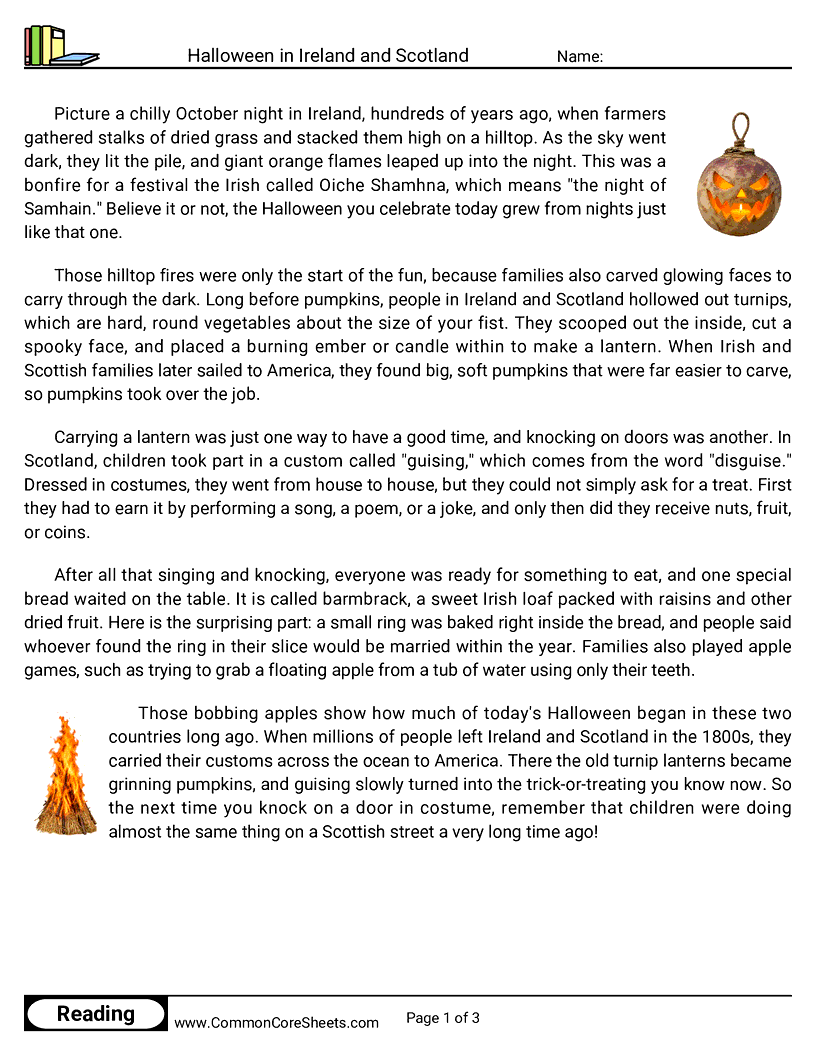
Those hilltop fires were only the start of the fun, because families also carved glowing faces to carry through the dark. Long before pumpkins, people in Ireland and Scotland hollowed out turnips, which are hard, round vegetables about the size of your fist. They scooped out the inside, cut a spooky face, and placed a burning ember or candle within to make a lantern. When Irish and Scottish families later sailed to America, they found big, soft pumpkins that were far easier to carve, so pumpkins took over the job.
Carrying a lantern was just one way to have a good time, and knocking on doors was another. In Scotland, children took part in a custom called "guising," which comes from the word "disguise." Dressed in costumes, they went from house to house, but they could not simply ask for a treat. First they had to earn it by performing a song, a poem, or a joke, and only then did they receive nuts, fruit, or coins.
After all that singing and knocking, everyone was ready for something to eat, and one special bread waited on the table. It is called barmbrack, a sweet Irish loaf packed with raisins and other dried fruit. Here is the surprising part: a small ring was baked right inside the bread, and people said whoever found the ring in their slice would be married within the year. Families also played apple games, such as trying to grab a floating apple from a tub of water using only their teeth.
Those bobbing apples show how much of today's Halloween began in these two countries long ago. When millions of people left Ireland and Scotland in the 1800s, they carried their customs across the ocean to America. There the old turnip lanterns became grinning pumpkins, and guising slowly turned into the trick-or-treating you know now. So the next time you knock on a door in costume, remember that children were doing almost the same thing on a Scottish street a very long time ago!
Ever wonder where Halloween got its jack-o'-lanterns, its costumes, and its trick-or-treating? The trail leads across the ocean to two rainy, green countries: Ireland and Scotland. There, more than a thousand years ago, people celebrated a festival called Samhain, marking the end of the harvest and the start of winter's dark half. In Irish it is still spoken as Oiche Shamhna, which means "the night of Samhain."
That word "harvest" is the key to understanding what people ate and did on this night. Because the crops were gathered and the cold was coming, families lit huge bonfires on the hills to keep warm and to celebrate together. In Ireland, cooks baked a fruit bread called barmbrack and hid a ring inside the dough, and the person who found the ring in their slice was said to be the next to marry. Imagine biting into a warm slice of raisin bread and feeling a little metal ring against your tooth!
A ring baked in bread might surprise you, but the glowing lantern in the window would surprise you even more. Long before pumpkins, children in Ireland and Scotland carved faces into turnips, then set a small candle inside so a spooky light shone out. Turnips are hard and much smaller than pumpkins, so carving one took real muscle and patience. When Irish and Scottish families later moved to America, they found big, soft pumpkins that were far easier to carve, and the jack-o'-lantern we know today was born.
Those glowing faces weren't the only thing carried across the sea. In Scotland, going door to door was called "guising," because children dressed in disguise and had to earn their treat by singing a song, telling a joke, or reciting a poem. That little performance is the ancestor of today's "trick or treat," though modern trick-or-treaters usually skip the joke and go straight for the candy! So the next time you knock on a door in costume, you're doing something Scottish kids have done for hundreds of years.
Costumes and treats weren't the only games on Samhain night. People bobbed for apples floating in a tub of water, trying to grab one with only their teeth, and this apple game is still played at Halloween parties today. Others hung apples on strings and tried to take a bite without using their hands, which is harder than it sounds. It's a strange thought, but the candy-filled, pumpkin-carving holiday you love began with turnips, bonfires, and a ring hidden in a loaf of bread.
You probably think Halloween was invented in America, with its bags of candy and glowing plastic pumpkins. Guess again! The holiday's oldest roots stretch back more than 2,000 years to Ireland and Scotland, where people once celebrated an ancient festival called Samhain (pronounced "SOW-in"). In the Irish language, Halloween night is still called Oiche Shamhna, which means "the night of Samhain." Long before candy corn existed, families across these misty green islands marked the end of the harvest season and the start of the dark winter months.
That end-of-harvest feeling brought neighbors together around enormous bonfires. Communities would gather on hilltops as the flames crackled and orange sparks drifted into the cold autumn sky. People believed the fires offered protection and light during the darkest part of the year, when the sun set early and the fields went bare. Can you imagine standing in a field at night, warmed by a fire taller than a person, while the whole village sang and told stories? For our ancestors in Ireland and Scotland, this glowing gathering was the heart of the celebration.
The firelight also lit the faces of children going door to door, a custom called guising. Instead of simply shouting "trick or treat," young guisers had to earn their reward by performing a song, a poem, a joke, or a short dance for the neighbors who answered the door. They dressed in disguises so they would not be recognized, which is exactly where the word "guising" comes from. When millions of Irish and Scottish people moved to America in the 1800s, they carried this custom across the ocean with them. Over time, guising slowly transformed into the trick-or-treating that kids know today.
Those early guisers didn't carry pumpkins, either, because pumpkins are native to the Americas and didn't grow in Ireland or Scotland. Instead, people carved lanterns out of turnips, hollowing out the hard root and cutting spooky faces into its pale skin. Carving a rock-hard turnip by hand was far tougher than scooping a soft pumpkin, so those lanterns were smaller and grimmer-looking. When immigrants reached America, they discovered that pumpkins were bigger, softer, and much easier to carve, and the jack-o'-lantern was reborn. People also played apple games, like trying to grab floating apples from a tub of water using only their teeth.
Alongside the apples sat another treat that made the holiday delicious and a little suspenseful. Families baked a fruity loaf called barmbrack, hiding a small ring inside the dough before it went into the oven. According to tradition, whoever found the ring in their slice was said to be the next to marry, which turned every bite into a tiny game of chance. These customs still matter because they remind us that a holiday shared by millions began as a way for communities to face the long, dark winter together. So the next time you light a jack-o'-lantern, remember it once flickered inside a turnip on an Irish hillside long ago.
Picture a night more than two thousand years ago, when whole villages huddled around bonfires so tall the flames lit up the hills for miles. This was Samhain, a festival marking the end of harvest and the start of winter for the ancient Celts of Ireland and Scotland. In Irish it is still called Oiche Shamhna, which means "the eve of Samhain," a name that reminds us how old this holiday truly is. People believed that on this one night the line between the living world and the world of spirits grew thin. Almost every custom you enjoy today, from costumes to carved lanterns, can trace a thread back to this smoky, star-lit celebration.
Those thin borders between worlds gave people a clever excuse to hide their faces. This was the beginning of guising, a tradition where children dressed in disguise and went from door to door. Here is the twist that might surprise you: they did not simply get candy for showing up. To earn a treat, each guiser had to perform, singing a song, reciting a poem, or telling a joke to the household. When Irish and Scottish families later carried this custom across the ocean to North America, it slowly softened into the trick-or-treating we know, where a knock and a costume are usually enough.
Before those young performers headed out, many of them carried a light that looked nothing like the pumpkins on your porch. In Ireland and Scotland, people hollowed out turnips, a hard, pale root vegetable, and carved eerie faces into their thick sides. Inside they placed a glowing ember or a small candle, creating a lantern that flickered along the dark lanes. Carving a turnip is brutally difficult, since the vegetable is dense and stubborn compared with a soft pumpkin. So when immigrants reached America and met the plump, easily carved pumpkin, they happily switched, and the jack-o'-lantern was reborn.
That same spirit of transformation showed up on the dinner table in the form of a special bread. Barmbrack is a sweet, speckled loaf packed with raisins and other dried fruit, traditionally sliced and spread thick with butter. What made it exciting was not the taste but the surprise baked inside, for cooks hid a small ring in the dough. People told a story that whoever found the ring in their slice would be the next to marry within the year. Other tiny objects were sometimes added too, each one carrying its own playful meaning for the person who bit into it.
Games could be just as full of fortune-telling fun as that hidden ring. One favorite was apple bobbing, where players lean over a tub of water and try to grab floating apples using only their teeth. In another version, apples dangled from strings, and the trick was to take a bite without any hands at all. Apples were everywhere at this time of year because the harvest had just filled every barn and cellar. These simple games spread far beyond the Celtic lands and are still splashing water across party floors today.
From a floating apple all the way back to a hilltop fire, every piece of this holiday tells a story of people carrying their traditions into new homes. The Celts who lit those first bonfires could never have imagined children in America carving pumpkins and shouting "trick or treat." Yet the connection is real, stitched together across centuries and an entire ocean. Consider this: the next time you flick on a plastic jack-o'-lantern, you are echoing a turnip lantern that glowed in an Irish field before your country even existed.
Picture a village in the west of Ireland more than a thousand years ago, when the harvest was done and the nights were growing long. People lit enormous bonfires on the hilltops, carried glowing lanterns carved from turnips, and pulled cloaks over their faces before knocking on their neighbors' doors. This was Oiche Shamhna, the Irish name for the eve of the old festival of Samhain, and it is where many of the traditions you know as Halloween were born. If you have ever gone trick-or-treating in a costume, you were repeating something Celtic communities did centuries before the word "Halloween" even existed. The holiday you celebrate today is not one person's invention but a patchwork stitched together over hundreds of years.
Those neighbors who pulled cloaks over their faces were doing something Scots and Irish still call guising. Instead of simply demanding candy, a guiser was expected to earn a treat by performing a party trick, singing a song, telling a joke, or reciting a poem at the door. Historians point to guising as the clearest ancestor of modern trick-or-treating, which spread widely in North America only in the twentieth century. There is a real distinction here worth noticing: the American child says "trick or treat" as a playful threat, while the Scottish guiser actually delivered the entertainment first. The exchange was a performance for a reward, not a bribe to avoid mischief.
Long before plastic buckets, those performers needed something to light their way, and that is where the turnip lantern comes in. People hollowed out large turnips, and sometimes beets or potatoes, then carved crude faces into them and placed a burning ember or candle inside. A carved turnip is far harder to hollow than a pumpkin, so making one was genuine work, not a five-minute craft. When Irish and Scottish immigrants arrived in America in the 1800s, they found pumpkins, which were bigger, softer, and easier to carve, and the tradition happily switched vegetables. This is a neat example of how a custom survives by adapting to whatever materials a new place offers.
Lanterns lit the doorway, but inside the house the real prize was often waiting on the table. In Ireland, families baked a fruit loaf called barmbrack, and cooks hid small objects inside the dough before baking. People told a story about each token: a ring meant marriage was coming, a coin meant wealth, and a piece of cloth was said to warn of lean times ahead. Slicing the barmbrack became a game of fortune-telling, though of course the outcome depended entirely on which slice you happened to grab. Bakeries in Ireland still sell barmbrack every autumn, and many loaves come with a toy ring tucked inside, keeping the custom alive.
The barmbrack ring was not the only way people played at glimpsing the future on this night. Apples were everywhere at Samhain, and games like bobbing for apples in a tub of water grew out of the season's harvest. Some historians argue these apple games arrived through the Romans, who honored Pomona, a goddess of fruit and orchards, and whose customs blended with Celtic ones after Rome reached Britain. Others caution that the evidence for a direct Roman link is thin, and that apples were simply the fruit most available in late autumn. This debate is a good reminder that folklore is rarely traced to a single tidy origin, no matter how satisfying that would be.
That very messiness is what makes the history of this holiday so rich. When Irish and Scottish families emigrated in the nineteenth century, especially during and after the Great Famine of the 1840s, they carried Samhain customs across the Atlantic in their memories and their kitchens. Over time these traditions mixed with others and grew into the costume-and-candy holiday now marked in many countries. According to a National Retail Federation survey, Americans plan to spend billions of dollars on Halloween each year, on candy, costumes, and decorations combined. It is a strange and wonderful thought that a modern shopping-cart holiday began with a hollowed turnip and a song sung at a stranger's door.
About this worksheet
Students read a nonfiction passage about Halloween in Ireland and Scotland, written at 8 reading levels (1st grade to 8th grade), and answer multiple-choice questions about it.
A reading comprehension worksheet about Halloween in Ireland and Scotland with a different article for each reading level, 1st grade to 8th grade, each with its own multiple-choice questions aligned to the Common Core Reading: Informational Text standards. Printable with an answer key, and available as an online assignment at any level.
Student objectives
- Read a passage about the Irish and Scottish roots of Halloween
- Find details that explain how old customs changed over time
- Explain why turnip lanterns became pumpkins in America
- Determine the meaning of words like guising and Oiche Shamhna in context
Everyday practice
- Look at a jack-o'-lantern and imagine carving one from a hard turnip instead
- Ask a family member about costumes or treats from when they were young
- Notice how a bread or dessert can carry a story or tradition inside it