Giant Pumpkins Worksheet Download
Free reading comprehension worksheet about giant pumpkins and the people who grow them. Pick the reading level (kindergarten to 8th grade), print the passage with its questions, or assign it online.


Sheet Information >
Available at kindergarten, 1st grade, 2nd grade, 3rd grade, 4th grade, 5th grade, 6th grade, 7th grade and 8th grade reading levels.
Read the passage
Look at that giant orange pumpkin! It is as big as a small car. Some people grow pumpkins this huge on purpose.
These big growers give their pumpkins lots of sun and water. A giant pumpkin can grow so fast that it gets many pounds heavier in just one day! The seeds come from a kind of pumpkin called the Atlantic Giant.
When the pumpkins are done growing the growers take them to a contest. People weigh the pumpkins to see which one is the biggest. The biggest pumpkin ever weighed more than 2,700 pounds!
Have you ever seen a pumpkin as big as a car? Some pumpkins grow that huge! These giant pumpkins are round, orange, and bumpy on top.
Big pumpkins like these need a lot of care to grow. Growers plant a seed and give it sun and water each day. At its best, a pumpkin can gain many pounds in just one day!
When a pumpkin is done growing, growers take it to a weigh-off. A weigh-off is a contest to see whose pumpkin is heaviest. The biggest pumpkin ever grown weighed more than 2,700 pounds!
Wow, can you imagine a pumpkin as heavy as a small car? Some giant pumpkins really do get that big and round! These orange giants sit fat and lumpy on the ground, so heavy that no one can lift them alone.
Big as they are, these pumpkins start as one tiny seed. The seed comes from a special kind called the Atlantic Giant, which is grown just to get huge. Growers plant it in spring, and by fall it can grow into a pumpkin bigger than you!
Growing that fast is hard, hungry work for a pumpkin. At its best, a giant pumpkin can put on dozens of pounds in a single day, so it needs lots of water and sunny days. Growers give it good soil and check on it every day, like caring for a big orange baby.
When fall comes, growers bring their pumpkins to a contest called a weigh-off. A big crane lifts each pumpkin onto a scale, and everyone cheers to see which one weighs the most. The heaviest pumpkin ever grown weighed more than 2,700 pounds, which is heavier than a small car!
Imagine walking into a garden and seeing a pumpkin as big as a couch! Some pumpkins grow so huge that they weigh more than a small car. These are not the little pumpkins you carve on Halloween. They are orange giants, round and lumpy, with skin as thick as your fist.
To grow one of these orange giants, you need a very special seed. Growers plant a kind of pumpkin called the Atlantic Giant, because its seeds can make the biggest pumpkins of all. First, they plant the seed in spring, then they water it, feed it, and watch it closely all summer long. At its fastest, a giant pumpkin can gain dozens of pounds in a single day, so it grows almost too fast to believe!
Growing that fast takes lots of care from the people who love these plants. Growers shade their pumpkins from the hot sun and even tuck blankets around them on cold nights. Because a heavy pumpkin can crack if it grows too quickly, growers turn it gently so it keeps its round shape. Some growers talk to their pumpkins and give them names, just like pets!
When autumn comes, the biggest pumpkins are trucked to a contest called a weigh-off. At a weigh-off, growers lift their giants onto a huge scale to see whose pumpkin is the heaviest. The world record pumpkin weighed more than 2,700 pounds, which is heavier than a small car. Can you picture that? One single pumpkin, grown from one tiny seed, ended up heavier than a small car!
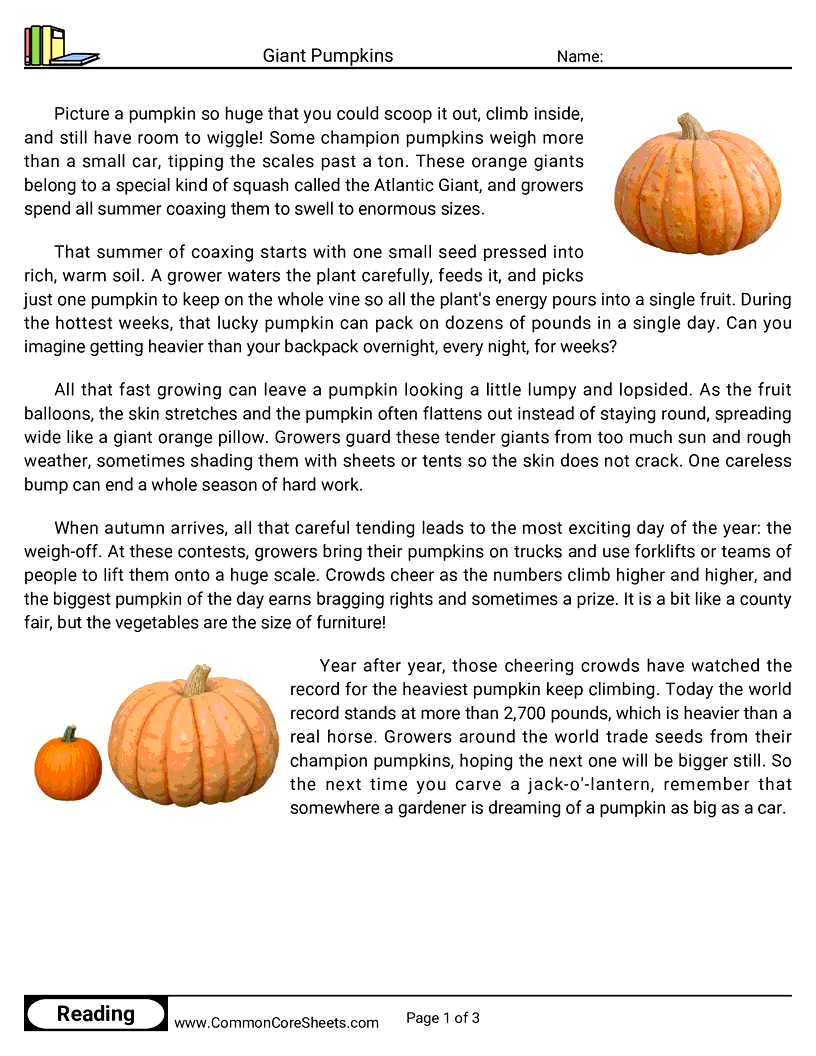
Picture a pumpkin so huge that you could scoop it out, climb inside, and still have room to wiggle! Some champion pumpkins weigh more than a small car, tipping the scales past a ton. These orange giants belong to a special kind of squash called the Atlantic Giant, and growers spend all summer coaxing them to swell to enormous sizes.
That summer of coaxing starts with one small seed pressed into rich, warm soil. A grower waters the plant carefully, feeds it, and picks just one pumpkin to keep on the whole vine so all the plant's energy pours into a single fruit. During the hottest weeks, that lucky pumpkin can pack on dozens of pounds in a single day. Can you imagine getting heavier than your backpack overnight, every night, for weeks?
All that fast growing can leave a pumpkin looking a little lumpy and lopsided. As the fruit balloons, the skin stretches and the pumpkin often flattens out instead of staying round, spreading wide like a giant orange pillow. Growers guard these tender giants from too much sun and rough weather, sometimes shading them with sheets or tents so the skin does not crack. One careless bump can end a whole season of hard work.
When autumn arrives, all that careful tending leads to the most exciting day of the year: the weigh-off. At these contests, growers bring their pumpkins on trucks and use forklifts or teams of people to lift them onto a huge scale. Crowds cheer as the numbers climb higher and higher, and the biggest pumpkin of the day earns bragging rights and sometimes a prize. It is a bit like a county fair, but the vegetables are the size of furniture!
Year after year, those cheering crowds have watched the record for the heaviest pumpkin keep climbing. Today the world record stands at more than 2,700 pounds, which is heavier than a real horse. Growers around the world trade seeds from their champion pumpkins, hoping the next one will be bigger still. So the next time you carve a jack-o'-lantern, remember that somewhere a gardener is dreaming of a pumpkin as big as a car.
Picture a pumpkin so heavy that a forklift has to lift it, one that weighs more than a small car sitting in a parking lot. Sounds impossible, right? Yet every autumn, growers wheel these orange monsters onto giant scales, hoping their pumpkin will tip the numbers higher than anyone else's. These aren't the little pumpkins you carve for Halloween; they are pale, lumpy, and wide as a kiddie pool, and they can flatten under their own enormous weight.
That flattened, lopsided shape is actually a clue to how these giants got so big in the first place. Almost every record-breaking pumpkin comes from a single variety called the Atlantic Giant, bred by a Canadian gardener named Howard Dill in the 1970s. Dill spent years saving seeds from his biggest pumpkins and planting them again, so each generation grew larger than the one before. He eventually trademarked his seeds, and today growers around the world trade Atlantic Giant seeds like treasure, because the right seed can mean hundreds of extra pounds.
Having a champion seed is only the beginning, because growing a giant is a summer-long science experiment. At the peak of its growth in mid-summer, a single pumpkin can pack on dozens of pounds in one day, swelling so fast you could almost watch it happen. To feed that hunger, growers give their plants gallons of water, rich compost, and careful shade so the skin doesn't crack under the strain. Some even pick off every pumpkin but one, so the whole plant pours all its energy into that single lucky fruit.
All that summer effort leads to one nerve-wracking morning: the weigh-off. At these contests, held across North America and Europe each October, growers crane their pumpkins onto official scales while a crowd counts down the pounds. The atmosphere feels like a sporting event, with families cheering, cameras flashing, and years of hard work resting on one final number. The current world record stands at more than 2,700 pounds, a pumpkin heavier than a full-grown horse.
Beating a record like that takes patience, luck, and a little bit of obsession. Many top growers spend the whole year thinking about next season, keeping journals of temperatures, measuring their pumpkins each morning with a tape measure. They share tips online and cheer each other on, even though they are competing for the same trophy. And here is the strangest twist of all: some of these giant pumpkins are later hollowed out, floated on lakes, and paddled like boats in wacky regatta races!
You probably think a pumpkin is something you can carry home from the store under one arm. Some pumpkins, though, are so heavy that it takes a forklift to move them off the vine! These monsters are round, pale orange, and slightly lopsided, like a beanbag chair that has slumped in the sun. Their thick shells crack and ripple as they swell, and their vines stretch across a garden like fat green fire hoses. Growing one is a hobby that has turned patient gardeners into champions.
The champions almost all start with the same secret ingredient: a variety called the Atlantic Giant. This special pumpkin was bred over many years by a Canadian grower named Howard Dill, who patented his seeds so his prize-winning line would live on. Every record-smashing pumpkin you see today traces its family tree back to seeds like his. Growers trade these seeds carefully, sometimes selling a single seed from a famous pumpkin for a surprising amount of money. A tiny seed, no bigger than your thumbnail, holds the promise of something that could outweigh a car.
That promise only comes true because of how fast these plants can pack on weight. At the peak of summer, a giant pumpkin can gain dozens of pounds in a single day, swelling so quickly that growers claim you can almost watch it grow. To feed that appetite, the plant grows enormous leaves that catch sunlight and roots that drink hundreds of gallons of water. Growers baby their pumpkins, shading them from harsh sun, tucking blankets around them on cold nights, and picking off all but one fruit so the whole vine pours its energy into a single giant. It is a bit like raising one very hungry, very demanding pet.
All that pampering leads to one nerve-racking moment: the weigh-off. Each fall, growers haul their heaviest pumpkins to contests where a giant scale settles who has grown the true champion. The current world record is a pumpkin that tipped the scale at more than 2,700 pounds, heavier than a small car with people inside it. Winners can take home cash prizes and, maybe more importantly, bragging rights that last all year. Losing by a few pounds after months of work can be heartbreaking, but most growers shake hands and start planning next season on the drive home.
That stubborn hope is exactly why this quirky hobby still matters. Giant pumpkins pull thousands of visitors to fall festivals, giving small farm towns a reason to celebrate and a boost to local businesses. Scientists and gardeners also learn from these plants, studying how living things can grow so fast without splitting apart under their own weight. And there is something wonderful about a hobby where ordinary people, armed with patience and a garden hose, can grow a piece of produce larger than themselves. The next record-breaker may be sprouting right now in somebody's ordinary backyard.
Picture a pumpkin so heavy that a forklift, not a farmer, has to lift it off the ground. Some giant pumpkins tip the scales at more than a small car, and a champion can gain dozens of pounds in a single day at its peak. These aren't the round orange pumpkins you carve on Halloween; they slump into pale, lopsided blobs, stretched wide by their own enormous weight. Growing one is part gardening, part science experiment, and part obsession that eats up an entire summer.
That obsession almost always begins with a single seed from a variety called the Atlantic Giant. Nearly every record-breaking pumpkin on Earth traces back to this one line, first developed by a Canadian grower named Howard Dill in the 1970s and early 1980s. Dill patented his seeds and won contest after contest with them, and other growers soon realized that if they wanted a monster, they needed his stock. Today the best seeds are practically treasures, passed between growers and sometimes auctioned for hundreds of dollars apiece.
Getting one of those prized seeds is only the start, because a giant pumpkin is a hungry, thirsty machine. During its fastest stretch in mid to late summer, a single plant can drink dozens of gallons of water in a day and pack on 40 to 50 pounds in that same 24 hours. Growers feed the soil, protect the fruit from sunburn with sheets and blankets, and pick off extra pumpkins so all the plant's energy pours into just one. Imagine putting on the weight of a large dog every single day, and you begin to understand the pace.
All that careful work builds toward one dramatic afternoon: the weigh-off. Each autumn, growers load their giants onto trucks and haul them to contests, where a crane or forklift sets each one on a giant scale before a cheering crowd. The tension is real, because a pumpkin that looks like a winner can hide a soft spot or a hidden split that gets it disqualified. A single afternoon on the scale can decide whose entire summer of watering, worrying, and record-keeping paid off.
The numbers those scales show have climbed almost unbelievably over the decades. When Howard Dill set an early record, his pumpkin weighed a few hundred pounds, which seemed gigantic at the time. The current world record now stands at more than 2,700 pounds, heavier than a car and many times the weight of Dill's early giant. Growers push the number higher almost every year by sharing seeds, comparing notes online, and treating each harvest like data for the next one.
That habit of sharing is exactly why the giants keep growing instead of hitting a wall. A grower in one country will mail seeds from a champion pumpkin to a stranger across an ocean, hoping their combined effort tops the record next season. It's a friendly kind of competition, where beating a rival and helping a rival somehow become the same thing. Not bad for a plant that started as a single seed and ended up needing a crane to lift it.
In the fall of 2023, a horticulturist named Travis Gienger loaded a pumpkin the size of a hay bale onto his truck in Minnesota and drove it all the way to California, sleeping only a few hours a night because he was afraid to leave it alone. When it finally rolled onto the scale, it weighed more than 2,700 pounds, and that number is real. Picture a squash heavier than a small car, its shoulders wider than a doorway, its skin stretched pale and pumpkin smooth. Growers call these monsters "Atlantic Giants," and the people who raise them treat the whole thing less like gardening and more like a science experiment that happens to end in a parking lot full of applause.
That "science experiment" description is not an exaggeration, because winning a weigh off has almost nothing to do with luck. Serious growers start with pedigreed seeds, saved from champion fruit and traded like rare baseball cards, sometimes for hundreds of dollars a seed. They test their soil the way a chemist tests a sample, adjusting the balance of nutrients so the plant has everything it needs. A single vine may spread across an area larger than a two car garage, and growers bury parts of it so it can grow extra roots to feed one enormous fruit. Everything the plant makes is funneled into that one pumpkin, the way a family might pour all its savings into a single dream.
All that careful preparation pays off in a burst of growth that is genuinely hard to believe. At its peak in mid summer, an Atlantic Giant can pack on 40 to 50 pounds in a single day, swelling so fast that growers say you can almost watch it happen. If you visited the same pumpkin each morning, you would find it noticeably larger by dinnertime, like a balloon being filled in slow motion. This explosive growth is also the plant's biggest danger, because skin that stretches too quickly can split, and a cracked pumpkin is disqualified. To prevent that, growers shade their giants with sheets and blankets, guarding them from sun and cold as if they were newborns.
Guarding a giant from cracking is only half the battle; the other half is getting it to the scale in one piece. Moving a fruit heavier than a grand piano requires a tripod, straps, and often several strong neighbors, because one clumsy lift can undo a whole summer of work. At the weigh off, each pumpkin is lowered onto an industrial scale while a crowd counts down, and the official number is announced like a sports score. The largest of these events, such as the Safeway World Championship in Half Moon Bay, California, draw growers from across the country and beyond. Prize money can climb into the tens of thousands of dollars, but many growers admit they would compete for nothing more than bragging rights.
Those bragging rights have climbed to heights that early growers could never have imagined, and that steady climb tells its own story. The Atlantic Giant variety was developed by a Canadian grower named Howard Dill, who patented his seeds in 1979 and became known as the father of the giant pumpkin world. Back then, a 500 pound pumpkin was a marvel; today that would not even qualify for a serious contest. The record has been shattered again and again as growers share seeds, data, and techniques instead of hoarding secrets, which is unusual for a competition. In other words, the giants keep getting bigger partly because the people racing to beat one another also help one another.
That spirit of cooperation leads to a surprising second life for the losing fruit. After the weigh offs, some giant pumpkins are hollowed out, fitted with seats, and paddled across lakes in "pumpkin regattas," turning the fruit into a boat. Others are carved into towering jack o lanterns for Halloween or donated to be smashed for compost and next year's seeds. The seeds themselves are the real treasure, saved and mailed around the world so that a champion in one country can father a champion in another. So the next time you lift a grocery store pumpkin and think it is heavy, remember that somewhere a grower is nervously watching a fruit gain your entire body weight in a single week.
About this worksheet
Students read a nonfiction passage about giant pumpkins and the people who grow them, written at 9 reading levels (kindergarten to 8th grade), and answer multiple-choice questions about it.
A reading comprehension worksheet about giant pumpkins and the people who grow them with a different article for each reading level, kindergarten to 8th grade, each with its own multiple-choice questions aligned to the Common Core Reading: Informational Text standards. Printable with an answer key, and available as an online assignment at any level.
Student objectives
- Read a passage about giant pumpkins and their growers.
- Find details explaining how growers help a pumpkin grow huge.
- Explain why the author uses comparisons like 'heavier than a horse'.
- Describe the steps a pumpkin goes through from seed to weigh-off.
Everyday practice
- Notice the size and shape of pumpkins at a store or patch this fall.
- Try measuring how much heavier your backpack is on different days.
- Look up a photo of a weigh-off and compare the pumpkin to a car.