Caramel Apples Worksheet Download
Free reading comprehension worksheet about caramel apples and candy apples. Pick the reading level (kindergarten to 5th grade), print the passage with its questions, or assign it online.


Sheet Information >
Available at kindergarten, 1st grade, 2nd grade, 3rd grade, 4th grade and 5th grade reading levels.
Read the passage
Yum look at that shiny red apple on a stick! It is a candy apple with a hard sugar shell. A caramel apple is soft and sticky and sweet.
That soft caramel starts as plain white sugar. A grown-up heats the sugar until it turns brown and gooey. Then they dip the apple in the warm caramel.
Apples like these are a fall treat when apples are ripe. In fall you can pick apples right off the tree. Did you know one apple can have a lot of tiny seeds inside?
Have you ever bitten into a sticky, sweet apple on a stick? That is a caramel apple, and it is a fall treat! A soft, tan coat wraps all around the crunchy fruit.
Some apples wear a shiny red coat instead of the soft tan one. These are candy apples, and their shell is hard and smooth. Cooks make that shell by heating sugar until it melts.
Fall is the best time for these treats because that is apple season. Farmers pick ripe apples from the trees in autumn. With a grown-up to help, you can dip an apple and make a treat too!
Crunch! Have you ever bitten into an apple wrapped in shiny red candy? A candy apple has a hard, sweet shell that shines like glass in the light. A caramel apple is soft and chewy instead, all covered in golden-brown caramel.
That chewy caramel starts as plain white sugar on the stove. When a grown-up heats sugar slowly, it melts and turns a warm brown color. This browning is called caramel, and it smells buttery and sweet all over the kitchen.
Sweet apples like these come from a busy time called the harvest. In fall, farmers pick ripe apples off the trees, filling baskets and bins. That is why these treats show up in autumn, when apples are fresh and crisp.
You can make one at home when a grown-up helps with the hot pot. First you push a stick into the apple, then dip it and let it cool. Best of all, one apple can hide under all that candy like a sweet little surprise!
Imagine you are at a fall fair, and you spot a shiny red apple on a stick that gleams like glass! That is a candy apple, an apple dipped in hard, sweet coating that crackles when you bite it. Right next to it sits its cousin, the caramel apple, wrapped in soft, chewy caramel the color of golden brown honey. Both are cool, crunchy, and sticky all at once.
That golden brown caramel does not come out of the ground looking like that. It starts as plain white sugar, which a grown-up heats in a pan until it melts and slowly turns brown. Because heat changes the sugar, it becomes gooey and tastes rich and buttery instead of just sweet. Then someone dips a whole apple right in, and the warm caramel hugs it like a blanket.
Speaking of apples, the best time to make these treats is when apples are freshest. Farmers pick most apples in the fall, from about September to October, which is called the harvest. Long ago, families would use the crunchy new apples to make sweet treats after the picking was done. So when the leaves turn orange and red, you know apple season, and treat season, has arrived!
Making these treats can be fun, but always ask a grown-up for help first. The melted sugar gets very hot, hotter than boiling water, so only a grown-up should heat it. Your job is the tasty part: washing the apples, pushing in the sticks, and rolling them in nuts or sprinkles. Here is something sweet to think about: one plain apple can turn into a treat that looks like a jewel!
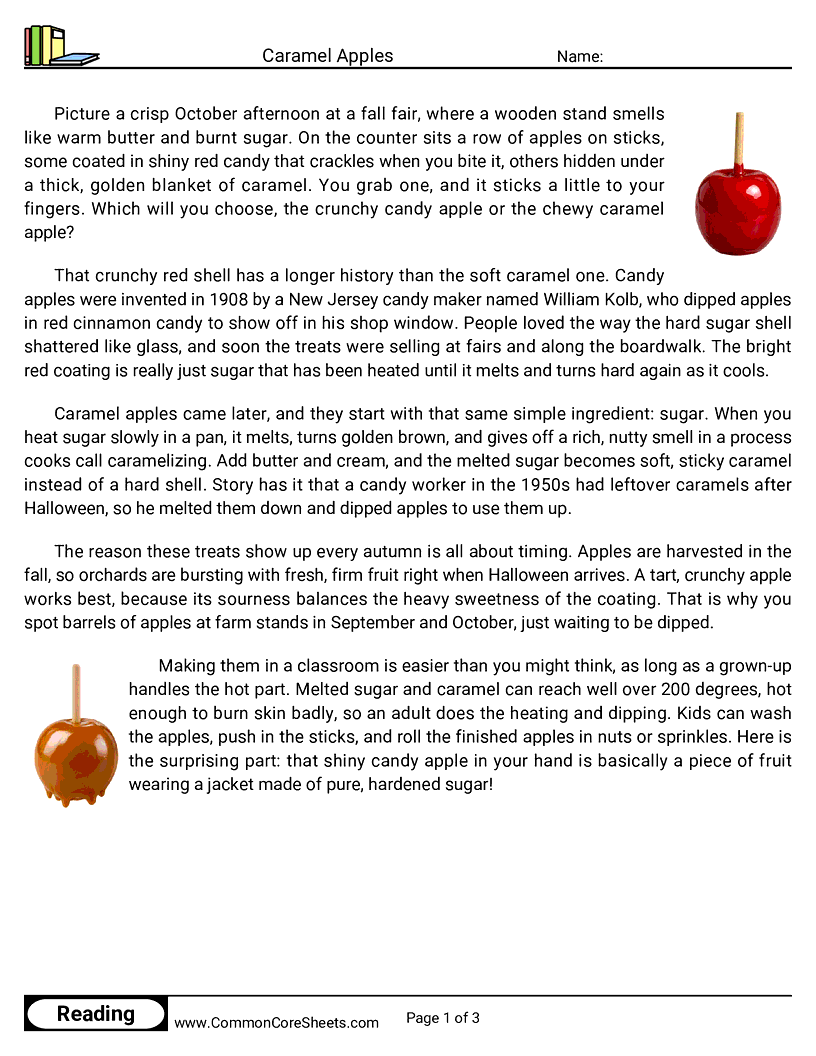
Picture a crisp October afternoon at a fall fair, where a wooden stand smells like warm butter and burnt sugar. On the counter sits a row of apples on sticks, some coated in shiny red candy that crackles when you bite it, others hidden under a thick, golden blanket of caramel. You grab one, and it sticks a little to your fingers. Which will you choose, the crunchy candy apple or the chewy caramel apple?
That crunchy red shell has a longer history than the soft caramel one. Candy apples were invented in 1908 by a New Jersey candy maker named William Kolb, who dipped apples in red cinnamon candy to show off in his shop window. People loved the way the hard sugar shell shattered like glass, and soon the treats were selling at fairs and along the boardwalk. The bright red coating is really just sugar that has been heated until it melts and turns hard again as it cools.
Caramel apples came later, and they start with that same simple ingredient: sugar. When you heat sugar slowly in a pan, it melts, turns golden brown, and gives off a rich, nutty smell in a process cooks call caramelizing. Add butter and cream, and the melted sugar becomes soft, sticky caramel instead of a hard shell. Story has it that a candy worker in the 1950s had leftover caramels after Halloween, so he melted them down and dipped apples to use them up.
The reason these treats show up every autumn is all about timing. Apples are harvested in the fall, so orchards are bursting with fresh, firm fruit right when Halloween arrives. A tart, crunchy apple works best, because its sourness balances the heavy sweetness of the coating. That is why you spot barrels of apples at farm stands in September and October, just waiting to be dipped.
Making them in a classroom is easier than you might think, as long as a grown-up handles the hot part. Melted sugar and caramel can reach well over 200 degrees, hot enough to burn skin badly, so an adult does the heating and dipping. Kids can wash the apples, push in the sticks, and roll the finished apples in nuts or sprinkles. Here is the surprising part: that shiny candy apple in your hand is basically a piece of fruit wearing a jacket made of pure, hardened sugar!
Picture biting into an apple and hearing a loud crack instead of the usual soft crunch. That's what happens with a candy apple, an ordinary apple dunked in a hard, glassy shell of bright red sugar. Its cousin, the caramel apple, wears a softer coat of golden-brown caramel that stretches and pulls when you take a bite. Both treats show up every autumn on sticks, glowing like little jewels at fairs and festivals.
Those two shells may look similar, but they are made in totally different ways. A candy apple's coating is just sugar and water boiled until it turns rock-hard and shatters like glass when it cools. Caramel is trickier, because sugar has to be heated slowly until it browns and takes on a rich, toasty flavor. That browning is a real chemical change called caramelization, and it usually begins when sugar gets to around 320 degrees Fahrenheit.
That searing heat is exactly why these treats are older than you might guess. The candy apple came first, invented in 1908 by a candy maker named William Kolb in Newark, New Jersey. Story has it that he was experimenting with red cinnamon candy for the holidays and decided to dip apples into the melted syrup as a display. Shoppers loved them, and soon shiny red apples were being sold at candy shops and, later, at seaside boardwalks up and down the coast.
Caramel apples rolled onto the scene decades after those glassy red ones. One popular tale says a Kraft Foods employee named Dan Walker came up with the idea in the 1950s by melting leftover caramels and dipping apples into the warm goo. Whether or not that story is exactly true, caramel apples caught on fast because caramel is easier to eat than a shell that can crack a tooth. People began rolling the sticky apples in chopped peanuts, and today you can find them coated in chocolate, sprinkles, and even crushed cookies.
It's no accident that both treats arrive right around Halloween. Apples are harvested in the fall, so orchards are bursting with fresh fruit exactly when candy season begins. If your class wants to try making some, an adult must handle the boiling sugar, because it is far hotter than boiling water and can cause serious burns. The wildest part is the timing itself: the apple you dip took a whole summer of sunshine to grow, yet its shiny coat forms in less than a minute.
About this worksheet
Students read a nonfiction passage about caramel apples and candy apples, written at 6 reading levels (kindergarten to 5th grade), and answer multiple-choice questions about it.
A reading comprehension worksheet about caramel apples and candy apples with a different article for each reading level, kindergarten to 5th grade, each with its own multiple-choice questions aligned to the Common Core Reading: Informational Text standards. Printable with an answer key, and available as an online assignment at any level.
Student objectives
- Read an informational passage about candy apples and caramel apples
- Explain why these treats are made in the fall
- Find details that show how caramel is made from sugar
- Explain the difference between a candy shell and caramel
Everyday practice
- Notice which apples at the store are labeled tart or sweet
- Watch a grown-up melt sugar and see how it changes color
- Compare the crunch of a hard candy to the chew of a soft caramel