Candy Corn Worksheet Download
Free reading comprehension worksheet about candy corn. Pick the reading level (kindergarten to 8th grade), print the passage with its questions, or assign it online.


Sheet Information >
Available at kindergarten, 1st grade, 2nd grade, 3rd grade, 4th grade, 5th grade, 6th grade, 7th grade and 8th grade reading levels.
Read the passage
Look at that little candy shaped like corn! It has three fun colors. The bottom is yellow the middle is orange and the tip is white.
Those three colors are very old! Candy corn was made a long long time ago before your grandparents were born. Long ago people made it look like corn because many families grew corn on farms.
Back then workers made candy corn by hand. They poured it to make each color. Did you know some kids love candy corn and some kids do not? Both are okay because candy corn tastes very very sweet!
Have you ever eaten a candy shaped like corn? That is candy corn! Each little piece has three colors: a white tip, an orange middle, and a yellow bottom.
Those three colors are very old. Candy corn began in the 1880s, longer ago than your great-great-grandparents were born. A candy maker named George Renninger is said to have made the first pieces.
Back then, workers poured the candy by hand, one color at a time. That job was slow and hard! Today many people love candy corn, but some do not like it at all.
Have you ever eaten a candy shaped like a tiny piece of corn? That candy is called candy corn, and it comes in three bright colors! Each little piece has a white tip, an orange middle, and a yellow bottom, just like a real kernel of corn.
Those three colors have not changed in a very long time. Candy corn was first made way back in the 1880s, longer ago than your great-great-grandparents were born! A candy maker named George Renninger, who worked at the Wunderlee Candy Company, is often given credit for the idea.
Because so many people back then lived and worked on farms, the candy was shaped to look like something they knew well: corn! Long ago, workers made it by hand, pouring sugary syrup from buckets in three colored layers. They had to pour one color, let it dry, then pour the next, over and over.
Even today, candy corn still looks and tastes almost the same as it did back then. Some people love its sweet, waxy chew, while others say they do not like it one bit! That is why candy corn is one of the most argued-about treats every Halloween.
Imagine you are holding a tiny piece of candy shaped just like a kernel of corn. The bottom is bright yellow, the middle is warm orange, and the very tip is white as snow. It feels waxy and smooth, and when you bite it, it tastes sweet like honey and sugar. This little three-colored treat is called candy corn, and it shows up in bowls all over America every fall!
That corn shape was not picked by accident. Long ago, in the 1880s, most people in America lived and worked on farms, so corn was everywhere. A candy maker named George Renninger, who worked at the Wunderlee Candy Company, made a candy that looked just like the crop farmers grew. People loved that a sweet treat could look like something from their own fields.
Making these little kernels back then was slow, hard work. First, workers heated up sugar until it turned into a thick, gooey syrup. Then they carried heavy buckets and poured the three colors into corn-shaped molds by hand, one layer at a time, so each color could cool before the next one went in. Because it took so much careful pouring, one worker could only make so much in a day.
Today machines do the pouring, but the candy still wears the very same three colors it had over a hundred years ago. Here is something funny about it: people argue about candy corn more than almost any other treat! Some folks say it is too sweet and cannot stand it, while others happily eat handfuls every October. Can you believe a candy older than your great-great-grandparents is still starting friendly arguments today?
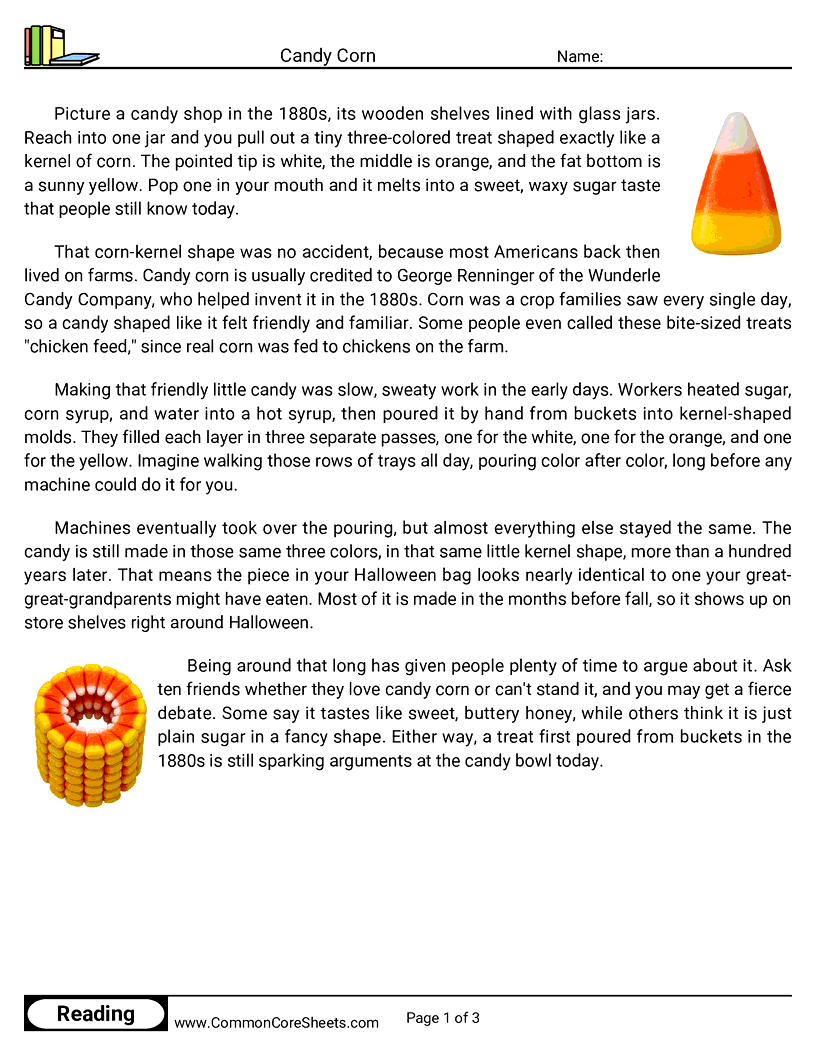
Picture a candy shop in the 1880s, its wooden shelves lined with glass jars. Reach into one jar and you pull out a tiny three-colored treat shaped exactly like a kernel of corn. The pointed tip is white, the middle is orange, and the fat bottom is a sunny yellow. Pop one in your mouth and it melts into a sweet, waxy sugar taste that people still know today.
That corn-kernel shape was no accident, because most Americans back then lived on farms. Candy corn is usually credited to George Renninger of the Wunderle Candy Company, who helped invent it in the 1880s. Corn was a crop families saw every single day, so a candy shaped like it felt friendly and familiar. Some people even called these bite-sized treats "chicken feed," since real corn was fed to chickens on the farm.
Making that friendly little candy was slow, sweaty work in the early days. Workers heated sugar, corn syrup, and water into a hot syrup, then poured it by hand from buckets into kernel-shaped molds. They filled each layer in three separate passes, one for the white, one for the orange, and one for the yellow. Imagine walking those rows of trays all day, pouring color after color, long before any machine could do it for you.
Machines eventually took over the pouring, but almost everything else stayed the same. The candy is still made in those same three colors, in that same little kernel shape, more than a hundred years later. That means the piece in your Halloween bag looks nearly identical to one your great-great-grandparents might have eaten. Most of it is made in the months before fall, so it shows up on store shelves right around Halloween.
Being around that long has given people plenty of time to argue about it. Ask ten friends whether they love candy corn or can't stand it, and you may get a fierce debate. Some say it tastes like sweet, buttery honey, while others think it is just plain sugar in a fancy shape. Either way, a treat first poured from buckets in the 1880s is still sparking arguments at the candy bowl today.
Picture a tiny pyramid the size of your fingernail, striped in white, orange, and yellow, sweet enough to make your teeth tingle. You have probably seen candy corn spilling out of a bowl every October, but have you ever wondered why it looks like a piece of corn in the first place? The answer takes us back more than a hundred years, to a time when most Americans lived on farms. Back then, corn was not just food for people; it fed the horses, the pigs, and the whole country.
Because so much of the country depended on farming, candy makers in the 1880s decided to shape their sweets like the crops people knew best. One of those makers was a man named George Renninger, who worked at the Wunderle Candy Company and is usually given credit for inventing this three-colored treat. At first it was called "chicken feed," because it looked like the kernels farmers scattered for their hens. Imagine handing a friend a box labeled chicken feed today and telling them it was candy!
Naming it after farm animals was clever, but making it was slow, sticky work. Long before machines could do the job, workers poured hot, colored sugar into little kernel molds by hand, one bucket at a time. They filled each mold with three layers, starting with the white tip, then the orange middle, then the yellow bottom, and waited for every batch to cool. Because the whole thing was done by hand, candy corn was mostly a fall treat, produced only in small amounts and sold near the seasons when farmers had time to buy it.
Those same three colors that workers layered by hand have not changed in all the years since. Machines took over the pouring, so factories can now make the little kernels by the millions instead of the bucketful, which is why the candy is no longer a rare seasonal surprise. One thing has stayed exactly the same, though: it is still made from sugar, corn syrup, and a bit of waxy shine, in the very same white-orange-yellow pattern Renninger's workers first poured. In other words, the candy corn you eat looks almost identical to the ones your great-great-grandparents might have munched.
Here is where the friendly fighting begins, because few candies split people into two camps the way this one does. Some folks pop handfuls happily, while others insist it tastes like flavored wax, and both sides defend their opinion every single October. Surveys by the National Retail Federation and candy sellers show it is one of the most-bought Halloween candies each year, even though plenty of people say they cannot stand it. So the next time someone groans at a bowl of it, remember you are holding a treat older than cars, older than airplanes, and stubborn enough to survive over a century of arguments.
Here's a question that can start a fight at any Halloween party: is candy corn a delicious classic or the worst treat in the bowl? Almost nobody feels neutral about it. Picture a tiny triangle striped in three bands of color \u2014 a white tip, an orange middle, and a wide yellow base \u2014 shaped to look exactly like a plump kernel of corn. It's chewy, waxy, and sweet enough to make your teeth ache, and every autumn it reappears in stores like clockwork. Love it or hate it, this little candy has survived for well over a century, which is more than most trends can claim.
That survival is even stranger when you learn how humble its beginnings were. Candy corn was invented in the 1880s, and the recipe is usually credited to George Renninger of the Wunderle Candy Company in Philadelphia. Back then the United States was still mostly a nation of farmers, so making a candy that looked like a crop was a clever way to connect with everyday life. At a time when most of America worked the land, a sweet shaped like corn felt friendly and familiar rather than fancy. It wasn't tied to Halloween at all yet \u2014 it was simply a bright treat that reminded people of the fields around them.
Familiar as it looks today, making it used to be backbreaking work done entirely by hand. Workers heated sugar, corn syrup, and other ingredients into a thick slurry, then poured it into kernel-shaped molds using buckets, one color at a time. First the white passed down the rows, then the orange, and finally the yellow, so the stripes stacked up layer by layer. Imagine walking mile after mile in a factory, hauling heavy buckets and pouring molten sugar all day long. The whole process was seasonal, running only in the cooler months, and for decades it was known by the charming nickname \u201cchicken feed.\u201d
Those hand-poured buckets are long gone, but the candy itself has barely changed. Machines now do the layering that workers once managed by hand, yet the classic version still wears the very same three colors it did in the 1880s. In other words, the candy corn you grab this October looks almost identical to the kind your great-great-grandparents might have eaten. Companies have added new flavors over the years \u2014 chocolate, caramel apple, even holiday versions in red and green \u2014 but the original tricolor kernel remains the star. Somewhere along the way it became firmly attached to Halloween, and today most of the year's supply is sold in the weeks leading up to it.
So why does a simple sugar triangle still matter more than 130 years after it appeared? Part of the answer is that it has become a symbol of the season itself, as recognizable as a jack-o'-lantern or a bag of trick-or-treat candy. The other part is the argument it starts, because few foods inspire such loud opinions on both sides. In my view, that endless debate is exactly why candy corn refuses to disappear \u2014 a treat people ignored would have vanished long ago. The strangest twist of all is that a candy invented to celebrate cornfields is now most famous for dividing dinner tables every fall.
Here is a candy that has been starting arguments at the dinner table since your great-great-grandparents were kids. Candy corn is a tiny, triangular sweet no bigger than the tip of your finger, striped in three bold bands: a white pointed top, an orange middle, and a wide yellow base. Bite into one and it is waxy, chewy, and almost pure sugar, with a faint honey-and-vanilla flavor. People either adore it or can't stand the sight of it, and almost nobody feels lukewarm about the stuff.
That fierce love-it-or-hate-it split is nothing new, because this candy is well over a century old. It is usually credited to George Renninger of the Wunderlee Candy Company, who is thought to have invented it back in the 1880s. Picture America at that time: most families still lived on farms, and corn was one of the crops that fed the whole country. A candy shaped like a kernel of corn felt friendly and familiar, a little piece of the harvest you could carry in your pocket.
Familiar as it looked, making it was surprisingly slow and messy work. Back then there were no machines to squirt out neat rows, so workers poured hot sugar syrup from buckets into kernel-shaped molds by hand. They laid down one color, let it cool, then poured the next, which is exactly why each piece has three separate stripes. Doing this all day was hot, sticky, tiring labor, and a single worker could only fill so many trays before the batch hardened.
That handmade, three-layer look turned out to be the candy's lucky charm. When another company, the Goelitz Confectionery Company, began producing it, the treat's popularity spread far beyond the farm. Goelitz is still around today under the name Jelly Belly, which means the recipe has been passed down for well over a hundred years. Astonishingly, the candy is still made in those same three colors, so the piece you eat this October looks almost identical to one from the 1800s.
Looking the same for a century has not made everyone agree it should exist. According to surveys reported around Halloween, candy corn regularly lands on both the most-loved and most-hated candy lists, sometimes in the very same poll. Fans say the honey flavor and the satisfying way it snaps between your teeth are part of the fun. Critics groan that it tastes like flavored wax and is far too sweet, arguing that one handful is one handful too many.
Whichever side you land on, the numbers show plenty of people are still buying it. Manufacturers report making billions of these little kernels every year, most of them sold in the weeks around Halloween. There is even a National Candy Corn Day, celebrated on October 30th, the day before Halloween. So the next time you spot that white-orange-yellow triangle, remember it has survived more than 130 years of people insisting it is the worst candy ever made.
Ask ten people how they feel about candy corn, and you might start an argument that lasts until dinner. Few candies in America are loved and loathed with such equal energy. Each little piece is shaped like a fat kernel of corn, wider than your fingernail, painted in three stripes: a white tip, an orange middle, and a yellow base. It is soft but waxy, and so sweet it seems to buzz on your tongue. Somehow this tiny triangle has become one of the most recognizable candies of the Halloween season, and one of the most divisive.
That division has a surprisingly long history, because this candy is far older than most people guess. It was invented in the 1880s, back when the majority of Americans still lived on farms and worked the land. Historians usually credit George Renninger, a candy maker at the Wunderle Candy Company in Philadelphia, with dreaming up the recipe. At a time when candy was often plain and one color, a striped piece shaped like a crop was a clever novelty. Renninger's little kernel was designed to look like something a farmer grew, which is exactly why the country noticed it.
Looking like a crop was the whole point, and that choice tells you something about the America that first bought it. In the late 1800s, corn was not just food; it was the symbol of an entire way of life, the thing that fed families and livestock alike. A candy shaped like corn spoke directly to that world, which is one reason it was originally sold as a year-round treat called "chicken feed," not a Halloween snack at all. Manufacturers even printed a rooster on early boxes, leaning into the farm joke. In other words, the candy we now file under October was first a wink at farm life the whole year round.
Making that farm joke by hand was slow, grueling work that few of us would volunteer for today. Workers melted sugar, corn syrup, and other ingredients into a hot slurry, then poured it into kernel-shaped molds in three separate passes, one color at a time. Men called "stringers" walked backward down the line, hauling heavy buckets and dribbling each layer in turn so the white, orange, and yellow set in order. The whole batch had to cool and firm between pours, so a single tray took real patience. Today machines do the layering in seconds, but the recipe and those same three colors have barely changed in more than a century.
Those unchanged colors are part of why the candy became a fixture, and why it eventually drifted toward one holiday in particular. As Halloween grew into a major American celebration in the twentieth century, the treat's warm autumn colors and harvest shape made it a natural fit for October. Companies began marketing it heavily for the season, and the year-round "chicken feed" slowly became a fall tradition instead. According to the National Confectioners Association, manufacturers now produce billions of pieces each year, most of them sold in the weeks around Halloween. A candy born to celebrate the cornfield had found a second life celebrating the jack-o'-lantern.
And still, after all these years, people cannot agree on whether the stuff is any good. Critics call it flavorless sugar in a costume; fans insist the honey-and-vanilla sweetness is exactly the point. Surveys taken around Halloween regularly place it near the top of America's "most hated" candy lists, yet stores keep selling it out every autumn, which tells you the haters may be outnumbered at the register. That contradiction is the real secret of candy corn: a treat can be wildly unpopular in conversation and wildly popular in the shopping cart at the very same time. Perhaps the most surprising thing is that a candy invented to look like farm feed has survived, unchanged, longer than the cars, phones, and songs of every generation that has argued about it.
About this worksheet
Students read a nonfiction passage about candy corn, written at 9 reading levels (kindergarten to 8th grade), and answer multiple-choice questions about it.
A reading comprehension worksheet about candy corn with a different article for each reading level, kindergarten to 8th grade, each with its own multiple-choice questions aligned to the Common Core Reading: Informational Text standards. Printable with an answer key, and available as an online assignment at any level.
Student objectives
- Read a chronological passage about the history of candy corn
- Find specific details that explain why the candy was shaped like corn
- Explain how candy corn was made before machines took over
- Determine the meaning of words like "credited" from context
Everyday practice
- Look at a piece of candy corn and name its three colors from tip to bottom
- Ask family members whether they love or dislike candy corn and compare answers
- Notice which stores start selling Halloween candy before fall begins