Boxelder Bugs Worksheet Download
Free reading worksheets on Boxelder Bugs. Each worksheet has 20 problems with an answer key and are ideal for teachers and homeschooling. You can download the PDF, create a set of flash cards or set it up for online learning.


Sheet Information >
Available at 2nd grade, 3rd grade, 4th grade, 5th grade and 6th grade reading levels.
Read the passage
Hey kids, let's talk about boxelder bugs, a fascinating little creature! These bugs have red and black bodies and can be found mostly in North America. Boxelder bugs live on boxelder trees, maple trees, and even sometimes on fruit trees.
Now let's explore the life of a boxelder bug and what they eat. These bugs love munching on leaves, flowers, and seeds of their favorite trees. The life cycle of a boxelder bug consists of four stages: egg, nymph, and adult.
Lastly, let's learn about their relationship with humans and other insects. Boxelder bugs don't harm humans but can be a nuisance when they gather in large numbers. Their defense mechanism is releasing a smelly substance to deter predators like birds and spiders.
In conclusion, boxelder bugs are interesting insects that play a unique role in nature.
Hey kids, let's learn about boxelder bugs! Boxelder bugs are black and red insects that are about half an inch long. They love to eat boxelder tree seeds and sometimes the leaves of other trees like maple and ash. These bugs usually live in the United States and Canada, where they can find their favorite trees.
Now, let's talk about their life cycle and how they get along with humans and other insects. Boxelder bugs start as eggs, then hatch into tiny red nymphs, and eventually grow into full-sized adults. They don't usually bother humans, but sometimes they come inside our homes when it gets cold outside. Other insects like ladybugs and praying mantises are their predators and help to control their population.
Boxelder bugs have some interesting differences and cool ways to protect themselves. Unlike other bugs, boxelder bugs have a unique red and black pattern on their wings. To defend themselves, they release a smelly liquid that tastes bad to predators. Isn't it fascinating how these little creatures have their own unique characteristics and ways to survive?
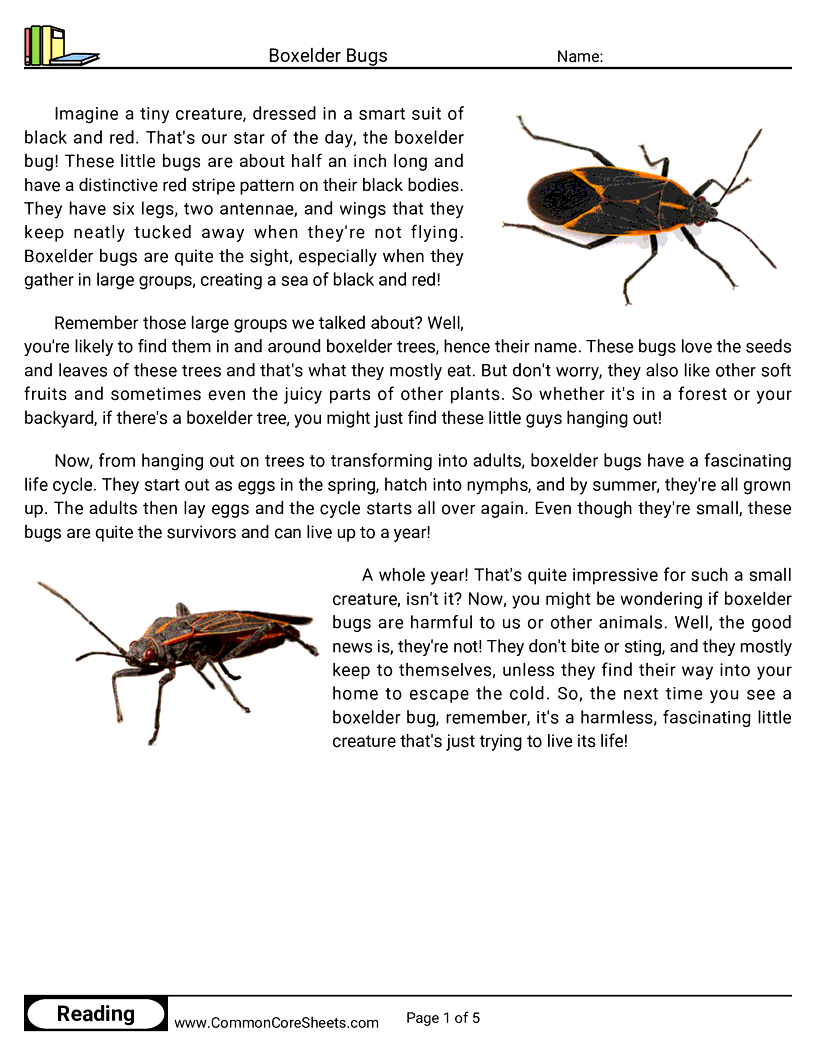
Imagine a tiny creature, dressed in a smart suit of black and red. That's our star of the day, the boxelder bug! These little bugs are about half an inch long and have a distinctive red stripe pattern on their black bodies. They have six legs, two antennae, and wings that they keep neatly tucked away when they're not flying. Boxelder bugs are quite the sight, especially when they gather in large groups, creating a sea of black and red!
Remember those large groups we talked about? Well, you're likely to find them in and around boxelder trees, hence their name. These bugs love the seeds and leaves of these trees and that's what they mostly eat. But don't worry, they also like other soft fruits and sometimes even the juicy parts of other plants. So whether it's in a forest or your backyard, if there's a boxelder tree, you might just find these little guys hanging out!
Now, from hanging out on trees to transforming into adults, boxelder bugs have a fascinating life cycle. They start out as eggs in the spring, hatch into nymphs, and by summer, they're all grown up. The adults then lay eggs and the cycle starts all over again. Even though they're small, these bugs are quite the survivors and can live up to a year!
A whole year! That's quite impressive for such a small creature, isn't it? Now, you might be wondering if boxelder bugs are harmful to us or other animals. Well, the good news is, they're not! They don't bite or sting, and they mostly keep to themselves, unless they find their way into your home to escape the cold. So, the next time you see a boxelder bug, remember, it's a harmless, fascinating little creature that's just trying to live its life!
Hey there, curious minds! Today, we're going to learn about boxelder bugs. These little creatures are small, black bugs with red markings on their back. You'll often find them around boxelder trees, which is where they get their name. Let's dive deeper into their world and discover more about their lives!
First, let's talk about what boxelder bugs eat. These insects are primarily herbivores, which means they mostly munch on plants. Their favorite food is the seeds and leaves of boxelder trees and occasionally maple trees. While they usually don't cause too much harm to the trees, they can still be a nuisance.
Now, let's explore the life cycle of boxelder bugs. In the spring, adult females lay their eggs on trees, and soon after, tiny nymphs hatch. These nymphs go through several stages, called instars, before they become fully grown adults. The whole process takes about two months, and these bugs usually live for about a year.
Boxelder bugs have a unique relationship with humans and other insects. Although they aren't dangerous to us, they can be quite a nuisance when they gather in large numbers around homes. As for other insects, they usually keep to themselves and don't bother other bug species too much. However, they can become a tasty snack for predators like birds, spiders, and praying mantises.
Finally, let's look at some interesting facts and differences between boxelder bugs and other species. One cool fact is that boxelder bugs are true bugs, which means they have special mouthparts for sucking up their food. Unlike some other insects, they don't bite or sting, and they don't spread diseases. Now, you know a lot more about these fascinating little creatures, and you can share your knowledge with your friends!
Boxelder bugs are fascinating creatures that you may have seen crawling around your backyard. These little insects are black with red markings and have a flat, oval-shaped body. They are about a half-inch long and can be found throughout North America. Boxelder bugs get their name from the boxelder tree, which is where they often live and lay their eggs. However, they can also be found on some other trees and plants.
Boxelder bugs have a unique life cycle, starting as tiny red eggs. They hatch into nymphs, which are smaller versions of the adult bugs and are also red and black. Throughout the summer, these nymphs will molt, shedding their skin several times as they grow. By the time autumn arrives, they will have become fully grown adult boxelder bugs. Adults will then mate, and the females will lay new eggs to start the cycle all over again.
These bugs are mostly harmless to humans and are considered more of a nuisance than a threat. While they don't bite or sting, they can sometimes invade homes in large numbers, especially during the fall when they're seeking warmth. If you find boxelder bugs in your home, you can simply vacuum them up and release them outside. It's also a good idea to seal up any cracks in your home to prevent them from getting inside. Remember, they're not dangerous, just a bit annoying when they're in our space.
Boxelder bugs have a few interesting relationships with other insects and the environment. Their main source of food is the seeds and leaves of boxelder trees, as well as some other plants. This makes them harmless to most garden plants, so they're not considered pests like some other bugs. However, they do have their share of predators, such as spiders, birds, and other insects that feed on them. These predators help keep the boxelder bug population in check, making it a part of the natural ecosystem.
Lastly, let's look at some unique facts and differences between boxelder bugs and other species. Unlike some other insects, boxelder bugs can survive cold temperatures and will often hibernate during the winter months. This is one reason why they might try to get inside your warm home when the weather gets colder. Another interesting fact is that, although they may look similar to some other red and black bugs, boxelder bugs are actually a part of the 'true bug' family, which includes insects like stink bugs and cicadas. So, even though they can be a bit of a nuisance, boxelder bugs are an intriguing part of our natural world and worth learning about!
About this worksheet
Students read a short informational passage about boxelder bugs and answer questions to show they understood the key details.
This worksheet is designed to enhance reading comprehension with an engaging focus on boxelder bugs. It features 20 interactive problems exploring their physical attributes, diet, lifespan, and behavior. Concepts such as seasonal changes and creature habitats are addressed. This customizable educational tool is suitable for remote learning and can be effortlessly converted into flashcards for diversified study methods.
Student objectives
- Read a nonfiction passage and understand the main idea
- Find specific facts and details in the text to answer questions
- Learn new words related to insects and their habits
- Explain what the passage says using evidence from the reading
Everyday practice
- Read a sign at a park or nature center about a bug you spotted
- Look up facts about an insect you find in your yard
- Answer a friend's question about why bugs show up on your house
- Read a pest control label or brochure and understand what it says