Bobbing for Apples and Other Halloween Games Worksheet Download
Free reading comprehension worksheet about bobbing for apples and other old Halloween games. Pick the reading level (1st grade to 8th grade), print the passage with its questions, or assign it online.


Sheet Information >
Available at 1st grade, 2nd grade, 3rd grade, 4th grade, 5th grade, 6th grade, 7th grade and 8th grade reading levels.
Read the passage
Have you ever tried to bite an apple in a tub of water? That fun game is called bobbing for apples! You put your hands behind your back and grab an apple with just your teeth.
Those wet, bouncing apples have been party fun for a very long time. People played apple games hundreds of years ago at harvest parties in the fall. They also hung apples on strings and tried to bite them, called snap-apple.
Long ago, some people played guessing games to have fun with friends. Today we play safe party games like a fun apple hunt or a candy toss. So the next time you bob for an apple, know that kids played it long before you were born!
Splash! Can you picture a big tub of water with shiny red apples floating on top? At a game called bobbing for apples, you put your hands behind your back and try to grab an apple with just your teeth. The apples bob and roll away, so it is trickier than it looks!
Getting an apple with only your mouth takes a lot of giggling and dripping chins. This game is very old, older than your great-great-grandparents. People played it long ago at harvest parties in the fall, when apples were fresh off the trees and easy to find.
Fresh apples showed up in another game too, called snap-apple. In that game, an apple was tied to a string and hung from the ceiling, and players tried to bite it while it swung. Some people even played guessing games to have fun and tell silly fortunes at their parties.
Those old parties turned into the Halloween parties families enjoy today. In the early 1900s in America, children played apple games, told stories, and wore costumes at parties in their homes. Today many schools use clean, dry games instead of water, like grabbing paper apples, so nobody goes home with a soggy shirt!
Imagine you are at a Halloween party, and someone rolls out a big tub filled with cool water and floating red apples. Your job is to grab an apple using only your teeth, with your hands held behind your back! You lean over, and splash, your whole face goes into the water. This soggy, giggly game is called bobbing for apples, and people have played it for hundreds of years.
Those bobbing apples first floated at old harvest festivals, long before there were Halloween parties. Fall was apple-picking season, so families had baskets and baskets of fresh apples to use. In one game called snap-apple, an apple was tied to a string and hung from the ceiling. Players had to catch the swinging apple with their teeth, and it was even trickier than bobbing because it kept spinning away.
Catching an apple was hard, but people once believed an apple could tell you a secret. In the 1800s, some folks told a fun story that the first person to grab an apple would be the next to get married. Others played a game where you peeled an apple in one long curl, then tossed the peel over your shoulder to see what letter it made. These fortune games were just for laughs at parties, kind of like reading a joke from a candy wrapper.
By the early 1900s, American families were throwing whole parties built around these silly apple games. Because a wet face and a spinning apple can be messy, many schools today play safer versions instead. Kids might race to bite a doughnut hanging from a string, keeping the fun without the giant tub of water. The next time you dunk for an apple, remember you are playing a game older than your great-great-grandparents!
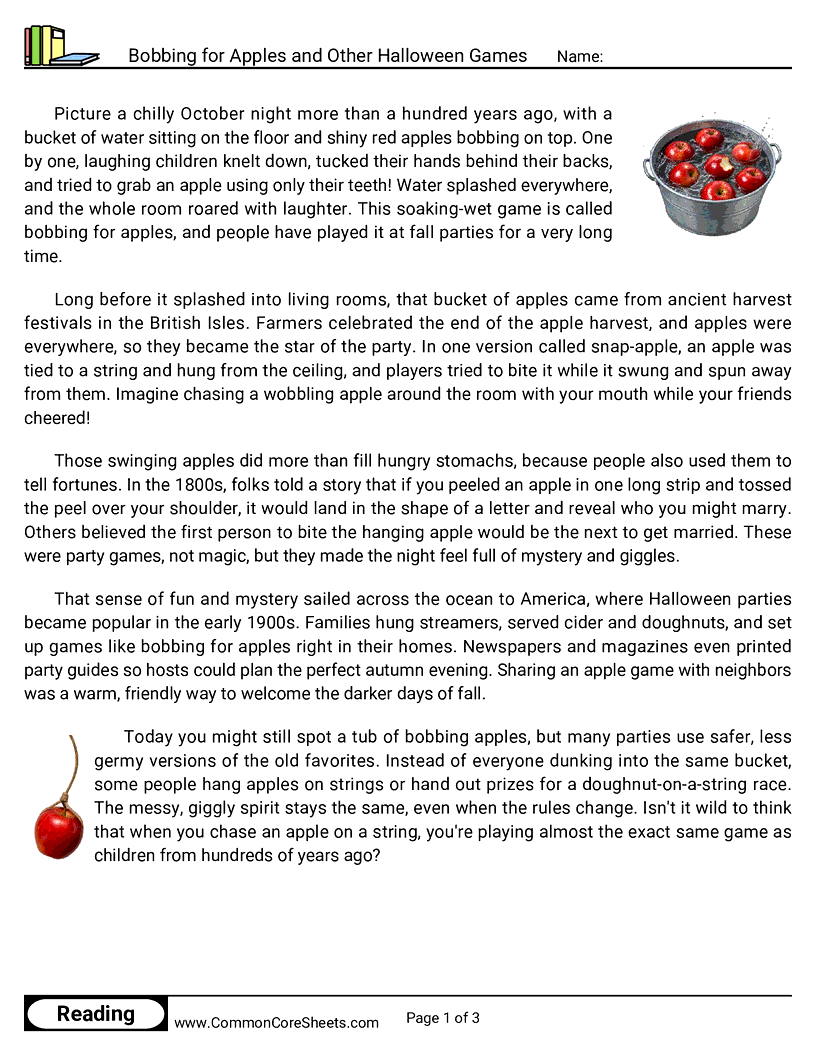
Picture a chilly October night more than a hundred years ago, with a bucket of water sitting on the floor and shiny red apples bobbing on top. One by one, laughing children knelt down, tucked their hands behind their backs, and tried to grab an apple using only their teeth! Water splashed everywhere, and the whole room roared with laughter. This soaking-wet game is called bobbing for apples, and people have played it at fall parties for a very long time.
Long before it splashed into living rooms, that bucket of apples came from ancient harvest festivals in the British Isles. Farmers celebrated the end of the apple harvest, and apples were everywhere, so they became the star of the party. In one version called snap-apple, an apple was tied to a string and hung from the ceiling, and players tried to bite it while it swung and spun away from them. Imagine chasing a wobbling apple around the room with your mouth while your friends cheered!
Those swinging apples did more than fill hungry stomachs, because people also used them to tell fortunes. In the 1800s, folks told a story that if you peeled an apple in one long strip and tossed the peel over your shoulder, it would land in the shape of a letter and reveal who you might marry. Others believed the first person to bite the hanging apple would be the next to get married. These were party games, not magic, but they made the night feel full of mystery and giggles.
That sense of fun and mystery sailed across the ocean to America, where Halloween parties became popular in the early 1900s. Families hung streamers, served cider and doughnuts, and set up games like bobbing for apples right in their homes. Newspapers and magazines even printed party guides so hosts could plan the perfect autumn evening. Sharing an apple game with neighbors was a warm, friendly way to welcome the darker days of fall.
Today you might still spot a tub of bobbing apples, but many parties use safer, less germy versions of the old favorites. Instead of everyone dunking into the same bucket, some people hang apples on strings or hand out prizes for a doughnut-on-a-string race. The messy, giggly spirit stays the same, even when the rules change. Isn't it wild to think that when you chase an apple on a string, you're playing almost the exact same game as children from hundreds of years ago?
Picture a wooden tub filled to the brim with water, apples floating on top like little red boats, and a crowd of kids leaning over with their hands behind their backs. The only rule is that you can catch an apple with your teeth—no hands allowed! This soggy, giggly contest is called bobbing for apples, and people have been playing it for hundreds of years. If you have ever tried it, you know it is much harder than it looks, because those apples keep bobbing away just as you close your mouth.
Those runaway apples were once part of something much bigger than a party trick. Bobbing for apples grew out of harvest festivals, back when autumn meant orchards heavy with ripe fruit and long celebrations to mark the end of the growing season. One old cousin of the game was called snap-apple, where an apple was tied to a string and swung in the air while players tried to bite it—again, with no hands. Reaching for a spinning apple with your mouth was probably even messier than fishing one out of a tub!
Catching an apple was fun, but people in the 1800s believed those apples could do something stranger: tell your future. At parties, some players told a story that the first person to bite a bobbing apple would be the next to marry, and others peeled an apple in one long ribbon to see whose name the peel might spell. These were fortune-telling party games, played for laughs and thrills rather than as anything serious. They fit the mood of the season, when autumn nights grew long and dark and a spooky guessing game felt just right.
Those fireside guessing games sailed across the ocean and landed at American Halloween parties in the early 1900s. By then, families were hosting parties in their homes with apple bobbing, bean-bag tosses, and games where blindfolded guests guessed what they touched. Halloween was becoming a friendly neighborhood holiday, and hosts filled the evening with contests so nobody stood around bored. Newspapers and magazines of the day even printed suggestions for party games, spreading the same ideas from town to town.
Many of those old games are still bouncing around today, though a few have been made safer along the way. Because sharing a tub of water can spread germs, lots of schools now hang apples from strings or have kids grab doughnuts dangling on threads instead. You might also see a plastic version with floating toys, so nobody has to dunk a face at all. The next time an apple slips away from your teeth, remember you are playing a game your great-great-grandparents may have loved on a chilly autumn night long ago.
You probably think bobbing for apples is just a soggy way to get a snack, but for hundreds of years people believed it could tell your future. Picture a wooden tub filled with cool water, apples drifting on top like little red boats. Players kneel with their hands behind their backs and lunge, chins first, trying to trap a bobbing apple with only their teeth. It sounds like harmless party chaos, and it is, but the game began as something far more serious than a game. Believe it or not, that splashing tub carries a story older than the United States itself.
That old story starts with the harvest, not with Halloween candy. Long before pumpkins and porch lights, the ancient Celts of Britain and Ireland ended the growing season with a festival called Samhain, held around the start of November. Apples were one of the last fruits gathered before winter, so they became prizes at the celebration, sometimes hung on strings for a game people called snap-apple. In that version, a piece of fruit dangled from a beam, and players jumped and snapped at it with their mouths while it swung teasingly away. Missing it a dozen times was part of the fun, and catching it was supposed to be a lucky sign.
Being lucky was exactly the point, because to many people these apple games were fortune-telling dressed up as play. In the 1800s, young people at parties told a story that the first person to bite a bobbing apple would be the next to marry. Others peeled an apple in one long ribbon, tossed the peel over a shoulder, and squinted to see if it landed in the shape of a letter, believing it spelled a sweetheart's initial. None of it truly predicted anything, of course, but the giggling and guessing turned an ordinary apple into a tiny crystal ball. For one evening, a piece of fruit could feel like it held a secret about your whole life.
Those flirty fortune games sailed across the ocean and landed at American Halloween parties in the early 1900s. Hosts turned their parlors into playrooms, setting out apple tubs, blindfold games, and bowls of nuts to roast in the fire. Magazines of the day printed party plans, and suddenly bobbing for apples was the must-have event for a proper Halloween gathering. The old fortune-telling faded into a joke, but the tub of apples stuck around because it was simply too much fun to drop.
That stubborn fun is why you might still spot an apple tub today, even as people worry about sharing one bowl of water. Many schools and parties now play safer versions, hanging apples from strings or having each player use a clean cup, so the game survives without the shared germs. Think about that the next time your chin is dripping and an apple keeps slipping away. You are playing something the Celts would recognize, a harvest game that once pretended to read the future. Not bad for a piece of fruit you could buy for pocket change.
Picture a wooden tub brimming with cold water, a dozen shiny apples floating on top, and a room full of people with their hands tucked behind their backs. One by one, they lean over and try to snatch an apple using only their teeth, cheeks dripping and everyone laughing. This is bobbing for apples, a game so old that people played versions of it long before Halloween existed as we know it. You might think it is just silly party fun, but it actually carries centuries of history in every splash.
That splashing tub did not start as a Halloween game at all, but as part of the autumn harvest. Apples ripen in fall, so ancient communities in the British Isles used them in games during festivals that marked the end of the growing season. One old cousin of the game was snap-apple, in which an apple was hung from a string or a spinning stick, sometimes with a candle on the other end, and players tried to bite it without using their hands. The Roman goddess Pomona, who watched over orchards and fruit, is often linked to these apple customs by historians. When cultures blended over the centuries, the harvest apple and the fall festival slowly found each other.
Long before you could win a prize, though, an apple game was believed to tell your future. In Britain and Ireland during the 1800s, young people played fortune games in which the first person to bite a bobbing apple would supposedly be the next to marry. Some peeled an apple in one long strip and tossed the peel over a shoulder, then looked for the shape of a letter, believing it named a future sweetheart. People told these stories as harmless party fun, a way to giggle about romance on a dark autumn night. No one truly expected an apple peel to know the future, but the games gave friends a reason to gather and tease one another.
Those playful fortune games packed their bags and crossed the ocean with the people who believed in them. Irish and Scottish immigrants brought Halloween customs to the United States in the 1800s, and by the early 1900s, American families were throwing lively Halloween parties. Magazines of that era printed party guides suggesting apple bobbing, ring-toss games, and blindfolded guessing games for guests. Hosts decorated with corn stalks and paper lanterns, and neighbors gathered indoors as the weather turned cold. A game once tied to the harvest had become a social evening, proof that a tradition can change its purpose while keeping its shape.
Keeping its shape, however, did not mean the game stayed exactly the same, especially once health worries entered the picture. Sharing one tub of water became less popular as families learned more about how germs spread from person to person. Today many schools and parties offer safer versions, such as apples hanging on strings that each player gets alone, or a doughnut-on-a-string race. Some events skip the biting entirely and let kids scoop floating apples with a small net or spoon. The old thrill of chasing a slippery apple survives, just with fewer shared mouthfuls of water.
That survival is exactly what makes this simple game worth a second look. A tub of apples connects you to Roman orchards, Irish harvest nights, and living rooms from a hundred years ago, all at once. According to the National Retail Federation, Americans spend billions of dollars on Halloween each year, yet one of its oldest traditions costs little more than some fruit and water. The next time you dunk your face toward a bobbing apple, remember that you are playing a game older than any costume in the room.
Picture a young woman in Ireland in the 1700s, kneeling by a tub of water on a chilly October night, hair pinned back, biting at a floating apple until she finally sinks her teeth into one. She isn't just playing a game. According to old folklore, the apple she caught was supposed to reveal something about who she would marry. This is the strange double life of Halloween party games: activities that look like harmless fun today were once tangled up with harvest festivals, courtship, and fortune-telling. Bobbing for apples, the most famous of them all, is a perfect example of how a custom can survive for centuries while its original meaning quietly fades away.
That fading meaning is exactly what makes apple bobbing so tricky for historians to trace. Many researchers connect the game to Samhain, an ancient Celtic harvest festival marking the end of the growing season, though the evidence is more suggestive than certain. What historians agree on is that apples were everywhere at autumn festivals in the British Isles, because October was harvest time and orchards were heavy with fruit. Some accounts also link the apple to the Roman goddess Pomona, who watched over orchards, since the Romans had brought their own customs to Britain long before. When two explanations point in the same direction, it is tempting to treat both as proof, but a careful reader notices that neither one is written down in detail until much later.
That gap between the game and the first written record is where a second version enters the story. Alongside bobbing, people played snap-apple, in which an apple was tied to a string or a spinning stick and players tried to bite it with their hands held behind their backs. The trick was that the apple swung and turned, so a confident lunge often ended with a nose full of fruit and a room full of laughter. In parts of Ireland and Scotland, Halloween itself was sometimes called Snap-Apple Night, which tells you how central the game once was. An 1833 painting by the Irish artist Daniel Maclise, titled Snap-Apple Night, shows a crowded room of dancers, games, and firelight, giving us a rare glimpse of the custom in action.
That firelit room full of games points to the real reason these traditions lasted: they turned a dark, cold night into a party. By the 1800s, many of the apple games had shed their fortune-telling purpose and become simple entertainment for gatherings. People told stories that an unmarried person could peel an apple in one long strip, toss the peel over a shoulder, and read the letter it formed as the initial of a future sweetheart. Others claimed the first person to bite a bobbing apple would be the next to marry. It is worth noting the pattern here: the games that survived best were the ones flexible enough to be either a serious ritual or a silly party trick, depending on who was playing.
That flexibility is precisely what carried the games across the ocean. As Irish and Scottish immigrants arrived in the United States in the 1800s, they brought their autumn customs with them, and by the early 1900s Halloween parties were popular across America. Magazines and party-planning guides of that era described apple bobbing, ring-toss games, and fortune-telling amusements as standard entertainment for a festive evening. In this new setting, the games lost almost all of their old ritual weight and became purely social, a way for neighbors to gather and children to compete. The distinction is subtle but important: the same action, biting an apple in water, meant a glimpse of the future in one century and simple bragging rights in the next.
Those bragging rights come with a modern catch that our great-grandparents never worried about. Because many people share one tub of water, some schools and health experts today discourage traditional bobbing and suggest hanging apples from strings instead, which keeps the challenge without the shared water. Other party hosts swap in doughnuts tied to strings, a sweeter cousin of snap-apple that requires no washing at all. What began as a solemn attempt to read the future has become, in a single lifetime, a game we redesign for hygiene and convenience. Perhaps the most surprising fact is that the apple, chosen centuries ago simply because it was ripe in October, has outlasted every meaning people ever attached to it.
About this worksheet
Students read a nonfiction passage about bobbing for apples and other old Halloween games, written at 8 reading levels (1st grade to 8th grade), and answer multiple-choice questions about it.
A reading comprehension worksheet about bobbing for apples and other old Halloween games with a different article for each reading level, 1st grade to 8th grade, each with its own multiple-choice questions aligned to the Common Core Reading: Informational Text standards. Printable with an answer key, and available as an online assignment at any level.
Student objectives
- Read a passage about the history of Halloween apple games and party traditions
- Find details that explain how bobbing for apples and snap-apple were played
- Explain why apple games changed over time and how they are played today
Everyday practice
- Notice which fall or Halloween games you play that use apples, cider, or doughnuts
- Ask an older relative what party games they played as a kid and compare them to yours
- Try inventing a safe, no-shared-bucket version of an old apple game with friends