Bats: Halloween's Misunderstood Mammals Worksheet Download
Free reading comprehension worksheet about bats. Pick the reading level (kindergarten to 8th grade), print the passage with its questions, or assign it online.


Sheet Information >
Available at kindergarten, 1st grade, 2nd grade, 3rd grade, 4th grade, 5th grade, 6th grade, 7th grade and 8th grade reading levels.
Read the passage
Look up at the dark sky on Halloween night! Do you see a little shape flapping by? That is a bat and it can really fly.
A bat can fly because it is a mammal with wings. No other animal that has fur can fly like this! Bats sleep all day and wake up at night to eat.
Many bats eat bugs and that helps farmers a lot. Some bats even eat sweet fruit and help new plants grow. So the next time you see a bat just say thank you!
Have you ever seen a bat on a Halloween card? A bat is a small animal with soft fur and thin wings. Bats are the only mammals that can really fly!
Those wings help bats catch bugs all night long. Many bats eat moths, beetles, and other little bugs. One bat can eat lots of bugs, which helps farmers keep their crops safe.
Bugs are not the only food that bats love. Some bats eat sweet fruit and carry seeds to new spots, so more plants can grow. Bats are not blind at all, and that spooky myth is just make-believe!
Wow, look up at the Halloween night sky, and you might spot a little shape flapping in the dark! That's a bat, and it is the only mammal that can really fly. A bat has soft fur, tiny ears, and wings made of thin skin that stretch between its long finger bones.
Those wide ears help bats do something like magic in the dark. Bats make squeaky sounds, and they listen for the echoes that bounce back, which tells them where things are. This trick is called echolocation, and it helps a bat catch bugs without bumping into anything.
Speaking of bugs, some bats are hungry insect hunters who help people more than you might think. A single little brown bat can gobble up hundreds of mosquitoes and other pests in just one night, so farmers keep more crops. Other bats love fruit instead, and when they fly from tree to tree, they spread seeds and help new plants grow.
Because bats fly at night, people once made up spooky stories about them. Some folks said bats are blind or that they get stuck in your hair, but neither of those tales is true. Bats can see just fine, and they are far too clever to tangle in your hair, which makes these little fliers friends, not frights!
Imagine you are outside on a warm evening, watching the sky turn dark. Suddenly a small, winged shape swoops past your head, twisting and darting after bugs. That's not a bird, and it's not a spooky monster from a Halloween story. It's a bat, the only mammal in the whole world that can truly fly!
Because they zip around so fast in the dark, people once believed bats were blind. That myth is not true at all, because bats can see just fine. In the dark, though, many bats find their way using a trick called echolocation. They make squeaky sounds, then listen as the sound bounces back off objects, so they can tell where a tiny insect is buzzing.
Speaking of insects, catching them is one of the most helpful things a bat does. A single little brown bat can gobble up hundreds of mosquitoes and other bugs in just one hour. Because bats eat so many pests, farmers save lots of money on crop-eating insects each year. So the next time a bug bites you, you might wish a hungry bat were nearby!
Not every bat hunts bugs, though, because some bats love to eat fruit instead. As these fruit bats fly from tree to tree, they spread seeds and pollen, which helps new plants grow. Bananas, mangoes, and agave come from plants that bats help to pollinate. So a creature people once feared on Halloween is really a gardener, a bug catcher, and the only flying mammal all in one!
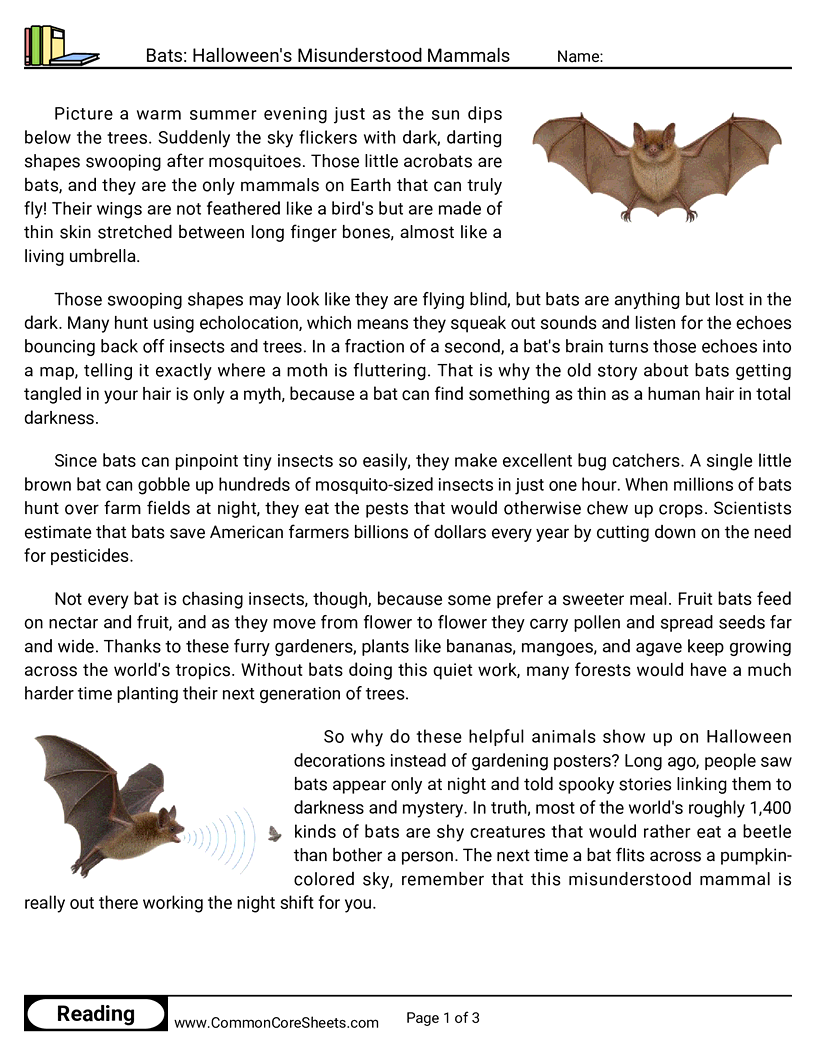
Picture a warm summer evening just as the sun dips below the trees. Suddenly the sky flickers with dark, darting shapes swooping after mosquitoes. Those little acrobats are bats, and they are the only mammals on Earth that can truly fly! Their wings are not feathered like a bird's but are made of thin skin stretched between long finger bones, almost like a living umbrella.
Those swooping shapes may look like they are flying blind, but bats are anything but lost in the dark. Many hunt using echolocation, which means they squeak out sounds and listen for the echoes bouncing back off insects and trees. In a fraction of a second, a bat's brain turns those echoes into a map, telling it exactly where a moth is fluttering. That is why the old story about bats getting tangled in your hair is only a myth, because a bat can find something as thin as a human hair in total darkness.
Since bats can pinpoint tiny insects so easily, they make excellent bug catchers. A single little brown bat can gobble up hundreds of mosquito-sized insects in just one hour. When millions of bats hunt over farm fields at night, they eat the pests that would otherwise chew up crops. Scientists estimate that bats save American farmers billions of dollars every year by cutting down on the need for pesticides.
Not every bat is chasing insects, though, because some prefer a sweeter meal. Fruit bats feed on nectar and fruit, and as they move from flower to flower they carry pollen and spread seeds far and wide. Thanks to these furry gardeners, plants like bananas, mangoes, and agave keep growing across the world's tropics. Without bats doing this quiet work, many forests would have a much harder time planting their next generation of trees.
So why do these helpful animals show up on Halloween decorations instead of gardening posters? Long ago, people saw bats appear only at night and told spooky stories linking them to darkness and mystery. In truth, most of the world's roughly 1,400 kinds of bats are shy creatures that would rather eat a beetle than bother a person. The next time a bat flits across a pumpkin-colored sky, remember that this misunderstood mammal is really out there working the night shift for you.
Picture a spooky Halloween night: a full moon, a creaky porch, and a shadowy shape swooping silently across the sky. For hundreds of years, people saw that shape and told scary stories about bats being creepy or dangerous. But here's a puzzle worth solving: how did such a helpful little animal end up on so many spooky decorations? The real bat is far more surprising than the one on your jack-o'-lantern stickers.
That silent swooping is actually a clue to something no other animal can do quite like a bat. Bats are the only mammals in the world that truly fly, flapping wings made of skin stretched between long, thin finger bones. That means they are more closely related to you than to any bird, since mammals have fur and feed milk to their babies. Some bats are tiny enough to curl up in your palm, while the giant flying foxes have wingspans as wide as a doorway, stretching up to about five feet.
Flying in the dark sounds impossible, yet bats have a trick that makes the blackest night no problem at all. Many of them use echolocation, sending out high squeaks and listening for the echoes that bounce back off objects and insects. From those echoes, a bat can picture exactly where a moth is, how far away it sits, and which way it is flying. This is why the old myth that "bats are blind" is simply wrong, because they can both see and "hear" the world around them.
Those echoes lead hungry bats straight to their favorite meal, and that meal is very good news for farmers. A single little brown bat can snap up hundreds of insects in one hour, gobbling mosquitoes and crop pests all night long. Because they eat so many bugs, bats save farmers in the United States billions of dollars each year on pesticides. So the next time a mosquito misses you at a summer cookout, you might have a bat to thank.
Not every bat is chasing insects, though; some prefer a sweeter dinner altogether. Fruit bats feast on nectar and fruit, and as they travel they spread pollen and drop seeds that grow into new plants. Foods people love, like bananas, mangoes, and guavas, depend on bats and other animals to help their plants reproduce. So while a bat may decorate your window this October, remember it is really one of nature's busiest gardeners and pest controllers.
Picture a bat and you might imagine a creepy creature swooping toward your hair in the dark, ready to tangle in it like the villain of a spooky movie. That image shows up on Halloween decorations, greeting cards, and jack-o'-lantern stickers every October. But here's the twist: nearly everything scary you've heard about bats is wrong. The real animal is one of the most helpful and hardworking creatures on the planet, and it deserves a much better reputation than the one Halloween gave it.
That better reputation starts with a fact no other mammal can claim. Bats are the only mammals that truly fly, flapping their way through the night on wings made of skin stretched between long, thin finger bones. Can you imagine your own hand turned into a wing? That is basically what a bat's wing is. There are more than 1,400 different kinds of bats, ranging from tiny ones that could sit in your palm to fruit bats with wingspans wider than an adult's outstretched arms.
Those wide-open eyes on a bat's face might make you think it needs sharp vision to hunt, but many bats barely rely on sight at all. Instead, they use echolocation, a built-in sonar system that lets them "see" with sound. A bat sends out high-pitched squeaks, too high for human ears, and listens for the echoes that bounce back off objects around it. From those echoes, its brain builds a map of the darkness, pinpointing a moth in midair with astonishing accuracy. This is why the old belief that bats are blind is simply false; they are not blind, and they navigate better in the dark than you ever could.
That skill at snatching insects out of the air makes bats a farmer's best friend. A single little brown bat can eat hundreds of mosquitoes and other insects in one hour, and a whole colony devours millions in a night. By eating pests that would otherwise munch on crops, bats save farmers in the United States billions of dollars a year in pest control, according to scientists who study them. Fruit-eating bats do a different job just as important: they pollinate flowers and scatter seeds as they feed, helping plants like bananas, mangoes, and agave grow. Without these winged gardeners, some of your favorite foods would be a lot harder to find.
Knowing all this, why do bats still get cast as Halloween villains? Long ago, people who saw them fly at dusk near homes and churches spun stories that they were creatures of darkness, and those tales stuck for centuries. The truth is far kinder: bats avoid people whenever they can, and they have no interest in your hair. Today scientists work to protect them from diseases and habitat loss, because a world with fewer bats means more insect pests and fewer pollinated plants. So the next time a paper bat dangles from your classroom ceiling, remember it stands for an animal that quietly protects your food, your farms, and your summer evenings.
Picture a hunter so precise it can snag a mosquito in total darkness while flying twenty feet in the air, guided by sounds you can't even hear. That hunter is a bat, and it may be the most misunderstood guest at any Halloween party. Every October, paper bats flap across classroom windows and cling to haunted-house doorways, cast as creatures of the night. But the real animal behind the decoration is far stranger and far more useful than the spooky version pinned to the wall.
Those paper cutouts get one thing exactly right: bats really do rule the night sky. In fact, they are the only mammals on Earth that truly fly, beating wings made of thin skin stretched between long, fingerlike bones. A flying squirrel can only glide, but a bat flaps, banks, and hovers like a tiny acrobat. With more than 1,400 known species, bats make up about one in five mammal species alive today, which is a huge share for animals most people rarely see.
Flying in the dark sounds impossible, yet these acrobats have a trick that turns blackness into a map. It is called echolocation: a bat sends out high-pitched clicks, then listens for the echoes that bounce back off insects, branches, and walls. From those returning sounds, its brain builds a picture detailed enough to catch a moth mid-flip. This is why the old saying "blind as a bat" is simply wrong; bats can see, and many species see quite well, but in the dark their ears do the heavy lifting.
Because their ears are so sharp, the idea that a bat would blunder into your hair makes no sense at all. People used to tell a story that bats got tangled in people's hair on purpose, but an animal that can dodge a single mosquito is not going to crash into your head by accident. If a bat swoops near you on an autumn evening, it is almost certainly chasing an insect buzzing close by, not aiming for you. A single little brown bat can eat hundreds of insects in an hour, which is welcome news if you dislike mosquito bites.
That appetite for insects turns out to be worth real money to the people who grow your food. Scientists estimate that bats save American farmers billions of dollars each year by eating pests that would otherwise chew through crops, meaning fewer chemical sprays are needed. Not every bat hunts insects, though; in tropical forests, fruit bats sip nectar and munch fruit, and in doing so they pollinate flowers and scatter seeds as they fly. Plants we enjoy, including bananas, mangoes, and agave, depend on these winged gardeners to keep growing.
So how did such a helpful animal end up starring in scary stories instead of thank-you cards? Part of the answer is simply that bats come out when we head indoors, and anything glimpsed in the dark is easy to imagine as sinister. Their leathery wings and cave homes made them a natural fit for legends about the night, and Halloween happily borrowed the image. The next time a plastic bat dangles from a doorway, remember that the living version is a mosquito-eating, banana-pollinating pilot flying by echoes, which is a far better trick than any costume.
Picture a farmer in central Texas on a summer evening, standing at the mouth of a limestone cave as the sky turns purple. Suddenly, a ribbon of dark shapes pours upward, twisting like smoke against the fading light, until millions of Mexican free-tailed bats have spilled into the air. That single colony at Bracken Cave is one of the largest gatherings of mammals on Earth, and each night it will hunt down tons of insects before dawn. To the people watching, those bats are not creatures of horror at all, but a spectacle worth driving hours to see. And yet, come October, the same animal becomes a cardboard cutout taped to school windows, a symbol of spookiness.
That gap between the fluttering cartoon and the living animal is exactly where the misunderstandings begin. Consider one so-called fact you have surely heard: that bats are blind. In truth, every bat species can see, and some fruit bats have vision sharp enough to spot ripening fruit from far away. The confusion likely grew because many bats hunt in total darkness, where eyes are nearly useless, so they rely on a different tool entirely. People assumed that an animal thriving in the dark must be sightless, when really it had simply solved the problem another way.
That other way is echolocation, and it is far cleverer than any legend about blindness suggests. A hunting bat sends out pulses of sound too high for human ears, then listens for the echoes that bounce back off objects. From the timing and pitch of each returning echo, its brain builds a detailed map of the space ahead, pinpointing a moth in midair. This is why the old story about bats tangling themselves in your hair falls apart: an animal that can detect a mosquito in the dark is not going to blunder into your head. In fact, the swooping you might see near your porch light is a bat expertly chasing the insects the light attracts, not aiming for you.
Those appetites for insects turn out to be worth serious money, which is where bats stop being spooky and start being useful. Scientists estimate that by eating crop-destroying pests, bats save American farmers billions of dollars every year in avoided damage and pesticide costs. A single little brown bat can snap up hundreds of mosquito-sized insects in one hour, and a large colony devours pests by the ton. Unlike a machine or a chemical spray, this pest control refuels itself, breeds more of itself, and asks for nothing but a place to roost. When you weigh that against a few Halloween shivers, the ledger tilts sharply in the bat's favor.
Insect hunters are only half the story, because in warmer parts of the world other bats trade the night hunt for a night shift among flowers. These fruit and nectar bats pollinate plants and scatter seeds as they feed, doing for tropical forests what bees do for a garden. Bananas, mangoes, and the agave used to make some drinks all depend on bats or their pollinating relatives. When a bat carries seeds far from a parent tree and drops them in a cleared patch of forest, it plants the next generation of jungle. So the same family of animals that guards a cornfield in Texas is busy regrowing rainforest thousands of miles away.
Given all that, it is worth asking how a helpful animal ended up as a Halloween mascot in the first place. Part of the answer is timing: many bats fly at dusk and roost in caves, attics, and other shadowy places we associate with the eerie. Part of it is fiction, since nineteenth-century vampire stories borrowed the bat's night habits and stitched them onto a monster. But of the roughly 1,400 bat species alive today, only three feed on blood, and those live in Latin America, not in your closet. The next time a paper bat glares down from a classroom wall, remember it is the world's only flying mammal, a farmer's ally and a forest's gardener, hiding behind a costume.
About this worksheet
Students read a nonfiction passage about bats, written at 9 reading levels (kindergarten to 8th grade), and answer multiple-choice questions about it.
A reading comprehension worksheet about bats with a different article for each reading level, kindergarten to 8th grade, each with its own multiple-choice questions aligned to the Common Core Reading: Informational Text standards. Printable with an answer key, and available as an online assignment at any level.
Student objectives
- Read a passage about bats and explain what makes them the only flying mammals.
- Find details showing how echolocation helps bats hunt in the dark.
- Explain how bats help farmers and forests.
- Describe how the author organizes the passage from description to helpful facts.
Everyday practice
- Watch the sky at dusk in warm months to see bats swooping after insects.
- Notice which Halloween decorations show bats and think about how the real animal differs.
- Look up whether foods like bananas, mangoes, or agave depend on bats or other pollinators.