American Dog Tick Worksheet Download
Free reading worksheets on American Dog Tick. Each worksheet has 20 problems with an answer key and are ideal for teachers and homeschooling. You can download the PDF, create a set of flash cards or set it up for online learning.


Sheet Information >
Available at 2nd grade, 3rd grade, 4th grade, 5th grade and 6th grade reading levels.
Read the passage
Hey there, kiddos! Let's talk about the American dog tick, a tiny creature that you might find crawling around in the great outdoors. These little bugs are reddish-brown, shaped like an oval, and have eight legs. They're called 'dog ticks' because they like to live on dogs, but they can also be found on other animals, even humans sometimes!
Now, let's learn about the life cycle of the American dog tick and what they eat. Ticks go through four life stages - egg, larva, nymph, and adult - and they need a meal of blood at each stage to grow and survive. These ticks usually live in grassy or wooded areas, waiting for animals like dogs, deer, or even humans to walk by so they can hitch a ride and find their next meal.
Lastly, it's important to know how American dog ticks can affect humans and how they're different from other ticks. While many ticks can carry diseases, American dog ticks are mostly known for spreading a disease called Rocky Mountain spotted fever. It's always a good idea to check yourself and your pets for ticks after spending time outside, and if you find one, ask an adult for help to remove it safely.
Hey kids, let's talk about the American dog tick, a tiny creature you might have heard about. These little bugs are reddish-brown and love to eat blood from mammals, like dogs, cats, and even humans. They can usually be found in grassy areas, like your backyard or a park, and they can live all over the United States. American dog ticks are pretty small, but when they're full of blood after a meal, they can become as big as a grape!
Now, let's learn about the life cycle of an American dog tick. They start out as eggs, then hatch into tiny larvae that have six legs. After they eat, they grow into nymphs with eight legs, and finally into adult ticks. This whole process can take anywhere from three months to over a year, depending on the weather and if they can find enough food.
It's important to know how American dog ticks interact with humans and other insects. Though they don't usually cause harm to humans, they can sometimes carry diseases like Rocky Mountain spotted fever and tularemia, so it's important to be careful when you see one. They don't have too many defenses, but they can hide pretty well in the fur of animals or in the grass. One interesting fact is that American dog ticks are different from deer ticks, which are much smaller and can carry Lyme disease.
Remember, it's always good to be aware of the creatures around us, like the American dog tick, and to stay safe while exploring the great outdoors.
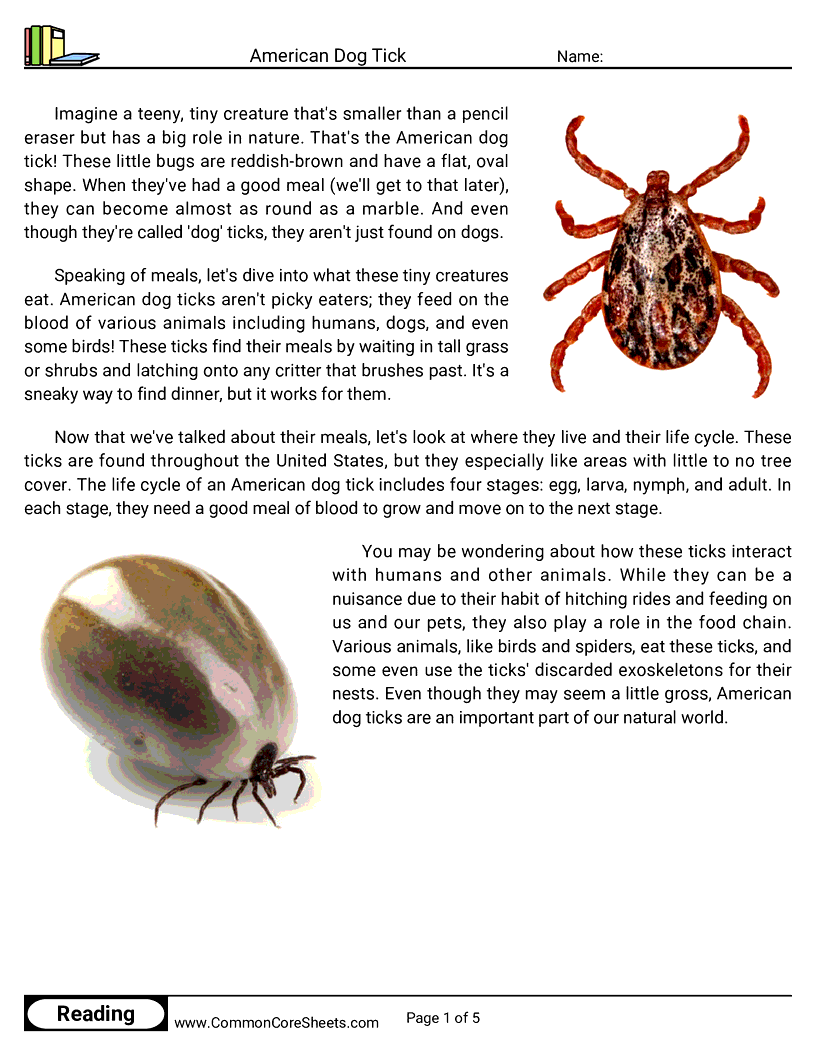
Imagine a teeny, tiny creature that's smaller than a pencil eraser but has a big role in nature. That's the American dog tick! These little bugs are reddish-brown and have a flat, oval shape. When they've had a good meal (we'll get to that later), they can become almost as round as a marble. And even though they're called 'dog' ticks, they aren't just found on dogs.
Speaking of meals, let's dive into what these tiny creatures eat. American dog ticks aren't picky eaters; they feed on the blood of various animals including humans, dogs, and even some birds! These ticks find their meals by waiting in tall grass or shrubs and latching onto any critter that brushes past. It's a sneaky way to find dinner, but it works for them.
Now that we've talked about their meals, let's look at where they live and their life cycle. These ticks are found throughout the United States, but they especially like areas with little to no tree cover. The life cycle of an American dog tick includes four stages: egg, larva, nymph, and adult. In each stage, they need a good meal of blood to grow and move on to the next stage.
You may be wondering about how these ticks interact with humans and other animals. While they can be a nuisance due to their habit of hitching rides and feeding on us and our pets, they also play a role in the food chain. Various animals, like birds and spiders, eat these ticks, and some even use the ticks' discarded exoskeletons for their nests. Even though they may seem a little gross, American dog ticks are an important part of our natural world.
Let's explore the fascinating world of American dog ticks! These tiny creatures are a type of arachnid, which means they're related to spiders and scorpions. You can identify them by their reddish-brown color and oval shape. They're most commonly found in grassy areas, along trails, and in wooded places.
Now, let's learn about their eating habits. Ticks are parasites, which means they feed on the blood of other animals, including humans, dogs, and other mammals. They use their sharp mouthparts to pierce the skin and suck blood from their host. When they're done eating, they detach from their host and start looking for their next meal.
The life cycle of the American dog tick is pretty interesting. Ticks go through four stages in their life: egg, larva, nymph, and adult. In each stage, they grow and shed their skin before moving on to the next stage. The entire process takes about a year, depending on factors like temperature and humidity.
Ticks have a unique relationship with humans and other insects. While ticks can be a nuisance to humans, they also play an important role in the ecosystem by helping control other insect populations. However, ticks can also transmit diseases to humans, such as Lyme disease and Rocky Mountain spotted fever, so it's important to protect yourself when spending time outdoors. Ticks have natural predators, like ants, spiders, and some species of birds, which help keep their population under control.
Lastly, let's look at some differences between American dog ticks and other tick species. Some ticks, like the black-legged tick or the Lone Star tick, are much smaller than the American dog tick. Different species of ticks also prefer different hosts and environments, and they can transmit different diseases. Remember to stay curious and keep exploring the world of insects and arachnids!
Let's talk about the American dog tick, a fascinating little creature that's found all across the United States. These tiny arachnids are brownish in color and have flat, oval-shaped bodies that can expand when they consume blood from their host. They usually measure around 3-5 millimeters in length, but can grow up to 15 millimeters after a good meal. American dog ticks are commonly found in grassy areas, wooded spots, and along trails where they patiently wait for a host to walk by. They primarily feed on the blood of mammals like dogs, raccoons, and even humans, which is how they got their name.
The life cycle of an American dog tick is quite interesting and consists of four stages: egg, larva, nymph, and adult. After hatching from an egg, the tick goes through the larval and nymph stages, during which it will need to find a host for a blood meal in order to grow and molt. Once it reaches the adult stage, it will seek another host to feed on, mate, and lay its eggs. This entire process can take up to two years, depending on factors like temperature and availability of hosts. Ticks are most active during the warmer months, so be extra cautious during spring and summer when you're out exploring the great outdoors.
Now, let's discuss the relationship between American dog ticks and humans. Although these ticks prefer feeding on dogs, they won't hesitate to latch onto a human if given the opportunity. Unfortunately, American dog ticks can transmit diseases like Rocky Mountain spotted fever and tularemia, which can cause serious health issues if not treated promptly. To prevent tick bites, wear long sleeves and pants, use insect repellent, and check your body for ticks after spending time outdoors. If you do find a tick on you, remove it carefully with tweezers and clean the area with soap and water.
American dog ticks also have relationships with other insects, both positive and negative. They share their habitat with many other arthropods, like spiders and ants, which can sometimes be their predators. On the other hand, some insects, like wasps, lay their eggs inside ticks, providing a safe environment for their larvae to develop. This kind of relationship is called parasitism, where one organism benefits at the expense of another. While it might sound strange, these interactions are a natural part of the ecosystem and help maintain balance in nature.
Lastly, let's explore some differences between American dog ticks and other tick species. There are over 800 species of ticks in the world, but the most common ones found in the United States are the American dog tick, the black-legged tick, and the lone star tick. Each species has its unique characteristics, such as preferred hosts, habitats, and even the diseases they can transmit. For example, black-legged ticks are known to transmit Lyme disease, while lone star ticks can cause a rare allergy to red meat. Understanding these differences can help us better protect ourselves and our pets from these pesky parasites.
About this worksheet
Students read an informational passage about the American dog tick and answer questions about its traits, habitat, and behavior.
This worksheet is designed to teach children about the American Dog Tick through a set of 20 reading questions. It covers a variety of topics such as color, life cycle, habitat, feeding, and geographical distribution of these ticks. Versatile in nature, it can be easily customized, converted into flashcards for a more interactive experience, or utilized for distance learning to facilitate child's independent study.
Student objectives
- Read a nonfiction passage and understand the main details
- Learn facts about the American dog tick and where it lives
- Answer questions using information from the text
- Build vocabulary related to insects and animals
Everyday practice
- Recognize a tick you might find on a pet or after playing outside
- Understand why checking for ticks after a hike is important
- Talk about how to stay safe from ticks during camping trips
- Explain to a friend where ticks are commonly found