All Souls' Day Around the World Worksheet Download
Free reading comprehension worksheet about All Saints' and All Souls' Day around the world. Pick the reading level (3rd grade to 8th grade), print the passage with its questions, or assign it online.


Sheet Information >
Available at 3rd grade, 4th grade, 5th grade, 6th grade, 7th grade and 8th grade reading levels.
Read the passage
Imagine you are walking through a quiet garden at night, and everywhere you look, tiny flames flicker like fallen stars. This is a cemetery on All Souls' Day, a holiday when families remember people they loved who have died. It is not a scary night at all. Instead, it feels warm, calm, and full of soft candlelight.
Those glowing candles have a special home, because the holiday happens on the same two days every year. November 1 is called All Saints' Day, and November 2 is All Souls' Day. Long ago, families began setting aside these days to visit graves, clean them, and place fresh flowers. People lit candles so their loved ones would not feel forgotten in the dark.
Fresh flowers and bright flames look a little different depending on where you are in the world. In Poland, families gather during these days, filling cemeteries with so many candles that whole hillsides seem to glow. In the Philippines, this time is called Undas, and families spend hours, sometimes even the whole night, together beside the graves. In France and Italy, people carry armfuls of chrysanthemums, the big round flowers that bloom in autumn.
No matter which country you visit, one feeling ties all these traditions together. Because the holiday is about remembering, it is quiet and gentle, not spooky. Did you know some families bring a picnic and share stories about grandparents they miss? So the next time you see a flickering candle, imagine millions of them lit at once, each one saying, "We remember you."
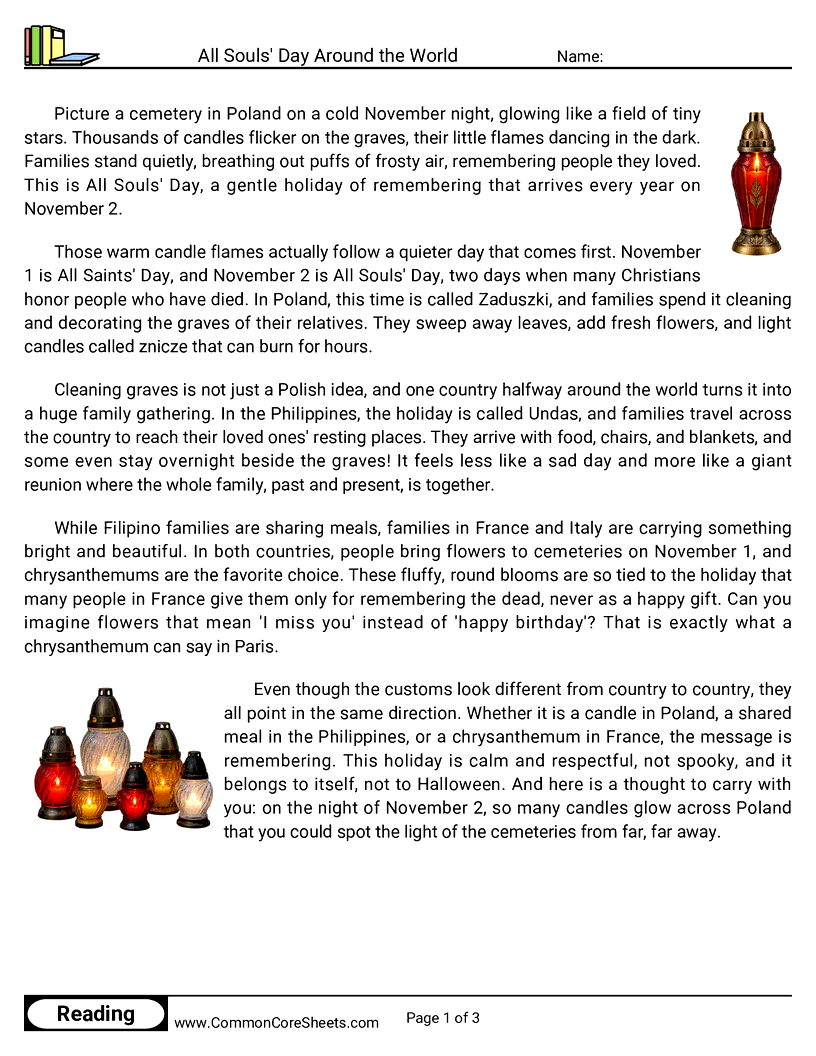
Picture a cemetery in Poland on a cold November night, glowing like a field of tiny stars. Thousands of candles flicker on the graves, their little flames dancing in the dark. Families stand quietly, breathing out puffs of frosty air, remembering people they loved. This is All Souls' Day, a gentle holiday of remembering that arrives every year on November 2.
Those warm candle flames actually follow a quieter day that comes first. November 1 is All Saints' Day, and November 2 is All Souls' Day, two days when many Christians honor people who have died. In Poland, this time is called Zaduszki, and families spend it cleaning and decorating the graves of their relatives. They sweep away leaves, add fresh flowers, and light candles called znicze that can burn for hours.
Cleaning graves is not just a Polish idea, and one country halfway around the world turns it into a huge family gathering. In the Philippines, the holiday is called Undas, and families travel across the country to reach their loved ones' resting places. They arrive with food, chairs, and blankets, and some even stay overnight beside the graves! It feels less like a sad day and more like a giant reunion where the whole family, past and present, is together.
While Filipino families are sharing meals, families in France and Italy are carrying something bright and beautiful. In both countries, people bring flowers to cemeteries on November 1, and chrysanthemums are the favorite choice. These fluffy, round blooms are so tied to the holiday that many people in France give them only for remembering the dead, never as a happy gift. Can you imagine flowers that mean 'I miss you' instead of 'happy birthday'? That is exactly what a chrysanthemum can say in Paris.
Even though the customs look different from country to country, they all point in the same direction. Whether it is a candle in Poland, a shared meal in the Philippines, or a chrysanthemum in France, the message is remembering. This holiday is calm and respectful, not spooky, and it belongs to itself, not to Halloween. And here is a thought to carry with you: on the night of November 2, so many candles glow across Poland that you could spot the light of the cemeteries from far, far away.
Picture a hillside cemetery at dusk, glowing like a field of tiny stars because thousands of candles are burning between the graves. This is not a spooky scene at all, but one of the most peaceful nights of the year in many countries. On November 1 and 2, families around the world gather to remember people who have died, a two-day observance often called All Saints' Day and All Souls' Day. It is quiet, warm, and full of light, more like a soft hug than a scary story.
That glow of candlelight shines brightest in Poland, where the holiday is one of the biggest of the whole year. Polish families call November 2 Zaduszki, and in the days before it they visit cemeteries to scrub the gravestones and pull up weeds until everything looks its best. Then, when night falls, they light rows and rows of candles inside little glass lanterns, so that from a distance a graveyard seems to flicker and breathe. Some cemeteries hold so many flames that the sky above them turns a faint orange, as if the town were lit by a giant campfire.
Poland is far from the only place where these days matter, because halfway across the globe the Philippines celebrates just as brightly. There the holiday is known as Undas, and families travel long distances, sometimes across whole islands, to reach the graves of their grandparents and great-grandparents. Once they arrive, they may stay for hours or even overnight, sharing food, telling stories, and playing games right beside the tombs. Can you imagine a picnic in a cemetery? For many Filipino families it is a happy reunion, not a sad one.
While Filipino families spread out their picnic blankets, families in France and Italy are carrying something else to the cemetery: armfuls of flowers. In France the flower of choice is the chrysanthemum, a big round bloom that shopkeepers sell by the potful in the days before November 1. People place these bright flowers on graves so thickly that some cemeteries look like gardens in full bloom. Because of this custom, the French usually give chrysanthemums only for the dead, so handing someone a bouquet of them as a gift would seem very strange!
From Polish candles to French flowers, all of these customs share the same gentle heart: remembering. Even though the holiday grew out of Christian tradition many centuries ago, today people of many backgrounds join in cleaning graves and lighting lights. It is important to know that All Souls' Day is its own holiday with its own meaning, not simply another version of Halloween that comes right before it. Perhaps the most surprising thing is that a day about people who have died turns out to be one of the most alive nights of the year, glowing with candles, flowers, and family.
You've probably heard that the first days of November are all about candy wrappers and costumes. But in dozens of countries, November 1 and 2 are something else entirely: two quiet days set aside to remember people who have died. Picture a cemetery glowing gold after dark, thousands of tiny flames flickering over the graves like a field of fallen stars. This is All Saints' Day and All Souls' Day, and for millions of families it is one of the most meaningful times of the whole year.
Those flames you imagined burn brightest in Poland, where All Souls' Day is called Zaduszki. On the evening of November 1, families crowd into cemeteries to scrub headstones, arrange chrysanthemums, and light candles inside little glass lanterns called znicze. Some large cemeteries hold so many candles that the glow can be seen for miles, and the air smells of melting wax and cold autumn leaves. Rather than being sad or scary, it feels calm and warm, like a whole nation stepping outside together to say, "We haven't forgotten you."
That idea of gathering as one enormous family travels halfway around the world to the Philippines, where the holiday is known as Undas. There, All Saints' Day can look almost like a giant reunion picnic: families spend hours, sometimes the entire day, beside the graves of their relatives. They bring folding chairs, food, card games, and even guitars, turning a solemn visit into a celebration of the people they loved. Roads fill with traffic as millions of Filipinos travel home, making it one of the busiest travel periods of the country's year.
Flowers do much of the talking on these days, especially in France and Italy, where families carry armfuls of chrysanthemums to the cemetery. In France the connection is so strong that many people would never give chrysanthemums as an ordinary gift, because the blooms belong to the dead. The custom grew out of a much older Christian tradition: All Saints' Day honors saints, and the day after honors ordinary souls who have died. Both days trace back more than a thousand years, long before anyone was handing out chocolate on doorsteps.
Why should any of this matter to you, halfway across the map from a Polish cemetery? Because it shows that people everywhere share the same wish to remember and honor those they've lost, even when the customs look completely different. All Souls' Day is not "someone else's Halloween"; it is its own holiday, with its own meaning, and it sits quietly beside Halloween on the calendar without competing with it. So the next time the calendar flips to November, remember that while some people are counting candy, others are lighting a sea of candles for the people they miss.
Picture an entire cemetery glowing like a field of fireflies, thousands of tiny flames flickering in the November dark while families stand quietly among the graves. This is the sight across much of Poland on the night of November 2, a holiday called Zaduszki, or All Souls' Day. It isn't spooky at all, even though it happens right after Halloween on the calendar. Instead, it is one of the gentlest holidays in the world, a time set aside to remember people who have died. Around the globe, millions of people mark November 1 and 2 not with costumes or candy, but with candles, flowers, and quiet visits to those they miss.
Those two dates carry two different names, and knowing the difference helps the whole holiday make sense. November 1 is All Saints' Day, when many Christians honor the saints and holy people of the past, and November 2 is All Souls' Day, set aside for remembering ordinary loved ones who have died. Both grew out of the Catholic Church more than a thousand years ago, and by the 800s a pope had fixed All Saints' Day on November 1. Over the centuries the two days blended together in everyday life, so that families now often visit the cemetery across both dates. What began as a strictly religious observance slowly became a family and cultural event, one that even people who rarely attend church still keep.
That blending of religion and family life looks a little different everywhere the holiday traveled. In France and Italy, the custom centers on flowers, especially chrysanthemums, which arrive by the millions and cover graves in bursts of gold and deep red. In fact, in those countries chrysanthemums are so tied to the dead that giving them as a casual gift would seem strange or even rude. In Poland, the star of the night is the candle, and cemeteries fill with so many lights that the glow can be seen from far away. A custom carried by the same church took root in different soil and grew into different traditions.
Cross the ocean to the Philippines and that same root produced something louder and more crowded. There the holiday is known as Undas, and instead of a quiet evening it can stretch into a days-long family reunion right in the cemetery. Relatives travel long distances, clean and repaint the graves, and then settle in with food, music, card games, and folding chairs. Children who moved away for work or school come home, so the roads out of the cities jam with traffic in the days before November 1. It shows how a solemn idea, remembering the dead, can also become a warm, noisy celebration of a family still together.
That mix of solemn and social is exactly why this holiday is easy to misunderstand. Because it lands beside Halloween on the calendar, some people lump the two together, but they are not the same thing and never were. Halloween grew into a night of costumes and treats, while All Souls' Day stayed focused on memory and respect. Even the popular Mexican Day of the Dead, which shares these November dates and some of the same church roots, is its own celebration with its own meaning, not a version of anything else. Each of these holidays deserves to be understood on its own terms, for what its own people say it means.
Understanding a holiday on its own terms often means noticing the small, human details. Think of a grandmother in Warsaw kneeling to light a candle, or a family in Manila laughing over a card game beside a freshly painted tomb. Modern life has changed some of the details, with electric graveside lights now sold alongside wax candles and flowers ordered online. Yet the heart of the holiday has barely moved in a thousand years, because the wish behind it is one almost everyone shares. Here is the thought worth carrying away: a holiday about people who are gone turns out to be one of the world's warmest gatherings of the living.
On the evening of November 1, a hillside cemetery in southern Poland glows so brightly that you can see it from miles away. Thousands of candles flicker on graves, their small flames trembling in the cold autumn wind, while whole families stand shoulder to shoulder in heavy coats. This is Zaduszki, part of the two days that much of the Christian world sets aside each year to remember the dead. November 1 is All Saints' Day and November 2 is All Souls' Day, and together they turn quiet graveyards into some of the most visited places in a country. Notice what this holiday is not: it is not spooky, and it is not designed to scare anyone. It is a season of memory, and understanding why it looks the way it does means looking closely at how one idea spread and changed across many cultures.
That idea took centuries to settle into the calendar, and historians can actually point to the people who shaped it. In the early Middle Ages, Christians honored their martyrs on scattered dates, but Pope Gregory III, in the 700s, dedicated a chapel in Rome to all the saints and helped fix a single feast. About a century later, another pope, Gregory IV, encouraged the whole Western church to observe All Saints' Day on November 1. The second day, All Souls' Day, is usually credited to Odilo, an abbot of the monastery at Cluny in France, who around the year 998 set November 2 aside to pray for all the faithful dead. Here is the key distinction historians draw: the first day honors the saints in heaven, while the second remembers ordinary souls, the everyday people missed by their families.
Those two purposes, saints above and loved ones below, explain why the customs you see today can look so different from one country to the next. In the Philippines, the holiday is called Undas, and families often travel long distances to reach the graves of grandparents and great-grandparents. They clean the tombs, repaint them, and then stay for hours or even overnight, sharing food, playing cards, and talking as if the whole extended family were together again. In France and Italy, people carry chrysanthemums to the cemetery, so strongly linked to this season that in those countries the flower is rarely given as a cheerful gift. One tradition leans toward a joyful reunion, the other toward solemn tribute, yet both grow from the same root: showing the dead they are not forgotten.
That root, the belief that the living owe something to the dead, also shaped the foods that appear around these days. In Mexico, where the related Day of the Dead unfolds on the same dates, bakers sell pan de muerto, a round sweet bread often decorated with strips of dough shaped like bones. In parts of Spain and Italy, families eat small almond or sugar cookies traditionally called "bones of the dead," or ossa dei morti. People once told a story that on the night between the two days, the souls of the dead returned home, so households left out food and kept a light burning to welcome them. Historians treat that story as folklore rather than fact, but they agree it reveals something true: communities wanted a way to keep the departed close.
Keeping the departed close is exactly why writers argue this holiday should never be called "the Catholic Halloween." The two days share a calendar corner and a distant history, and the word Halloween itself comes from "All Hallows' Eve," the evening before All Saints' Day. But sharing a name origin is not the same as sharing a meaning, and the difference matters to the people who observe it. Halloween in the United States centers on costumes, candy, and playful frights, while All Souls' Day centers on family, prayer, and memory. Calling one the other's version, scholars point out, erases what a community actually intends its holiday to mean.
That insistence on meaning is why, in many places, the day stays deliberately quiet rather than loud. In Poland, roads near cemeteries fill with traffic, and vendors sell not costumes but glass lanterns called znicze, built to shelter a flame from rain and wind. In much of Latin America, Europe, and Asia, November 2 is a public occasion when work slows and cemeteries overflow with visitors. Think about that for a moment: across dozens of countries and several continents, millions of people spend the same two days doing the same simple thing, tending graves and lighting lights. And perhaps the most striking fact is the oldest one, that a custom begun by a French abbot more than a thousand years ago still lights up a Polish hillside every single autumn.
About this worksheet
Students read a nonfiction passage about All Saints' and All Souls' Day around the world, written at 6 reading levels (3rd grade to 8th grade), and answer multiple-choice questions about it.
A reading comprehension worksheet about All Saints' and All Souls' Day around the world with a different article for each reading level, 3rd grade to 8th grade, each with its own multiple-choice questions aligned to the Common Core Reading: Informational Text standards. Printable with an answer key, and available as an online assignment at any level.
Student objectives
- Read a passage comparing All Souls' Day customs in four countries
- Find details about candles, flowers, and meals used to honor the dead
- Explain why families visit and decorate graves on this holiday
- Identify the comparison structure the author uses across the article
Everyday practice
- Notice how different families and cultures remember people they have lost
- Look up where Poland, the Philippines, France, and Italy are on a world map
- Ask a family member about a way your own family remembers loved ones