A Parade of Giant Puppets Worksheet Download
Free reading comprehension worksheet about the Village Halloween Parade in New York City. Pick the reading level (2nd grade to 8th grade), print the passage with its questions, or assign it online.


Sheet Information >
Available at 2nd grade, 3rd grade, 4th grade, 5th grade, 6th grade, 7th grade and 8th grade reading levels.
Read the passage
Can you imagine a puppet so big it takes many people to carry it down the street? At the Village Halloween Parade in New York City, huge puppets float high above the crowd on long poles. Some of them look like skeletons, and others look like giant animals, and they wobble and dance as they go!
Those dancing puppets first came from one man's idea. In 1974, a puppet maker named Ralph Lee led a walk through his neighborhood with his children and friends. They wore costumes and carried his handmade puppets, and people came out of their houses to watch.
That small neighborhood walk grew and grew into something much bigger. Today, thousands of people put on costumes and march together every year on Halloween night. The parade fills the streets with music, drums, and lights while crowds cheer from the sidewalks.
The best part is that you do not need a ticket to join the fun. Anyone who wears a costume can step right into the parade and march along. That is why some people call it a parade made by the people who walk in it!
Imagine you are standing on a busy street in New York City on Halloween night. Suddenly a puppet as tall as a small tree floats over the crowd, its arms swaying above your head! This is the Village Halloween Parade, where giant puppets and thousands of people in costumes march together. Music plays, drums pound, and everyone smiles, because tonight the whole neighborhood becomes one big, happy show.
Those towering puppets are the real stars of the parade. They are held up on tall poles, so puppeteers below can make them dance, wave, and bow to the crowd. Some are bright skeletons, some are strange creatures, and some are shaped like animals with wide, waving wings. Because they are so big and so colorful, you can spot them from far down the street!
The parade that shows off these puppets started with just one man and his family. Long ago, in the early 1970s, a puppet maker named Ralph Lee led a walk through his neighborhood in New York City with his children and friends. First it was a small parade, but more and more people wanted to join the fun. Soon it grew into one of the biggest Halloween parades anywhere.
Today, anyone who wears a costume can march in the parade, and that is what makes it so special. You do not need a ticket or a famous name to walk with the giant puppets. Kids, grown-ups, and even whole families dress up and join the crowd of costumed marchers. Can you believe that one small family walk grew into a river of costumes flowing down the street each Halloween?
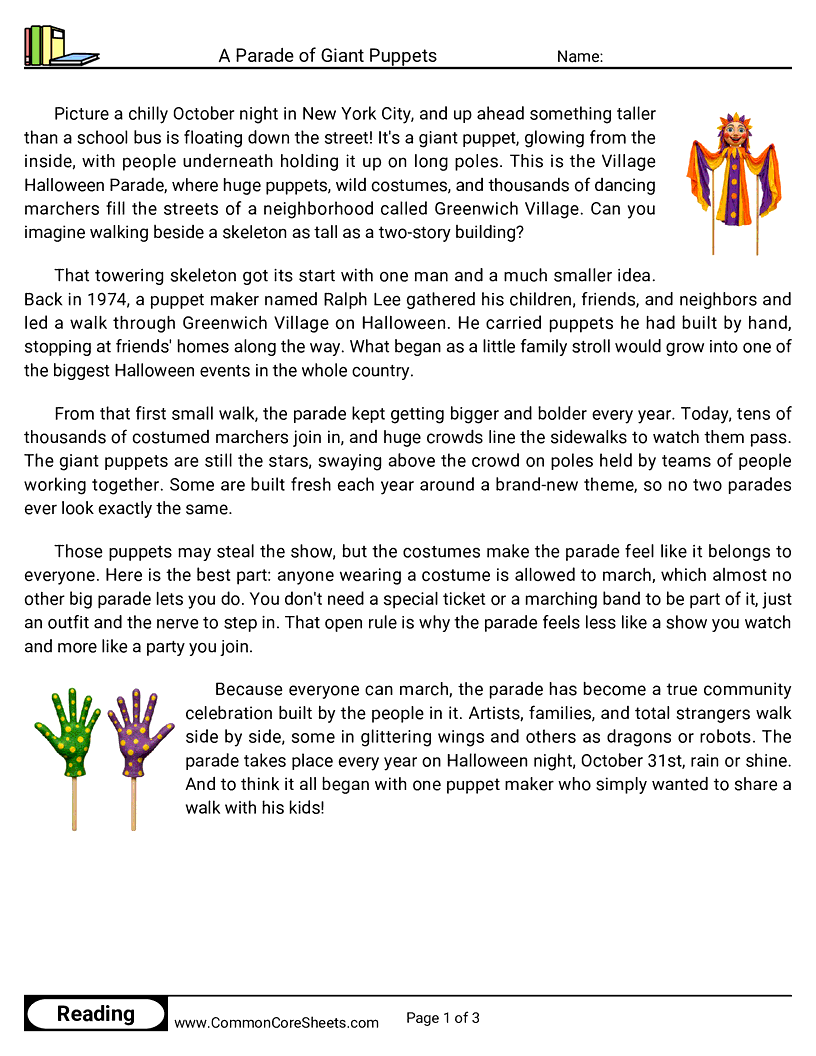
Picture a chilly October night in New York City, and up ahead something taller than a school bus is floating down the street! It's a giant puppet, glowing from the inside, with people underneath holding it up on long poles. This is the Village Halloween Parade, where huge puppets, wild costumes, and thousands of dancing marchers fill the streets of a neighborhood called Greenwich Village. Can you imagine walking beside a skeleton as tall as a two-story building?
That towering skeleton got its start with one man and a much smaller idea. Back in 1974, a puppet maker named Ralph Lee gathered his children, friends, and neighbors and led a walk through Greenwich Village on Halloween. He carried puppets he had built by hand, stopping at friends' homes along the way. What began as a little family stroll would grow into one of the biggest Halloween events in the whole country.
From that first small walk, the parade kept getting bigger and bolder every year. Today, tens of thousands of costumed marchers join in, and huge crowds line the sidewalks to watch them pass. The giant puppets are still the stars, swaying above the crowd on poles held by teams of people working together. Some are built fresh each year around a brand-new theme, so no two parades ever look exactly the same.
Those puppets may steal the show, but the costumes make the parade feel like it belongs to everyone. Here is the best part: anyone wearing a costume is allowed to march, which almost no other big parade lets you do. You don't need a special ticket or a marching band to be part of it, just an outfit and the nerve to step in. That open rule is why the parade feels less like a show you watch and more like a party you join.
Because everyone can march, the parade has become a true community celebration built by the people in it. Artists, families, and total strangers walk side by side, some in glittering wings and others as dragons or robots. The parade takes place every year on Halloween night, October 31st, rain or shine. And to think it all began with one puppet maker who simply wanted to share a walk with his kids!
Picture a puppet so tall it looks a person in the second-floor windows straight in the eye, gliding down a city street while a crowd cheers below. That is exactly what you would see at the Village Halloween Parade in New York City, where giant puppets tower over the marchers who carry them. These aren't small hand puppets; they ride high on long poles, with several people working together to make their arms wave and their heads turn. Some look like skeletons, some like enormous birds or spiders, and every one of them helps turn a regular avenue into a moving, glowing show.
Those towering puppets did not appear overnight, because the whole parade grew from one man's simple idea. Back in 1974, a puppet maker and mask artist named Ralph Lee led a walk through his Greenwich Village neighborhood with his own children, some friends, and a batch of his handmade puppets. It was less a grand event and more like a big, friendly stroll from house to house, stopping to visit families along the way. Nobody watching that little group could have guessed it would one day fill entire streets.
From that neighborhood stroll, the walk grew into one of the largest Halloween celebrations you can find anywhere. Today about 50,000 costumed people march in the parade each year, and many more line the sidewalks to watch them pass. The route runs up Sixth Avenue in Manhattan, and the whole thing is often called the country's biggest Halloween parade. Imagine a river of costumes flowing for blocks, with those famous puppets bobbing above the crowd like the tallest waves.
What makes this parade different from a football game or a concert is that here you don't just watch, you can jump right in. There is one simple rule: anyone wearing a costume is welcome to join the marchers, no ticket and no invitation needed. That means a kid dressed as a robot might walk beside a grown-up dressed as a dragon, with a whole family of playing cards behind them. The parade belongs to everyone who shows up ready to be part of the spectacle.
Because everyone brings their own costume, no two years of the parade ever look quite the same. Bands play, dancers spin, and the puppeteers steer their giant creations around corners like sailors guiding tall ships. The event has grown so beloved that it has appeared on television and even survived years when storms or hard times threatened to cancel it. Not bad for something that started as one puppet maker taking a walk with his kids on a fall evening.
Picture a giant skeleton the size of a two-story building, gliding down a dark city street while thousands of people cheer. You might think a spectacle like that would take a movie studio and a million dollars, but the Village Halloween Parade in New York City proves you wrong every single year. This is not a parade you watch from behind a rope; if you show up in a costume, you can simply step in and march. Towering puppets bob overhead, drums thunder, and the whole thing rolls up Sixth Avenue in Manhattan like a river of light and noise.
Would you believe this enormous event began as a small family stroll? Back in 1974, a puppet maker and mask artist named Ralph Lee led a walk through his Greenwich Village neighborhood with his children, friends, and a few of his handmade puppets. There were no crowds of strangers that first night, just a small group wandering from house to house so people could enjoy the costumes up close. Lee had spent years building masks and puppets for the stage, and he wanted to share that magic with his own community.
That neighborhood magic turned out to be contagious, and the little walk did not stay little for long. Word spread, and each October more marchers and more onlookers appeared, until the sidewalks could barely hold them all. Within a decade the parade had grown so large that it moved onto a major avenue to make room for the swelling crowds. Today it draws tens of thousands of costumed marchers and enormous crowds of spectators, making it one of the biggest Halloween celebrations in the country.
The real stars, though, are not the crowds but the puppets that seem to float above them. Many are built on tall poles and lightweight frames, so a single person walking underneath can lift a creature that stretches high into the night sky. Puppeteers hidden below tilt the poles to make a spider crouch, a dragon swoop, or a giant figure turn its head as if it were alive. Some designs come from artists, but ordinary volunteers help carry and operate them, which means the puppets belong to everyone, not just professionals.
That idea of belonging is exactly why this parade still matters. In a city where millions of strangers pass each other every day, one October night invites all of them to become neighbors, sharing the same street and the same imagination. Nobody buys a ticket to march, and nobody has to be a famous artist to join; a homemade costume is your only pass. So the next time you assume a grand event needs money and fame, remember that the largest Halloween parade in the United States started with one puppet maker and a few kids walking door to door.
Picture a puppet as tall as a two-story house floating down a city street, its painted head swaying above a sea of skeletons, dragons, and dancers. That is a normal night at the Village Halloween Parade in New York City, held every October 31 in the Greenwich Village neighborhood of Manhattan. No tickets are sold and no famous marshal leads it; instead, the whole thing is powered by people in costume who simply show up. If you can imagine a moving art gallery that anyone is allowed to walk inside, you are picturing this event.
Those towering puppets did not appear by accident, because the parade was dreamed up by an artist who worked with them for a living. In the early 1970s, a mask and puppet maker named Ralph Lee led a walk through his own neighborhood, bringing along his children, friends, and the giant figures he built by hand. Back then it was small enough to feel like a block party, winding past front stoops where neighbors watched from their windows. Lee did not want a stage where a crowd sits and watches; he wanted a parade the audience could join, and that idea would shape everything that came after.
That single choice, to let watchers become marchers, is exactly why the parade swelled far beyond one artist's block. Word spread that you needed nothing but a costume to take part, and each year more people poured in until the crowd stretched for blocks. Today the event draws tens of thousands of costumed participants and around a million spectators lining the route. What began as a handful of friends grew into one of the largest Halloween celebrations in the country, all without a single ticket booth.
Growing that large meant the parade needed a new home, so it moved from quiet side streets onto a wide, famous avenue. The march now travels up Sixth Avenue, giving the enormous puppets the room they need to turn corners and rise above the crowd. Some of these figures are operated by several people at once, with puppeteers holding long poles or working rods hidden inside the frame. When a spider the size of a car creeps overhead or a skeleton stretches taller than a streetlight, teams of hands beneath the fabric are making it move.
Those hidden puppeteers are only part of a much larger crew that keeps the giants alive year after year. A nonprofit organization and a small army of volunteers design, build, and repair the puppets, often out of light materials like papier-mâché, cloth, and bamboo so the figures stay easy to carry. Musicians, dancers, and marching bands join the parade too, so the street fills with drumbeats and brass along with the costumes. This mix of homemade art and live music is what makes the event feel less like a show you watch and more like one you help create.
That do-it-yourself spirit has kept the parade going even through hard times, such as the year a hurricane forced it to be postponed. It has survived storms, rising costs, and decades of change because the community keeps rebuilding it, puppet by puppet. The rule that started it all still holds: put on a costume, and you are welcome to march. Not bad for an event that began as one puppet maker taking his kids for a walk down the block.
Picture a puppet so tall it seems to peer into second-story windows, its painted face swaying above a river of costumes flooding a New York City street. This is the Village Halloween Parade, held every October 31st in Greenwich Village in Manhattan. Skeletons on poles dance overhead, dragons ripple down the avenue, and enormous figures rise from bamboo frames carried by teams of people below. What began as one family's evening stroll has become a spectacle that thousands of costumed marchers join and hundreds of thousands more line up to watch.
That first stroll is where the whole story starts, and it was smaller than you might guess. In 1974, a mask and puppet maker named Ralph Lee led a walk through his own Greenwich Village neighborhood, bringing along his children, friends, and the puppets he had built by hand. He wanted a moving theater piece, a show that traveled from door to door rather than sitting still on a stage. The route wound past the homes of neighbors, who stepped outside to watch the strange and wonderful figures pass. In other words, the parade was designed as art before it was ever designed as a party.
That idea of art on the move explains why the puppets, not the crowd, remain the parade's beating heart. Some of these creations tower two or three stories high, taller than a city bus stood on its end, and it can take a dozen puppeteers to steer a single one. They are built the old way, over lightweight frames of bamboo and cloth, so that arms can be raised and heads can turn as the figures glide forward. A puppeteer hidden underneath sees the street through a small gap, guiding a creature that looks alive to everyone above. The result is less a march of decorations than a slow-moving performance you can walk right into.
Walking right into the performance is exactly what sets this parade apart from the ones you watch from a curb. Unlike a parade with a fixed lineup of official floats, the Village event follows a simple rule: anyone wearing a costume may join the marching line, no application required. That single rule turns spectators into participants, blurring the border between the show and the audience. Compare it to a Thanksgiving parade, where the marchers are chosen months ahead and the rest of us watch; here, the crowd itself becomes the parade. This is why organizers have long called it a parade made by the people who show up.
The people who show up have kept coming for a reason that goes beyond the puppets. Over the decades the gathering grew from a neighborhood happening into one of the largest Halloween celebrations in the United States, drawing marchers by the tens of thousands. Its survival was not guaranteed, though; funding troubles and other setbacks have threatened it more than once, and neighbors and volunteers repeatedly stepped in to keep it alive. That pattern reveals something important about the event: it belongs less to any single organizer than to the community that refuses to let it disappear. A tradition that people fight to save is a tradition that clearly means a great deal to them.
What it means becomes clearest when you notice how the parade keeps circling back to where it began. Even now, artists still build fresh giant puppets each year, honoring the handmade spirit of that 1974 walk rather than swapping it for store-bought balloons. The costumes have changed with the times, reflecting whatever people are thinking and talking about in a given year, so the parade doubles as a kind of yearly snapshot. Yet the core has held: a maker, some puppets, and an open invitation to march. It is a rare thing for a single evening stroll with a few children to grow, decade after decade, into a moving artwork that a whole city helps carry.
About this worksheet
Students read a nonfiction passage about the Village Halloween Parade in New York City, written at 7 reading levels (2nd grade to 8th grade), and answer multiple-choice questions about it.
A reading comprehension worksheet about the Village Halloween Parade in New York City with a different article for each reading level, 2nd grade to 8th grade, each with its own multiple-choice questions aligned to the Common Core Reading: Informational Text standards. Printable with an answer key, and available as an online assignment at any level.
Student objectives
- Read a chronological passage and follow how the parade grew over time
- Find specific details about who started the parade and when
- Explain why the parade feels like a celebration everyone can join
- Determine the meaning of words like "theme" from context
Everyday practice
- Notice a parade or festival in your own town and ask when and how it began
- Sketch a giant puppet you would carry on poles and give it a theme
- Ask a family member about a costume or event they remember from childhood