The Twelve Days of Christmas Worksheet Download
Free reading comprehension worksheet about the twelve days of Christmas and the counting song. Pick the reading level (2nd grade to 8th grade), print the passage with its questions, or assign it online.


Sheet Information >
Available at 2nd grade, 3rd grade, 4th grade, 5th grade, 6th grade, 7th grade and 8th grade reading levels.
Read the passage
Wow, one bird shows up twelve times in a single song! In "The Twelve Days of Christmas," a partridge in a pear tree returns in every verse, and each verse adds more. It is a cumulative song, which means each verse adds to the ones before.
That piling-up tune is old: it was first printed in England in 1780. That was more than 240 years ago, before cars, phones, or light bulbs! Some people think it began as a memory game where players sang every gift in order.
Those players sang about twelve days, and those days are real. For many Christians, the twelve days begin on Christmas Day and end just before Epiphany on January 6. Some say the four calling birds stand for the four Gospels, books about Jesus's life, but no one is sure.
Whatever the birds mean, the numbers add up fast. Count every gift in every verse, and you get 364 presents! That is one less than the 365 days in most years, and the partridge appears in all twelve verses.
Imagine you are in a circle of friends, and it is your turn to sing the next verse! You take a big breath: five gold rings, four calling birds, three French hens, and on down to a partridge in a pear tree. This is a cumulative song: each verse adds one new gift and repeats all the old ones. By the end, everyone is out of breath and giggling.
People have been giggling over this song for more than 240 years. It was first printed in England in 1780, in a children's book, and some people think it began as a memory game. Its twelve days run from Christmas Day until Epiphany, January 6, when Christians remember the wise men visiting baby Jesus.
Those wise men brought gifts too, but the song's gifts are much stranger! Some people say the five gold rings stand for the first five books of the Bible, though historians are not sure that was the meaning long ago. Another puzzle is the "calling birds," which were once "colly birds"; colly means black as coal, so they were probably blackbirds.
Blackbirds and gold rings make you wonder how many gifts the song gives in all. Verse twelve alone has 78 gifts, and every verse added together makes 364, just one short of the days in most years. So a song that takes minutes to sing hands out nearly a gift for every day of the year.
Picture a room in England in the late 1700s, where candles flicker and a circle of children waits for a turn. One child begins, "On the first day of Christmas...," and the song grows longer with every round. By the twelfth day, players must remember a whole parade of birds, dancers, and musicians without a single slip! Anyone who forgot a gift paid a forfeit, which was a small, playful penalty.
Those forfeits were part of the fun, but the twelve days in the song are a real holiday season. It begins on Christmas Day, December 25, and lasts through January 5. The next day, January 6, is Epiphany, when Christians remember the visit of the wise men to the young Jesus. For centuries, many families in Europe kept the season with feasts, music, and games, so a counting song fit right in.
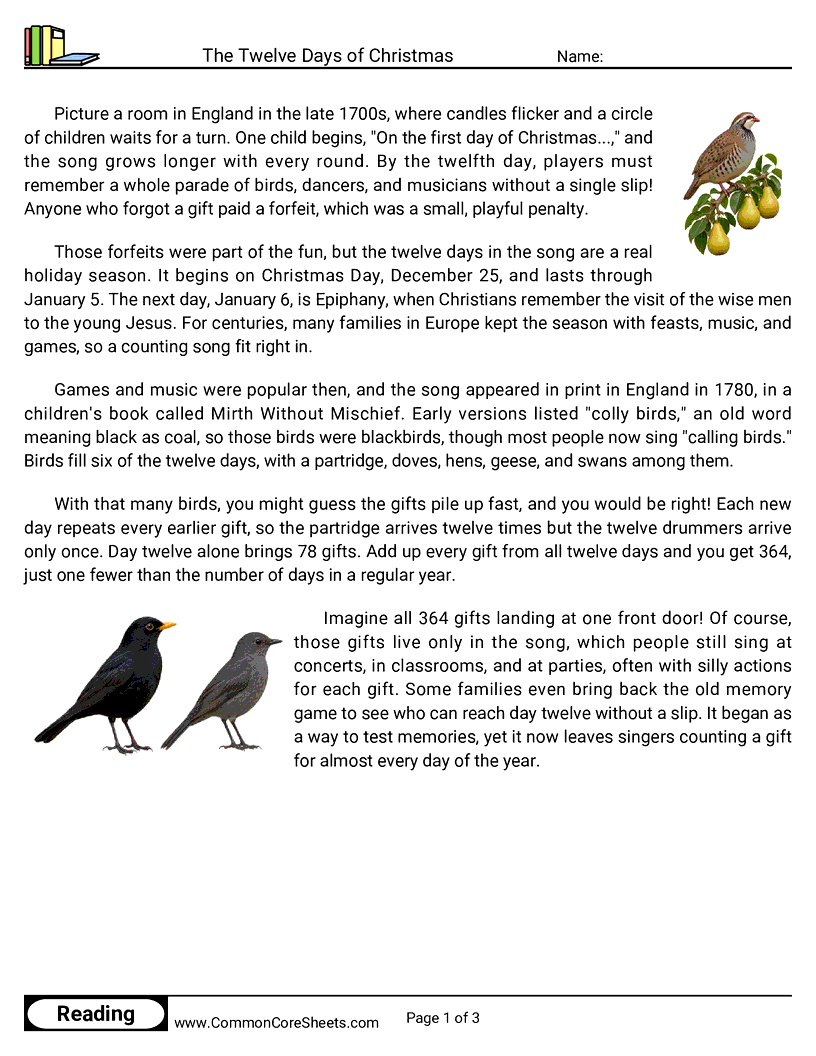
Games and music were popular then, and the song appeared in print in England in 1780, in a children's book called Mirth Without Mischief. Early versions listed "colly birds," an old word meaning black as coal, so those birds were blackbirds, though most people now sing "calling birds." Birds fill six of the twelve days, with a partridge, doves, hens, geese, and swans among them.
With that many birds, you might guess the gifts pile up fast, and you would be right! Each new day repeats every earlier gift, so the partridge arrives twelve times but the twelve drummers arrive only once. Day twelve alone brings 78 gifts. Add up every gift from all twelve days and you get 364, just one fewer than the number of days in a regular year.
Imagine all 364 gifts landing at one front door! Of course, those gifts live only in the song, which people still sing at concerts, in classrooms, and at parties, often with silly actions for each gift. Some families even bring back the old memory game to see who can reach day twelve without a slip. It began as a way to test memories, yet it now leaves singers counting a gift for almost every day of the year.
Here is a puzzle: if a true love sent you every gift in one famous holiday song, how many presents would pile up at your door? The answer hides inside "The Twelve Days of Christmas," a song that builds like a tower of birds, dancers, and musicians. Each verse adds one new gift and repeats all the old ones, so singers need plenty of breath! By the end, they race from twelve drummers drumming all the way back to a partridge in a pear tree.
Those twelve drummers are counting real days, too, starting on Christmas Day. Christians celebrate the birth of Jesus on December 25, and in many churches the season lasts twelve days, leading to Epiphany on January 6, when the visit of the wise men is remembered. In old England, these days meant feasts, visits, and a special Twelfth Night cake on the evening of January 5. Imagine a holiday that lasts nearly two weeks, packed with music, food, and games!
Games may explain how the song began, because it first appeared in print in England in 1780, in a children's book called Mirth Without Mischief. The words were printed as a memory game, with each player adding one more gift to the growing list. Anyone who forgot a gift had to pay a small penalty called a forfeit. The tune we sing today came much later, when English composer Frederic Austin arranged it in 1909.
Just as the tune was updated in 1909, some gifts have changed too, and today's "calling birds" were once "colly birds." Colly is an old word related to coal, so those birds were probably blackbirds. Some historians also think the "five gold rings" may have meant ring-necked birds such as pheasants. Most other gifts are birds or people who dance, leap, pipe, or drum, so the song sounds like a farmyard joining a parade.
Picture that parade marching up your driveway, because all the gifts in the song add up to 364. You can find the total by adding each day's pile, which grows from 1 gift on day one to 3, then 6, and on up to 78 on day twelve. Of those 364 gifts, 184 would be birds, a lot of feathers for one front porch! Here is the striking part: a song about twelve days holds just one gift fewer than the 365 days in a regular year.
Here is a puzzle: if you sing about the twelve days of Christmas, when do those days actually start? Most people guess they come before December 25, like a countdown calendar with a bow on top. Surprise! They begin on Christmas Day and keep the party going afterward. The song that shares their name is a cheerful pile-up of presents, from a partridge in a pear tree to twelve drummers drumming, and every verse is longer than the last. By the end, you are out of breath, tangled in birds, and grinning.
That grin fits, because the twelve days were always meant for celebrating, not waiting. Christians celebrate the birth of Jesus on December 25, and in many Christian traditions the season lasts until Epiphany on January 6. On Epiphany, many Christians remember the visit of the wise men, or Magi, to the child Jesus. The night before, called Twelfth Night, was once a huge party in England, with cake, music, and games. Picture a holiday that keeps going for twelve full days after the presents are opened!
Music and games may be just where the song felt at home, and it first appeared in print in England in 1780. A small children's book called Mirth Without Mischief printed it as words to chant, with no tune at all. The melody most of us hum today was arranged by English composer Frederic Austin in 1909. The song is cumulative, which means each verse piles new gifts on top of the old ones like a growing snowball. You may have heard that the gifts were a secret code for church teachings, but historians have found no solid early evidence for that claim.
A snowball like that gets big fast, and so does the gift pile. On the first day you get 1 gift, on the second day 3, and the twelfth day's verse names 78. Add up every verse and the grand total is 364 gifts, just one short of the days in a regular year. The partridge appears 12 times, but the geese and the swans share the biggest pile, with 42 each. Birds alone add up to 184, so more than half of the presents come with feathers!
A shopping list of feathers, pipers, and rings sounds silly, yet this song has lasted more than 240 years. I think that is because it turns a simple counting trick into a game everyone can join, from kindergartners to grandparents. Choirs still sing it, families race to remember every verse, and the famous line "five gold rings" is where voices tend to swell. It also reminds us that the season does not end when the wrapping paper hits the floor, since for many Christians it stretches to January 6. So when you reach the last verse, remember that you are singing about 364 gifts that began with one lonely partridge.
Sing every verse of "The Twelve Days of Christmas" and you will hand over 364 gifts, just one short of the number of days in a year! Yet the song starts small, with a single partridge sitting in a pear tree. With each verse, another gift joins the pile, and you chant the whole list backward to reach that first bird. By the drummers' verse, the tune is a breathless, tongue-twisting parade of birds, dancers, and musicians. That pile-it-higher trick is the song's charm, but its title points to something real: days on the calendar.
Those twelve days are real ones, running from Christmas Day on December 25 until the night before Epiphany on January 6. Christians celebrate the birth of Jesus at Christmas, and in many traditions the days that followed were a season of feasting, church services, and visiting. Epiphany, in many Western churches, remembers the visit of the magi, or wise men, to the young Jesus. In Tudor England, the last evening, Twelfth Night, was famous for parties, music, and games.
Games were a big part of that celebrating, and one of them gave us the earliest printed version of the song. In 1780, an English children's book called Mirth Without Mischief printed the words as a memory game in which a player who slipped paid a small penalty called a forfeit. Historians think the verses are older than 1780, but nobody can name the author. The words also shifted as the song traveled; some early versions sang of "colly birds," an old word for blackbirds, where we now sing "calling birds." One changed word shows how a song travels from mouth to mouth, like a message whispered down a line of friends.
Whispered messages tend to shrink, but this song's list only grows, and its growth follows a neat mathematical pattern. Day one delivers 1 gift, day two delivers 3 (two doves plus the partridge), day three delivers 6, and day twelve delivers 78. Add all twelve days together, and what does the grand total reach? It reaches 364. Some gifts pile up more than others: the partridge appears 12 times, while the six geese and the seven swans each add up to 42 birds. Try it yourself: multiply each gift's number by the number of days it is given, and your results should add up to 364, too.
Counting the gifts is easy to check, but explaining what they mean is much harder. You may have heard that the song was a secret code that helped Catholics in England, who faced restrictions on their faith, teach their beliefs. It is a lovely story, but historians have found no written evidence from the 1700s or earlier to support it. A careful reader asks what proof stands behind a claim, and this code story seems to have spread only in recent decades. Whatever meaning singers find in the gifts today, the earliest evidence points to a playful start.
A game that playful has a long afterlife, and the version you hear today owes much to one composer. In 1909, English composer Frederic Austin published an arrangement with the melody most people now sing, including the long, stretched-out "five gold rings." Since 1984, PNC Financial Services has tracked the cost of every gift in its yearly Christmas Price Index, which has reached tens of thousands of dollars in recent years. Not bad for a party game that starts with one bird in one tree and ends, 364 gifts later, one day short of a year of presents.
In 1909, an English singer and composer named Frederic Austin made one tiny change that millions of people still copy every December. While arranging a traditional tune for an old counting song, he stretched the words "five gold rings" into a long, ringing flourish. Can you imagine the song without that moment, when everybody takes a deep breath and holds the note? The song is "The Twelve Days of Christmas," and it builds like a tower, with each new day adding a gift and then repeating every gift before it, from a partridge in a pear tree at the bottom to drummers drumming at the top. By the last verse, singers must recall twelve different gifts in exact order, which is much harder than it sounds!
Remembering all those gifts is a big job, but the song at least has a calendar to lean on, borrowed from the church year. Christians celebrate the birth of Jesus on December 25, and in many traditions the twelve days of Christmas begin then and run through January 5. January 6 is Epiphany, when many Christians remember the visit of the Magi, the traveling wise men who brought gifts to the young Jesus. In Spanish-speaking countries and communities, that same date is also celebrated as Three Kings Day, a festival with its own customs and treats. The festive evening that closed the season, known as Twelfth Night, was such a famous party in England that William Shakespeare named a comedy after it around 1601.
Twelfth Night parties were packed with games, and the song first appeared in print in a children's book. That book, called Mirth Without Mischief, was published in England in 1780 and gave the words but no music. Where the song lived before that is still debated: some scholars suspect French origins, because similar cumulative verses appear in French folk songs, while others see a homegrown English game. Whatever its earlier life, in that book it was a memory game, in which players recited the verses and anyone who stumbled paid a small penalty called a forfeit.
Forfeits were easy to earn with this song, because the list keeps growing, and the growth hides a tidy math puzzle. Verse one names 1 gift, verse two names 3, verse three names 6, and by verse twelve the singers rattle off 78 gifts in a single rush. Add up all twelve verses and the grand total is 364 gifts. Each gift shows up a different number of times: the two turtle doves appear in eleven verses, making 22 birds, and the three French hens appear in ten, making 30. Even better, the pattern is a mirror, since the eleven pipers also total 22, the ten lords total 30, and the partridges and the drummers both total 12. That grand total of 364 is just one short of the 365 days in a common year.
Numbers this tidy tempt people to hunt for hidden messages, and one popular claim says the gifts were a secret code. In that story, English Catholics who were restricted from practicing their faith openly used the song to teach religious ideas, with each gift standing for a lesson. Historians are skeptical, because the code idea seems to have surfaced only in the late 1900s and no known writing from earlier centuries connects the song to that purpose. The wording itself shows how meanings drift: early versions had four "colly birds," an old term for coal-black birds such as blackbirds, and over time the phrase became "calling birds." Even so, families are free to give the gifts their own symbolic meanings, and that is a tradition of interpretation rather than a documented origin.
Whatever the gifts once meant, modern number crunchers treat them like a shopping list. Since 1984, the PNC Financial Services Group has published its Christmas Price Index, an annual estimate of what it would cost to buy everything in the song. In recent years, the index has put the price of the song's gifts in the tens of thousands of dollars, and the total for all 364 gifts has been several times higher. So the next time you hold that long note on "five gold rings," remember that you are singing inside a 1780 party game with a math puzzle hidden in its verses: 364 gifts, one short of a year's days.
About this worksheet
Students read a nonfiction passage about the twelve days of Christmas and the counting song, written at 7 reading levels (2nd grade to 8th grade), and answer multiple-choice questions about it.
A reading comprehension worksheet about the twelve days of Christmas and the counting song with a different article for each reading level, 2nd grade to 8th grade, each with its own multiple-choice questions aligned to the Common Core Reading: Informational Text standards. Printable with an answer key, and available as an online assignment at any level.
Student objectives
- Read a nonfiction passage about the twelve days of Christmas and the counting song.
- Find the sentences that tell when the twelve days begin and end.
- Explain why some gifts in the song are repeated many times.
- Use context to work out the meaning of words like forfeit and colly.
Everyday practice
- Try singing the song with a friend and see who can get to day twelve without a slip.
- Add up the gifts day by day (1, 3, 6, 10...) and see if you reach 364.
- Look at a calendar and count the days from December 25 to January 5.