The History of Artificial Christmas Trees Worksheet Download
Free reading comprehension worksheet about the history of artificial Christmas trees. Pick the reading level (3rd grade to 8th grade), print the passage with its questions, or assign it online.


Sheet Information >
Available at 3rd grade, 4th grade, 5th grade, 6th grade, 7th grade and 8th grade reading levels.
Read the passage
Imagine you are walking into a cozy living room on a snowy December night. In the corner stands a tall green tree with twinkling lights, shiny balls, and a sparkly star on top. Look closely, because this tree never grew in a forest! It is an artificial tree, which means people made it instead of growing it.
People made trees like this long before plastic existed, and the first ones were made of goose feathers! Long ago in Germany, in the 1800s, families dyed feathers green and attached them to wire branches. Some people worried about forests losing too many trees, so a feather tree was another choice.
Feather trees were only the start, and another big idea came from a brush factory! Many people say the Addis Brush Company, known for toilet brushes, used its bristles to make green trees. In the 1950s and 1960s, shiny trees made of aluminum, a light metal, became popular. Because lights on metal could be unsafe, families used a spinning color wheel instead.
Those sparkly silver trees are rare today, and most artificial trees now are made of plastic. People still debate which kind of tree is kinder to the environment, or the nature around us. Real trees grow on farms and can become mulch, while a plastic tree can be used for many years. Remember, some of the very first fake trees were made from goose feathers!
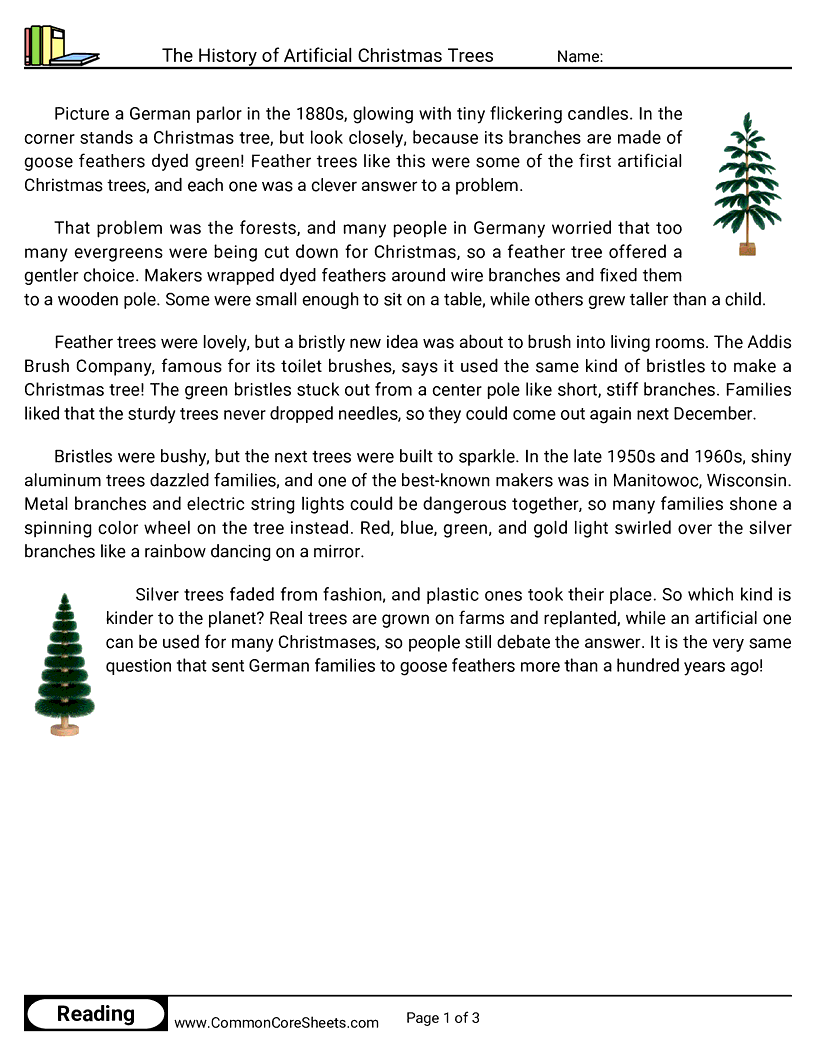
Picture a German parlor in the 1880s, glowing with tiny flickering candles. In the corner stands a Christmas tree, but look closely, because its branches are made of goose feathers dyed green! Feather trees like this were some of the first artificial Christmas trees, and each one was a clever answer to a problem.
That problem was the forests, and many people in Germany worried that too many evergreens were being cut down for Christmas, so a feather tree offered a gentler choice. Makers wrapped dyed feathers around wire branches and fixed them to a wooden pole. Some were small enough to sit on a table, while others grew taller than a child.
Feather trees were lovely, but a bristly new idea was about to brush into living rooms. The Addis Brush Company, famous for its toilet brushes, says it used the same kind of bristles to make a Christmas tree! The green bristles stuck out from a center pole like short, stiff branches. Families liked that the sturdy trees never dropped needles, so they could come out again next December.
Bristles were bushy, but the next trees were built to sparkle. In the late 1950s and 1960s, shiny aluminum trees dazzled families, and one of the best-known makers was in Manitowoc, Wisconsin. Metal branches and electric string lights could be dangerous together, so many families shone a spinning color wheel on the tree instead. Red, blue, green, and gold light swirled over the silver branches like a rainbow dancing on a mirror.
Silver trees faded from fashion, and plastic ones took their place. So which kind is kinder to the planet? Real trees are grown on farms and replanted, while an artificial one can be used for many Christmases, so people still debate the answer. It is the very same question that sent German families to goose feathers more than a hundred years ago!
Here is a puzzle for you: what kind of Christmas tree can be made from goose feathers, brush bristles, or shiny aluminum? None of them grew in a forest, yet families proudly set them up at home and hung ornaments on their branches. For many people, a decorated tree is part of Christmas, whether they celebrate it as a religious or a cultural holiday. So why did inventors keep making trees that never grew, and what were they thinking?
To learn what inventors were thinking, travel to 1800s Germany, where some people worried that cutting young evergreens could thin their forests. Their clever answer was the feather tree, made by dyeing goose feathers green and attaching them to wire branches. Feather trees ranged from tiny tabletop models to much taller ones, and their spaced-out branches gave ornaments room to dangle. Some of those feathery trees have lasted more than a hundred years, and collectors treasure them today.
Collectors still treasure feather trees, but a very different company came up with a very different idea. The Addis company in England made household brushes, including toilet brushes, and says it used similar bristles to make spiky green trees. Yes, bristles like the ones in a bathroom brush ended up holding ornaments! These trees never dropped needles the way a real evergreen does, and they could be packed in a box for next year.
Reusable trees were handy, and by the late 1950s one company found a shinier way to make them. The Aluminum Specialty Company of Manitowoc, Wisconsin, sold an aluminum tree called the Evergleam, and soon many sparkled in living rooms. Because electric lights on a metal tree could cause a shock, families often lit it with a spinning color wheel instead. The 1965 TV special A Charlie Brown Christmas even shows a lot full of aluminum trees, but plastic ones that safely held lights soon grew popular.
Plastic trees are the ones many families unpack today, and they raise a question: which kind of tree is kinder to the environment? Real trees grow on farms for about seven to ten years before they are cut, and farmers usually plant new seedlings. Artificial trees are made from plastic and metal, so some researchers estimate they must be reused for several years to break even. Whichever you choose, the story of fake trees started with dyed goose feathers and people who wanted to protect forests.
Quick: what do you picture when you hear "artificial Christmas tree"? Most people see a plastic tree squeezed into a cardboard box, its branches waiting to be fluffed out like a sleepy bird's wings. It feels like a modern invention, doesn't it? Get ready to have that idea turned upside down, because fake trees are well over a century old, and the first ones weren't plastic at all. They were made of feathers, and that is only the beginning of a strange, sparkling story.
Feathers may sound like a silly way to build a tree, but in Germany in the 1800s they helped solve a real problem. Families there had long brought evergreens indoors for Christmas, when Christians celebrate the birth of Jesus, and some worried that too many young firs were being cut down. So craftspeople took goose feathers, dyed them green, and wrapped them around wire branches attached to a wooden pole. The finished tree looked like a tall, skinny pine, with wide gaps between its branches that were just right for holding small candles and ornaments. Feather trees soon crossed the ocean, and by the early 1900s some American families were setting them up in their parlors.
Feathers were only the first branch of the fake-tree family, and the next one sprouted from an unlikely place: a factory that made toilet brushes. The Addis Brush Company reportedly used the same machinery that made its household brushes to create a tree with green bristles twisted around a central stem. Have you ever seen a bottle brush? Now picture one stretched into a fluffy cone. The odd invention proved that a Christmas tree could be made from almost anything, and inventors took that as a challenge.
That challenge led to the shiniest tree of all: the aluminum tree of the late 1950s and 1960s. Its branches were made of shimmering metal strips, and one famous brand, Evergleam, came from a company in Manitowoc, Wisconsin. Metal and electric string lights don't mix safely, so families aimed a spotlight with a spinning color wheel at the tree, washing its silvery needles in red, blue, green, and gold. Imagine a tree that glittered like a mirror ball at a party! Not everyone loved the look, though: the 1965 TV special A Charlie Brown Christmas poked fun at aluminum trees, and by the 1970s they were fading from fashion.
Charlie Brown chose a scrawny real tree, but most artificial ones today are plastic, and families still debate which kind is better. Which is kinder to the environment? Real trees grow on farms and can be chipped into mulch, while a fake tree can shine for many Christmases but takes energy to make, so experts say the answer depends on how long you keep it. To me, the best part is the imagination behind it, because each generation spotted a problem and invented a new answer. So when you fluff out those branches, remember that your tree's distant ancestor may have been made of dyed goose feathers.
Which would you rather decorate: a tree made of goose feathers, a tree made of toilet-brush bristles, or a tree made of shimmering aluminum? Families have proudly set up all three, and each one has a story. Today's artificial trees are usually plastic, with branches that fold out of a box and sometimes lights already wired in. For Christians, who celebrate Jesus's birth at Christmas, and for many others who enjoy it as a cultural holiday, a tree often stands at the center of the decorations. But the fake tree is no modern shortcut, because it grew out of more than a century of clever inventors solving real problems.
One of those problems was the forest itself, and the story starts in Germany in the 1800s. Families there had long brought evergreens indoors for Christmas, and as the custom grew, some people worried that too many young trees were being cut down. One answer was the feather tree, made from goose feathers dyed green and attached to wire branches on a wooden pole. Some were small enough for a tabletop, and some had tiny holders for candles at the branch tips. Picture a tree whose 'needles' are soft, fluffy feathers: it must have looked like a giant green bird's tail!
Feather trees did not stay in Germany, because German immigrants carried their Christmas customs across the ocean to the United States. By the early 1900s, American families could buy them too, and the idea of a tree you could pack away in a box and reuse was catching on. Later, the Addis Brush Company, a maker of toilet brushes, is said to have used its bristle-making skills to create trees with green-dyed bristles for branches. It was a surprising meeting of two worlds: an invention from the cleaning closet reshaped how families decorated for the holidays.
Bristles may seem like an odd material for a tree, but the 1950s and 1960s went even shinier. In 1959, the Aluminum Specialty Company of Manitowoc, Wisconsin, began selling a tree called the Evergleam, with silvery aluminum needles. Because bulbs on a metal tree could be a shock hazard, owners often lit them with a spotlight and a spinning color wheel in red, blue, green, and gold. The trees were popular enough that the 1965 TV special A Charlie Brown Christmas has a character suggest getting an aluminum one, maybe painted pink. By the end of the 1960s, though, the shimmering trees had faded from fashion.
Fashions change, and the tree that took over was made of plastic. Modern artificial trees are usually built from PVC plastic and metal, and some makers mold the branch tips to look like real fir or pine. Fans point out that they never drop needles, need no watering, and can be used year after year. But are fake trees kinder to nature than real ones? That question has sparked a lively debate, and the answer depends on what you measure and how long you keep the tree.
Measuring is exactly what a consulting firm in Montreal, Canada, did in 2009. Its study of climate effects concluded that an artificial tree must be used for about 20 years to beat buying a fresh one every year. Real trees, after all, are a crop: farmers grow them for roughly seven to ten years, and afterward many are turned into mulch. Since a tree's kindness to nature depends partly on how long you keep it, the debate is not settled. It is a fitting twist that a tree first made partly out of worry for the forests is now judged by how many Decembers it can last.
In December 1965, millions of television viewers watched a cartoon boy named Charlie Brown wander past a lot full of shiny aluminum Christmas trees and choose the scrawniest real one instead. The joke worked because artificial trees were already familiar, and people had strong opinions about them. Today's versions can look startlingly real, with plastic needles, branches that swing down from a central pole, and lights already wired in. Yet the story of these trees stretches back to the 1800s, long before anyone owned a television. As you'll see, each new kind of tree solved a problem for somebody, and each one kicked off an argument about whether it was really an improvement.
The very first of those arguments, according to a popular story, was about forests. For centuries, people in German lands had brought evergreens indoors for Christmas, when Christians celebrate the birth of Jesus, and many saw the green branches as a sign of life continuing through winter. By the 1800s, some Germans were building substitutes out of wire branches wrapped in goose feathers dyed green, often with little red berries added for color. Many accounts say these feather trees were meant to spare real forests from the ax. Some historians, however, caution that this explanation is hard to prove, since a tree that never dropped needles and could be stored for next year had other charms too. Feathers may sound fragile, but some of these trees still survive in collections more than a century later.
Lasting a long time was one goal, but making trees quickly was another, and the Addis Brush Company says it found a shortcut in an unexpected place. It used the process that made its toilet brushes, only with bristles dyed green and shaped like a fir. The result looked a bit like a giant bottle brush, which is more or less what it was. Can you picture hanging ornaments on a tree built by a toilet-brush maker? Some families did exactly that. For anyone who studies inventions, the lesson is that progress often works by borrowing: the tools were old, but using them for a tree was new.
Borrowing from a factory floor also produced the shiniest tree of all, when the Aluminum Specialty Company of Manitowoc, Wisconsin, began selling its Evergleam trees in the late 1950s. Their branches were aluminum strips that sparkled like tinsel, and they came in silver and later in gold, blue, and pink. Strings of bulbs touching metal branches could cause a shock, so families shone a spinning color wheel onto the tree instead. The tree seemed to glow red, then blue, then green, a perfect match for a decade in love with space-age design. Not everyone was dazzled, though, and the cartoon that opened this story gently teased the trend by letting a small real tree win the day.
Fashions change, and as the silver sparkle faded, plastic quietly took over. Manufacturers began using PVC plastic, which can be cut into strips and shaped to look like needles. Most modern trees pair those needles with a metal frame and hinged branches that fold away for storage. They never need watering or drop needles, which is why many families find them worry-free. Still, the convenience raises a big question: is a tree made of plastic and metal, often manufactured overseas and shipped across an ocean, kinder to the planet than a pine grown on a farm?
That question has no simple answer, but a much-quoted 2009 study tried to give one. A Montreal consulting firm named Ellipsos concluded that an artificial tree must be used for about 20 years before its environmental impact drops below that of buying a fresh tree each year. Notice, though, that the American Christmas Tree Association, a trade group for the artificial tree industry, paid for a different study of its own in 2010. Real-tree growers make their own case: farmers plant new seedlings, the trees take roughly seven to ten years to reach typical size, and after the holidays they can be chipped into mulch. Careful readers ask who paid for a study and what it measured, and both sides of this debate deserve those questions. By that 20-year yardstick, feather trees from the 1800s that survive in collections have beaten the mark many times over.
About this worksheet
Students read a nonfiction passage about the history of artificial Christmas trees, written at 6 reading levels (3rd grade to 8th grade), and answer multiple-choice questions about it.
A reading comprehension worksheet about the history of artificial Christmas trees with a different article for each reading level, 3rd grade to 8th grade, each with its own multiple-choice questions aligned to the Common Core Reading: Informational Text standards. Printable with an answer key, and available as an online assignment at any level.
Student objectives
- Read a history passage and identify events in the order they happened.
- Find the cause behind each new kind of artificial Christmas tree.
- Explain the meaning of a vocabulary word using clues in the text.
- Explain how the author uses reasons to show why people debate real and artificial trees.
Everyday practice
- Look at a Christmas tree in your home, a store, or a window and notice what it is made of and how it is decorated.
- Ask a grown-up what kind of tree they grew up with and whether it was real or artificial.
- Think of an object you use that was invented to solve a problem, and explain the problem it solves.