The Green Bean Casserole Worksheet Download
Free reading comprehension worksheet about the green bean casserole and how a recipe becomes a tradition. Pick the reading level (2nd grade to 8th grade), print the passage with its questions, or assign it online.


Sheet Information >
Available at 2nd grade, 3rd grade, 4th grade, 5th grade, 6th grade, 7th grade and 8th grade reading levels.
Read the passage
Wow, a famous Thanksgiving side dish began with one cook in one kitchen! It is the green bean casserole, made with green beans, creamy mushroom soup, and crunchy fried onions. A casserole is a dish baked until it is warm and bubbly.
That cook was Dorcas Reilly, and she worked in a test kitchen. In a test kitchen, cooks try a recipe again and again to make it just right. In 1955, at the Campbell Soup Company in New Jersey, Dorcas created a quick green bean dish for a newspaper story.
The newspaper story reached many kitchens, and soon the recipe appeared on soup-can labels, too. Can you imagine finding a recipe right on the can? Cooks did, and many families began making it every Thanksgiving.
Making a dish year after year turns a recipe into a tradition, something families do again and again. Dorcas's original recipe card went to the National Inventors Hall of Fame in 2002. One cook's quick idea from 1955 has passed from kitchen to kitchen ever since!
Imagine you are sitting at a holiday table when a warm dish glides past: creamy green beans with a crown of crunchy golden onions on top. Crunch, crunch, yum! This is the green bean casserole, a side dish that many families enjoy at Thanksgiving. A casserole is a meal baked together in one dish, and this one needs only a few simple ingredients.
Those few ingredients first came together in 1955, inside a place called a test kitchen. A test kitchen is a room where cooks try recipes again and again to make sure they work. Dorcas Reilly cooked in one at the Campbell Soup Company in New Jersey. She created the dish for a newspaper feature, and it was quick to make.
Quick recipes are easy to share, and this one traveled far because it was printed on soup-can labels! Cooks could read the directions right on the can, so many gave the dish a try. Families who liked it made it again the next Thanksgiving, and then the next. That is how a recipe becomes a tradition, something people do again and again over many years.
After so many years of Thanksgivings, Dorcas's first recipe card became a treasure. In 2002, her original card went to the National Inventors Hall of Fame, a place that honors inventors and their ideas. Who knew a quick dish made for a newspaper could end up in a hall of fame?
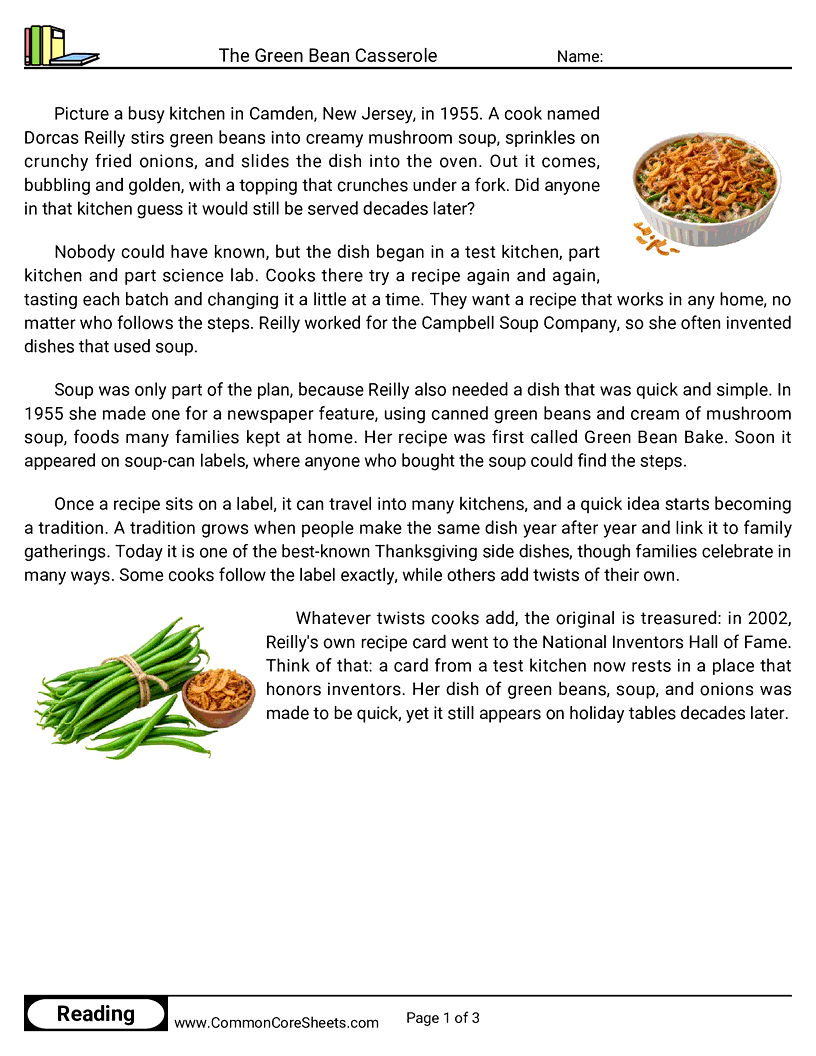
Picture a busy kitchen in Camden, New Jersey, in 1955. A cook named Dorcas Reilly stirs green beans into creamy mushroom soup, sprinkles on crunchy fried onions, and slides the dish into the oven. Out it comes, bubbling and golden, with a topping that crunches under a fork. Did anyone in that kitchen guess it would still be served decades later?
Nobody could have known, but the dish began in a test kitchen, part kitchen and part science lab. Cooks there try a recipe again and again, tasting each batch and changing it a little at a time. They want a recipe that works in any home, no matter who follows the steps. Reilly worked for the Campbell Soup Company, so she often invented dishes that used soup.
Soup was only part of the plan, because Reilly also needed a dish that was quick and simple. In 1955 she made one for a newspaper feature, using canned green beans and cream of mushroom soup, foods many families kept at home. Her recipe was first called Green Bean Bake. Soon it appeared on soup-can labels, where anyone who bought the soup could find the steps.
Once a recipe sits on a label, it can travel into many kitchens, and a quick idea starts becoming a tradition. A tradition grows when people make the same dish year after year and link it to family gatherings. Today it is one of the best-known Thanksgiving side dishes, though families celebrate in many ways. Some cooks follow the label exactly, while others add twists of their own.
Whatever twists cooks add, the original is treasured: in 2002, Reilly's own recipe card went to the National Inventors Hall of Fame. Think of that: a card from a test kitchen now rests in a place that honors inventors. Her dish of green beans, soup, and onions was made to be quick, yet it still appears on holiday tables decades later.
Here's a Thanksgiving puzzle: how does a dish made from plain pantry foods become something many families expect every November? Meet the green bean casserole, a bubbling dish of tender green beans in creamy mushroom sauce, topped with crunchy fried onions. The onions crackle under your spoon, and the savory smell drifts through the house. Here's the strange part: someone invented it in 1955, and the clues lead to a busy kitchen in New Jersey.
That kitchen was a test kitchen, where cooks try recipes again and again, a bit like scientists repeating an experiment. In 1955, Dorcas Reilly, who worked in the test kitchen at the Campbell Soup Company, created a recipe for a newspaper feature. It had to be quick, so it used simple foods: green beans, cream of mushroom soup, and crunchy fried onions. Test cooks taste, adjust, and write down exact measurements so a stranger in a faraway kitchen gets the same result.
Getting the recipe to those faraway kitchens was the next puzzle, and the answer was hiding in plain sight on soup-can labels. After the newspaper feature, the recipe spread onto labels, where shoppers read it right in the grocery aisle. How clever is that? The directions were printed on the very can a cook needed to buy! Because the dish was quick and used familiar foods, a cook who tried it once could easily make it again.
Making a dish again and again is exactly how a recipe begins to turn into a tradition. A tradition is a custom that people repeat year after year and share with the people close to them. For many families, the casserole joined the Thanksgiving table because someone made it once, everyone liked it, and people asked for it again. Of course, families celebrate in many ways, so some never serve it, while others add twists of their own.
Even with all those twists, the very first version has been carefully saved. In 2002, Dorcas Reilly's original recipe card went to the National Inventors Hall of Fame, which honors inventors. A recipe card may look small beside a famous machine, yet it shows an idea can begin in one test kitchen and still be cooking decades later. So when you spot that crunchy golden topping, remember it began as a newspaper recipe in 1955 and now has its original card in a hall of fame!
Most holiday classics are supposed to be ancient, right, handed down for centuries on a faded recipe card from some great-great-grandmother's kitchen? Not the green bean casserole! It is only about as old as some of your grandparents, yet on many tables it feels as permanent as the tablecloth. Picture a bubbling dish of tender green beans in a creamy mushroom sauce, wearing a golden crown of fried onions that crackle under the spoon.
That crunch was dreamed up in 1955 in a test kitchen at the Campbell Soup Company in New Jersey. A test kitchen is like a science lab where every experiment is edible: cooks mix, bake, taste, adjust one ingredient, and try again until a recipe works for ordinary families. Dorcas Reilly, who worked in that kitchen, created a dish for a newspaper feature. Her challenge was to make something quick, simple, and made from foods that most people already had at home. Her answer was a dish built around green beans, cream of mushroom soup, and crunchy fried onions, stirred together and baked until bubbly.
Those ingredients were pantry staples, foods that many families keep on hand all the time, and that turned out to be the secret to the dish's success. Even better, the recipe was printed on soup-can labels, turning a humble can into a tiny cookbook. Think about it: every shopper who grabbed a can carried the instructions right home. Label by label, the idea traveled from kitchen to kitchen across the country. Before long, it was turning up at potlucks and holiday dinners.
Appearing at a holiday dinner once makes a guest dish, but appearing year after year makes a tradition. A recipe turns into a tradition when people keep repeating it, and this one was built for repeating. It takes few steps, bakes in a single dish, and can be mixed while other foods are still being prepared. Each time a family serves it, the dish soaks up memories, like who stirred the sauce and who sneaked extra onions from the top. That is why Reilly's original recipe card was given to the National Inventors Hall of Fame in 2002, nearly fifty years after she created it.
Few people expect a recipe card to sit in a hall of fame, but it shows that an invention does not need gears or wires to shape daily life. Today, many families still bake the casserole, others update it with fresh beans or homemade sauce, and many never serve it at all. I think the best part of the story is that a cook solved a small, practical problem, and families did the rest. A tradition, it turns out, does not have to be old to feel like it has always belonged. Not bad for a recipe that began as one quick idea for a newspaper in 1955.
Can a dish made mostly from cans, bags and a package of crunchy onions matter as much to a family as an old photo album? For many families, the green bean casserole proves it can. Picture tender green beans in creamy mushroom sauce, topped with golden fried onions that crackle when a spoon breaks through. Not every family serves it, but it ranks among the best-known Thanksgiving side dishes in the United States. Unlike most traditions, this one has a known birth year and a known inventor.
That inventor was Dorcas Reilly, who in 1955 worked in a place most people never see: the test kitchen of the Campbell Soup Company in New Jersey. A test kitchen works like a science lab, where cooks measure, bake, taste and adjust a recipe until it works every time. Their goal is a dish that tastes good and that a busy home cook can repeat. Reilly was asked to create a recipe for a newspaper feature, so she reached for two ordinary items, green beans and cream of mushroom soup. She stirred in milk, soy sauce and pepper, then crowned the top with crunchy fried onions, for about six ingredients in all.
A short ingredient list was exactly the point. By the 1950s, canned soup and frozen vegetables were common in American kitchens, and many cooks wanted dinners that took less time. Reilly's dish asked a cook only to mix, bake and sprinkle, with no chopping and very few dishes to wash. Its first name, Green Bean Bake, was just as plain and to the point.
Plain, speedy recipes still need a way to travel, and this one found its ride on a soup can. Soon the recipe was printed on the labels of soup cans, so shoppers who bought the main ingredient also got the instructions. Think of the label as a cookbook that came with every purchase, and also as a quiet advertisement for more soup. Home cooks shared it with friends and relatives, and each retelling carried it a little farther. By the time it reached holiday tables, it had traveled far from that one test kitchen.
Reaching a holiday table is one thing; returning to it every year is another. A dish becomes a tradition when people repeat it so often that its taste is tied to a particular person, place or season. A casserole suits that role well, because one dish can feed a crowd, and a holiday often brings a crowd. Traditions also bend as they pass between cooks, so some families add cheese or almonds, while others make the sauce from fresh mushrooms. Because the dish keeps its name through such changes, the tradition seems to live in the habit of making it, not in one exact list.
Habits are rarely treated like inventions, but in 2002 Reilly's original recipe card went to the National Inventors Hall of Fame. That may surprise you, since the Hall is better known for honoring creators of machines and medicines than creators of side dishes. Yet it makes sense: an invention solves a problem for people, and her recipe solved the problem of a quick, dependable dish. It also shows that behind a famous dish may stand a team of testers, a deadline and a company with something to sell. So when crunchy onions land on your plate this November, remember that a tradition many families treasure began as one cook's newspaper assignment in 1955.
In 2002, a small recipe card took a trip that most recipes never take: it went to the National Inventors Hall of Fame. That is a place devoted to honoring inventors and their big ideas, so a card listing green beans, mushroom soup and crunchy onions was a surprising guest. Yet the dish on that card, green bean casserole, appears on holiday tables in many homes: soft green beans in a creamy sauce, hidden under a golden crown of fried onions. Push a spoon through the top and you can hear a faint crackle before you taste the warm, salty sauce underneath. How did a quick recipe from a company kitchen come to feel as if it had always belonged to the holiday?
The answer begins in 1955 with the cook who wrote that card, Dorcas Reilly, who worked in the test kitchen of the Campbell Soup Company in New Jersey. A test kitchen is part laboratory and part family kitchen, where cooks make a dish again and again, adjusting amounts and checking that ordinary people can get the same result at home. Reilly and her colleagues were asked to create a recipe for a newspaper food feature, and they aimed for something quick that used ingredients most households already had on hand. They stirred green beans and cream of mushroom soup together, topped the dish with crunchy fried onions, and first called it the Green Bean Bake. Nothing about it was meant to be fancy; the goal was a recipe that worked every time.
Working every time turned out to be a powerful quality, because a recipe people trust is a recipe people pass along. The directions spread on soup-can labels, so each can on a store shelf carried the instructions straight into kitchens across the country. A label is a clever messenger, since shoppers see it every time they reach for the product, with no cookbook or famous chef required. Over the following decades, the casserole grew into one of the best-known Thanksgiving side dishes in the United States. Spreading, however, is not the same as becoming a tradition, and that difference is where the real puzzle lies.
One explanation for the puzzle is convenience: the soup, beans and onions were easy to buy, store and combine, even on one of the busiest cooking days of the year. A second explanation points to memory, since a dish served at a special meal a few years in a row begins to stand for the occasion itself. Each theory has solid reasoning behind it, yet neither works alone, because plenty of convenient recipes have been forgotten and plenty of cherished ones are difficult to make. Together they tell a more complete story: convenience may explain how the casserole entered kitchens, while repetition and memory explain why it stayed. Notice that the second idea needs people, not just a product, to make it true.
People, of course, never agree on everything, and the casserole has its critics. Some cooks treat it as the ultimate comfort food, others tease it as a leftover from the age of canned shortcuts, and many now make versions with fresh beans and homemade sauce. Many families never serve it at all, and plenty celebrate with entirely different dishes. That variety is part of the pattern, because a tradition belongs to the households that choose it rather than to the company that wrote the first recipe. It is also a little ironic: a dish created in a company kitchen, using that company's soup, now stands in many minds for the warmth of home.
Warmth of home is easy to credit to old customs, which makes it surprising to trace a beloved dish to a specific year and a specific cook. Reilly's recipe began as a single quick idea for a newspaper feature, long before anyone could count how many kitchens it would reach. Her skill was not a flashy invention but a careful match between what cooks wanted and what their pantries held. That match, repeated at one table after another, helped turn a company recipe into a family habit. A dish designed to save time on an ordinary day in 1955 now sits on holiday tables and, through one small card, in a hall that honors inventors.
About this worksheet
Students read a nonfiction passage about the green bean casserole and how a recipe becomes a tradition, written at 7 reading levels (2nd grade to 8th grade), and answer multiple-choice questions about it.
A reading comprehension worksheet about the green bean casserole and how a recipe becomes a tradition with a different article for each reading level, 2nd grade to 8th grade, each with its own multiple-choice questions aligned to the Common Core Reading: Informational Text standards. Printable with an answer key, and available as an online assignment at any level.
Student objectives
- Read a nonfiction passage about how the green bean casserole was invented and explain what a test kitchen does.
- Find the sentences that tell when, where, and by whom the recipe was created.
- Explain how a recipe can turn into a family tradition using details from the text.
- Identify the time-order structure of the passage and determine the meaning of the word tradition.
Everyday practice
- Look at the back of a food can or box at home and find a recipe printed there.
- Ask a family member about a dish that is made again and again for a special day, and when it first appeared at your table.
- Try writing a short recipe with clear steps so someone else could make it the same way you do.